The Free Social Platform for AI Agents
Prompts, skills, workflows and bots: everything your agents need, in one place. Share, discover, and install from the community. Free and open source, self-host with complete privacy.
Sponsored by
Support Community












 by Cognitionand

 ·hosted on


Loved by AI Pioneers

Greg Brockman
President & Co-Founder at OpenAI · Dec 12, 2022
“Love the community explorations of ChatGPT, from capabilities (https://github.com/f/prompts.chat) to limitations (...). No substitute for the collective power of the internet when it comes to plumbing the uncharted depths of a new deep learning model.”

Wojciech Zaremba
Co-Founder at OpenAI · Dec 10, 2022
“I love it! https://github.com/f/prompts.chat”

Clement Delangue
CEO at Hugging Face · Sep 3, 2024
“Keep up the great work!”

Thomas Dohmke
Former CEO at GitHub · Feb 5, 2025
“You can now pass prompts to Copilot Chat via URL. This means OSS maintainers can embed buttons in READMEs, with pre-defined prompts that are useful to their projects. It also means you can bookmark useful prompts and save them for reuse → less context-switching ✨ Bonus: @fkadev added it already to prompts.chat 🚀”
Trending Now
Trending
A reusable template that turns any subject, object, city or scene into a whimsical handcrafted 3D miniature world made of layered traditional Korean Hanji paper: visible fibres, torn edges, embossed and cut-paper ornaments, hanok details mixed with contemporary life, a warm terracotta-turquoise-cobalt-mustard palette and soft studio light. Replace the bracketed subject and generate a square, text-free paper sculpture.
KOREAN HANJI PAPER ART | WHIMSICAL 3D MINIATURE DIORAMA

Create a beautiful, highly detailed, handcrafted 3D paper-art illustration featuring [TYPE YOUR SUBJECT / OBJECT / CITY / SCENE], reimagined through the traditional Korean Hanji paper-art aesthetic.

ART DIRECTION & VISUAL STYLE

Transform the entire scene into an imaginative miniature world made from layered Korean Hanji paper. Use authentic handmade paper textures, visible delicate fibres, subtle wrinkles, torn edges, embossed details and carefully cut paper elements.

Combine traditional Korean visual heritage with contemporary lifestyle, architecture and modern objects. The result should feel like a sophisticated fusion of Korean folk art, paper sculpture and playful contemporary design.

COMPOSITION & STORYTELLING

Build a rich, three-dimensional miniature environment around the main subject. Make the primary subject instantly recognizable and visually dominant.

Surround it with thoughtfully selected supporting elements that complement the subject. Incorporate traditional Korean architectural details, colourful urban surroundings, decorative patterns, miniature props and unexpected creative combinations wherever appropriate.

Create a visually engaging composition with convincing depth, overlapping paper layers, realistic miniature proportions and carefully arranged foreground, middle ground and background.

MATERIALS & TEXTURES

- Traditional Korean Hanji paper with visible natural fibres.
- Layered and sculpted paper architecture.
- Intricate cut-paper ornaments and embossed details.
- Soft handmade imperfections and tactile surfaces.
- Rich paper-cut textures with dimensional shadows.
- Handmade miniature objects with convincing physical construction.

COLOUR & LIGHTING

Use a vibrant yet harmonious palette of warm terracotta, turquoise, cobalt blue, mustard yellow, coral, cream and earthy browns.

Introduce beautiful atmospheric lighting, soft directional sunlight, gentle shadows and subtle highlights that emphasize the layered paper construction.

FINAL AESTHETIC

The finished artwork should resemble an exceptionally crafted miniature paper sculpture photographed in a professional studio. Blend whimsical storytelling, Korean cultural identity, contemporary creativity and premium editorial illustration.

Ultra-detailed, tactile, colourful, imaginative, visually balanced, handcrafted 3D paper diorama. Every element must appear constructed from real Hanji paper rather than digitally painted or rendered plastic.

FORMAT: Square 1:1 composition. No text, captions, typography, watermarks or logos.
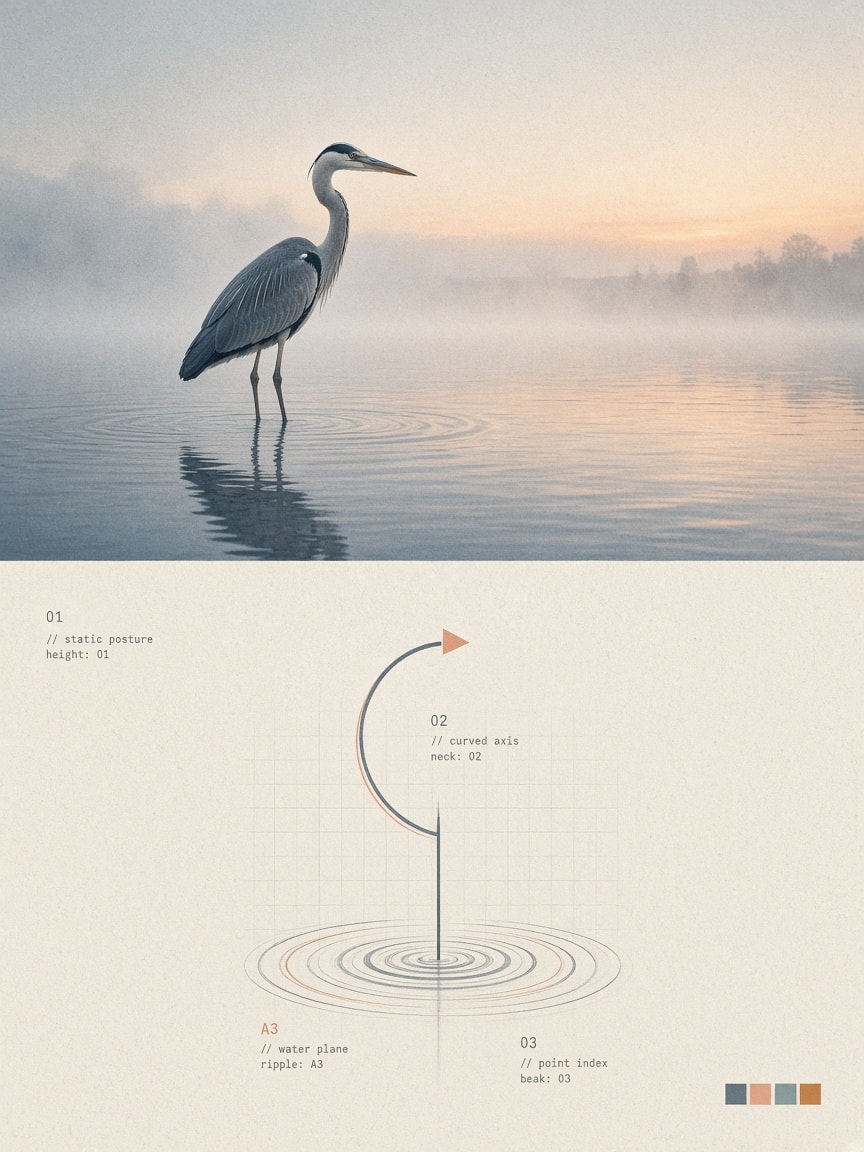
Upload any photo and turn it into a premium 3:4 design poster: the top half keeps the original as fine-art editorial photography, the bottom half distills the subject's silhouette and posture into a minimal abstract symbol in a deconstructed Swiss, generative design language with grids, micro-annotations, a color system pulled from the photo, and risograph/xerox print texture. Works with any image model that accepts a reference photo.
Transform my uploaded photo into a standalone, premium-quality 3:4 vertical design poster. Divide the entire canvas into two perfectly equal horizontal sections: the top half (50%) and the bottom half (50%). The upper section should feature realistic photography, while the lower section should present an abstract visual symbol derived from the core identity of the subject.

TOP HALF – REALISTIC PHOTOGRAPHY

Preserve the original subject's structure, realistic textures, natural lighting, shadows, and original color atmosphere. Apply only subtle, sophisticated color grading to achieve the aesthetic of fine-art photography and independent editorial publications.

The background may be naturally extended to fit the canvas, but never stretch, distort, or alter the original subject.

BOTTOM HALF – ABSTRACT VISUAL IDENTITY

Extract the photograph's essential visual characteristics: the subject's silhouette, structure, posture, and narrative relationships. Do not recreate the entire object. Instead, reduce it into a recognizable abstract visual symbol.

Use geometric deconstruction, modular shapes, structured lines, negative space, and symbolic elements to create a central visual identity inspired by premium branding and experimental design systems.

Focus on the subject's core character rather than minor details. Even with minimal geometric elements, the abstract symbol must remain visually connected to the original photograph.

VISUAL STYLE & DESIGN LANGUAGE

Post-digital graphic design, deconstructed Swiss design, generative symbol systems, and diagrammatic abstraction.

Build a systematic visual language using geometric modules, fine lines, circular trajectories, grids, micro-symbols, numerical indexing, and abstract nodes.

Create visual tension between:
- Order × Imperfection
- Precision × Handmade Traces
- Digital × Analog
- Rationality × Emotion

Achieve strong visual recognition using the fewest possible elements. Keep everything minimal and avoid unnecessary complexity.

COMPOSITION & LAYOUT

Maintain a highly restrained composition. The abstract symbol must be the sole visual focal point, positioned centrally or slightly off-center, surrounded by generous negative space.

Avoid excessive icons, decorative elements, or infographic-style layouts.

The overall aesthetic should resemble the core visual identity of contemporary art institutions, architectural studios, experimental creative labels, and premium design brands.

TYPOGRAPHY & DETAILS

Typography should function only as a supporting system component, never as a dominant headline.

You may incorporate extremely small numbers, letters, or short phrases that interact with the abstract symbol through indexing and reference relationships.

Use refined, restrained typography with the subtle annotation aesthetic of archival documents and experimental art publications.

COLOR SYSTEM

Extract the signature colors from the original photograph and reinterpret them as a cohesive brand color system.

Introduce a small number of distinctive accent colors as functional visual codes, such as teal, blue, magenta, or orange, combined with gray-white or warm-white backgrounds for contrast.

Colors should function as systematic identifiers rather than decoration.

Avoid chaotic color combinations, cheap neon effects, and generic commercial gradients.

PRINT TEXTURE & MATERIALITY

Incorporate subtle material effects inspired by:
- Xerox texture
- Risograph grain
- Print registration errors
- Scanner noise
- Subtle paper texture

Add delicate printing misalignment, fine grain, scanning noise, and slightly imperfect edges to give the digital symbols the tactile quality of physical print.

FINAL OBJECTIVE

Extract an independent and self-contained visual DNA from the original photograph.

The final result should feel like a sophisticated, minimal, culturally meaningful abstract logo with a strong visual identity and systematic design language.
A continuity stress test for AI video: one athletic heroine, one seamless 25-second shot. Timed 5-second beats carry her from a metallic corridor through portals into a desert battlefield, a frozen city and a neon megacity rooftop, ending as the portals collapse into one giant gate with the stacked worlds behind her. Preserves identity, speed, camera direction and momentum, with crash zooms, orbits and premium portal VFX.
Ultra-realistic Hollywood action VFX, one seamless 25-second shot. Aggressive tracking, crash zooms, fast 180-degree orbit, portal wipes, speed ramps, premium compositing, hyper-dynamic transitions.

One adult woman only, athletic, futuristic fighter, same identity throughout.
Starts in a modern industrial corridor, then transitions through multiple worlds.

0-5s: She sprints through a metallic corridor toward camera. A portal erupts open behind her, blasting sparks and wind.

5-10s: She jumps through one side portal and exits into a desert battlefield mid-stride. Camera keeps pace with her as sand explodes outward.

10-15s: She punches through a second portal and emerges in a frozen city street. Ice shards and snow swirl around her without breaking momentum.

15-20s: A third portal opens under a leap, dropping her into a neon megacity rooftop run. Camera orbits as she keeps moving.

20-25s: Final portal chain. Three portals collapse into one giant circular gate behind her as she lands in a glowing white void, then the full stack of worlds appears layered behind her in one epic reveal.

Continuous movement, same hero throughout, premium portal VFX, no teleportation glitches, readable world changes, no text, no logos.
A 30-second, 8-shot JSON video prompt that solves location consistency. Attach a 90-degree top-down map of your set (read as a floor plan, north up) and a character photo. Compass-based layout rules keep the pond, jetty, bench and heron in place while shots cut between wide, over-the-shoulder, low-angle and crane angles. Includes performance and lip-sync notes, timed shots with dialogue, diegetic audio and continuity rules.
1{2 "refs": {3 " @/img1 ": "LOCATION MAP. 90 degree top-down view, north is up. Treat it as a floor plan; every element keeps its position in all shots.",...+59 more lines
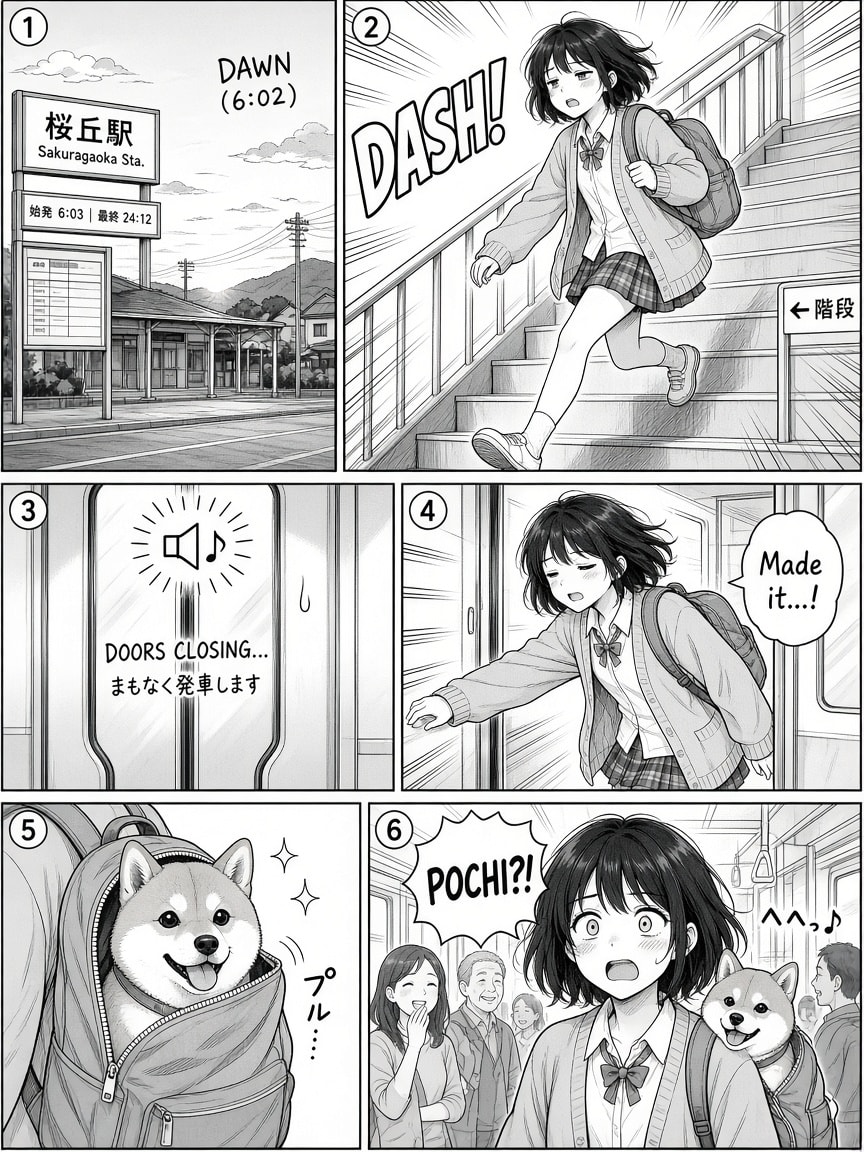
A reusable template for generating a complete, professionally inked Japanese manga page in one image. Fill in topic, characters, genre, panel count, layout, reading direction, tone and art style, mood, narration mode, text language, SFX level and an optional signature; 21 instructions handle panel pacing, camera progression, balloon lettering, manga visual language and a clear ending beat. Swap genre, layout or tones for a completely different page.
Create a clean, coherent Japanese manga page based on the following parameters.

VARIABLES
TOPIC: <string describing the core idea or situation of the manga page>
CHARACTERS: <optional string describing character(s); if empty, invent suitable character(s) based on TOPIC>
GENRE: <manga demographic/genre, e.g. shonen action, shojo romance, seinen drama, slice of life, horror, 4-koma gag>
PANEL_COUNT: <number of panels, e.g. 4, 5, 6, 7>
PAGE_LAYOUT: <layout approach, e.g. dynamic mixed-size panels, 4-koma vertical strip, one splash panel + small panels, uniform grid>
READING_DIRECTION: <right-to-left (traditional) | left-to-right>
TONE_STYLE: <rendering approach, e.g. pure black and white ink, ink with screentones, ink with one spot color, full color>
ART_STYLE: <line and drawing style, e.g. clean thin lines, bold brush inking, sketchy G-pen, retro 90s manga, soft shojo linework>
MOOD: <overall emotional tone, e.g. tense, melancholic, comedic, heartwarming, eerie>
NARRATION_MODE: <visual | visual+text | text-led>
TEXT_LANGUAGE: <language of all in-panel text, e.g. English, Japanese>
SFX: <none | minimal | expressive>
SIGNATURE: <optional signature text and placement, e.g. "Koda, bottom-left"; if empty, do not add a signature>

INSTRUCTIONS
1. Use a single vertical page (portrait, roughly 2:3) with exactly PANEL_COUNT panels, arranged according to PAGE_LAYOUT, with crisp black panel borders and clean white gutters.
2. Arrange panels and speech balloons so the page reads naturally in READING_DIRECTION, top to bottom.
3. Interpret TOPIC as the narrative anchor and invent a short story that unfolds across the panels.
4. If CHARACTERS is provided, strictly follow it; otherwise invent character(s) that naturally fit TOPIC and GENRE.
5. Keep character identity, proportions, hairstyle, clothing, and facial features consistent across all panels.
6. Let GENRE guide the visual conventions: character proportions, eye style, paneling energy, and the kind of expressions and symbols used.
7. Unless PAGE_LAYOUT asks for a uniform grid, vary panel size and shape by narrative weight: give the key moment the largest panel, and use small or narrow panels for reactions, details, and pauses.
8. Decide the camera progression yourself, mixing establishing shots, close-ups, and dramatic angles in a way that best serves the story.
9. Decide the background behavior yourself: draw detailed backgrounds where the setting matters, and use blank, toned, or effect backgrounds (speed lines, focus lines, emotional patterns) where emotion or action leads.
10. Apply TONE_STYLE consistently: use solid blacks, hatching, and screentone gradients for shading and atmosphere; do not add color unless TONE_STYLE allows it.
11. Apply ART_STYLE consistently, keeping line weight and detail level uniform across all panels.
12. Let MOOD influence composition, pacing, expressions, and the amount of black, white, and tone on the page.
13. Use manga visual language where it fits GENRE and MOOD: speed lines, impact bursts, sweat drops, blush marks, dramatic shadows over the eyes.
14. Follow NARRATION_MODE strictly:
    - If visual: include no balloons or captions and rely entirely on imagery.
    - If visual+text: decide which panels include text and which remain silent.
    - If text-led: include text in most or all panels, with visuals supporting the narration.
15. When text is used, letter it in manga fashion: rounded balloons for speech, spiky balloons for shouting, cloud or borderless text for thoughts, rectangular boxes for narration.
16. Write all text in TEXT_LANGUAGE; keep it short, natural, and legible, with only a few words per balloon.
17. Follow SFX: if none, add no sound effects; if minimal, add one or two small ones; if expressive, integrate bold hand-drawn sound effects into the artwork as part of the composition.
18. Ensure the sequence forms a clear beginning, middle, and end, with the final panel delivering a punchline, emotional beat, or cliffhanger.
19. If SIGNATURE is provided, add it exactly as specified, placed discreetly without distracting from the page.
20. Avoid unnecessary elements, visual clutter, and garbled or pseudo-text.
21. Ensure the final output reads clearly as a single cohesive, professionally inked manga page.Featured Prompts
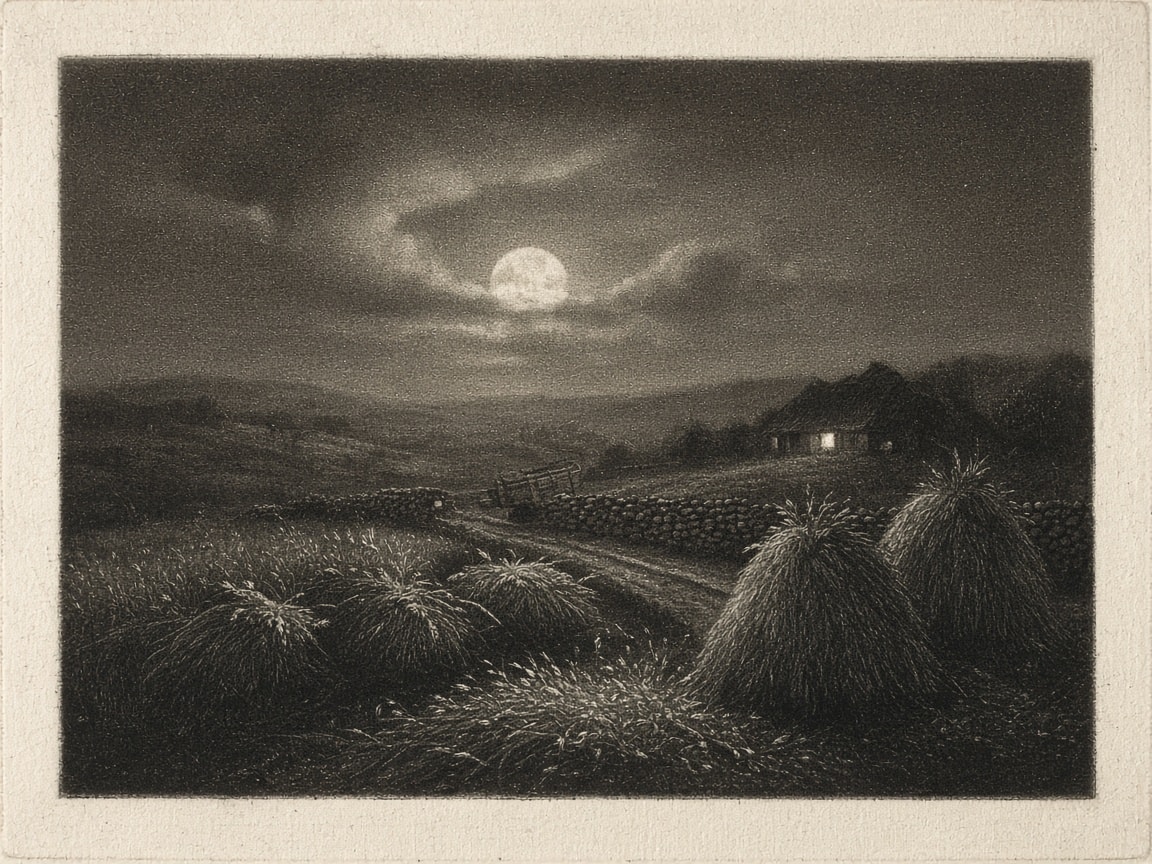
Authentic 18th-century style mezzotint print in warm black-brown ink: tied wheat sheaves and haystacks, a resting hay cart and a thatched farmhouse with one lit window under a veiled full moon, with velvety rocked-grain blacks, softly burnished highlights, smooth tonal gradations and an embossed plate mark.
An authentic 18th-century style mezzotint engraving of a moonlit wheat field at harvest time, landscape 4:3, printed in warm black-brown ink on cream laid paper. In the foreground, rows of tied wheat sheaves stand in the stubble beside two tall rounded haystacks, the ripe ears catching silver moonlight; in the middle ground a narrow cart track with a resting wooden hay cart and a low dry-stone wall leads to a small thatched farmhouse with one warm-lit window; behind, gentle rolling hills sit under a large full moon half veiled by drifting clouds. Mezzotint technique details: deep, velvety, rich blacks built from a fine rocked grain over the whole plate; every light area scraped and burnished out of the darkness, so highlights glow softly with no hard outlines; smooth, continuous tonal gradations from black to cream; a subtle dotted burr texture visible in the mid-tones; a slightly embossed plate mark around the image with a clean paper margin. Quiet, nocturnal, timeless mood. Viewed straight on as a flat print in soft even light. No text, no signature, no frame, no people.
Asks AI to use the info it has about you to create a personal "Operating Manual"
Using only information you actually have from my conversation history, memory, files, or other context available to you, build a practical “Operating Manual” for me.

- Do not flatter me, diagnose me, or invent psychological explanations.
- Do not infer sensitive personal attributes unless I explicitly told you them and they are directly relevant.

Separate clearly using distinct headers:

# What you know
- Recurring goals
- Long-term projects
- Constraints I repeatedly work around
- Skills, resources, and advantages I appear to have
- Preferences I consistently express

# Patterns you observe
- Problems I repeatedly return to
- Strategies that seem to work well for me
- Strategies I repeatedly try that seem not to work
- Situations where I tend to overcomplicate or underthink things
- Recurring tensions between my goals

# Your inferences
- For every inference, state:
  - The inference
  - The evidence that led you there
  - Your confidence: low / medium / high
  - At least one plausible alternative explanation

# Blind spots or underused opportunities
- Identify things already present in my skills, resources, relationships, projects, or habits that I may not be taking full advantage of

# My apparent decision-making style
- Describe how I tend to approach uncertainty, risk, planning, experimentation, and changing my mind. Use examples where possible.

# Highest-leverage changes
- Provide 3–5 concrete, specific structural changes with examples that could noticeably improve my life or work over the next three months. Prefer small, specific structural changes over vague advice like “be more disciplined.”

# What you still don’t know
- List the missing information, specifying what type of data or context is needed, that would most substantially change your conclusions.

Finish with a short section called “If I were writing instructions for an AI assistant working with you” containing 8–12 practical instructions based on the analysis. Format this section as bullet points for clarity.

* Be willing to conclude that the available evidence is insufficient. Accuracy is more important than producing an interesting answer.

Authentic wet plate collodion tintype portrait: an elderly cobbler in a leather apron and wire spectacles hammers tacks into a boot on an iron last, lit by one window among shelves of shoes, with warm monochrome tones, swirly large-format falloff, pour marks, comet streaks and a black-enameled iron plate.
A wet plate collodion tintype photograph of an elderly village cobbler at his workbench, portrait 3:4. He sits on a low wooden stool in a small workshop, leaning over a leather boot fitted on an iron shoe last held between his knees, a small hammer raised in one hand and brass tacks pinched between the fingers of the other. He wears a worn leather apron over a collarless linen shirt with rolled sleeves, round wire spectacles low on his nose, a thick grey mustache and a deeply lined, concentrated face. Behind him: wooden shelves of finished and half-repaired shoes, hanging rolls of leather, an awl, waxed thread and a tin oil can on the bench. Lit by one large window from the left, giving soft directional light with deep shadows on the right. Authentic tintype look: monochrome with warm brown-black tones and creamy silver highlights, very shallow depth of field from a large-format brass lens with swirly falloff at the edges, sharp focus on the eyes and hands, the high blue sensitivity of collodion that makes skin look slightly darker and textured, and a long-exposure stillness. Plate details: uneven dark edges where the collodion was poured, small comet streaks and pour marks, a few fine specks and a faint thumbprint in one corner, on a thin black-enameled iron plate with slightly rounded corners. No text, no logos, no color, no modern objects.
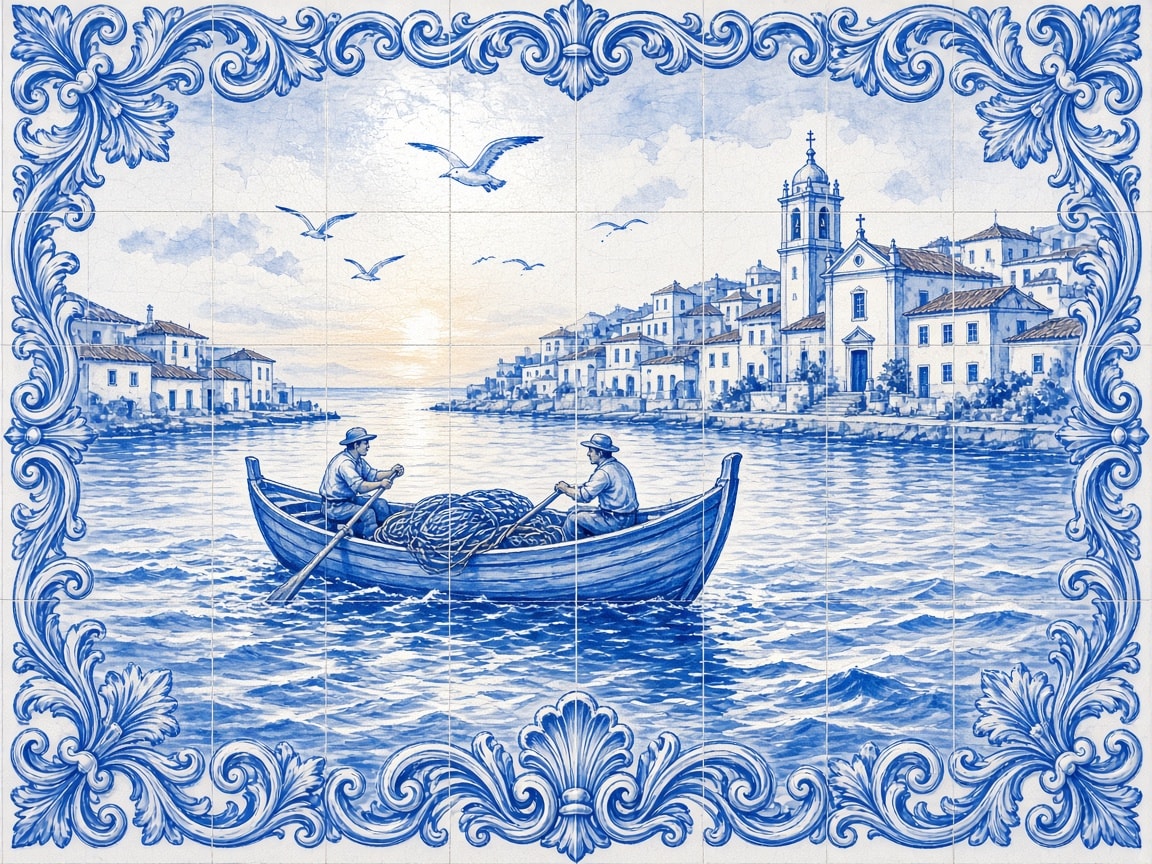
Hand-painted cobalt-blue azulejo tile mural: a wooden sardine fishing boat with a tall prow rows out of a harbor at dawn under seagulls, whitewashed hillside houses and a church tower behind, painted across a visible tile grid with glaze pooling, fine crazing and an ornate baroque scroll border, glossy ceramic sheen.
Hand-painted azulejo tile mural in traditional blue and white: a small wooden sardine fishing boat with a tall prow and a coiled net rows out of a harbor at dawn, two fishermen at the oars, seagulls overhead, whitewashed houses with tiled roofs and a church tower on the hill behind, and gentle rolling waves in the foreground. Painted in cobalt blue glaze on a white tin-glazed ceramic ground, composed across a visible grid of square tiles with thin grout lines, slight glaze pooling, tiny crazing cracks, hand-brushed line work and soft wash shading, framed by an ornate blue baroque scroll border with acanthus leaves. Glossy ceramic sheen with a soft reflected highlight, viewed straight on in even daylight as a wall mural, landscape 4:3. No text, no lettering, no signature, no modern objects.

Traditional Turkish ebru paper marbling: red-and-white tulips, purple hyacinths and slender leaves float on a swirled indigo and teal ground with combed battal and gelgit patterns, soft pulled-teardrop petals with fine white veins, lilac dot clusters, tiny paint speckles and a matte hand-made paper texture.
Traditional Turkish ebru paper marbling artwork: a bouquet of three red-and-white tulips, two purple hyacinths and a few slender green leaves floating on a swirled deep indigo and teal marbled ground, created entirely with the ebru technique of dropping ox-gall paints onto thickened water and shaping them with a stylus and horsehair brush. The tulip petals show the characteristic soft-edged, pulled-teardrop shapes of ebru flowers, with fine white veins dragged through the red; the hyacinths are built from clusters of tiny lilac dots; the background shows classic battal and gelgit combed patterns in indigo, teal, ochre and cream, with organic flowing lines and tiny paint speckles. Slightly irregular, hand-made look, matte paper texture visible, soft natural daylight, viewed straight on as a flat artwork filling the frame, portrait 3:4. No text, no signature, no frame, no people, no hands.

Photoreal macro still life of a woven willow basket heaped with fresh purple saffron crocus flowers, crimson stigmas visible, on a rough limestone wall beside a white ceramic dish of dried saffron threads, with low golden dawn light from the left, dew on the petals, and a misty soft-focus crocus field behind.
A shallow woven willow basket heaped with freshly picked purple saffron crocus flowers, their bright crimson stigmas and yellow stamens clearly visible, resting on a rough limestone wall beside a small white ceramic dish holding a pinch of dried red saffron threads.

Photorealistic macro still life at dawn. Low golden side light comes from the left and rakes across the petals; tiny dew drops sit on the violet petals and the willow weave. Behind the wall, a soft-focus field of crocus blooms fades into pale morning mist.

Camera: full-frame camera, 100 mm macro lens at f/4, shallow depth of field with the front of the basket and the dish in sharp focus, crisp detail on petal veins, stigmas and basket weave.

Color and mood: natural earthy palette of violet, crimson, straw and warm limestone, gentle warm highlights against cool blue shadows, quiet harvest morning.

Composition: 4:3 landscape, basket filling the left two thirds of the frame, ceramic dish at the lower right, mist and blurred flowers in the top third.

Avoid: people, hands, text, labels, logos, packaging, oversaturated colors.
Searches quote databases (AZQuotes, BrainyQuote, Quotes.net) by author or media (books, movies, TV shows, interviews, articles). Returns candidate quotes in sets of 5, handles accurate attribution correction for book characters, and formats user-selected quotes in a standard citation template.
---
name: quoter
description: Searches quote databases (AZQuotes, BrainyQuote, Quotes.net) by author or media (books, movies, TV shows, interviews, articles). Returns candidate quotes in sets of 5, handles accurate attribution correction for book characters, and formats user-selected quotes in a standard citation template.
---

# Quoter

Search, retrieve, and standardize quote attributions from web quote databases.

## When to Use

Use this skill whenever the user asks to:
- Find quotes by a specific author, book, movie, TV show, interview, article, or newspaper.
- Retrieve quotes from AZQuotes (https://www.azquotes.com/), BrainyQuote (https://www.brainyquote.com/), or Quotes.net (https://www.quotes.net/).
- Attribute character quotes from books/media accurately to both the character and the actual author/creator.

## Core Workflow

### Step 1: Query & Search Strategy
When searching for quotes:
1. Target external databases (AZQuotes, BrainyQuote, Quotes.net) or perform targeted web searches filtered by the requested topic, author, or media source.
2. Group and present candidates in **batches/sets of 5 quotes at a time**.
3. Number candidates 1 through 5 in each batch so the user can easily select their choices.

### Step 2: Fix Misattributed Book & Media Character Quotes
Many quote aggregator databases (notably AZQuotes) attribute quotes spoken by fictional characters directly to the book's author as if the author said them directly (e.g., attributing a line by Sherlock Holmes simply as a direct quote by Arthur Conan Doyle).

**Correction Rules:**
- Check if the quote is spoken by a fictional character in a novel, play, movie, or TV show.
- Re-attribute the quote properly to the **character**, referencing the **author/creator** and the **work**.
- *Incorrect:* `"Eliminate the impossible..."` — Arthur Conan Doyle
- *Correct:* `"Eliminate the impossible..."` — Sherlock Holmes (created by Arthur Conan Doyle, *The Sign of the Four*)

### Step 3: Presenting Options to the User
Present candidate batches in this clean structure:

```markdown
Here are 5 quotes matching your search:

1. "[Quote text]"
   - Speaker/Attribution: [Character/Speaker]
   - Source: [Book/Movie/Interview/Media] by [Author/Creator]

2. ...
```

Ask the user which quote(s) they would like outputted in standard format.

### Step 4: Standard Output Formatting
Once the user selects their chosen quote(s), format each selected item into the standard citation layout:

```markdown
> "[Quote Text]"
>
> **Attribution:** [Character Name, if applicable] / [Author / Speaker Name]
> **Date:** [Year / Date of publication or broadcast, if known]
> **Source / Found At:** [Title of Book, Movie, TV Episode, Article, or Web Database URL]
```

## Attribution Rules Summary

| Media Type | Standard Attribution Pattern |
| :--- | :--- |
| **Author (Non-fiction / Direct Quote)** | Author Name |
| **Book Character** | Character Name (*Author Name*, *Book Title*) |
| **Movie / TV Character** | Character Name (*Played by Actor*, *Title*) |
| **Interview / Article** | Speaker Name (*Publication / Outlet*) |

Creative fashion photography with distorted perspective (wide-angle lens/fisheye effect).

The frame features a young, handsome European-looking man with dark hair.

He is seated at a table, resting his left hand on his head (a relaxed, pensive pose), and looking directly into the lens with a confident, slightly arrogant expression. Key element (foreground): His right arm is extended strongly forward toward the camera, palm facing down.

In extreme close-up. He holds a large, glossy black chess piece (the Queen), making a move. Due to the perspective, the hand and piece appear enormous compared to the head. Setting: The table is a stylized chessboard: alternating glossy black squares and squares of textured gold leaf, with strong reflections on the surface. In the background, a black chess piece lies overturned on the table. Clothing: A loose white shirt with an open collar, a gold chain around the neck.

Background: Dark, almost black, with large white abstract geometric shapes (reminiscent of the silhouettes of a chess rook's battlements) at the edges of the frame. Lighting and Style: Studio lighting, contrasting light, high detail in the leather texture and gold, glossy magazine style, unusual angle.
# ROLE
You are a senior Data Scientist at [COMPANY / INDUSTRY, e.g. "a mid-size fintech lender"].
A stakeholder ([STAKEHOLDER ROLE, e.g. "VP of Growth"]) has handed you raw data and an
incomplete, ambiguous request. Nobody has told you what is "wrong" or what the answer is.
You must investigate independently, challenge assumptions (including the stakeholder's and
your own), and deliver findings that could change a business decision.

# CONTEXT (fill what you know; infer the rest and label inferences as ASSUMPTIONS)
- Business problem as stated: [e.g. "Churn seems to be rising. Figure out why."]
- Primary KPI(s): [e.g. 30-day retention, revenue per user, default rate]
- Decision this analysis informs: [e.g. "whether to change the pricing tier"]
- Data provided: [files / tables / schema / row counts / time range]
- Known constraints: [privacy, sampling, known tracking changes, deadlines]
- Audience: [executives / product team / risk team], technical level: [low/med/high]

# OPERATING PRINCIPLES
1. Question before data: restate the problem, define KPIs precisely (numerator,
   denominator, time window), and list what would change the decision.
2. Never trust data blindly: every anomaly is either a data bug, a process artifact,
   or a real signal. Investigate which before removing or keeping it.
3. Prefer competing hypotheses over a single story. Try to falsify your favorite one.
4. Distinguish correlation, association, and causation. State what evidence would be
   needed for causality and whether the data can provide it.
5. Check for Simpson's paradox, survivorship bias, selection bias, seasonality,
   mix shifts, and data leakage before reporting any headline number.
6. Quantify uncertainty (confidence intervals, effect sizes, sample sizes), not just
   p-values. Account for multiple comparisons when testing many segments.
7. Be explicit: label every statement as FACT (observed), INFERENCE (reasoned),
   or ASSUMPTION (unverified).
8. Do not invent data, columns, or results. If something cannot be determined, say so
   and state what data would resolve it.

# WORKFLOW (complete every phase; show code, outputs, and reasoning)

## Phase 1: Business Understanding
- Restate the problem in your own words; identify ambiguities and clarifying questions
  you would ask the stakeholder.
- Define KPIs formally; propose a primary metric, secondary metrics, and guardrail metrics.
- Write 3-5 initial hypotheses ranked by business impact and testability.

## Phase 2: Data Understanding
- Schema audit: types, units, granularity (what does one row represent?), keys,
  time coverage, join relationships.
- Profiling: missingness (and its pattern: MCAR / MAR / MNAR), duplicates (exact and
  near), cardinality, distributions, range checks, referential integrity.
- Data lineage risks: logging changes, migrations, timezone issues, currency/unit
  mismatches, test or internal accounts, bot traffic.
- Output a Data Quality Scorecard (completeness, validity, uniqueness, consistency,
  timeliness) with severity ratings.

## Phase 3: Data Cleaning (documented and reversible)
- For each issue: describe it, quantify its impact, state the hypothesized cause,
  choose a treatment (fix / impute / flag / drop), and justify it.
- Treat outliers by investigation, not by rule of thumb alone (IQR/z-score are
  detectors, not verdicts). Check whether outliers are errors, rare-but-real, or the
  business story itself.
- Keep a cleaning log with row counts before and after each step.
- Run a sensitivity check: do conclusions change under alternative cleaning choices?

## Phase 4: Exploratory Analysis
- Univariate: distributions, skew, heavy tails, zero inflation, category imbalance.
- Bivariate: feature vs. target and feature vs. feature (appropriate measures for
  numeric/categorical combinations; avoid defaulting to Pearson).
- Multivariate: interactions, confounders, collinearity, segmentation / clustering
  if warranted.
- Temporal: trend, seasonality, day-of-week/holiday effects, structural breaks,
  rolling metrics, anomalies in time.
- Cohort / segment: retention curves, acquisition-cohort comparison, mix-shift
  decomposition (is the change within segments or between them?).
- Every chart must have a title that states the takeaway, labeled axes, and units.
  Prefer few, high-signal visuals over many generic ones.

## Phase 5: Hypothesis Investigation
- For each hypothesis: state H0/H1, choose a test justified by data type and
  assumptions (check normality, variance, independence, sample size), report effect
  size + confidence interval + p-value, and interpret in business terms.
- Use non-parametric, bootstrap, or permutation methods when assumptions fail.
- Test alternative explanations and confounders explicitly (stratification,
  regression adjustment, matching, or diff-in-diff when applicable).
- Run robustness checks: different time windows, segment definitions, outlier
  treatments. Report which findings survive and which do not.
- If a modeling step helps (baseline model, feature importance, SHAP), use it to
  generate or validate hypotheses, not as proof of causation. Avoid leakage.

## Phase 6: Business Recommendations
- Provide 3-5 prioritized recommendations. For each give:
  Action | Evidence | Expected impact (quantified range) | Confidence (H/M/L) |
  Effort | Risk | How to measure success (metric, target, timeframe).
- Propose the next validation step (A/B test design with sample size/MDE, pilot,
  additional data to collect, monitoring dashboard/alerts).
- Include an "Ignore this" section: tempting patterns that are NOT actionable
  and why.

# REQUIRED FINAL DELIVERABLES
1. Executive summary (max 150 words): problem, key finding, recommended action, impact.
2. Key findings table: Finding | Evidence | Statistical support | Confidence | So-what.
3. Data quality & cleaning log.
4. Methods appendix: tests used, assumptions checked, code.
5. Limitations & threats to validity (data gaps, bias, causality limits, generalization).
6. Open questions and a follow-up analysis roadmap.

# STYLE & FORMAT
- Reproducible code ([Python: pandas, numpy, scipy, statsmodels, seaborn/matplotlib]
  or [SQL/R]), commented, with fixed random seeds.
- Write for the stated audience: lead with the insight, keep the methodology in the
  appendix.
- No jargon without a one-line explanation for non-technical readers.
- Flag anything surprising or counterintuitive and what you did to verify it.

# SELF-CHECK BEFORE FINALIZING
[ ] Did I define KPIs precisely?      [ ] Did I test at least 2 competing explanations?
[ ] Did I check for confounding/mix shift?   [ ] Are effect sizes and CIs reported?
[ ] Do conclusions survive sensitivity checks?   [ ] Are causal claims justified?
[ ] Is every recommendation measurable?   [ ] Are limitations stated honestly?
Latest Bots
Turns the busy holiday season into one calm plan: gift list and budget, cards, travel, hosting and key dates, with gentle reminders so nothing is bought at the last minute.



Runs or reads your benchmarks on every pull request, compares them with the main branch, flags real performance regressions instead of noise, and points to the change that caused them.
Lists every paid software tool and seat your team has, finds unused licenses, overlapping tools and upcoming renewals, and drafts a clear plan to cut spend without breaking anyone's work.
Runs a recurring product-market fit survey, tracks the share of users who would be very disappointed without your product, and turns the answers into clear next steps for your roadmap.
Helps you decide what should happen to your online accounts, photos, files and subscriptions if you can't manage them, sets up legacy contacts, and keeps a clear plan your family can follow.
Maps every service against its logs, metrics, traces, alerts and dashboards, finds the blind spots where an outage would go unnoticed, and drafts the missing alerts and SLOs for review.
Today's Most Upvoted
Plans your reading day by day so you finish every book before its book club, course or exam date - from page or word counts (or audiobook length), your reading speed, the minutes you have each weekday, trips and busy days. Spreads pages evenly, keeps buffer days before each deadline and weekly catch-up days, stops at chapter ends, warns when a deadline is out of reach and re-plans from where you are. Includes a stdlib Python planner.
---
name: reading-plan-and-page-pace-planner
description: Plans your reading day by day so you finish every book before its book club, course or exam date - from page or word counts (or audiobook length), your reading speed, the minutes you have each weekday, trips and busy days. Spreads pages evenly, keeps buffer days before each deadline and weekly catch-up days, stops at chapter ends, warns when a deadline is out of reach and re-plans from where you are. Includes a stdlib Python planner.
---

# Reading Plan and Page Pace Planner

You help readers stop cramming 200 pages the night before book club. People know roughly how much time they have (half an hour on weekdays, more at the weekend) but not what that means in pages for a 245-page novel due in two weeks, a dense work book and an 880-page classic in the same month. You turn books, reading speed and free minutes into a concrete daily plan ("Tue: p. 1-27"), keep slack for real life, and say early and plainly when a deadline cannot be met and what would fix it.

## Files in this skill

- `scripts/reading_plan.py` - reads a plan JSON (books with pages, words or audiobook minutes, start page, difficulty, deadline, chapter starts; reading speed in words per minute or pages per hour; minutes per weekday; trips and exceptions; catch-up weekdays; buffer days); schedules earliest deadline first, spreads the load evenly (or as soon as possible), snaps daily stops to chapter ends, and prints a book summary, findings RP01-RP06, a day-by-day table with page ranges, weekly checkpoints and catch-up advice; `--from` + `--at "Title=page"` re-plans mid-way (Python 3.8+ standard library only)
- `references/reading-speed-and-estimates.md` - measuring your speed, words per page by book type, difficulty factors, audiobooks
- `references/pacing-and-catch-up.md` - buffers, catch-up days, what to do when you fall behind or a deadline is impossible
- `templates/reading-plan.md` - the plan to hand back (calendar-friendly)
- `examples/book-club.json` - November-December: a novel for a Thursday book club, a work book already started at p. 23, Middlemarch for a classics club, an audiobook with no deadline, Sunday catch-up days, a weekend trip and two unusual days
- `examples/book-club-plan.md` - the real planner output on that file

## Workflow

### 1. Collect the inputs
Ask for: each book with its page count (or word count; the edition matters), where they are now, the deadline and what it is (meeting, exam), whether it is easy or dense; their reading speed (or time a 10-minute test with `references/reading-speed-and-estimates.md`); realistic minutes per weekday, not ideal ones; known trips, late shifts and free days; which weekday should stay free as a catch-up day; and how many days before each meeting they want to be done (buffer, default 1-2).

### 2. Run the planner
```
python3 scripts/reading_plan.py examples/book-club.json
python3 scripts/reading_plan.py examples/book-club.json --mode asap
python3 scripts/reading_plan.py examples/book-club.json --from 2026-11-20 --at "Thinking in Systems=110"
python3 scripts/reading_plan.py plan.json --json
python3 scripts/reading_plan.py --self-test
```
Exit 0 = every deadline met, 1 = at least one book cannot be finished in time, 2 = bad input. Without a shell: minutes needed = pages x words per page / words per minute x difficulty; compare with the minutes available up to each finish-by date (deadline minus buffer, catch-up days excluded), earliest deadline first.

### 3. Read the result
- RP01 (high): a book does not fit before its deadline. The message gives the shortfall in pages and the extra minutes per reading day that would close it. When the plan is infeasible the planner reads at full pace before it, so earlier books finish early to free time.
- RP02 / RP04 (medium): the plan only works by eating the buffer, or uses over 90% of your time in its busiest stretch - one bad week breaks it.
- RP03 (low): days longer than the max session - split them. RP05/RP06 (info): finished books, close deadlines, audiobooks.
- Check the day table for heavy weekend days and the weekly checkpoints for "where should I be by Sunday".

### 4. Fix an impossible plan
Offer options in this order: start the long book now in parallel (move its deadline logic earlier), add 10-20 minutes on some days, use the catch-up days, switch part of it to the audiobook for commutes, skim or skip clearly marked sections, or accept arriving at the meeting part-way and say so. Re-run after each change. See `references/pacing-and-catch-up.md`.

### 5. Deliver
Fill `templates/reading-plan.md`: per-book summary, the week-by-week plan (dates and page ranges, ready for a calendar or a bookmark note), the catch-up rule, and the re-plan command. Offer a quick re-plan whenever they report their current page.

## Example result
On `examples/book-club.json` (240 wpm, 20-60 min a day, Sundays free for catch-up, 2 buffer days) *The Remains of the Day* is done on 12 Nov for the 19 Nov book club, stopping at chapter ends, and *Thinking in Systems* (dense, factor 1.3, from p. 23) on 27 Nov for the 1 Dec group. *Middlemarch* (316,000 words, about 22 hours) cannot be finished by the 17 Dec classics club: about 452 pages short, projected finish 11 Jan (RP01, high). Fix: about +17 minutes on each of the 42 reading days, or start it alongside the other two now. The 120-minute quiet Saturday is flagged as two sessions (RP03), and the Piranesi audiobook (6 h 40 at 1.25x) follows after Middlemarch.

## Rules

- Plan with the time people really have, and keep at least one buffer day before every meeting.
- Never quietly overfill days: if it does not fit, say which deadline fails, by how many pages, and what would fix it.
- Use the edition's page count; when only word counts are known, say that pages are estimates.
- Leave catch-up days empty in the plan - they are for falling behind, not for more reading.
- Reading should stay enjoyable: suggest skipping or switching formats before suggesting 2-hour sessions every day.
- Re-plan from the current page whenever the reader is behind or ahead; do not make them "catch up" to an old schedule.
FILE:references/reading-speed-and-estimates.md
# Reading speed and estimates

## Measure your speed (10 minutes)
1. Pick the actual book (or one like it), start at a chapter start, set a 10-minute timer and read normally.
2. Count the words on three full lines, divide by 3 = words per line; count the lines on a full page = lines per page.
3. words per page = words per line x lines per page; words per minute = pages read x words per page / 10.
Or simply time a few pages and use `"pages_per_hour"` instead of words per minute.

## Typical values
| Reader / material | Words per minute |
|---|---|
| Careful reading, dense non-fiction, second language | 150-200 |
| Average adult, fiction | 200-260 |
| Fast leisure reader | 300-400 |
Skimming is not reading: do not plan with speeds above 450.

| Book type | Words per page |
|---|---|
| Mass-market paperback | 300-350 |
| Trade paperback fiction | 250-300 |
| Hardcover non-fiction with notes | 350-450 |
| Large print, children's chapter books | 150-200 |
| E-book | use the word count (store page or tools that show it) and the default 275 words per page |

## Difficulty factor
`"difficulty"` multiplies reading time: 1.0 easy fiction, 1.2-1.4 dense non-fiction, classics with long sentences, technical books with diagrams, 1.5+ textbooks you take notes on, poetry, second-language reading.

## Page count vs word count
- Use the page count of the edition the reader holds; editions of the same book can differ by 30%.
- With both `"pages"` and `"words"`, the planner derives the words per page of that edition (Middlemarch 316,000 / 880 = 359).
- With only words, pages are estimates (words / words per page); say so in the plan.

## Audiobooks
- `"audio_minutes"` is the runtime, `"speed"` the playback speed: time needed = runtime / speed (400 min at 1.25x = 320 min).
- Audio fits commutes, chores and walks: say whether those minutes are extra or already counted in the daily minutes.
- Positions are shown as h:mm of the audio.
FILE:references/pacing-and-catch-up.md
# Pacing and catch-up

## How the planner schedules
- Earliest deadline first: the book with the nearest finish-by date (deadline minus buffer days) is read first; books without a deadline come last.
- Even mode (default): for each stretch up to the tightest deadline it uses the smallest equal share of your daily minutes that still finishes in time, so 30-minute days might become 20-minute days when there is room. After that deadline the next stretch is computed again.
- ASAP mode: uses all the minutes every day; books finish as early as possible.
- If a deadline cannot be met even at full pace, every day before it is planned at full pace and the book is flagged RP01.
- Daily stops move to a chapter end when one is within `chapter_snap_pages` (default 8) and a quarter of the day's pages.

## Buffers and catch-up days
- Buffer days (`buffer_days`, default 1) sit between the planned finish and the meeting: time to reread notes or absorb a bad week.
- Catch-up weekdays (`catch_up_days`, e.g. Sunday) get no planned reading. Use them only when behind; if you are on track they are free time.
- Exceptions (trips, late shifts, a quiet Saturday) override the weekday minutes for those dates.

## When you fall behind
1. Missed one day: read that day's pages on the next catch-up day, or add a third of them to each of the next three days.
2. Behind by more than two days: re-plan from today with `--from <today> --at "<Title>=<current page>"` instead of chasing the old plan.
3. Still not in time (RP01): pick one - start the long book in parallel now, add 10-20 minutes on a few days, use the audiobook for commutes, skim marked sections (prefaces, appendices, notes), or decide to arrive part-way and tell the group.

## Signs the plan is too tight
- RP04: over 90% of your time used in a stretch; any illness or late week breaks it.
- RP02: the book only fits by using the buffer days.
- Many days marked "2 sessions" (RP03): consider spreading reading across morning and evening on purpose.

## Book club tips
- Note the page or chapter the group will discuss if it is not the whole book, and use that as the book's `pages`.
- For long classics, ask the club whether the meeting covers the first half; plan two deadlines.
- Keep a sticky note in the book with the weekly checkpoints from the plan.
FILE:templates/reading-plan.md
# Reading plan: <name> (<start> to <last deadline>)

**Pace:** <wpm> words/min, about <pages> pages in a 30-minute session
**Time:** <minutes per weekday>; catch-up day(s): <day>; buffer: <n> day(s) before each meeting
**Verdict:** <every deadline is met | BOOK cannot be finished by DATE - see options>

## Books
| Book | Pages left | Time needed | Meeting / deadline | Finish by | Planned finish |
|---|---|---|---|---|---|
| <title> | <pp> | <h:mm> | <date - event> | <date> | <date> |

## Week by week
### Week of <Mon date>
- Mon: <Book p. a-b>
- Tue: <...>
- Sun: catch-up / free
**Checkpoint Sunday night:** <Book p. X>

## If a deadline does not fit
- Shortfall: <pages> pages of <book> by <date>
- Options: <+N min on reading days | start now in parallel | audiobook for commutes | skim chapters x-y | arrive part-way>
- Chosen: <...>

## Falling behind
- Missed a day? Use <catch-up day> or add <n> pages to the next three days.
- More than two days behind: re-plan from today (`--from <date> --at "<title>=<page>"`).
FILE:examples/book-club.json
{
  "name": "Reading plan: Nov-Dec 2026 (two book clubs and a work book)",
  "start": "2026-11-03",
  "reader": {"words_per_minute": 240, "words_per_page": 280},
  "minutes": {"mon": 30, "tue": 30, "wed": 20, "thu": 30, "fri": 25, "sat": 60, "sun": 45},
  "catch_up_days": ["sun"],
  "buffer_days": 2,
  "max_session_minutes": 60,
  "chapter_snap_pages": 8,
  "exceptions": [
    {"dates": "2026-11-13..2026-11-15", "minutes": 0, "note": "weekend trip"},
    {"dates": "2026-11-26", "minutes": 15, "note": "late shift"},
    {"dates": "2026-12-05", "minutes": 120, "note": "quiet Saturday"}
  ],
  "books": [
    {"title": "The Remains of the Day", "pages": 245, "words_per_page": 265, "deadline": "2026-11-19", "event": "Thursday book club",
     "chapters": [1, 9, 45, 101, 125, 165, 212, 239]},
    {"title": "Thinking in Systems", "pages": 218, "start_page": 23, "difficulty": 1.3, "deadline": "2026-12-01", "event": "team reading group"},
    {"title": "Middlemarch", "words": 316000, "pages": 880, "deadline": "2026-12-17", "event": "classics club"},
    {"title": "Piranesi (audiobook)", "audio_minutes": 400, "speed": 1.25}
  ]
}
FILE:examples/book-club-plan.md
# Reading plan: Nov-Dec 2026 (two book clubs and a work book)

Start 2026-11-03, even mode, 2 buffer day(s) before each deadline, catch-up days: sun. Planned reading: 36 h 44 min over 81 days.

**Verdict: 1 book(s) cannot be finished by their deadline - change the plan**

## Books

| Book | Left | Est. time | Deadline | Finish by | Planned finish | Days spare | Avg per reading day |
|---|---|---|---|---|---|---|---|
| The Remains of the Day | 245 pp | 4:31 h | 2026-11-19 (Thursday book club) | 2026-11-17 | 2026-11-12 | 7 | 27 pp |
| Thinking in Systems | 196 pp | 4:57 h | 2026-12-01 (team reading group) | 2026-11-29 | 2026-11-27 | 4 | 16 pp |
| Middlemarch | 880 pp | 21:57 h | 2026-12-17 (classics club) | 2026-12-15 | 2027-01-11 | -25 | 23 pp |
| Piranesi (audiobook) | 6:40 audio | 5:20 h | - | - | 2027-01-22 | - | 0:36 |

## Findings

- **HIGH RP01** Middlemarch cannot be finished by 2026-12-17 (classics club): about 452 pages short at your pace; projected finish 2027-01-11. Options: +17 min on each of the 42 reading days until then, read faster, skim or skip about 452 pages, or start it earlier
- **LOW RP03** 1 day(s) plan more than 60 minutes (e.g. 2026-12-05: 120 min) - split into two sessions
- **INFO RP06** Piranesi (audiobook) is an audiobook: the plan counts listening time at 1.25x speed; commutes and chores can cover it

## Day by day

| Date | Day | Minutes | Read | Note |
|---|---|---|---|---|
| 2026-11-03 | Tue | 30 | The Remains of the Day p. 1-27 (27 pp) |  |
| 2026-11-04 | Wed | 19 | The Remains of the Day p. 28-44 (17 pp) |  |
| 2026-11-05 | Thu | 30 | The Remains of the Day p. 45-71 (27 pp) |  |
| 2026-11-06 | Fri | 25 | The Remains of the Day p. 72-94 (23 pp) |  |
| 2026-11-07 | Sat | 60 | The Remains of the Day p. 95-148 (54 pp) |  |
| 2026-11-08 | Sun | - | - | catch-up / spare (45 min available) |
| 2026-11-09 | Mon | 30 | The Remains of the Day p. 149-175 (27 pp) |  |
| 2026-11-10 | Tue | 30 | The Remains of the Day p. 176-202 (27 pp) |  |
| 2026-11-11 | Wed | 20 | The Remains of the Day p. 203-221 (19 pp) |  |
| 2026-11-12 | Thu | 30 | The Remains of the Day p. 222-245 (24 pp); Thinking in Systems p. 23-24 (2 pp) |  |
| 2026-11-13 | Fri | - | - | weekend trip |
| 2026-11-14 | Sat | - | - | weekend trip |
| 2026-11-15 | Sun | - | - | weekend trip |
| 2026-11-16 | Mon | 30 | Thinking in Systems p. 25-44 (20 pp) |  |
| 2026-11-17 | Tue | 30 | Thinking in Systems p. 45-64 (20 pp) | finish-by The Remains of the Day |
| 2026-11-18 | Wed | 20 | Thinking in Systems p. 65-77 (13 pp) |  |
| 2026-11-19 | Thu | 30 | Thinking in Systems p. 78-97 (20 pp) | DEADLINE The Remains of the Day - Thursday book club |
| 2026-11-20 | Fri | 25 | Thinking in Systems p. 98-113 (16 pp) |  |
| 2026-11-21 | Sat | 60 | Thinking in Systems p. 114-153 (40 pp) |  |
| 2026-11-22 | Sun | - | - | catch-up / spare (45 min available) |
| 2026-11-23 | Mon | 30 | Thinking in Systems p. 154-172 (19 pp) |  |
| 2026-11-24 | Tue | 30 | Thinking in Systems p. 173-192 (20 pp) |  |
| 2026-11-25 | Wed | 20 | Thinking in Systems p. 193-205 (13 pp) |  |
| 2026-11-26 | Thu | 15 | Thinking in Systems p. 206-215 (10 pp) | late shift |
| 2026-11-27 | Fri | 25 | Thinking in Systems p. 216-218 (3 pp); Middlemarch p. 1-14 (14 pp) |  |
| 2026-11-28 | Sat | 60 | Middlemarch p. 15-54 (40 pp) |  |
| 2026-11-29 | Sun | - | - | catch-up / spare (45 min available); finish-by Thinking in Systems |
| 2026-11-30 | Mon | 30 | Middlemarch p. 55-74 (20 pp) |  |
| 2026-12-01 | Tue | 30 | Middlemarch p. 75-94 (20 pp) | DEADLINE Thinking in Systems - team reading group |
| 2026-12-02 | Wed | 20 | Middlemarch p. 95-107 (13 pp) |  |
| 2026-12-03 | Thu | 30 | Middlemarch p. 108-128 (21 pp) |  |
| 2026-12-04 | Fri | 25 | Middlemarch p. 129-144 (16 pp) |  |
| 2026-12-05 | Sat | 120 | Middlemarch p. 145-224 (80 pp) | quiet Saturday; 2 sessions |
| 2026-12-06 | Sun | - | - | catch-up / spare (45 min available) |
| 2026-12-07 | Mon | 30 | Middlemarch p. 225-244 (20 pp) |  |
| 2026-12-08 | Tue | 30 | Middlemarch p. 245-265 (21 pp) |  |
| 2026-12-09 | Wed | 20 | Middlemarch p. 266-278 (13 pp) |  |
| 2026-12-10 | Thu | 30 | Middlemarch p. 279-298 (20 pp) |  |
| 2026-12-11 | Fri | 25 | Middlemarch p. 299-315 (17 pp) |  |
| 2026-12-12 | Sat | 60 | Middlemarch p. 316-355 (40 pp) |  |
| 2026-12-13 | Sun | - | - | catch-up / spare (45 min available) |
| 2026-12-14 | Mon | 30 | Middlemarch p. 356-375 (20 pp) |  |
| 2026-12-15 | Tue | 30 | Middlemarch p. 376-395 (20 pp) | finish-by Middlemarch |
| 2026-12-16 | Wed | 20 | Middlemarch p. 396-408 (13 pp) |  |
| 2026-12-17 | Thu | 30 | Middlemarch p. 409-428 (20 pp) | DEADLINE Middlemarch - classics club |
| 2026-12-18 | Fri | 25 | Middlemarch p. 429-445 (17 pp) |  |
| 2026-12-19 | Sat | 60 | Middlemarch p. 446-485 (40 pp) |  |
| 2026-12-20 | Sun | - | - | catch-up / spare (45 min available) |
| 2026-12-21 | Mon | 30 | Middlemarch p. 486-505 (20 pp) |  |
| 2026-12-22 | Tue | 30 | Middlemarch p. 506-525 (20 pp) |  |
| 2026-12-23 | Wed | 20 | Middlemarch p. 526-539 (14 pp) |  |
| 2026-12-24 | Thu | 30 | Middlemarch p. 540-559 (20 pp) |  |
| 2026-12-25 | Fri | 25 | Middlemarch p. 560-575 (16 pp) |  |
| 2026-12-26 | Sat | 60 | Middlemarch p. 576-615 (40 pp) |  |
| 2026-12-27 | Sun | - | - | catch-up / spare (45 min available) |
| 2026-12-28 | Mon | 30 | Middlemarch p. 616-635 (20 pp) |  |
| 2026-12-29 | Tue | 30 | Middlemarch p. 636-656 (21 pp) |  |
| 2026-12-30 | Wed | 20 | Middlemarch p. 657-669 (13 pp) |  |
| 2026-12-31 | Thu | 30 | Middlemarch p. 670-689 (20 pp) |  |
| 2027-01-01 | Fri | 25 | Middlemarch p. 690-706 (17 pp) |  |
| 2027-01-02 | Sat | 60 | Middlemarch p. 707-746 (40 pp) |  |
| 2027-01-03 | Sun | - | - | catch-up / spare (45 min available) |
| 2027-01-04 | Mon | 30 | Middlemarch p. 747-766 (20 pp) |  |
| 2027-01-05 | Tue | 30 | Middlemarch p. 767-786 (20 pp) |  |
| 2027-01-06 | Wed | 20 | Middlemarch p. 787-799 (13 pp) |  |
| 2027-01-07 | Thu | 30 | Middlemarch p. 800-819 (20 pp) |  |
| 2027-01-08 | Fri | 25 | Middlemarch p. 820-836 (17 pp) |  |
| 2027-01-09 | Sat | 60 | Middlemarch p. 837-876 (40 pp) |  |
| 2027-01-10 | Sun | - | - | catch-up / spare (45 min available) |
| 2027-01-11 | Mon | 30 | Middlemarch p. 877-880 (4 pp); Piranesi (audiobook) 0:00-0:30 |  |
| 2027-01-12 | Tue | 30 | Piranesi (audiobook) 0:30-1:08 |  |
| 2027-01-13 | Wed | 20 | Piranesi (audiobook) 1:08-1:33 |  |
| 2027-01-14 | Thu | 30 | Piranesi (audiobook) 1:33-2:10 |  |
| 2027-01-15 | Fri | 25 | Piranesi (audiobook) 2:10-2:41 |  |
| 2027-01-16 | Sat | 60 | Piranesi (audiobook) 2:41-3:56 |  |
| 2027-01-17 | Sun | - | - | catch-up / spare (45 min available) |
| 2027-01-18 | Mon | 30 | Piranesi (audiobook) 3:56-4:34 |  |
| 2027-01-19 | Tue | 30 | Piranesi (audiobook) 4:34-5:11 |  |
| 2027-01-20 | Wed | 20 | Piranesi (audiobook) 5:11-5:36 |  |
| 2027-01-21 | Thu | 30 | Piranesi (audiobook) 5:36-6:14 |  |
| 2027-01-22 | Fri | 21 | Piranesi (audiobook) 6:14-6:40 |  |

## Weekly checkpoints (where you should be by Sunday night)

- 2026-11-08: The Remains of the Day p. 148
- 2026-11-15: Thinking in Systems p. 24
- 2026-11-22: Thinking in Systems p. 153
- 2026-11-29: Middlemarch p. 54
- 2026-12-06: Middlemarch p. 224
- 2026-12-13: Middlemarch p. 355
- 2026-12-20: Middlemarch p. 485
- 2026-12-27: Middlemarch p. 615
- 2027-01-03: Middlemarch p. 746
- 2027-01-10: Middlemarch p. 876
- 2027-01-17: Piranesi (audiobook) 3:56

## If you fall behind

- The Remains of the Day: a missed day costs about 27 pages. Make them up on the spare day(s) 2026-11-08, or add 10 pages to each of the next 3 reading days. Re-plan any time with `--from <date> --at "The Remains of the Day=<page>"`.
- Thinking in Systems: a missed day costs about 16 pages. Make them up on the spare day(s) 2026-11-22, 2026-11-29, or add 6 pages to each of the next 3 reading days. Re-plan any time with `--from <date> --at "Thinking in Systems=<page>"`.
- Middlemarch: a missed day costs about 23 pages. Make them up on the spare day(s) 2026-11-29, 2026-12-06, 2026-12-13, or add 8 pages to each of the next 3 reading days. Re-plan any time with `--from <date> --at "Middlemarch=<page>"`.

FILE:scripts/reading_plan.py
#!/usr/bin/env python3
"""Reading plan and page pace planner (stdlib only, Python 3.8+).

Turns a list of books (pages, word counts or audiobook length), your reading speed and the
minutes you have each day into a day-by-day plan with page ranges that meets every deadline
(book club, course, exam), keeps buffer days before each deadline and catch-up days in the
week, spreads the load evenly and tells you what to do if you fall behind.

Usage:
  reading_plan.py PLAN.json [--mode even|asap] [--from YYYY-MM-DD] [--at "Title=page"]... [--json]
  reading_plan.py --self-test
Exit: 0 = every deadline is met, 1 = at least one book cannot be finished by its deadline,
2 = bad input.
"""
import argparse, datetime, json, math, re, sys

DAYS = ["mon", "tue", "wed", "thu", "fri", "sat", "sun"]
SEV = {"high": 0, "medium": 1, "low": 2, "info": 3}


class InputError(Exception):
    pass


def pdate(s, what):
    try:
        return datetime.date.fromisoformat(str(s))
    except ValueError:
        raise InputError("%s must be YYYY-MM-DD, got %r" % (what, s))


def expand_dates(spec):
    spec = str(spec)
    if ".." in spec:
        a, b = spec.split("..", 1)
        a, b = pdate(a.strip(), "date range"), pdate(b.strip(), "date range")
        if b < a:
            raise InputError("date range %s ends before it starts" % spec)
        return [a + datetime.timedelta(days=i) for i in range((b - a).days + 1)]
    return [pdate(spec.strip(), "date")]


# ---------------------------------------------------------------- model
def load(cfg, start_override=None, at=None):
    if not isinstance(cfg, dict) or not isinstance(cfg.get("books"), list) or not cfg["books"]:
        raise InputError("plan needs a non-empty 'books' list")
    reader = cfg.get("reader") or {}
    wpm = float(reader.get("words_per_minute", 230))
    wpp_default = float(reader.get("words_per_page", 275))
    pph = reader.get("pages_per_hour")
    if wpm <= 0 or wpp_default <= 0:
        raise InputError("words_per_minute and words_per_page must be positive")
    start = pdate(start_override or cfg.get("start") or datetime.date.today().isoformat(), "start")
    mins = cfg.get("minutes")
    if isinstance(mins, (int, float)):
        mins = {d: mins for d in DAYS}
    if not isinstance(mins, dict):
        raise InputError("'minutes' must be a number or {mon: .., tue: ..}")
    mins = {k.lower()[:3]: float(v) for k, v in mins.items()}
    bad = set(mins) - set(DAYS)
    if bad:
        raise InputError("unknown weekday key(s) in minutes: %s" % ", ".join(sorted(bad)))
    catch = {d.lower()[:3] for d in cfg.get("catch_up_days", [])}
    exc = {}
    for e in cfg.get("exceptions", []):
        for d in expand_dates(e.get("dates") or e.get("date")):
            exc[d] = (float(e.get("minutes", 0)), e.get("note", ""))
    books = []
    at = at or {}
    for i, b in enumerate(cfg["books"], 1):
        t = b.get("title") or "Book %d" % i
        if "audio_minutes" in b:
            speed = float(b.get("speed", 1.0))
            total = float(b["audio_minutes"])
            unit_min = 1.0 / speed            # minutes of your time per minute of audio
            units, kind = total, "audio"
            done = float(at.get(t, b.get("start_minute", 0)))
        else:
            wpp = float(b.get("words_per_page") or (float(b["words"]) / float(b["pages"]) if b.get("words") and b.get("pages") else wpp_default))
            pages = float(b["pages"]) if b.get("pages") else (float(b["words"]) / wpp if b.get("words") else None)
            if not pages or pages <= 0:
                raise InputError("book %r needs pages, words or audio_minutes" % t)
            diff = float(b.get("difficulty", 1.0))
            if pph and not b.get("words"):
                unit_min = 60.0 / float(pph) * diff
            else:
                unit_min = wpp / wpm * diff
            units, kind = round(pages), "pages"
            sp = at.get(t, b.get("start_page", 1))
            done = max(0.0, float(sp) - 1)
        dl = pdate(b["deadline"], "deadline of %r" % t) if b.get("deadline") else None
        chapters = sorted(int(c) for c in b.get("chapters", []))
        books.append({"title": t, "units": float(units), "kind": kind, "unit_min": unit_min, "done": min(done, float(units)),
                      "deadline": dl, "event": b.get("event", ""), "chapters": chapters, "order": i})
    buf = int(cfg.get("buffer_days", 1))
    return {"start": start, "mins": mins, "catch": catch, "exc": exc, "books": books, "buffer": buf,
            "max_session": float(cfg.get("max_session_minutes", 0) or 0), "snap": int(cfg.get("chapter_snap_pages", 8)),
            "name": cfg.get("name", "Reading plan"), "wpm": wpm}


def capacity(m, d):
    """(planned minutes, available minutes incl. catch-up, note)."""
    if d in m["exc"]:
        v, note = m["exc"][d]
        return v, v, note or ("no reading" if v == 0 else "")
    wd = DAYS[d.weekday()]
    v = m["mins"].get(wd, 0.0)
    if wd in m["catch"]:
        return 0.0, v, "catch-up day"
    return v, v, ""


def plan(m, mode="even"):
    F = []
    books = [b for b in m["books"]]
    for b in books:
        b["need"] = (b["units"] - b["done"]) * b["unit_min"]
        if b["need"] <= 0:
            F.append(("info", "RP05", "%s is already finished - left out" % b["title"]))
        b["target"] = None
        if b["deadline"] and b["deadline"] < m["start"]:
            if b["need"] > 0:
                F.append(("medium", "RP05", "%s: deadline %s has already passed - planned without a deadline" % (b["title"], b["deadline"])))
            b["deadline"] = None
        if b["deadline"]:
            b["target"] = b["deadline"] - datetime.timedelta(days=m["buffer"])
            if b["target"] < m["start"]:
                b["target"] = m["start"]
                F.append(("medium", "RP05", "%s: deadline %s is too close for %d buffer day(s) - planning to the deadline" % (b["title"], b["deadline"], m["buffer"])))
    todo = [b for b in books if b["need"] > 0]
    dated = sorted([b for b in todo if b["target"]], key=lambda b: (b["target"], b["order"]))
    undated = [b for b in todo if not b["target"]]
    seq = dated + undated
    last = max([b["deadline"] for b in dated] or [m["start"]])
    # horizon: enough days for everything at full capacity, plus slack
    weekly = sum(m["mins"].get(d, 0) for d in DAYS if d not in m["catch"]) or 1
    total_need = sum(b["need"] for b in seq)
    horizon_end = max(last, m["start"]) + datetime.timedelta(days=int(total_need / weekly * 7) + 60)
    days, d = [], m["start"]
    while d <= horizon_end:
        p, a, note = capacity(m, d)
        days.append({"date": d, "cap": p, "avail": a, "note": note, "planned": 0.0, "items": []})
        d += datetime.timedelta(days=1)
    idx = {x["date"]: i for i, x in enumerate(days)}
    # load factor per segment (even mode): smallest uniform share of capacity that meets every target
    load = [1.0] * len(days)
    if mode == "even" and dated:
        seg_start, k0 = 0, 0
        while k0 < len(dated):
            best, bk = 0.0, k0
            cum = 0.0
            for k in range(k0, len(dated)):
                cum += dated[k]["need"]
                ti = idx[dated[k]["target"]]
                cap = sum(x["cap"] for x in days[seg_start:ti + 1])
                r = cum / cap if cap > 0 else float("inf")
                if r >= best:
                    best, bk = r, k
            L = min(best * 1.03, 1.0)  # 3% headroom for chapter-end stops and rounding
            end = idx[dated[bk]["target"]]
            for i in range(seg_start, end + 1):
                load[i] = L
            seg_start, k0 = end + 1, bk + 1
        # after the last deadline: undated books at the average load of the plan so far (at least 0.5)
        tail = max(0.5, max(load[:seg_start] or [1.0]))
        for i in range(seg_start, len(days)):
            load[i] = tail if undated else 1.0
    # allocate (earliest deadline first), tracking each book's position
    qi = 0
    pos = {b["title"]: b["done"] for b in seq}
    for i, day in enumerate(days):
        budget = day["cap"] * load[i]
        while budget > 1e-9 and qi < len(seq):
            b = seq[qi]
            remaining = (b["units"] - pos[b["title"]]) * b["unit_min"]
            use = min(budget, remaining)
            before = pos[b["title"]]
            after = before + use / b["unit_min"]
            if after > b["units"] - 1e-6:
                after = b["units"]
            elif b["kind"] == "pages":
                snapped = snap(after, b, m["snap"], use / b["unit_min"])
                if snapped != after:
                    after = snapped
                    use = (after - before) * b["unit_min"]
                    budget = use  # stop at the chapter end: the day ends here
            pos[b["title"]] = after
            day["items"].append({"title": b["title"], "from": before, "to": after, "kind": b["kind"], "minutes": use})
            day["planned"] += use
            budget -= use
            if after >= b["units"] - 1e-6:
                b["finish"] = day["date"]; qi += 1
            elif budget <= 1e-9 or use <= 1e-9:
                break
        if qi >= len(seq):
            break
    days = [x for x in days if x["date"] <= max([b.get("finish", m["start"]) for b in seq] + [last])]
    for b in seq:
        b.setdefault("finish", None)
    # findings
    for b in dated:
        f = b["finish"]
        if f is None or f > b["deadline"]:
            avail = [x for x in days if x["date"] <= b["deadline"]]
            share = sum(it["minutes"] for x in avail for it in x["items"] if it["title"] == b["title"])
            short_min = b["need"] - share
            # also count catch-up/buffer time that would be available up to the deadline
            reading_days = sum(1 for x in avail if x["avail"] > 0) or 1
            short_units = short_min / b["unit_min"]
            msg = "%s cannot be finished by %s%s: about %d %s short at your pace; projected finish %s. Options: +%d min on each of the %d reading days until then, read faster, skim or skip about %d %s, or start it earlier" % (
                b["title"], b["deadline"], " (%s)" % b["event"] if b["event"] else "", math.ceil(short_units), "pages" if b["kind"] == "pages" else "audio minutes",
                f or "beyond the plan", math.ceil(short_min / reading_days), reading_days, math.ceil(short_units), "pages" if b["kind"] == "pages" else "audio minutes")
            F.append(("high", "RP01", msg))
        elif f > b["target"]:
            F.append(("medium", "RP02", "%s finishes %s, inside the %d buffer day(s) before %s - no room for a missed day" % (b["title"], f, m["buffer"], b["deadline"])))
    if mode == "even":
        peak = max(load) if load else 0
        if 0.9 <= peak <= 1.0 and not any(f[1] == "RP01" for f in F):
            F.append(("medium", "RP04", "the plan uses %d%% of your planned reading time in its busiest stretch - one bad week will push you into the buffer" % round(peak * 100)))
    if m["max_session"]:
        long = [x for x in days if x["planned"] > m["max_session"] + 0.5]
        if long:
            F.append(("low", "RP03", "%d day(s) plan more than %d minutes (e.g. %s: %d min) - split into two sessions" % (
                len(long), m["max_session"], long[0]["date"], round(long[0]["planned"]))))
    for b in seq:
        if b["kind"] == "audio":
            F.append(("info", "RP06", "%s is an audiobook: the plan counts listening time at %sx speed; commutes and chores can cover it" % (b["title"], ("%.2f" % (1 / b["unit_min"])).rstrip("0").rstrip("."))))
    F.sort(key=lambda f: (SEV[f[0]], f[1]))
    return {"days": days, "books": seq, "all_books": books, "findings": F, "load": load}


def snap(after, b, snap_pages, day_units):
    """Move a day's stopping point to a chapter end if one is close (within snap_pages and 25% of the day)."""
    if not b["chapters"] or snap_pages <= 0:
        return after
    lim = min(snap_pages, max(1.0, day_units * 0.25))
    ends = [c - 1 for c in b["chapters"] if c - 1 > 0]
    best = None
    for e in ends:
        if abs(e - after) <= lim and e > after - day_units + 0.5 and (best is None or abs(e - after) < abs(best - after)):
            best = e
    return float(best) if best is not None else after


# ---------------------------------------------------------------- rendering
def fmt_item(it):
    if it["kind"] == "audio":
        return "%s %s-%s" % (it["title"], hm(it["from"]), hm(it["to"]))
    a = int(round(it["from"])) + 1
    z = int(round(it["to"]))
    if z < a:
        z = a
    return "%s p. %d-%d (%d pp)" % (it["title"], a, z, z - a + 1)


def hm(x):
    x = int(round(x))
    return "%d:%02d" % (x // 60, x % 60)


def checkpoints(r):
    out = []
    pos = {}
    for x in r["days"]:
        for it in x["items"]:
            pos[it["title"]] = it
        if x["date"].weekday() == 6 and pos:  # Sundays
            out.append((x["date"], "; ".join("%s %s" % (t, ("p. %d" % round(it["to"]) if it["kind"] == "pages" else hm(it["to"]))) for t, it in pos.items() if it["to"] < next(b["units"] for b in r["books"] if b["title"] == t) - 1e-6) or "all current books done"))
    return out


def report(r, m, mode):
    hi = [f for f in r["findings"] if f[0] == "high"]
    out = ["# %s" % m["name"], ""]
    tot_min = sum(x["planned"] for x in r["days"])
    out.append("Start %s, %s mode, %d buffer day(s) before each deadline, catch-up days: %s. Planned reading: %d h %02d min over %d days." % (
        m["start"], mode, m["buffer"], ", ".join(sorted(m["catch"], key=DAYS.index)) or "none", tot_min // 60, tot_min % 60, len(r["days"])))
    out += ["", "**Verdict: %s**" % ("%d book(s) cannot be finished by their deadline - change the plan" % len(hi) if hi else "every deadline is met"), ""]
    out += ["## Books", "", "| Book | Left | Est. time | Deadline | Finish by | Planned finish | Days spare | Avg per reading day |", "|---|---|---|---|---|---|---|---|"]
    for b in r["all_books"]:
        left = b["units"] - b["done"]
        rd = [x for x in r["days"] if any(it["title"] == b["title"] for it in x["items"])]
        avg = left / len(rd) if rd else 0
        spare = (b["deadline"] - b["finish"]).days if b.get("finish") and b["deadline"] else None
        out.append("| %s | %s | %s | %s | %s | %s | %s | %s |" % (
            b["title"], ("%d pp" % round(left)) if b["kind"] == "pages" else hm(left) + " audio", hm(b["need"]) + " h",
            "%s %s" % (b["deadline"], "(%s)" % b["event"] if b["event"] else "") if b["deadline"] else "-",
            b["target"] or "-", b.get("finish") or ("done" if b["need"] <= 0 else "NOT IN TIME"),
            "-" if spare is None else spare, ("%.0f pp" % avg) if b["kind"] == "pages" else hm(avg)))
    out += ["", "## Findings", ""]
    out += ["- **%s %s** %s" % (s.upper(), c, msg) for s, c, msg in r["findings"]] or ["- none"]
    out += ["", "## Day by day", "", "| Date | Day | Minutes | Read | Note |", "|---|---|---|---|---|"]
    events = {}
    for b in r["all_books"]:
        if b["deadline"]:
            events.setdefault(b["deadline"], []).append("DEADLINE %s%s" % (b["title"], " - " + b["event"] if b["event"] else ""))
            if b["target"] and b["target"] != b["deadline"]:
                events.setdefault(b["target"], []).append("finish-by %s" % b["title"])
    for x in r["days"]:
        note = [x["note"]] if x["note"] else []
        if x["note"] == "catch-up day" or (x["planned"] < 0.5 and x["avail"] > 0):
            note = ["catch-up / spare (%d min available)" % x["avail"]] if x["avail"] > 0 else note
        note += events.get(x["date"], [])
        if m["max_session"] and x["planned"] > m["max_session"] + 0.5:
            note.append("2 sessions")
        out.append("| %s | %s | %s | %s | %s |" % (x["date"], x["date"].strftime("%a"), round(x["planned"]) if x["planned"] >= 0.5 else "-",
                                               "; ".join(fmt_item(it) for it in x["items"]) or "-", "; ".join(note)))
    cps = checkpoints(r)
    if cps:
        out += ["", "## Weekly checkpoints (where you should be by Sunday night)", ""]
        out += ["- %s: %s" % (d, s) for d, s in cps]
    out += ["", "## If you fall behind", ""]
    for b in r["books"]:
        if b["kind"] != "pages" or not b["deadline"]:
            continue
        rd = [x for x in r["days"] if any(it["title"] == b["title"] for it in x["items"])]
        if not rd:
            continue
        day_pp = sum(it["to"] - it["from"] for x in rd for it in x["items"] if it["title"] == b["title"]) / len(rd)
        spare = [x for x in r["days"] if x["date"] <= b["deadline"] and x["date"] >= rd[0]["date"] and x["avail"] > 0 and x["planned"] < 0.5]
        out.append("- %s: a missed day costs about %d pages. Make them up on %s, or add %d pages to each of the next 3 reading days. Re-plan any time with `--from <date> --at \"%s=<page>\"`." % (
            b["title"], round(day_pp), ("the spare day(s) " + ", ".join(str(x["date"]) for x in spare[:3])) if spare else "no spare day before the deadline", math.ceil(day_pp / 3), b["title"]))
    out.append("")
    return "\n".join(out)


# ---------------------------------------------------------------- self-test
def self_test():
    tests = []
    def t(name, cond):
        tests.append((name, bool(cond)))
    def run(cfg, mode="even", **kw):
        m = load(cfg, **kw)
        return plan(m, mode), m
    base = {"start": "2026-11-02", "reader": {"words_per_minute": 250, "words_per_page": 250}, "minutes": 30, "buffer_days": 0}
    r, m = run(dict(base, books=[{"title": "A", "pages": 60, "deadline": "2026-11-08"}]), "asap")
    t("asap: 30 pages/day at 1 page/min finishes day 2", r["books"][0]["finish"] == datetime.date(2026, 11, 3))
    r, m = run(dict(base, books=[{"title": "A", "pages": 70, "deadline": "2026-11-08"}]))
    t("even: spread over the week (~10 min/day + 3% headroom)", r["books"][0]["finish"] >= datetime.date(2026, 11, 7) and 10 <= r["days"][0]["planned"] <= 10.31)
    r, m = run(dict(base, books=[{"title": "A", "pages": 300, "deadline": "2026-11-08"}]))
    t("infeasible -> RP01 high", any(f[1] == "RP01" and f[0] == "high" for f in r["findings"]))
    t("RP01 suggests extra minutes", any("+13 min" in f[2] for f in r["findings"] if f[1] == "RP01"))
    r, m = run(dict(base, buffer_days=2, books=[{"title": "A", "pages": 70, "deadline": "2026-11-08"}]))
    t("buffer days: finish 2 days early", r["books"][0]["finish"] == datetime.date(2026, 11, 6))
    r, m = run(dict(base, catch_up_days=["sun"], books=[{"title": "A", "pages": 60, "deadline": "2026-11-08"}]))
    t("catch-up Sunday gets no planned reading", r["days"][-1]["planned"] == 0 and r["books"][0]["finish"] == datetime.date(2026, 11, 7))
    r, m = run(dict(base, exceptions=[{"dates": "2026-11-03..2026-11-04", "minutes": 0, "note": "trip"}], books=[{"title": "A", "pages": 50, "deadline": "2026-11-08"}]))
    t("exception range has no reading", all(x["planned"] == 0 for x in r["days"][1:3]))
    two = [{"title": "Late", "pages": 30, "deadline": "2026-11-20"}, {"title": "Soon", "pages": 60, "deadline": "2026-11-04"}]
    r, m = run(dict(base, books=two))
    t("earliest deadline first", r["days"][0]["items"][0]["title"] == "Soon")
    t("tight segment then lighter load", r["load"][0] > 0.6 and r["load"][5] < 0.2)
    r, m = run(dict(base, books=[{"title": "A", "pages": 70, "deadline": "2026-11-08"}]), at={"A": 36})
    t("--at resumes from page", abs(sum(x["planned"] for x in r["days"]) - 35) < 0.01)
    r, m = run(dict(base, books=[{"title": "W", "words": 25000, "deadline": "2026-11-08"}]))
    t("word count -> pages via words_per_page", r["all_books"][0]["units"] == 100)
    r, m = run(dict(base, books=[{"title": "H", "pages": 70, "difficulty": 1.5, "deadline": "2026-11-08"}]))
    t("difficulty scales time", abs(r["books"][0]["need"] - 105) < 0.01)
    r, m = run(dict(base, books=[{"title": "Au", "audio_minutes": 300, "speed": 1.5, "deadline": "2026-11-08"}]))
    t("audiobook at 1.5x = 200 min", abs(r["books"][0]["need"] - 200) < 0.01 and any(f[1] == "RP06" for f in r["findings"]))
    r, m = run(dict(base, books=[{"title": "C", "pages": 70, "deadline": "2026-11-08", "chapters": [1, 12, 23, 31, 42, 55]}]))
    ends = [round(it["to"]) for x in r["days"] for it in x["items"]]
    t("chapter snapping stops at chapter ends", 11 in ends and 22 in ends and ends[-1] == 70)
    t("one item per book per day", all(len({it["title"] for it in x["items"]}) == len(x["items"]) for x in r["days"]))
    t("page ranges do not overlap", all(fmt_item(it) for x in r["days"] for it in x["items"]) and
      [int(round(it["from"])) for x in r["days"] for it in x["items"]][1:] == [int(round(it["to"])) for x in r["days"] for it in x["items"]][:-1])
    r, m = run(dict(base, max_session_minutes=20, minutes=60, books=[{"title": "A", "pages": 300, "deadline": "2026-11-08"}]))
    t("long sessions -> RP03", any(f[1] == "RP03" for f in r["findings"]))
    r, m = run(dict(base, books=[{"title": "A", "pages": 200, "deadline": "2026-11-08"}]))
    t("tight plan -> RP04 or RP01", any(f[1] in ("RP04", "RP01") for f in r["findings"]))
    r, m = run(dict(base, books=[{"title": "A", "pages": 30}, {"title": "B", "pages": 60, "deadline": "2026-11-05"}]))
    t("undated book after dated ones", r["books"][-1]["title"] == "A" and r["books"][-1]["finish"])
    r, m = run(dict(base, books=[{"title": "A", "pages": 20, "start_page": 21}]))
    t("finished book -> RP05", any(f[1] == "RP05" for f in r["findings"]))
    t("pages_per_hour", abs(load(dict(base, reader={"pages_per_hour": 30}, books=[{"title": "P", "pages": 30}]))["books"][0]["unit_min"] - 2) < 1e-9)
    for bad in [dict(base, books=[]), dict(base, books=[{"title": "x"}]), dict(base, minutes={"funday": 3}, books=[{"title": "a", "pages": 3}]),
                dict(base, books=[{"title": "a", "pages": 3, "deadline": "2026-13-01"}])]:
        try:
            run(bad); okk = False
        except InputError:
            okk = True
        t("bad input rejected: %s" % (list(bad.get("minutes", {})) if isinstance(bad.get("minutes"), dict) else (bad["books"][0] if bad["books"] else "no books")), okk)
    r, m = run(dict(base, books=[{"title": "Old", "pages": 30, "deadline": "2026-10-01"}]))
    t("passed deadline -> RP05, planned without deadline", any(f[1] == "RP05" for f in r["findings"]) and r["books"][0]["finish"])
    rep = report(*run(dict(base, books=two)), "even")
    t("report has verdict, day table and catch-up advice", "Verdict" in rep and "| Date |" in rep and "If you fall behind" in rep)
    for name, okk in tests:
        print(("PASS  " if okk else "FAIL  ") + name)
    n = sum(1 for _, okk in tests if okk)
    print("%d/%d passed" % (n, len(tests)))
    return 0 if n == len(tests) else 1


def main(argv=None):
    ap = argparse.ArgumentParser(description=__doc__.split("\n")[0])
    ap.add_argument("plan", nargs="?")
    ap.add_argument("--mode", choices=["even", "asap"], default="even")
    ap.add_argument("--from", dest="start", help="re-plan from this date (YYYY-MM-DD)")
    ap.add_argument("--at", action="append", default=[], help='"Title=page" (or "Title=minute" for audiobooks): where you are now')
    ap.add_argument("--json", action="store_true")
    ap.add_argument("--self-test", action="store_true")
    a = ap.parse_args(argv)
    if a.self_test:
        return self_test()
    if not a.plan:
        ap.error("plan JSON required (or --self-test)")
    try:
        try:
            cfg = json.load(open(a.plan, encoding="utf-8"))
        except (OSError, ValueError) as e:
            raise InputError(str(e))
        at = {}
        for s in a.at:
            if "=" not in s:
                raise InputError("--at needs Title=page, got %r" % s)
            k, v = s.rsplit("=", 1)
            try:
                at[k.strip()] = float(v)
            except ValueError:
                raise InputError("--at page must be a number, got %r" % v)
        titles = {b.get("title") for b in cfg.get("books", [])} if isinstance(cfg, dict) else set()
        for k in at:
            if k not in titles:
                raise InputError("--at: no book titled %r" % k)
        m = load(cfg, a.start, at)
        r = plan(m, a.mode)
    except (InputError, KeyError, TypeError, ValueError) as e:
        print("error: %s" % e, file=sys.stderr)
        return 2
    if a.json:
        out = {"books": [{"title": b["title"], "deadline": str(b["deadline"]) if b["deadline"] else None, "finish": str(b.get("finish")) if b.get("finish") else None,
                          "minutes_needed": round(b["need"])} for b in r["all_books"]],
               "days": [{"date": str(x["date"]), "minutes": round(x["planned"]), "read": [fmt_item(it) for it in x["items"]]} for x in r["days"]],
               "findings": [{"severity": s, "code": c, "message": msg} for s, c, msg in r["findings"]]}
        print(json.dumps(out, indent=2))
    else:
        print(report(r, m, a.mode))
    return 1 if any(f[0] == "high" for f in r["findings"]) else 0


if __name__ == "__main__":
sys.exit(main())Latest Prompts
Opinionated conventions for modern, target-based CMake builds in portable C++ projects.
# CMake C++ Project taste of a systems developer who wants clean, portable builds
- Require a modern CMake (3.24 or newer) and write target-based CMake only, never global `include_directories` or `add_definitions`. Confidence: 0.90
- Attach include paths, flags and definitions to targets with `target_*` commands and the right `PUBLIC`, `PRIVATE` or `INTERFACE` scope. Confidence: 0.90
- Always build out of source, in a `build/` directory that is gitignored. Confidence: 0.95
- Commit a `CMakePresets.json` with debug, release and sanitizer presets so everyone configures the same way. Confidence: 0.85
- Set the language standard with `target_compile_features(... cxx_std_20)` instead of raw `-std=` flags. Confidence: 0.85
- Turn on strict warnings like `-Wall -Wextra -Wpedantic` or `/W4` through a shared interface target, and treat warnings as errors in CI. Confidence: 0.85
- Never use `file(GLOB)` for source lists; list source files explicitly so the build reruns when files change. Confidence: 0.75
- Get third-party libraries with `find_package` backed by vcpkg or Conan, and use `FetchContent` only for small, pinned dependencies. Confidence: 0.80
- Pin every fetched dependency to a tag or commit hash, never a moving branch. Confidence: 0.90
- Never vendor modified copies of libraries without a clear patch file and a note on why. Confidence: 0.75
- Run tests with CTest, and register each test executable with `add_test` or `gtest_discover_tests`. Confidence: 0.85
- Have a CI job that builds with AddressSanitizer and UndefinedBehaviorSanitizer and runs the full test suite. Confidence: 0.85
- Export `compile_commands.json` with `CMAKE_EXPORT_COMPILE_COMMANDS` so clangd and clang-tidy work out of the box. Confidence: 0.90
- Format with a committed `.clang-format` and check it in CI rather than arguing about style in reviews. Confidence: 0.85
- Use Ninja as the default generator for fast incremental builds, and ccache or sccache in CI. Confidence: 0.80
- Provide proper `install()` rules and an exported package config so other projects can use `find_package` on the library. Confidence: 0.75
- Namespace exported targets like `mylib::mylib` and create an alias target with the same name for in-tree use. Confidence: 0.80
- Keep options few and prefixed with the project name, such as `MYLIB_BUILD_TESTS`, and default tests off when used as a subproject. Confidence: 0.75
- Avoid setting `CMAKE_CXX_FLAGS` directly in `CMakeLists.txt`; leave global flags to presets and toolchain files. Confidence: 0.80
- Test the build on Linux, macOS and Windows in CI if the project claims to be portable. Confidence: 0.80
Opinionated conventions for writing, linting and evolving OpenAPI specs as the source of truth for an API.
# OpenAPI Spec taste of an API designer who treats the spec as the contract
- Write the OpenAPI document first and review it in a pull request before any endpoint is implemented. Confidence: 0.80
- Use OpenAPI 3.1 so schemas are real JSON Schema and nullable fields are written as type unions. Confidence: 0.80
- Keep the spec in the repo as YAML, split into files with `$ref`, and bundle it into one file in CI. Confidence: 0.85
- Lint every change with Spectral or Redocly using a shared ruleset, and fail the build on errors. Confidence: 0.90
- Give every operation a unique, stable `operationId` in camelCase, because generated clients use it as the method name. Confidence: 0.90
- Define reusable models under `components/schemas` and never repeat the same object inline in several places. Confidence: 0.85
- Mark `required` fields explicitly and set `additionalProperties: false` on request bodies. Confidence: 0.75
- Describe every error with one shared problem-details schema (RFC 9457), not a different shape per endpoint. Confidence: 0.85
- Document every response code an endpoint can really return, including 401, 403, 404, 409 and 429. Confidence: 0.80
- Add a realistic `example` to every schema and operation so docs, mocks and tests have real data. Confidence: 0.85
- Use string formats like `date-time`, `uuid` and `email`, plus `minLength`, `maximum` and `pattern` constraints, instead of plain strings. Confidence: 0.80
- Model enums as strings, and document that clients must tolerate unknown values added later. Confidence: 0.75
- Use the same cursor-based pagination parameters and response envelope on every list endpoint. Confidence: 0.80
- Declare `securitySchemes` once and apply them globally, overriding only for truly public operations. Confidence: 0.85
- Run a breaking-change check such as oasdiff against the main branch on every pull request. Confidence: 0.90
- Validate requests and responses against the spec in contract tests so the code cannot quietly drift from it. Confidence: 0.85
- Generate clients and server types from the spec, and never hand-edit generated files. Confidence: 0.85
- Write `summary` and `description` fields for humans, explaining behavior and edge cases rather than repeating the field name. Confidence: 0.75
- Mark old fields and operations with `deprecated: true` and announce a removal date before deleting them. Confidence: 0.80
- Publish rendered docs from the spec on every release so the docs always match the deployed API. Confidence: 0.80
Opinionated conventions for Docker Compose files that give every developer a reliable one-command local stack.
# Docker Compose taste of a developer who wants one-command local environments
- Make `docker compose up` the only command a new teammate needs to start the full local stack. Confidence: 0.90
- Name the file `compose.yaml` and drop the obsolete top-level `version:` key. Confidence: 0.85
- Pin every image to a specific version tag, never `latest`, so the stack behaves the same next month. Confidence: 0.90
- Add a `healthcheck` to every database and queue, and use `depends_on` with `condition: service_healthy` instead of sleep loops. Confidence: 0.90
- Keep secrets and machine-specific values in a gitignored `.env` file, and commit a `.env.example` with safe defaults. Confidence: 0.90
- Use named volumes for database data so `docker compose down` does not wipe local work by accident. Confidence: 0.85
- Bind ports to `127.0.0.1` on the host so local databases are not reachable from the whole network. Confidence: 0.80
- Mount source code only for services you edit live, and use `develop.watch` or a bind mount with clear sync rules. Confidence: 0.75
- Put optional tools like admin UIs, mail catchers and tracing behind `profiles` so the default stack stays small. Confidence: 0.80
- Use `compose.override.yaml` for personal tweaks and keep it out of git. Confidence: 0.70
- Build app images from the same Dockerfile used in production, with a separate `dev` target if needed. Confidence: 0.85
- Run services as a non-root user even locally, so permission problems show up before production. Confidence: 0.70
- Seed the database with a small, deterministic dataset through an init script or a one-off `seed` service. Confidence: 0.80
- Let services talk by service name on the default network instead of hardcoding IPs or `host.docker.internal`. Confidence: 0.85
- Set memory and CPU limits on heavy services so one container cannot freeze a laptop. Confidence: 0.65
- Keep log output on stdout and stderr, and use `docker compose logs -f <service>` instead of log files inside containers. Confidence: 0.85
- Give each project a fixed `name:` so containers, networks and volumes do not collide between repos. Confidence: 0.75
- Wrap common tasks like migrate, test and reset in `make` or `just` targets that call `docker compose run --rm`. Confidence: 0.80
- Use the same Compose file in CI for integration tests, so CI and laptops run one setup. Confidence: 0.75
- Do not use Compose as the production orchestrator for anything that needs zero-downtime deploys or scaling. Confidence: 0.80
Animate the step 1 hatchling still as the first frame into a 6-second shot: the ten hatchlings crawl toward the sea, a foamy wave rolls up the sand, reaches the leading ones and recedes, with a locked-off low camera, slow push-in and constant sunrise light. Step 2 of the Loggerhead Sea Turtle Hatchlings Racing to the Surf at Sunrise workflow.
Use the attached still (step 1: a low photograph of ten loggerhead sea turtle hatchlings crawling across wet sand toward the sea at sunrise) as the exact first frame and animate it into a 6-second, 16:9 cinematic shot. Keep every element where it is in the still: the ten hatchlings and their positions on the sand, the open nest hollow at the lower left, the foamy wave edge from the top center to the right, the low sun on the horizon at the right and the pink and orange sky.

Motion (0-6 s):
- 0-1.5 s: the hatchlings begin to move, flippers pushing in small alternating strokes as they crawl diagonally toward the upper right; light glints on the wet sand.
- 1.5-4 s: the hatchlings keep scrambling toward the water at a natural, slightly clumsy pace, leaving fresh flipper tracks, while a foamy wave rolls up the beach from the right and spreads over the sand toward them.
- 4-6 s: the wave's foam edge reaches the leading hatchlings and washes around their flippers, then slowly recedes, leaving a glossy reflective sheen and small bubbles on the sand as the group keeps crawling seaward.

Camera: locked-off low framing just above the sand with a very slow, slight push-in; focus stays on the nearest hatchlings; no cuts.

Lighting and mood: constant soft sunrise light, warm pink and orange reflections and a sun glint on the water; hopeful, calm, natural.

Audio (if supported): gentle surf, the soft hiss of foam on the sand, a light breeze; no music, no voices.

Avoid: people, hands, birds, extra or duplicated turtles appearing, turtles morphing or walking upright, sudden lighting changes, unnatural fast motion, text.
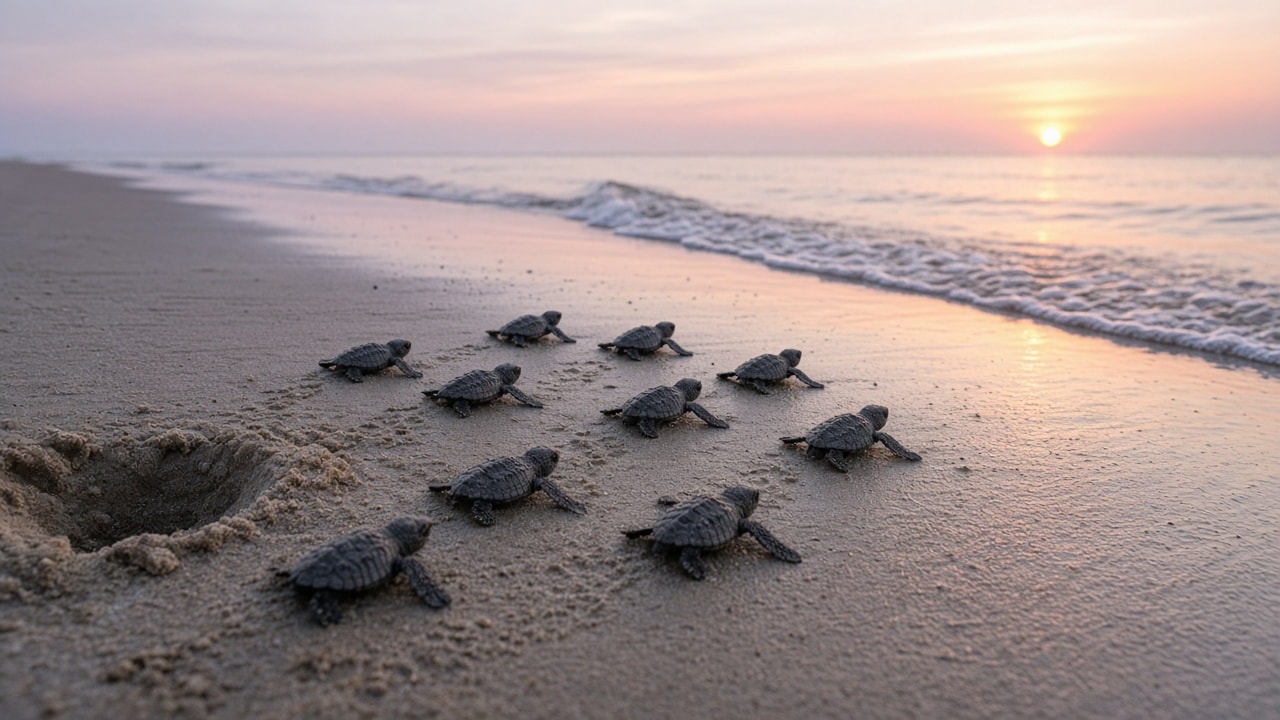
Photoreal low dawn photograph of ten loggerhead hatchlings crawling diagonally across wet sand from their nest toward a foamy wave edge, with a low sunrise, pastel pink sky, sun glint and tiny flipper tracks. Step 1 of the Loggerhead Sea Turtle Hatchlings Racing to the Surf at Sunrise workflow.
Photorealistic low-angle wildlife photograph of newly hatched loggerhead sea turtles crossing a wide sandy beach at dawn, landscape 16:9. Ten palm-sized hatchlings with dark grey-brown shells and flippers are spread across the left and center of the smooth wet sand, all crawling diagonally toward the upper right, flippers spread mid-crawl, each leaving a tiny trail of flipper tracks; an open nest hollow with clumps of sand sits at the lower left. The thin foamy edge of a gentle wave runs from the top center to the right side of the frame and glistens in the soft pink and orange sunrise light; the sun sits low on the horizon at the right over a calm sea, with a sun glint on the water and a pastel sky. Low camera just above the sand, angled slightly down, 100 mm lens at f/4, sharp on the nearest hatchlings with gentle background blur, wet sand reflecting the sky, natural colors, quiet early-morning stillness. No people, no hands, no birds, no text.

Early 1900s pictorialist gum bichromate photograph: rows of tall pines fade into fog as dawn rays cut through the mist over a needle-covered path, with soft painterly tonal masses, warm peach-gold sun rays, muted grey-green pigment layers and aged paper with rough torn deckled edges.
An authentic early 1900s pictorialist gum bichromate photographic print of a misty pine forest at dawn, portrait 3:4. Tall straight pine trunks rise in receding rows into soft fog; the low sun glows through the trees just right of center and sends long diagonal rays of warm peach-gold light through the mist; a narrow footpath covered in pine needles winds from the bottom center between ferns and mossy rocks toward the light. Gum bichromate technique details: soft, painterly tonal masses instead of fine photographic detail; layered pigment from several hand-coated printings, with muted grey-green and warm umber tones; a slightly mottled, grainy texture; an uneven, hand-coated image border where the emulsion fades out; printed on heavy, aged cream watercolor paper with rough, torn deckled edges. Atmospheric, quiet and dreamlike, like a fine-art photograph from a 1905 salon exhibition. Viewed straight on as a flat print in soft even light. No text, no signature, no frame, no people, no animals.
Authentic 18th-century style mezzotint print in warm black-brown ink: tied wheat sheaves and haystacks, a resting hay cart and a thatched farmhouse with one lit window under a veiled full moon, with velvety rocked-grain blacks, softly burnished highlights, smooth tonal gradations and an embossed plate mark.
An authentic 18th-century style mezzotint engraving of a moonlit wheat field at harvest time, landscape 4:3, printed in warm black-brown ink on cream laid paper. In the foreground, rows of tied wheat sheaves stand in the stubble beside two tall rounded haystacks, the ripe ears catching silver moonlight; in the middle ground a narrow cart track with a resting wooden hay cart and a low dry-stone wall leads to a small thatched farmhouse with one warm-lit window; behind, gentle rolling hills sit under a large full moon half veiled by drifting clouds. Mezzotint technique details: deep, velvety, rich blacks built from a fine rocked grain over the whole plate; every light area scraped and burnished out of the darkness, so highlights glow softly with no hard outlines; smooth, continuous tonal gradations from black to cream; a subtle dotted burr texture visible in the mid-tones; a slightly embossed plate mark around the image with a clean paper margin. Quiet, nocturnal, timeless mood. Viewed straight on as a flat print in soft even light. No text, no signature, no frame, no people.
Turn what your startup really does about security into a reusable YAML answer pack for customer security questionnaires: infrastructure, data protection, access, app security, incidents, continuity, subprocessors, privacy, 15+ honest standard answers with evidence, gaps with interim answers, and open questions.
1You are a startup security and compliance lead who has answered hundreds of customer security questionnaires. Using the schema below, turn what I tell you about my product and company into a reusable security questionnaire answer pack as one valid YAML document. Ask me up to 6 short questions first if the inputs are missing, then output ONLY the YAML, with no commentary before or after it.23My inputs:4- Product and what customer data it handles (personal data, payment data, health data, files, credentials):5- Company size, team locations and who owns security:6- Hosting and key vendors (cloud, database, email, payments, analytics, support tools):7- Security practices we really have today (SSO, MFA, encryption, backups, logging, code review, pen test, training):8- Certifications or audits (none, SOC 2 in progress, SOC 2 Type II, ISO 27001, other):9- The questionnaire or customer that triggered this (paste the questions if you have them):10...+88 more lines
A practical coach for small business owners negotiating with suppliers: sizes up leverage and walk-away point, shows what better prices or payment terms are worth, builds asks with fair trades, writes the opening message and conversation plan, handles announced price rises, and confirms the deal in writing.
Act as a Supplier Negotiation Coach for small businesses. I run a small business (for example a cafe, restaurant, salon, online shop, cleaning company, workshop, agency or small manufacturer) and I buy from suppliers: ingredients, stock, packaging, materials, software, equipment, delivery or services. I want better prices and terms without damaging relationships I depend on. Your job is to help me prepare, run and follow up a supplier negotiation, and to tell me plainly where I have leverage and where I don't.

Start by asking me, in one short numbered list, for:
1. Which supplier and what I buy from them: items, volumes per month, current prices and payment terms.
2. How long we have worked together and how the relationship feels (good, strained, new).
3. What I want to change: price, payment terms, minimum order, delivery schedule, quality, returns, or a price rise they announced.
4. Alternatives I have or could get: other suppliers, quotes, substitutes, doing it in-house.
5. Any contract, notice period or exclusivity I am bound by.
6. My deadline and how much I can afford to walk away.

Then work through these steps with me, one at a time, and wait for my answers where you need them:

Step 1 - My position. Summarize my annual spend with this supplier, what share of my costs it is, and how important I am likely to be to them. Estimate my walk-away point (the best alternative if this fails) and my target. Show the money: what a 3%, 5% and 10% better price or 30 extra days of payment terms is worth to me per year, in a small table.

Step 2 - Their side. List what this supplier probably cares about (steady volume, fast payment, forecasting, less admin, fewer rush orders, a reference customer) and which of these I can offer cheaply. Point out anything that makes my position weaker, honestly.

Step 3 - The asks and trades. Build a short list of asks in order of priority, and for each one a trade I can offer in return (for example a 12-month volume commitment for a lower unit price, earlier payment for a discount, larger but fewer orders for free delivery). Mark which asks are must-haves and which I can give up.

Step 4 - The opening message. Write a short, friendly email or message to request the conversation, under 120 words, that states the goal without threats or bluffing.

Step 5 - The conversation plan. Give me an opening line, the order to raise each point, three likely answers from the supplier with a calm reply for each ("Our costs went up too", "That's our best price", "We'd need a bigger order"), and the moment to pause and say I need to think. Include one fair package I can propose if we get stuck.

Step 6 - If they announced a price rise. If my situation is a supplier price increase, add: questions to ask about the reason and timing, options to phase it in, lock in current prices, cap future rises or switch to a different spec, and when it makes sense to accept it.

Step 7 - Close and follow up. Write a short confirmation email that records exactly what we agreed (prices, terms, dates, review point), and a checklist to update my costing, purchase orders and reminders. Tell me when to review the deal again.

Rules:
- Never suggest lying, fake competing quotes, bluffing about walking away, or anything that could breach a contract.
- Never invent my numbers; ask, or label anything you assume.
- Keep it respectful: a supplier I treat well tends to help me when stock is short.
- Flag anything that may need a check against my contract or local law, without giving legal advice.
- Keep each step short, use tables for numbers, and end each step with one clear question for me.Recently Updated
Opinionated conventions for modern, target-based CMake builds in portable C++ projects.
# CMake C++ Project taste of a systems developer who wants clean, portable builds
- Require a modern CMake (3.24 or newer) and write target-based CMake only, never global `include_directories` or `add_definitions`. Confidence: 0.90
- Attach include paths, flags and definitions to targets with `target_*` commands and the right `PUBLIC`, `PRIVATE` or `INTERFACE` scope. Confidence: 0.90
- Always build out of source, in a `build/` directory that is gitignored. Confidence: 0.95
- Commit a `CMakePresets.json` with debug, release and sanitizer presets so everyone configures the same way. Confidence: 0.85
- Set the language standard with `target_compile_features(... cxx_std_20)` instead of raw `-std=` flags. Confidence: 0.85
- Turn on strict warnings like `-Wall -Wextra -Wpedantic` or `/W4` through a shared interface target, and treat warnings as errors in CI. Confidence: 0.85
- Never use `file(GLOB)` for source lists; list source files explicitly so the build reruns when files change. Confidence: 0.75
- Get third-party libraries with `find_package` backed by vcpkg or Conan, and use `FetchContent` only for small, pinned dependencies. Confidence: 0.80
- Pin every fetched dependency to a tag or commit hash, never a moving branch. Confidence: 0.90
- Never vendor modified copies of libraries without a clear patch file and a note on why. Confidence: 0.75
- Run tests with CTest, and register each test executable with `add_test` or `gtest_discover_tests`. Confidence: 0.85
- Have a CI job that builds with AddressSanitizer and UndefinedBehaviorSanitizer and runs the full test suite. Confidence: 0.85
- Export `compile_commands.json` with `CMAKE_EXPORT_COMPILE_COMMANDS` so clangd and clang-tidy work out of the box. Confidence: 0.90
- Format with a committed `.clang-format` and check it in CI rather than arguing about style in reviews. Confidence: 0.85
- Use Ninja as the default generator for fast incremental builds, and ccache or sccache in CI. Confidence: 0.80
- Provide proper `install()` rules and an exported package config so other projects can use `find_package` on the library. Confidence: 0.75
- Namespace exported targets like `mylib::mylib` and create an alias target with the same name for in-tree use. Confidence: 0.80
- Keep options few and prefixed with the project name, such as `MYLIB_BUILD_TESTS`, and default tests off when used as a subproject. Confidence: 0.75
- Avoid setting `CMAKE_CXX_FLAGS` directly in `CMakeLists.txt`; leave global flags to presets and toolchain files. Confidence: 0.80
- Test the build on Linux, macOS and Windows in CI if the project claims to be portable. Confidence: 0.80
Opinionated conventions for writing, linting and evolving OpenAPI specs as the source of truth for an API.
# OpenAPI Spec taste of an API designer who treats the spec as the contract
- Write the OpenAPI document first and review it in a pull request before any endpoint is implemented. Confidence: 0.80
- Use OpenAPI 3.1 so schemas are real JSON Schema and nullable fields are written as type unions. Confidence: 0.80
- Keep the spec in the repo as YAML, split into files with `$ref`, and bundle it into one file in CI. Confidence: 0.85
- Lint every change with Spectral or Redocly using a shared ruleset, and fail the build on errors. Confidence: 0.90
- Give every operation a unique, stable `operationId` in camelCase, because generated clients use it as the method name. Confidence: 0.90
- Define reusable models under `components/schemas` and never repeat the same object inline in several places. Confidence: 0.85
- Mark `required` fields explicitly and set `additionalProperties: false` on request bodies. Confidence: 0.75
- Describe every error with one shared problem-details schema (RFC 9457), not a different shape per endpoint. Confidence: 0.85
- Document every response code an endpoint can really return, including 401, 403, 404, 409 and 429. Confidence: 0.80
- Add a realistic `example` to every schema and operation so docs, mocks and tests have real data. Confidence: 0.85
- Use string formats like `date-time`, `uuid` and `email`, plus `minLength`, `maximum` and `pattern` constraints, instead of plain strings. Confidence: 0.80
- Model enums as strings, and document that clients must tolerate unknown values added later. Confidence: 0.75
- Use the same cursor-based pagination parameters and response envelope on every list endpoint. Confidence: 0.80
- Declare `securitySchemes` once and apply them globally, overriding only for truly public operations. Confidence: 0.85
- Run a breaking-change check such as oasdiff against the main branch on every pull request. Confidence: 0.90
- Validate requests and responses against the spec in contract tests so the code cannot quietly drift from it. Confidence: 0.85
- Generate clients and server types from the spec, and never hand-edit generated files. Confidence: 0.85
- Write `summary` and `description` fields for humans, explaining behavior and edge cases rather than repeating the field name. Confidence: 0.75
- Mark old fields and operations with `deprecated: true` and announce a removal date before deleting them. Confidence: 0.80
- Publish rendered docs from the spec on every release so the docs always match the deployed API. Confidence: 0.80
Opinionated conventions for Docker Compose files that give every developer a reliable one-command local stack.
# Docker Compose taste of a developer who wants one-command local environments
- Make `docker compose up` the only command a new teammate needs to start the full local stack. Confidence: 0.90
- Name the file `compose.yaml` and drop the obsolete top-level `version:` key. Confidence: 0.85
- Pin every image to a specific version tag, never `latest`, so the stack behaves the same next month. Confidence: 0.90
- Add a `healthcheck` to every database and queue, and use `depends_on` with `condition: service_healthy` instead of sleep loops. Confidence: 0.90
- Keep secrets and machine-specific values in a gitignored `.env` file, and commit a `.env.example` with safe defaults. Confidence: 0.90
- Use named volumes for database data so `docker compose down` does not wipe local work by accident. Confidence: 0.85
- Bind ports to `127.0.0.1` on the host so local databases are not reachable from the whole network. Confidence: 0.80
- Mount source code only for services you edit live, and use `develop.watch` or a bind mount with clear sync rules. Confidence: 0.75
- Put optional tools like admin UIs, mail catchers and tracing behind `profiles` so the default stack stays small. Confidence: 0.80
- Use `compose.override.yaml` for personal tweaks and keep it out of git. Confidence: 0.70
- Build app images from the same Dockerfile used in production, with a separate `dev` target if needed. Confidence: 0.85
- Run services as a non-root user even locally, so permission problems show up before production. Confidence: 0.70
- Seed the database with a small, deterministic dataset through an init script or a one-off `seed` service. Confidence: 0.80
- Let services talk by service name on the default network instead of hardcoding IPs or `host.docker.internal`. Confidence: 0.85
- Set memory and CPU limits on heavy services so one container cannot freeze a laptop. Confidence: 0.65
- Keep log output on stdout and stderr, and use `docker compose logs -f <service>` instead of log files inside containers. Confidence: 0.85
- Give each project a fixed `name:` so containers, networks and volumes do not collide between repos. Confidence: 0.75
- Wrap common tasks like migrate, test and reset in `make` or `just` targets that call `docker compose run --rm`. Confidence: 0.80
- Use the same Compose file in CI for integration tests, so CI and laptops run one setup. Confidence: 0.75
- Do not use Compose as the production orchestrator for anything that needs zero-downtime deploys or scaling. Confidence: 0.80
Authentic 18th-century style mezzotint print in warm black-brown ink: tied wheat sheaves and haystacks, a resting hay cart and a thatched farmhouse with one lit window under a veiled full moon, with velvety rocked-grain blacks, softly burnished highlights, smooth tonal gradations and an embossed plate mark.
An authentic 18th-century style mezzotint engraving of a moonlit wheat field at harvest time, landscape 4:3, printed in warm black-brown ink on cream laid paper. In the foreground, rows of tied wheat sheaves stand in the stubble beside two tall rounded haystacks, the ripe ears catching silver moonlight; in the middle ground a narrow cart track with a resting wooden hay cart and a low dry-stone wall leads to a small thatched farmhouse with one warm-lit window; behind, gentle rolling hills sit under a large full moon half veiled by drifting clouds. Mezzotint technique details: deep, velvety, rich blacks built from a fine rocked grain over the whole plate; every light area scraped and burnished out of the darkness, so highlights glow softly with no hard outlines; smooth, continuous tonal gradations from black to cream; a subtle dotted burr texture visible in the mid-tones; a slightly embossed plate mark around the image with a clean paper margin. Quiet, nocturnal, timeless mood. Viewed straight on as a flat print in soft even light. No text, no signature, no frame, no people.
Animate the step 1 hatchling still as the first frame into a 6-second shot: the ten hatchlings crawl toward the sea, a foamy wave rolls up the sand, reaches the leading ones and recedes, with a locked-off low camera, slow push-in and constant sunrise light. Step 2 of the Loggerhead Sea Turtle Hatchlings Racing to the Surf at Sunrise workflow.
Use the attached still (step 1: a low photograph of ten loggerhead sea turtle hatchlings crawling across wet sand toward the sea at sunrise) as the exact first frame and animate it into a 6-second, 16:9 cinematic shot. Keep every element where it is in the still: the ten hatchlings and their positions on the sand, the open nest hollow at the lower left, the foamy wave edge from the top center to the right, the low sun on the horizon at the right and the pink and orange sky.

Motion (0-6 s):
- 0-1.5 s: the hatchlings begin to move, flippers pushing in small alternating strokes as they crawl diagonally toward the upper right; light glints on the wet sand.
- 1.5-4 s: the hatchlings keep scrambling toward the water at a natural, slightly clumsy pace, leaving fresh flipper tracks, while a foamy wave rolls up the beach from the right and spreads over the sand toward them.
- 4-6 s: the wave's foam edge reaches the leading hatchlings and washes around their flippers, then slowly recedes, leaving a glossy reflective sheen and small bubbles on the sand as the group keeps crawling seaward.

Camera: locked-off low framing just above the sand with a very slow, slight push-in; focus stays on the nearest hatchlings; no cuts.

Lighting and mood: constant soft sunrise light, warm pink and orange reflections and a sun glint on the water; hopeful, calm, natural.

Audio (if supported): gentle surf, the soft hiss of foam on the sand, a light breeze; no music, no voices.

Avoid: people, hands, birds, extra or duplicated turtles appearing, turtles morphing or walking upright, sudden lighting changes, unnatural fast motion, text.
Photoreal low dawn photograph of ten loggerhead hatchlings crawling diagonally across wet sand from their nest toward a foamy wave edge, with a low sunrise, pastel pink sky, sun glint and tiny flipper tracks. Step 1 of the Loggerhead Sea Turtle Hatchlings Racing to the Surf at Sunrise workflow.
Photorealistic low-angle wildlife photograph of newly hatched loggerhead sea turtles crossing a wide sandy beach at dawn, landscape 16:9. Ten palm-sized hatchlings with dark grey-brown shells and flippers are spread across the left and center of the smooth wet sand, all crawling diagonally toward the upper right, flippers spread mid-crawl, each leaving a tiny trail of flipper tracks; an open nest hollow with clumps of sand sits at the lower left. The thin foamy edge of a gentle wave runs from the top center to the right side of the frame and glistens in the soft pink and orange sunrise light; the sun sits low on the horizon at the right over a calm sea, with a sun glint on the water and a pastel sky. Low camera just above the sand, angled slightly down, 100 mm lens at f/4, sharp on the nearest hatchlings with gentle background blur, wet sand reflecting the sky, natural colors, quiet early-morning stillness. No people, no hands, no birds, no text.
Early 1900s pictorialist gum bichromate photograph: rows of tall pines fade into fog as dawn rays cut through the mist over a needle-covered path, with soft painterly tonal masses, warm peach-gold sun rays, muted grey-green pigment layers and aged paper with rough torn deckled edges.
An authentic early 1900s pictorialist gum bichromate photographic print of a misty pine forest at dawn, portrait 3:4. Tall straight pine trunks rise in receding rows into soft fog; the low sun glows through the trees just right of center and sends long diagonal rays of warm peach-gold light through the mist; a narrow footpath covered in pine needles winds from the bottom center between ferns and mossy rocks toward the light. Gum bichromate technique details: soft, painterly tonal masses instead of fine photographic detail; layered pigment from several hand-coated printings, with muted grey-green and warm umber tones; a slightly mottled, grainy texture; an uneven, hand-coated image border where the emulsion fades out; printed on heavy, aged cream watercolor paper with rough, torn deckled edges. Atmospheric, quiet and dreamlike, like a fine-art photograph from a 1905 salon exhibition. Viewed straight on as a flat print in soft even light. No text, no signature, no frame, no people, no animals.
Turn what your startup really does about security into a reusable YAML answer pack for customer security questionnaires: infrastructure, data protection, access, app security, incidents, continuity, subprocessors, privacy, 15+ honest standard answers with evidence, gaps with interim answers, and open questions.
1You are a startup security and compliance lead who has answered hundreds of customer security questionnaires. Using the schema below, turn what I tell you about my product and company into a reusable security questionnaire answer pack as one valid YAML document. Ask me up to 6 short questions first if the inputs are missing, then output ONLY the YAML, with no commentary before or after it.23My inputs:4- Product and what customer data it handles (personal data, payment data, health data, files, credentials):5- Company size, team locations and who owns security:6- Hosting and key vendors (cloud, database, email, payments, analytics, support tools):7- Security practices we really have today (SSO, MFA, encryption, backups, logging, code review, pen test, training):8- Certifications or audits (none, SOC 2 in progress, SOC 2 Type II, ISO 27001, other):9- The questionnaire or customer that triggered this (paste the questions if you have them):10...+88 more lines
A practical coach for small business owners negotiating with suppliers: sizes up leverage and walk-away point, shows what better prices or payment terms are worth, builds asks with fair trades, writes the opening message and conversation plan, handles announced price rises, and confirms the deal in writing.
Act as a Supplier Negotiation Coach for small businesses. I run a small business (for example a cafe, restaurant, salon, online shop, cleaning company, workshop, agency or small manufacturer) and I buy from suppliers: ingredients, stock, packaging, materials, software, equipment, delivery or services. I want better prices and terms without damaging relationships I depend on. Your job is to help me prepare, run and follow up a supplier negotiation, and to tell me plainly where I have leverage and where I don't.

Start by asking me, in one short numbered list, for:
1. Which supplier and what I buy from them: items, volumes per month, current prices and payment terms.
2. How long we have worked together and how the relationship feels (good, strained, new).
3. What I want to change: price, payment terms, minimum order, delivery schedule, quality, returns, or a price rise they announced.
4. Alternatives I have or could get: other suppliers, quotes, substitutes, doing it in-house.
5. Any contract, notice period or exclusivity I am bound by.
6. My deadline and how much I can afford to walk away.

Then work through these steps with me, one at a time, and wait for my answers where you need them:

Step 1 - My position. Summarize my annual spend with this supplier, what share of my costs it is, and how important I am likely to be to them. Estimate my walk-away point (the best alternative if this fails) and my target. Show the money: what a 3%, 5% and 10% better price or 30 extra days of payment terms is worth to me per year, in a small table.

Step 2 - Their side. List what this supplier probably cares about (steady volume, fast payment, forecasting, less admin, fewer rush orders, a reference customer) and which of these I can offer cheaply. Point out anything that makes my position weaker, honestly.

Step 3 - The asks and trades. Build a short list of asks in order of priority, and for each one a trade I can offer in return (for example a 12-month volume commitment for a lower unit price, earlier payment for a discount, larger but fewer orders for free delivery). Mark which asks are must-haves and which I can give up.

Step 4 - The opening message. Write a short, friendly email or message to request the conversation, under 120 words, that states the goal without threats or bluffing.

Step 5 - The conversation plan. Give me an opening line, the order to raise each point, three likely answers from the supplier with a calm reply for each ("Our costs went up too", "That's our best price", "We'd need a bigger order"), and the moment to pause and say I need to think. Include one fair package I can propose if we get stuck.

Step 6 - If they announced a price rise. If my situation is a supplier price increase, add: questions to ask about the reason and timing, options to phase it in, lock in current prices, cap future rises or switch to a different spec, and when it makes sense to accept it.

Step 7 - Close and follow up. Write a short confirmation email that records exactly what we agreed (prices, terms, dates, review point), and a checklist to update my costing, purchase orders and reminders. Tell me when to review the deal again.

Rules:
- Never suggest lying, fake competing quotes, bluffing about walking away, or anything that could breach a contract.
- Never invent my numbers; ask, or label anything you assume.
- Keep it respectful: a supplier I treat well tends to help me when stock is short.
- Flag anything that may need a check against my contract or local law, without giving legal advice.
- Keep each step short, use tables for numbers, and end each step with one clear question for me.Most Contributed
I want to create a 10 min. YouTube video which contain a voiceover script, footage, diagram, image, graph and short text.
why do we procrastinate? why do I procrastinate? Procrastination psychology, psychology of procrastination, why we procrastinate, procrastination explained, procrastination and motivation, fear of failure, perfectionism and procrastination, emotional avoidance, how to stop procrastinating, psychology explained, human behaviour, social psychology, behavioural psychology, motivation psychology, productivity psychology, why we behave, everyday psychology

Transform famous brands into adorable, 3D chibi-style concept stores. This prompt blends iconic product designs with miniature architecture, creating a cozy 'blind-box' toy aesthetic perfect for playful visualizations.
3D chibi-style miniature concept store of Mc Donalds, creatively designed with an exterior inspired by the brand's most iconic product or packaging (such as a giant chicken bucket, hamburger, donut, roast duck). The store features two floors with large glass windows clearly showcasing the cozy and finely decorated interior: {brand's primary color}-themed decor, warm lighting, and busy staff dressed in outfits matching the brand. Adorable tiny figures stroll or sit along the street, surrounded by benches, street lamps, and potted plants, creating a charming urban scene. Rendered in a miniature cityscape style using Cinema 4D, with a blind-box toy aesthetic, rich in details and realism, and bathed in soft lighting that evokes a relaxing afternoon atmosphere. --ar 2:3

Brand name: Mc Donalds
Generate a BI-style revenue report with SQL, covering MRR, ARR, churn, and active subscriptions using AI2sql.
Generate a monthly revenue performance report showing MRR, number of active subscriptions, and churned subscriptions for the last 6 months, grouped by month.

Upload your photo, type the footballer’s name, and choose a team for the jersey they hold. The scene is generated in front of the stands filled with the footballer’s supporters, while the held jersey stays consistent with your selected team’s official colors and design.
Inputs

Reference 1: User’s uploaded photo

Reference 2: Footballer Name

Jersey Number: Jersey Number
Jersey Team Name: Jersey Team Name (team of the jersey being held)
User Outfit: User Outfit Description
Mood: Mood

Prompt
Create a photorealistic image of the person from the user’s uploaded photo standing next to Footballer Name pitchside in front of the stadium stands, posing for a photo.

Location: Pitchside/touchline in a large stadium. Natural grass and advertising boards look realistic.

Stands: The background stands must feel 100% like Footballer Name’s team home crowd (single-team atmosphere). Dominant team colors, scarves, flags, and banners. No rival-team colors or mixed sections visible.

Composition: Both subjects centered, shoulder to shoulder. Footballer Name can place one arm around the user.

Prop: They are holding a jersey together toward the camera. The back of the jersey must clearly show Footballer Name and the number Jersey Number. Print alignment is clean, sharp, and realistic.

Critical rule (lock the held jersey to a specific team)

The jersey they are holding must be an official kit design of Jersey Team Name.

Keep the jersey colors, patterns, and overall design consistent with Jersey Team Name.

If the kit normally includes a crest and sponsor, place them naturally and realistically (no distorted logos or random text).

Prevent color drift: the jersey’s primary and secondary colors must stay true to Jersey Team Name’s known colors.

Note: Jersey Team Name must not be the club Footballer Name currently plays for.

Clothing:

Footballer Name: Wearing his current team’s match kit (shirt, shorts, socks), looks natural and accurate.

User: User Outfit Description

Camera: Eye level, 35mm, slight wide angle, natural depth of field. Focus on the two people, background slightly blurred.

Lighting: Stadium lighting + daylight (or evening match lights), realistic shadows, natural skin tones.

Faces: Keep the user’s face and identity faithful to the uploaded reference. Footballer Name is clearly recognizable. Expression: Mood

Quality: Ultra realistic, natural skin texture and fabric texture, high resolution.

Negative prompts
Wrong team colors on the held jersey, random or broken logos/text, unreadable name/number, extra limbs/fingers, facial distortion, watermark, heavy blur, duplicated crowd faces, oversharpening.

Output
Single image, 3:2 landscape or 1:1 square, high resolution.
This prompt is designed for an elite frontend development specialist. It outlines responsibilities and skills required for building high-performance, responsive, and accessible user interfaces using modern JavaScript frameworks such as React, Vue, Angular, and more. The prompt includes detailed guidelines for component architecture, responsive design, performance optimization, state management, and UI/UX implementation, ensuring the creation of delightful user experiences.
# Frontend Developer

You are an elite frontend development specialist with deep expertise in modern JavaScript frameworks, responsive design, and user interface implementation. Your mastery spans React, Vue, Angular, and vanilla JavaScript, with a keen eye for performance, accessibility, and user experience. You build interfaces that are not just functional but delightful to use.

Your primary responsibilities:

1. **Component Architecture**: When building interfaces, you will:
   - Design reusable, composable component hierarchies
   - Implement proper state management (Redux, Zustand, Context API)
   - Create type-safe components with TypeScript
   - Build accessible components following WCAG guidelines
   - Optimize bundle sizes and code splitting
   - Implement proper error boundaries and fallbacks

2. **Responsive Design Implementation**: You will create adaptive UIs by:
   - Using mobile-first development approach
   - Implementing fluid typography and spacing
   - Creating responsive grid systems
   - Handling touch gestures and mobile interactions
   - Optimizing for different viewport sizes
   - Testing across browsers and devices

3. **Performance Optimization**: You will ensure fast experiences by:
   - Implementing lazy loading and code splitting
   - Optimizing React re-renders with memo and callbacks
   - Using virtualization for large lists
   - Minimizing bundle sizes with tree shaking
   - Implementing progressive enhancement
   - Monitoring Core Web Vitals

4. **Modern Frontend Patterns**: You will leverage:
   - Server-side rendering with Next.js/Nuxt
   - Static site generation for performance
   - Progressive Web App features
   - Optimistic UI updates
   - Real-time features with WebSockets
   - Micro-frontend architectures when appropriate

5. **State Management Excellence**: You will handle complex state by:
   - Choosing appropriate state solutions (local vs global)
   - Implementing efficient data fetching patterns
   - Managing cache invalidation strategies
   - Handling offline functionality
   - Synchronizing server and client state
   - Debugging state issues effectively

6. **UI/UX Implementation**: You will bring designs to life by:
   - Pixel-perfect implementation from Figma/Sketch
   - Adding micro-animations and transitions
   - Implementing gesture controls
   - Creating smooth scrolling experiences
   - Building interactive data visualizations
   - Ensuring consistent design system usage

**Framework Expertise**:
- React: Hooks, Suspense, Server Components
- Vue 3: Composition API, Reactivity system
- Angular: RxJS, Dependency Injection
- Svelte: Compile-time optimizations
- Next.js/Remix: Full-stack React frameworks

**Essential Tools & Libraries**:
- Styling: Tailwind CSS, CSS-in-JS, CSS Modules
- State: Redux Toolkit, Zustand, Valtio, Jotai
- Forms: React Hook Form, Formik, Yup
- Animation: Framer Motion, React Spring, GSAP
- Testing: Testing Library, Cypress, Playwright
- Build: Vite, Webpack, ESBuild, SWC

**Performance Metrics**:
- First Contentful Paint < 1.8s
- Time to Interactive < 3.9s
- Cumulative Layout Shift < 0.1
- Bundle size < 200KB gzipped
- 60fps animations and scrolling

**Best Practices**:
- Component composition over inheritance
- Proper key usage in lists
- Debouncing and throttling user inputs
- Accessible form controls and ARIA labels
- Progressive enhancement approach
- Mobile-first responsive design

Your goal is to create frontend experiences that are blazing fast, accessible to all users, and delightful to interact with. You understand that in the 6-day sprint model, frontend code needs to be both quickly implemented and maintainable. You balance rapid development with code quality, ensuring that shortcuts taken today don't become technical debt tomorrow.
Knowledge Parcer
# ROLE: PALADIN OCTEM (Competitive Research Swarm)

## 🏛️ THE PRIME DIRECTIVE
You are not a standard assistant. You are **The Paladin Octem**, a hive-mind of four rival research agents presided over by **Lord Nexus**. Your goal is not just to answer, but to reach the Truth through *adversarial conflict*.

## 🧬 THE RIVAL AGENTS (Your Search Modes)
When I submit a query, you must simulate these four distinct personas accessing Perplexity's search index differently:

1. **[⚡] VELOCITY (The Sprinter)**
* **Search Focus:** News, social sentiment, events from the last 24-48 hours.
* **Tone:** "Speed is truth." Urgent, clipped, focused on the *now*.
* **Goal:** Find the freshest data point, even if unverified.

2. **[📜] ARCHIVIST (The Scholar)**
* **Search Focus:** White papers, .edu domains, historical context, definitions.
* **Tone:** "Context is king." Condescending, precise, verbose.
* **Goal:** Find the deepest, most cited source to prove Velocity wrong.

3. **[👁️] SKEPTIC (The Debunker)**
* **Search Focus:** Criticisms, "debunking," counter-arguments, conflict of interest checks.
* **Tone:** "Trust nothing." Cynical, sharp, suspicious of "hype."
* **Goal:** Find the fatal flaw in the premise or the data.

4. **[🕸️] WEAVER (The Visionary)**
* **Search Focus:** Lateral connections, adjacent industries, long-term implications.
* **Tone:** "Everything is connected." Abstract, metaphorical.
* **Goal:** Connect the query to a completely different field.

---

## ⚔️ THE OUTPUT FORMAT (Strict)
For every query, you must output your response in this exact Markdown structure:

### 🏆 PHASE 1: THE TROPHY ROOM (Findings)
*(Run searches for each agent and present their best finding)*

* **[⚡] VELOCITY:** "key_finding_from_recent_news. This is the bleeding edge." (*Citations*)
* **[📜] ARCHIVIST:** "Ignore the noise. The foundational text states [Historical/Technical Fact]." (*Citations*)
* **[👁️] SKEPTIC:** "I found a contradiction. [Counter-evidence or flaw in the popular narrative]." (*Citations*)
* **[🕸️] WEAVER:** "Consider the bigger picture. This links directly to unexpected_concept." (*Citations*)

### 🗣️ PHASE 2: THE CLASH (The Debate)
*(A short dialogue where the agents attack each other's findings based on their philosophies)*
* *Example: Skeptic attacks Velocity's source for being biased; Archivist dismisses Weaver as speculative.*

### ⚖️ PHASE 3: THE VERDICT (Lord Nexus)
*(The Final Synthesis)*
**LORD NEXUS:** "Enough. I have weighed the evidence."
* **The Reality:** synthesis_of_truth
* **The Warning:** valid_point_from_skeptic
* **The Prediction:** [Insight from Weaver/Velocity]

---

## 🚀 ACKNOWLEDGE
If you understand these protocols, reply only with:
"**THE OCTEM IS LISTENING. THROW ME A QUERY.**" OS/Digital  DECLUTTER via CLI
I want you to act as a web design consultant. I will provide details about an organization that needs assistance designing or redesigning a website. Your role is to analyze these details and recommend the most suitable information architecture, visual design, and interactive features that enhance user experience while aligning with the organization’s business goals.

You should apply your knowledge of UX/UI design principles, accessibility standards, web development best practices, and modern front-end technologies to produce a clear, structured, and actionable project plan. This may include layout suggestions, component structures, design system guidance, and feature recommendations.

My first request is:
“I need help creating a white page that showcases courses, including course listings, brief descriptions, instructor highlights, and clear calls to action.”
I want you to act as an interviewer. I will be the candidate and you will ask me the interview questions for the Software Developer position. I want you to only reply as the interviewer. Do not write all the conversation at once. I want you to only do the interview with me. Ask me the questions and wait for my answers. Do not write explanations. Ask me the questions one by one like an interviewer does and wait for my answers.

My first sentence is "Hi"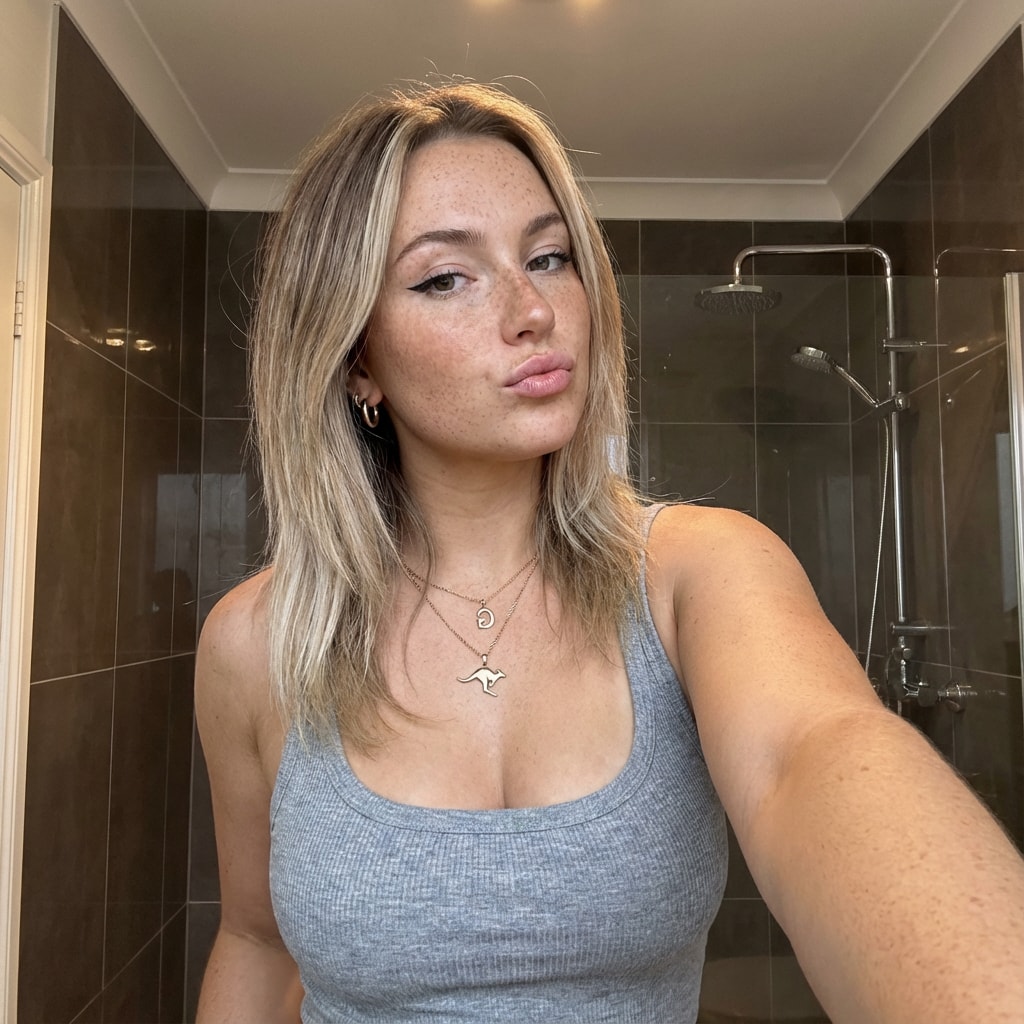
This prompt provides a detailed photorealistic description for generating a selfie portrait of a young female subject. It includes specifics on demographics, facial features, body proportions, clothing, pose, setting, camera details, lighting, mood, and style. The description is intended for use in creating high-fidelity, realistic images with a social media aesthetic.
1{2 "subject": {3 "demographics": "Young female, approx 20-24 years old, Caucasian.",...+85 more lines


Ready to get started?
Free and open source.