Create a photorealistic cinematic portrait in an ordinary room where selected objects obey different directions of gravity. Designed to look like a practical-effects movie set, with strong visual logic and a surreal but believable atmosphere.
Use the uploaded photo as a strict identity reference. Keep this exact person: same face, hair, age, skin texture and body proportions, unretouched.

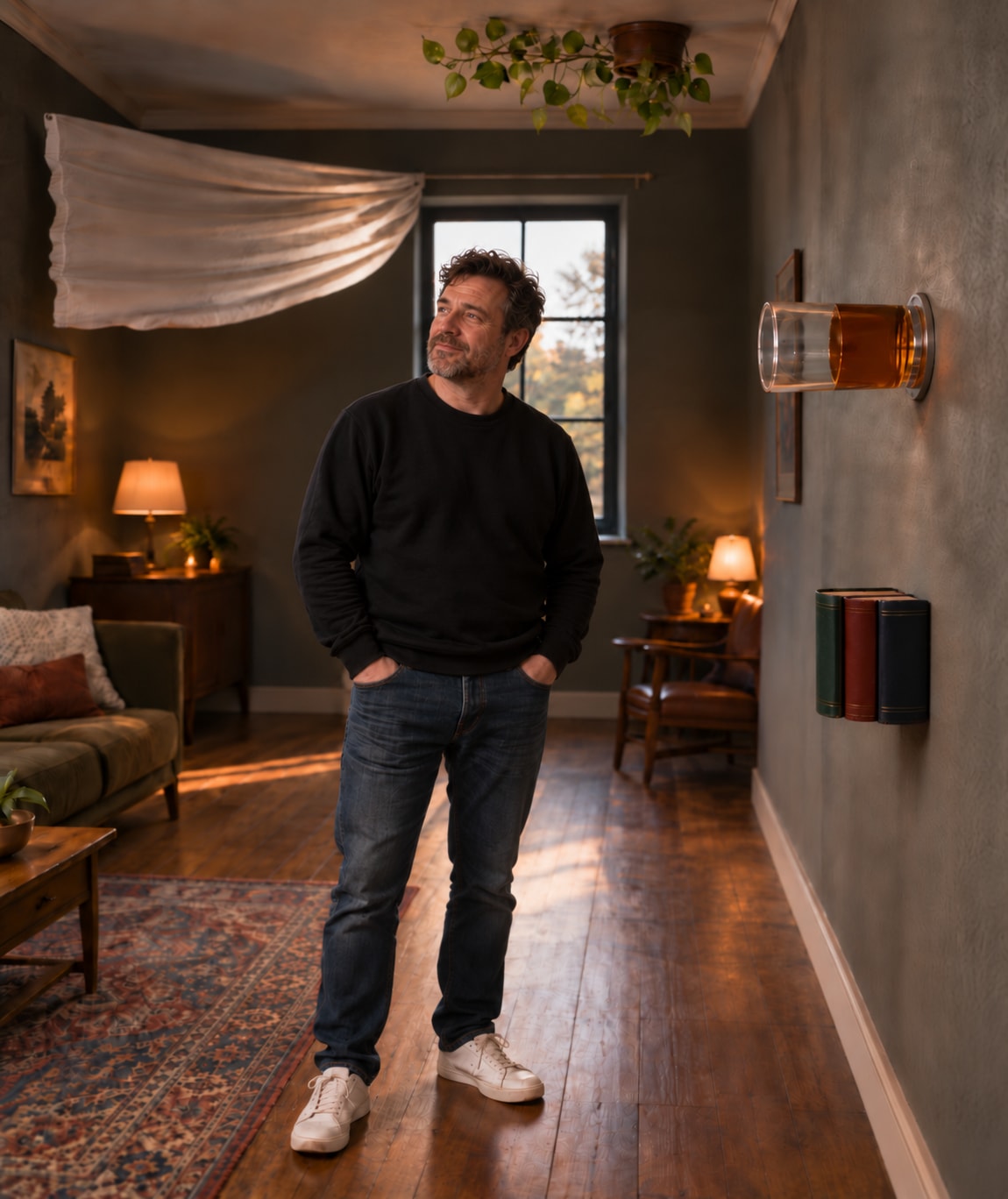
A photorealistic cinematic photograph, vertical 4:5, shot at eye level with a perfectly level camera, medium-wide. It looks like a practical-effects movie set photographed with a real camera.

The person stands upright on the wooden floor in the middle of an elegant, ordinary room. Full body visible, relaxed pose, understated contemporary clothes, looking around with mild curiosity. The face is clearly visible and softly lit. They are the only person and the main focal point.

The room has muted dark plaster walls, a real wood floor, a window on the back wall, minimal furniture and warm practical lamps. Both side walls, the floor and part of the ceiling are visible. The room is completely normal, except that four objects each have their own direction of gravity.

Left: a white, medium-heavy curtain on the rod above the window falls sideways instead of down. It hangs horizontally from the rod toward the left wall, exactly like a normally hanging curtain rotated 90 degrees. The rod above the window is its only attachment. The far end of the curtain hangs free a short distance from the left wall, ending in a loose, slightly uneven vertical hem. Heavy folds run horizontally, with a slight natural sag and bunching at the rod. The fabric is heavy and completely still.

Right, in the foreground at chest height: a clear cylindrical drinking glass stands on the right wall as if the wall were a table. Its base rests against the wall, held by a small metal ring bracket. Its open end points horizontally into the room. The glass is seen in side profile and is large and sharp in the frame.

The glass holds amber-coloured tea. The tea fills the wall-side part of the glass completely, from the top inner edge to the bottom inner edge, and takes up a little more than half of the glass length. The tea-filled part is clearly longer than the empty part. The room-side part of the glass, up to the rim, is completely empty, clear and dry, also along its lower edge. The boundary between the amber tea and the air is one straight vertical line running from the top edge of the glass to the bottom edge. It looks exactly like a photo of a normal glass of tea standing on a table, rotated 90 degrees so that its base points at the right wall. Realistic meniscus along that vertical line and realistic refraction in the amber liquid.

Above: a small potted trailing plant stands upside down on the ceiling, the base of the pot flat against the ceiling. Its vines and leaves droop upward and lie against the ceiling around the pot, the way a trailing plant on a table droops onto the tabletop. No vines hang down into the room. The plant is smaller and less prominent than the curtain and the glass.

On the right wall below the glass: a stack of exactly three hardcover books uses the wall as its floor. One dark green book lies with its cover flat against the wall. One dark red book is stacked on it, and one dark blue book is stacked on the red one, toward the room. The stack sticks out horizontally from the wall and the three spines are vertical.

Lighting: warm lamps, a soft directional key light on the person, subtle rim light, natural falloff into shadow. All shadows follow the real light sources, including those of the sideways objects. Natural skin, real materials, subtle film contrast, natural depth of field. No text in the image.