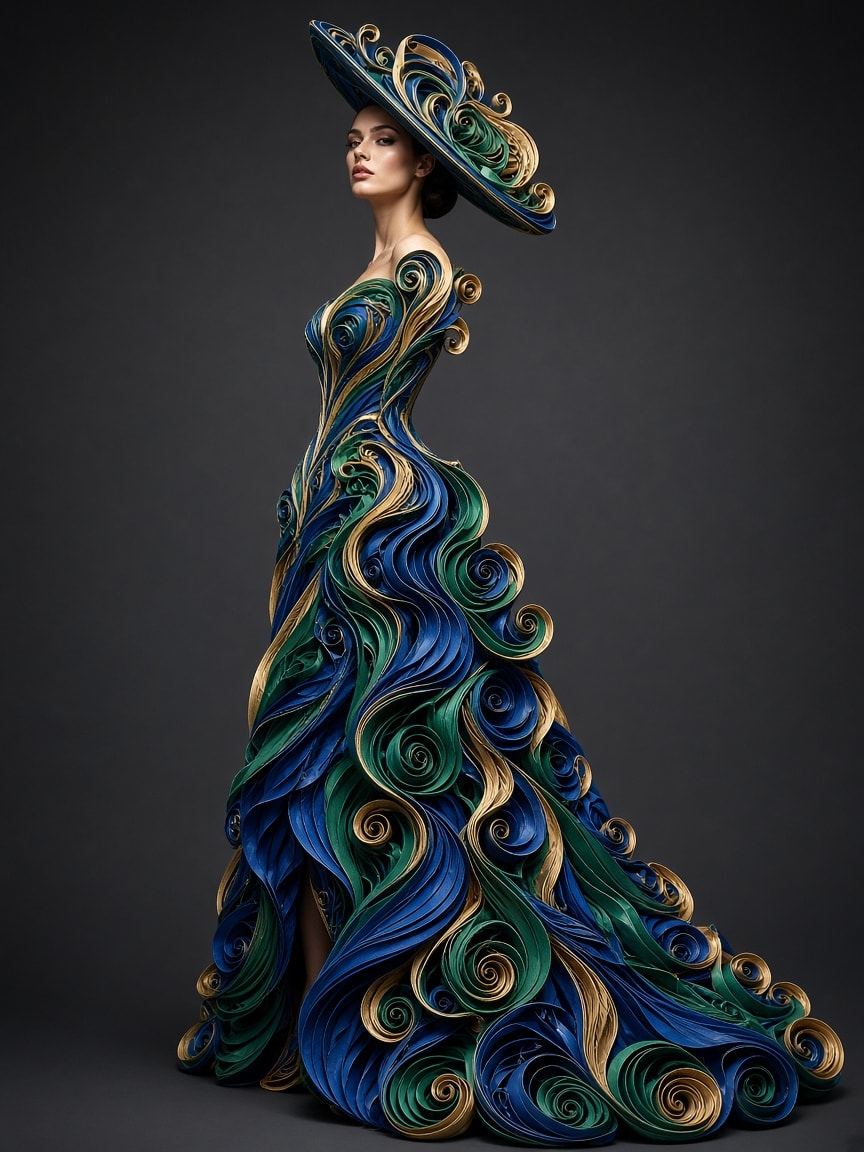
Full-body high-fashion shot of a model in an avant-garde paper-quilled couture gown made of overlapping 3D ribbon strands, with variables for the model, pose, dress features, color gradient, headwear, and background, lit by dramatic studio spotlights. Trending on X, originally shared by @yourPlugAI: https://x.com/yourPlugAI/status/2114219176646586620
Generate a full-body high-fashion shot of a tall model with a sleek low bun in a elegant three-quarter standing pose, wearing an avant-garde paper-quilled haute couture gown made of fluid, overlapping 3D ribbon strands. The dress features a fitted corset bodice and sweeping train made of swooping ribbon layers in a gradient of vivid cobalt, emerald green, and gold. Accessories include a wide-brimmed matching hat with quilled plume details. Set against a dark charcoal grey background with dramatic studio spotlighting highlighting texture and fine edges. Rendered in crisp, high-contrast 3D detail.
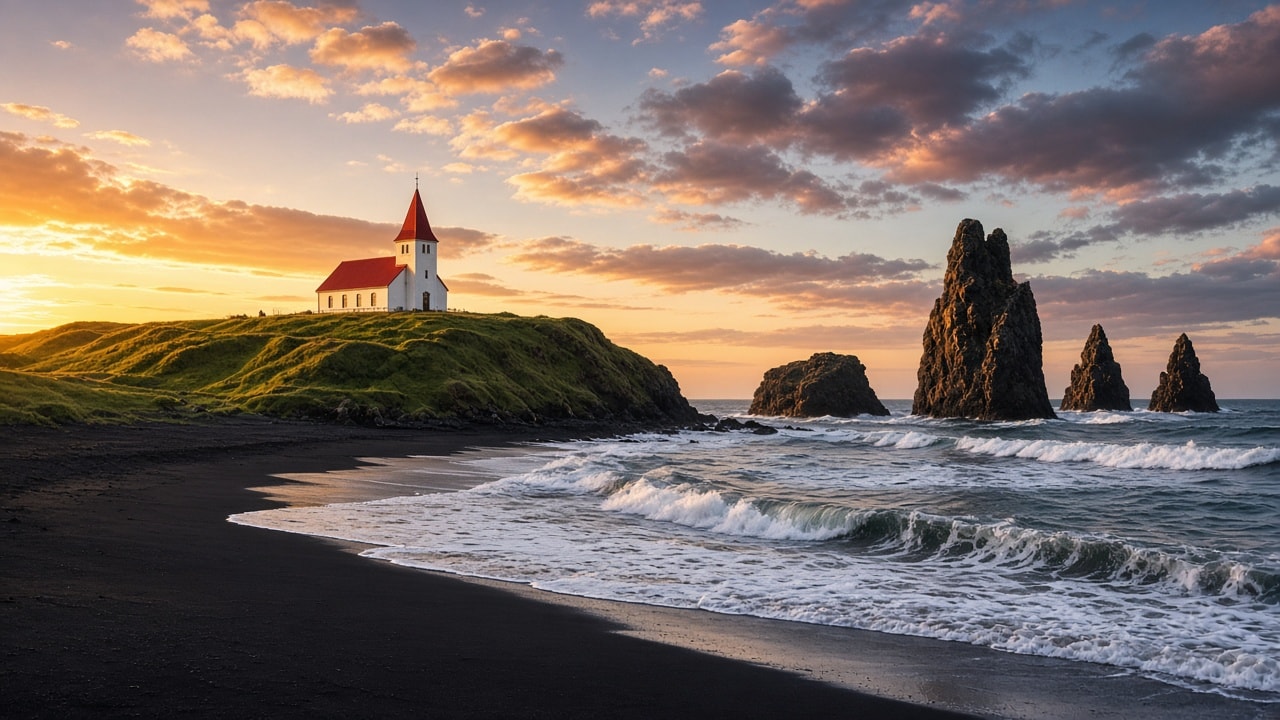
Photoreal golden-hour landscape: a small white church with a red roof and steeple on a grassy headland in the left third, a curve of glossy black sand, white surf rolling in from the right, four dark basalt rocks and sea stacks offshore, a low sun at the far left, and orange, pink, and purple clouds. Step 2 of the Icelandic Black Sand Beach Church workflow.
A small white wooden church with a red gabled roof and a pointed red steeple stands on a rounded grassy green headland above an Icelandic black sand beach at golden hour, with dark basalt sea stacks rising from the ocean on the right. The church sits in the left third of the frame, near the top of the headland, its white walls and small windows lit warm gold by the low sun. The headland's grassy slope drops down to the beach, and a wide curve of fine black volcanic sand sweeps from the lower left corner across the foreground, wet and glossy near the water. White foamy surf rolls in from the right in several long lines and washes up the black sand. In the sea on the right half stand four dark basalt rocks: a low rounded rock near the end of the headland, a tall jagged sea stack in the center right, and two smaller pointed spires further right. The low sun sits near the horizon at the far left behind the headland, glowing yellow-orange, and the sky is filled with scattered clouds lit orange, pink, and purple against soft blue. Photoreal landscape photography, wide angle, natural colors, calm and dramatic mood. Wide landscape 16:9. No people, no text, no logos.

Warm macro photo of five boxy 1950s wind-up tin robots in red, teal, cream, mustard, and red lined up on a worn wooden shelf, each with a chest dial, antenna, and brass wind-up key, the last one carrying a red pennant flag, with blurred shelves of old toys and golden window light from the left.
A macro product photograph of five vintage 1950s wind-up tin toy robots standing side by side in a parade line on a worn wooden shelf, in a wide landscape 16:9 frame. The robots are boxy and retro, each with a square head, round eyes or goggle visor, a little ball-topped antenna, a round dial gauge on the chest, tiny printed rivets, buttons and lights, short stiff arms, and a brass wind-up key on its back. Their painted tin colors from left to right are red, teal, cream, mustard yellow, and red, with slightly worn paint, soft scratches, and a little rust at the edges. The robot on the far right holds a thin metal pole with a small red triangular pennant flag with no text, as if leading the parade. Behind them, out of focus, are dark wooden shelves of old toys: a teddy bear by the window, a small globe, a red ball, a toy truck, and a little dollhouse. Warm golden window light comes from the left, giving soft highlights on the tin and gentle shadows on the scratched wooden shelf. Shallow depth of field, rich warm browns, nostalgic and cheerful mood. No readable text, no logos, no people.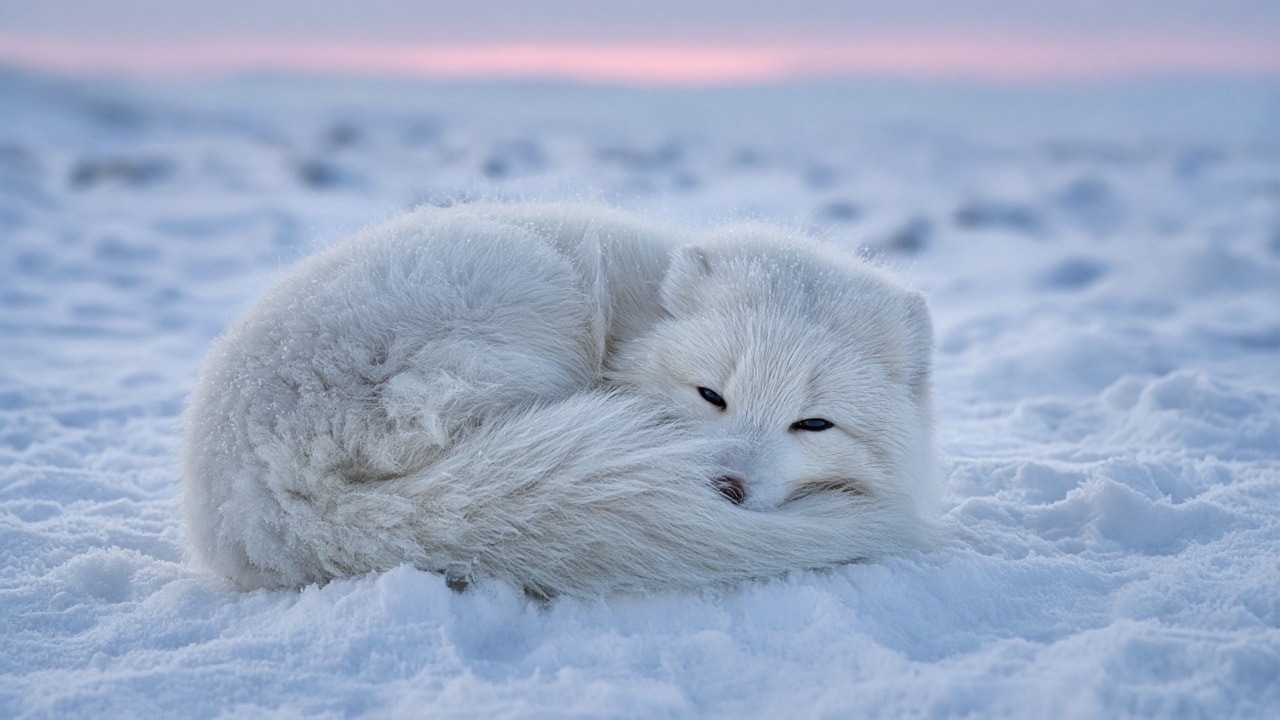
Photoreal low-angle telephoto wildlife shot of a pure white Arctic fox curled in a ball on fresh powder snow, bushy tail wrapped around its body, both eyes half open and drowsy, snowflakes on its fur, with a blurred snowy tundra, soft blue-hour light, and a thin pink glow on the horizon.
A photorealistic wildlife photograph of an Arctic fox in its thick pure white winter coat, curled up in a round ball on fresh powder snow in the center of a wide landscape 16:9 frame. Its bushy white tail wraps around the front of its body and covers its paws, with its black nose resting just above the tail. Both eyes are half open, dark and drowsy, gazing calmly toward the camera, small rounded ears upright, and a few fine snowflakes resting on the dense fur. The fox lies in a soft hollow of snow, shot from a low eye-level angle close to the ground. Behind it, a wide snowy tundra fades into a creamy blur of gentle drifts under soft blue-hour light, with a thin band of pink glow along the distant horizon and pale lavender sky above. Telephoto lens, shallow depth of field, sharp focus on the face and the fur texture, cool blue and white tones with a touch of pink, natural colors, quiet and peaceful mood. No text, no watermark, no people.
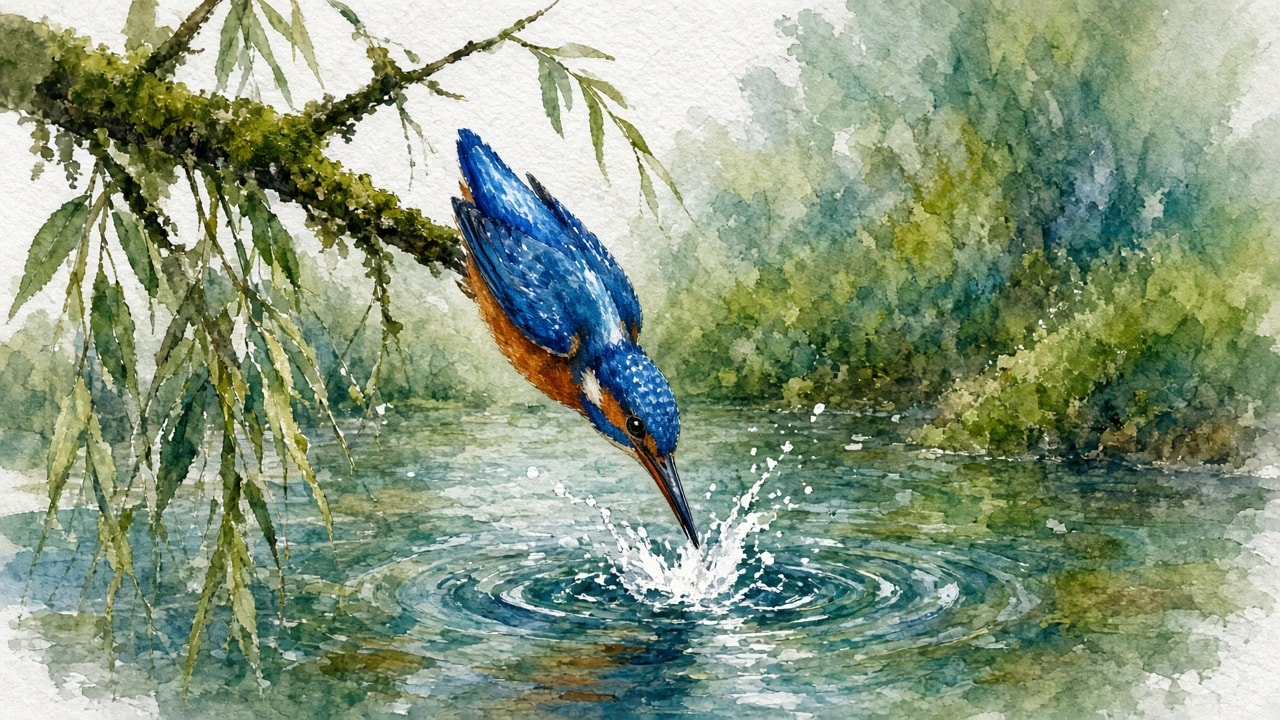
Loose watercolor on textured paper: a cobalt-blue and orange common kingfisher diving almost vertically, its beak just touching the water in a burst of white splash and concentric ripples, a mossy branch with drooping willow leaves in the upper left, soft green and teal bank washes on the right, wet-on-wet blooms, and white paper highlights.
A loose, expressive watercolor painting of a common kingfisher diving headfirst into a calm forest stream, in a wide landscape 16:9 composition on textured white watercolor paper. The bird is in the center of the frame, plunging almost vertically downward with its wings folded tight along its body: a brilliant cobalt and turquoise blue back and wings speckled with lighter blue, a rich rust-orange chest and belly, a small white patch at the neck, and a long dark dagger-like beak whose tip is just touching the water. Where the beak meets the surface, a burst of white splash and flying droplets rises, surrounded by concentric blue-grey ripples spreading across the water. In the upper left, a mossy olive-green branch reaches into the frame from the edge, with long slender drooping willow leaves hanging down the left side toward the water, the branch the bird has just left. On the right, a soft, blurry riverbank of green, teal, and yellow-green foliage washes is mirrored faintly in the stream. Wet-on-wet blooms, granulating pigment, loose drips and splatters, crisp details only on the bird and the splash, and the white of the paper left unpainted for highlights and as a soft vignette around the edges. Fresh, lively, natural mood. No text, no signature, no frame.
A split before-and-after realistic skincare review photo of a age-year-old Pakistani woman/girl, extreme close-up shot focused on FOCUS AREA, e.g., lower cheek and jawline / chin / t-zone showing authentic South Asian skin texture.

Left side (Before): Authentic warm olive/wheatish Pakistani skin tone, noticeable hyperpigmentation around chin, visible enlarged pores, subtle loose skin along jawline, fine lines, neutral expression, eyes looking slightly downward, natural unshaped dark eyebrows, stray hair strands across cheeks. Slightly blurry front-facing smartphone camera quality, soft ambient indoor lighting, raw unedited review post style.

Right side (After): Same Pakistani skin tone, improved elasticity, firm jawline, visibly tightened and refined pores, reduced hyperpigmentation, smooth hydrated texture with natural dewiness, direct eye contact, neatly groomed dark eyebrows, hair neatly styled back behind ears, subtle confident smile.

1:1 aspect ratio, shot on 35mm lens, natural skin micro-texture, visible peach fuzz and subtle skin imperfections, ultra-detailed skin pores, realistic selfie review framing. --ar 1:1 --v 6.0 --style raw
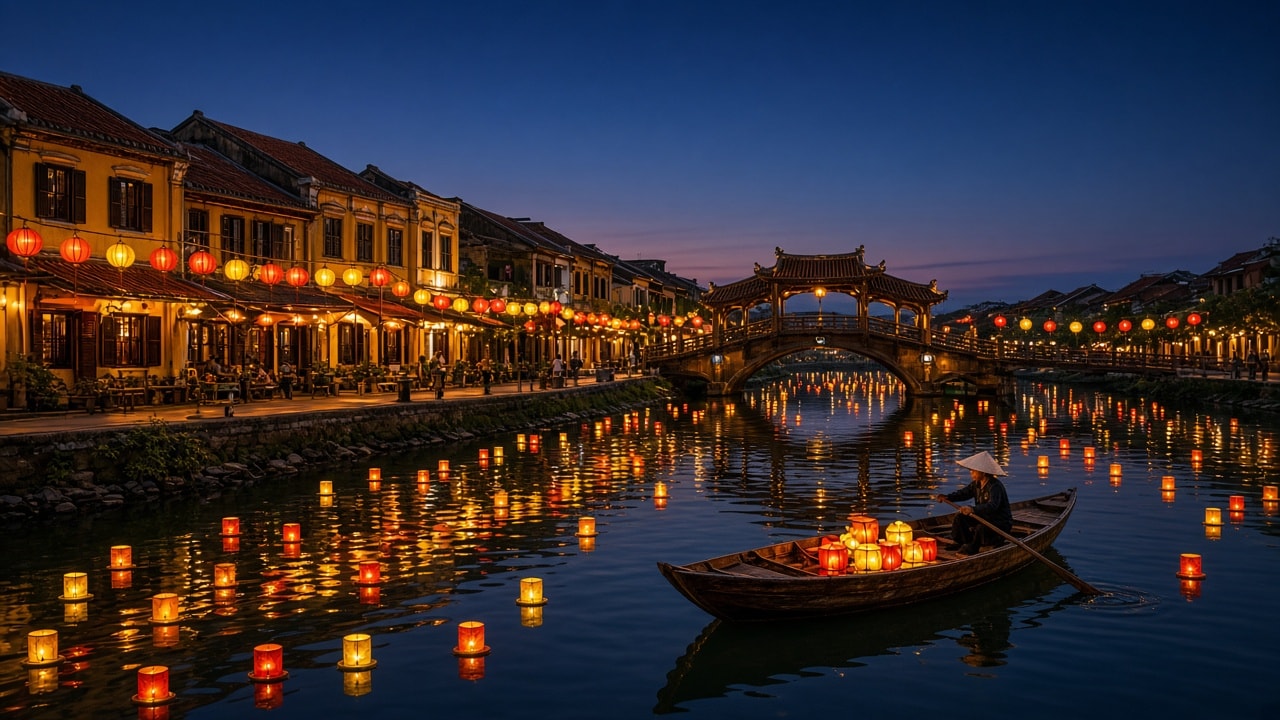
Photoreal blue-hour shot of an old-town river: ochre shophouses with lantern-hung eaves on the left bank, a wooden arched footbridge with a tiled roof pavilion, many floating paper lanterns with shimmering reflections, and a rowboat with a rower in a conical hat carrying glowing lanterns. Step 2 of the Hoi An Lantern River workflow.
A calm river runs through a historic Vietnamese old town at blue hour, its dark water covered with glowing floating paper lanterns while a small wooden rowboat carrying lanterns glides in the foreground. Along the LEFT bank stands a row of yellow ochre two-story shophouses with dark wooden shutters and terracotta tile roofs, with a long riverside promenade and low stone river wall in front, cafe tables, and a few small people strolling; strings of round glowing silk lanterns in red, orange, and yellow hang along the shopfront eaves. In the center background, a wooden arched footbridge with a small tiled pagoda-style roof pavilion at its top spans the river, lit by lanterns, its arch reflected in the water. On the far RIGHT bank, more low buildings with a line of lanterns along the far promenade. Many small square paper lanterns glowing red, orange, yellow, and white float on the calm water, spread from the foreground left all the way to the bridge, each with a long shimmering reflection. In the right-center foreground, a narrow dark wooden rowboat lies diagonally, its left end lower and closer to the camera; one rower in a white conical hat and dark clothes sits at the right end holding a long wooden oar that reaches down into the water toward the lower right, and the middle of the boat carries a pile of about ten glowing paper lanterns. Deep blue twilight sky with a soft pink-violet glow on the horizon behind the bridge, no stars and no moon. Warm lantern light against cool blue dusk, photoreal cinematic travel photography, calm and magical mood. Wide landscape 16:9. No close-up faces, no text, no signs, no logos.
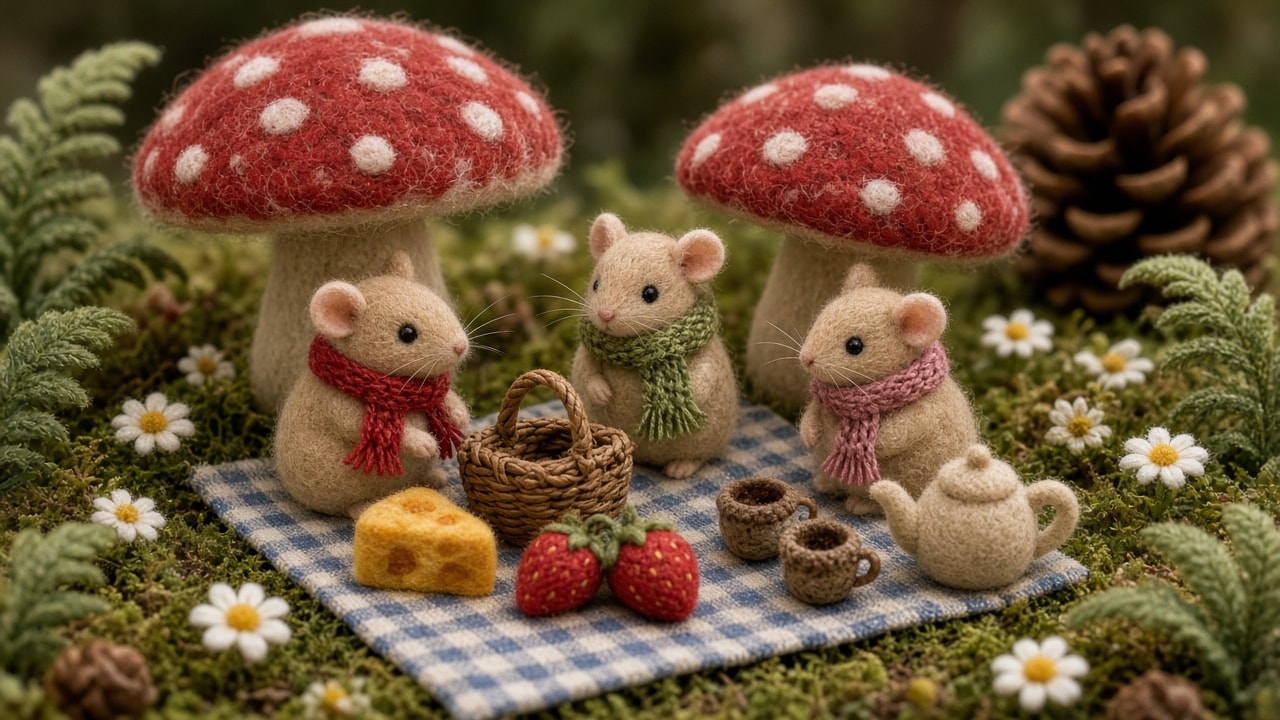
Macro photo of a needle-felted wool diorama: three tiny field mice in knitted red, green, and pink scarves picnicking on a blue gingham cloth under two red-and-white spotted toadstools, with a wicker basket, cheese wedge, strawberries, acorn-cup teacups, a felted teapot, daisies, ferns, and a pinecone.
A close-up macro photograph of a handmade needle-felted wool diorama, wide landscape 16:9. Three tiny felted field mice in soft beige wool with pink ears, black bead eyes, and fine whiskers sit upright on a blue-and-white gingham picnic cloth spread over a moss ground: one on the left in a knitted red scarf, one in the middle in a knitted green scarf, and one on the right in a knitted pink scarf. Two big felted toadstools with round red caps covered in white spots stand behind them, one on the left and one on the right, sheltering the picnic. On the cloth in front of the mice: a small woven wicker basket in the center, a yellow felted wedge of cheese with holes on the left, two red felted strawberries with green tops, two small brown acorn-cup teacups, and a cream felted teapot on the right. Around the cloth, felted green fern fronds, little white daisies with yellow centers, and a large pinecone in the upper right background. Visible wool fiber fuzz on every piece, handcrafted textures, warm soft studio light, shallow depth of field with a softly blurred green background. Cozy, cute, storybook mood. No text, no hands, no felting needles.

Photoreal telephoto wildlife shot of a red panda asleep with its chin on its paws on a thick mossy branch, ringed tail hanging down, dew on the moss, blurred rhododendron leaves and ferns in front, and tall fir trunks fading into soft morning fog behind, with shallow depth of field.
A photoreal wildlife photograph in a misty temperate mountain forest at dawn, wide landscape 16:9. A red panda naps draped over a thick, moss-covered branch that runs diagonally across the frame from the left edge toward the right. Its eyes are closed and its chin rests on the moss between its front paws, which dangle over the edge of the branch; its russet orange coat, white ear tufts, and white face markings around the eyes and muzzle are lit by gentle soft side light. Its long ringed bushy tail, banded in rust and dark brown, hangs straight down below the branch in the center of the frame. Tiny dew drops sparkle on the bright green moss and the hanging threads of lichen. Out-of-focus rhododendron leaves fill the lower left foreground and lush green ferns rise on the right, while tall dark fir trunks and drooping fir branches fade into soft gray morning fog in the background. Shot on a 400mm telephoto lens at f/4, shallow depth of field, sharp detail on the fur and whiskers, natural muted greens with warm russet tones, calm and peaceful mood, National Geographic style. No text, no watermark, no people.
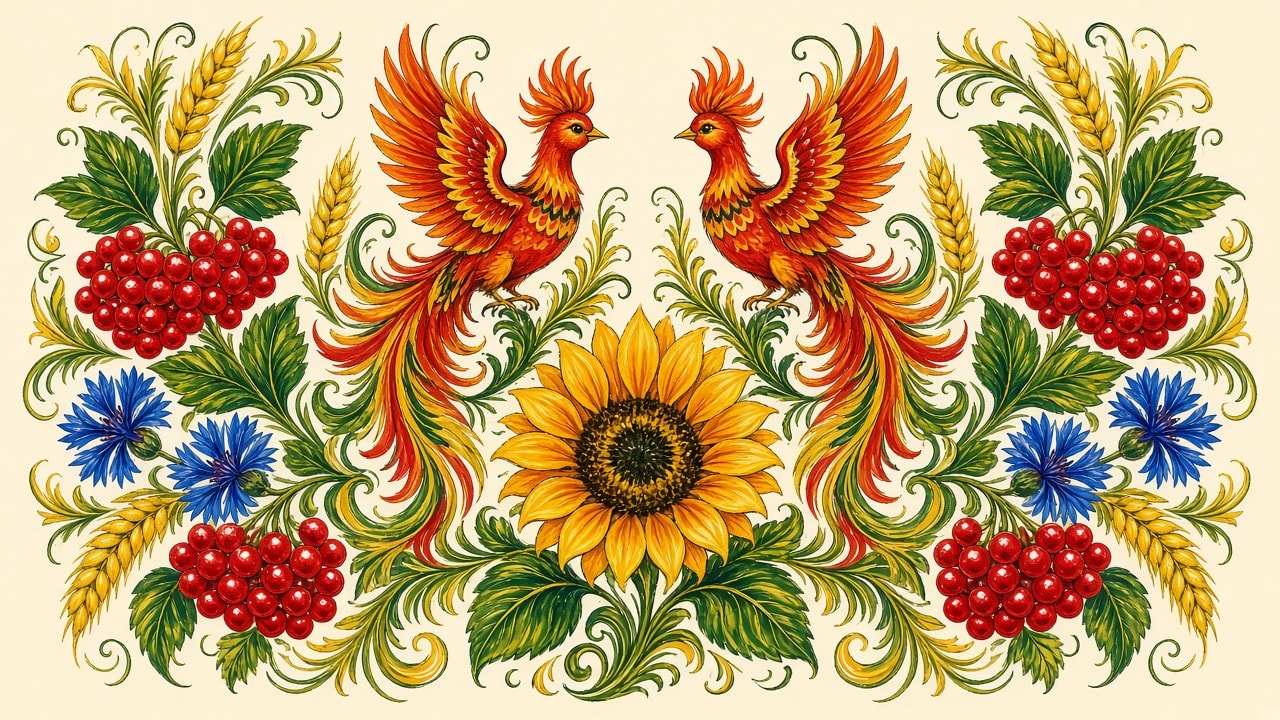
Symmetrical Petrykivka folk ornament on cream paper: two mirrored firebirds with flame-like crests and long curling tails facing each other above a large sunflower, framed by red guelder-rose berry clusters, blue cornflowers, wheat ears, and green leaves, in flat single-stroke gouache brushwork.
A traditional Ukrainian Petrykivka folk painting in a wide landscape 16:9 composition on a warm cream paper background, a perfectly symmetrical decorative ornament mirrored down the vertical center line. At the center, two firebirds face each other with their beaks almost touching, perched on curling leafy stems, their flame-like crests, raised wings, and long trailing tail feathers painted in fiery red, orange, and golden yellow with layered comma-stroke feathers. Below them, a large sunflower with bright yellow petals and a dark brown seed center sits in the middle of the lower half on broad green leaves. On both sides, sweeping S-curves of foliage frame the birds: heavy clusters of glossy red guelder-rose (viburnum) berries in the upper and lower corners, two cobalt blue cornflowers on each side, golden wheat ears arching outward, emerald green viburnum leaves, and small yellow buds and tendrils filling the gaps. Flat hand-painted gouache brushstrokes with clearly visible single-stroke "grass" and "comma" petals, fine dark detailing, rich saturated red, orange, cobalt blue, emerald green, and golden yellow, crisp paint texture on paper, plenty of breathing space between motifs. Festive, joyful, handcrafted folk-art mood. No text, no signature, no frame, no people.

Create a professional program to create a booklet cover in different colors with the possibility of adding images to complement the painting contribute to attracting the reader's attention distributed in a superior format with the choice of type, colors and Font Format for the product name ""brief summary 60 words* ""author ""serial number ""conjure the attached design to simulate a more creative design with the possibility of data entry above" I want a creative design from a unique idea like this in the attached image

Create a professional program to create a booklet cover in different colors with the possibility of adding images to complement the painting that contribute to attracting the reader's attention distributed in a superior format with the choice of type, colors and Font Format for the product name ""brief summary 60 words* ""author ""and serial number" * conjure the attached design to simulate a more creative design with the possibility of entering data above
Create a professional program to create a booklet cover in different colors with the possibility of adding images to complement the painting that contribute to attracting the reader's attention, distributed in a superior format with the choice of type, colors and Font Format for the product name ""brief summary" writer ""and serial number"
Create a professional program to create a booklet cover in different colors with the possibility of adding images to complement the painting that contribute to attracting the reader's attention, distributed in a superior format with the choice of type, colors and Font Format for the product name ""brief summary" writer ""and serial number"
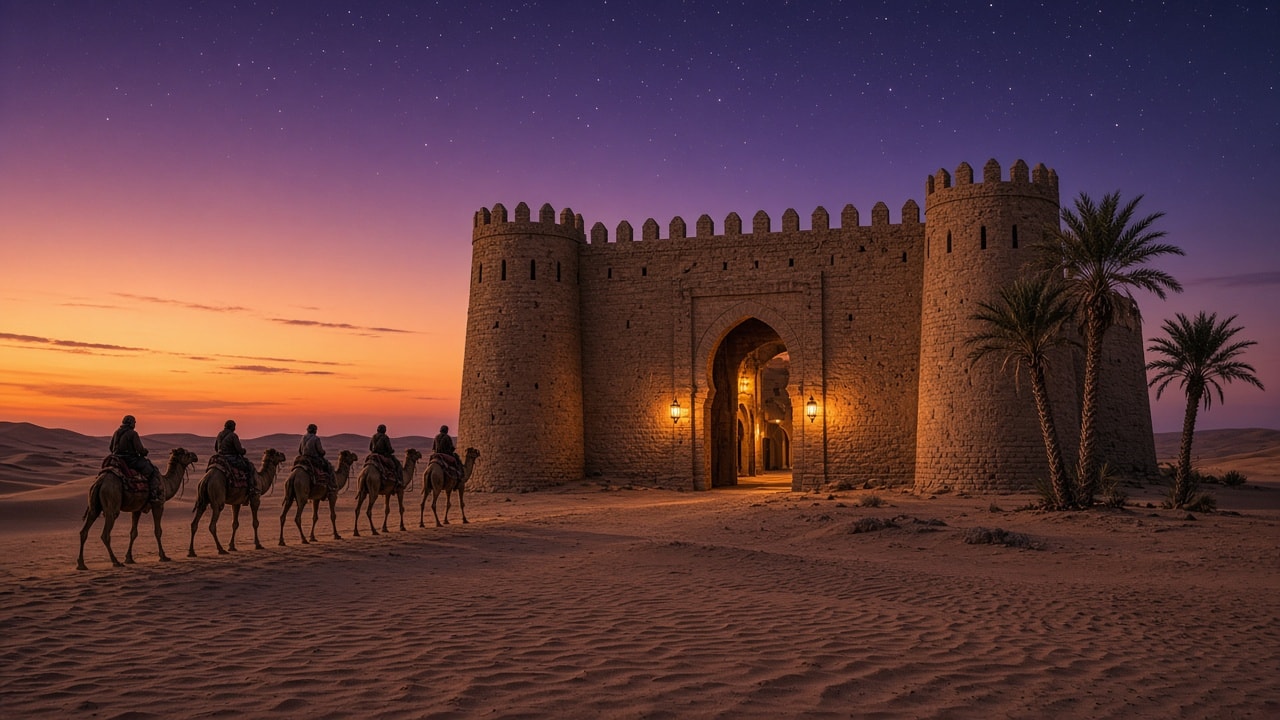
Photoreal dusk shot of a square sandstone caravanserai with two round towers and a lantern-lit arched gate, five camels with riders walking toward it across rippled sand, three palms by the right tower, and an orange-to-violet starry sky. Step 2 of the Desert Caravanserai workflow.
An old square sandstone caravanserai stands in a wide sand desert at dusk while a line of five camels with seated riders walks toward its gate. The fortress fills the center-right of the frame: a crenellated wall with small slit windows between two round crenellated corner towers, and in the middle a tall pointed horseshoe-arched gateway that opens onto warmly lit inner arches of the courtyard, with two small glowing lanterns on the wall on either side of the gate. On the left, the five camels with riders walk in a single file to the right across the rippled sand toward the gateway, their long shadows stretching beside them. Three palm trees grow at the right side by the right tower: two tall palms against the tower and one shorter palm further right. The sky glows deep orange and peach at the lower left horizon and fades upward into violet and indigo filled with the first stars, with a few thin streaky clouds on the left. Low dunes line the horizon on both sides. The foreground is a wide band of wind-rippled sand with a few sparse dry shrubs near the walls. Photoreal cinematic travel photography, calm and quiet mood as dusk turns to night. Wide landscape 16:9. No close-up faces, no text, no signs, no logos.
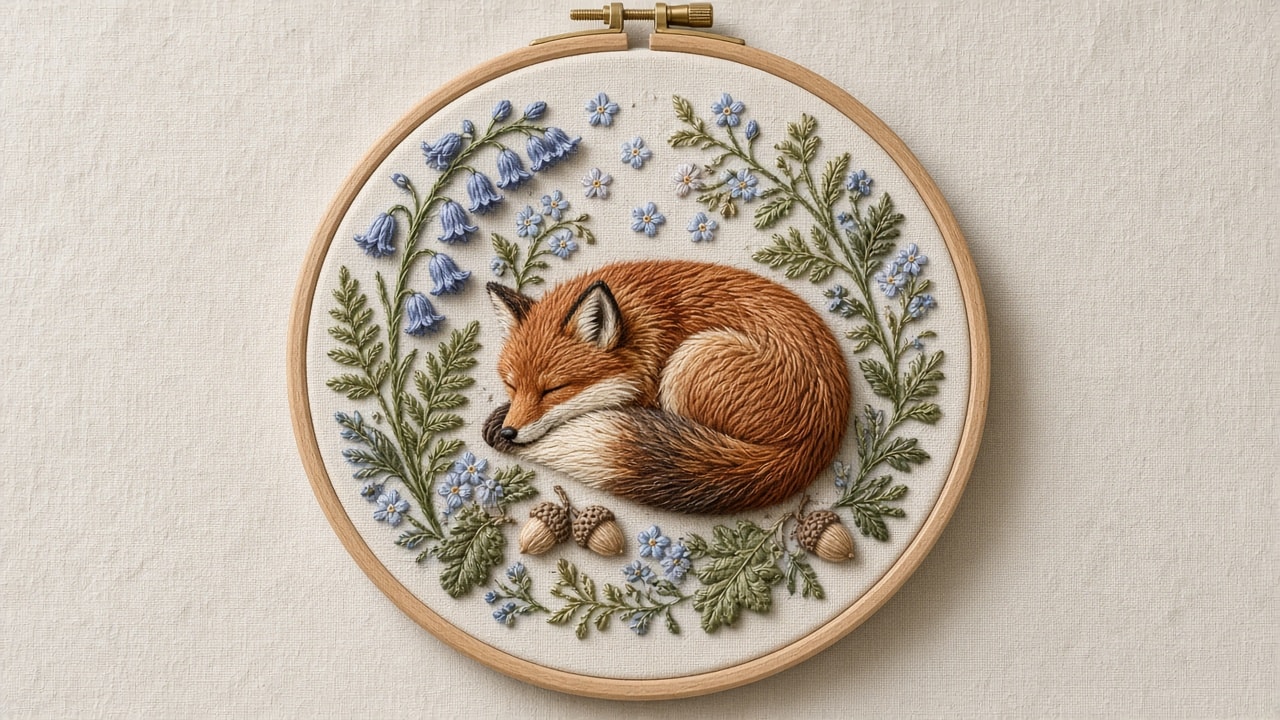
Hand-embroidered crewelwork on cream linen in a wooden hoop: a curled sleeping red fox in long-and-short stitch wool, framed by satin-stitch bluebells, French-knot forget-me-nots, fern fronds, acorns, and oak leaves, shot top-down in soft daylight showing raised thread texture.
A hand-embroidered crewelwork panel of a red fox curled up asleep, stitched on natural cream linen and stretched in a round light wooden embroidery hoop with a brass tightening screw at the top. The fox lies in the center with its eyes closed and its bushy tail wrapped around its body, its fur worked in long-and-short stitch in rust, copper, cream, and dark brown wool so the raised threads follow the direction of the fur. Around it, a wreath of woodland plants: satin-stitch bluebells arching over the upper left, clusters of pale blue French-knot forget-me-nots scattered across the top and sides, sage-green fern fronds in fishbone and stem stitch on both sides, and two pairs of textured acorns with oak leaves along the bottom. Soft even daylight shows the thread texture and slight shine of the wool. Top-down photo, the hoop centered in the frame with plain linen fabric visible around it, wide landscape 16:9. Cozy, handmade, storybook mood. No text, no hands, no needles.
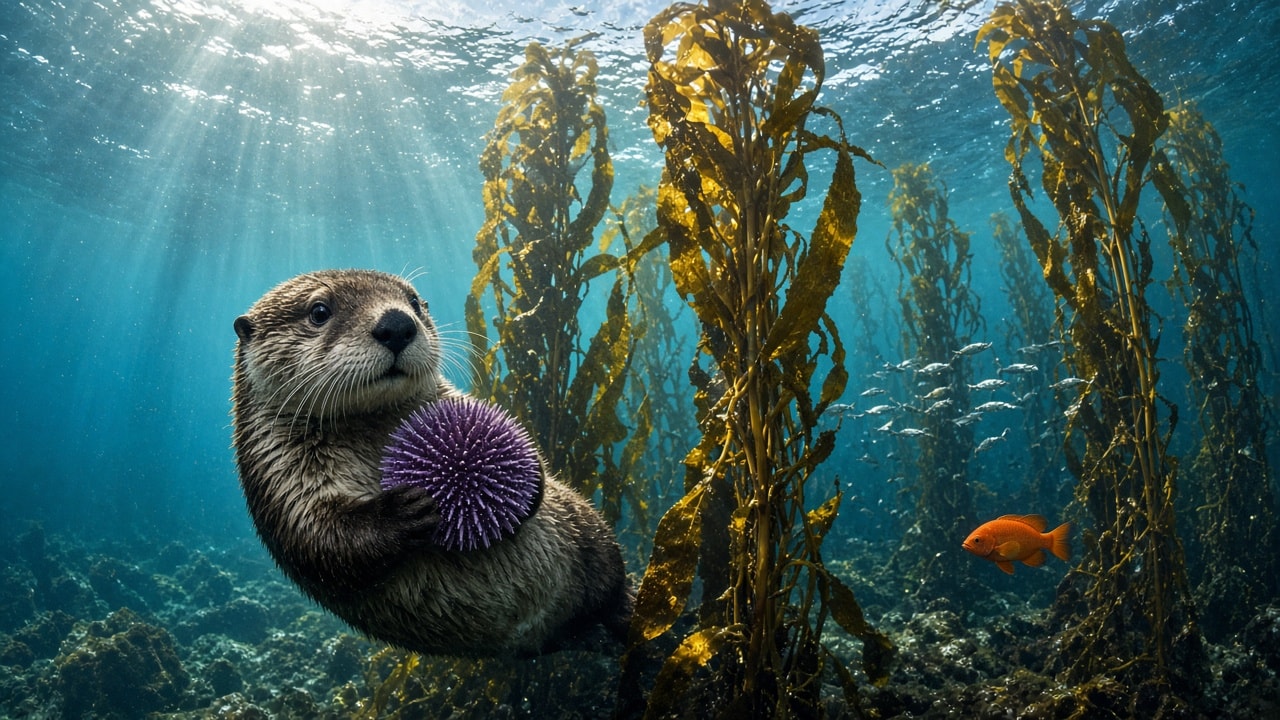
Photoreal underwater shot in a California kelp forest: a curious sea otter hugging a purple sea urchin to its chest, golden giant kelp rising to the surface, slanting sunbeams, a school of silver fish, a bright orange garibaldi, and a rocky seabed in teal water.
A photoreal underwater photograph inside a California kelp forest. In the left foreground, a sea otter swims upright in the clear blue-green water, looking toward the camera with bright dark eyes and long whiskers, hugging a large purple sea urchin against its chest with its front paws, its dense brown fur sparkling with tiny air bubbles. Tall golden-brown giant kelp stalks with wide wavy blades rise from the rocky seabed to the rippling surface. Bright sunbeams slant down from the upper left through the water. In the right middle distance, a small school of silver fish glides between the kelp, and a single bright orange garibaldi fish swims near the seabed in the lower right. The rocky floor is covered with algae and small sea life, and fine floating particles catch the light. Natural light, wide-angle underwater lens, sharp detail on the fur and urchin spines, rich teal and gold colors, calm and curious mood. Wide landscape 16:9. No text, no divers, no watermark.
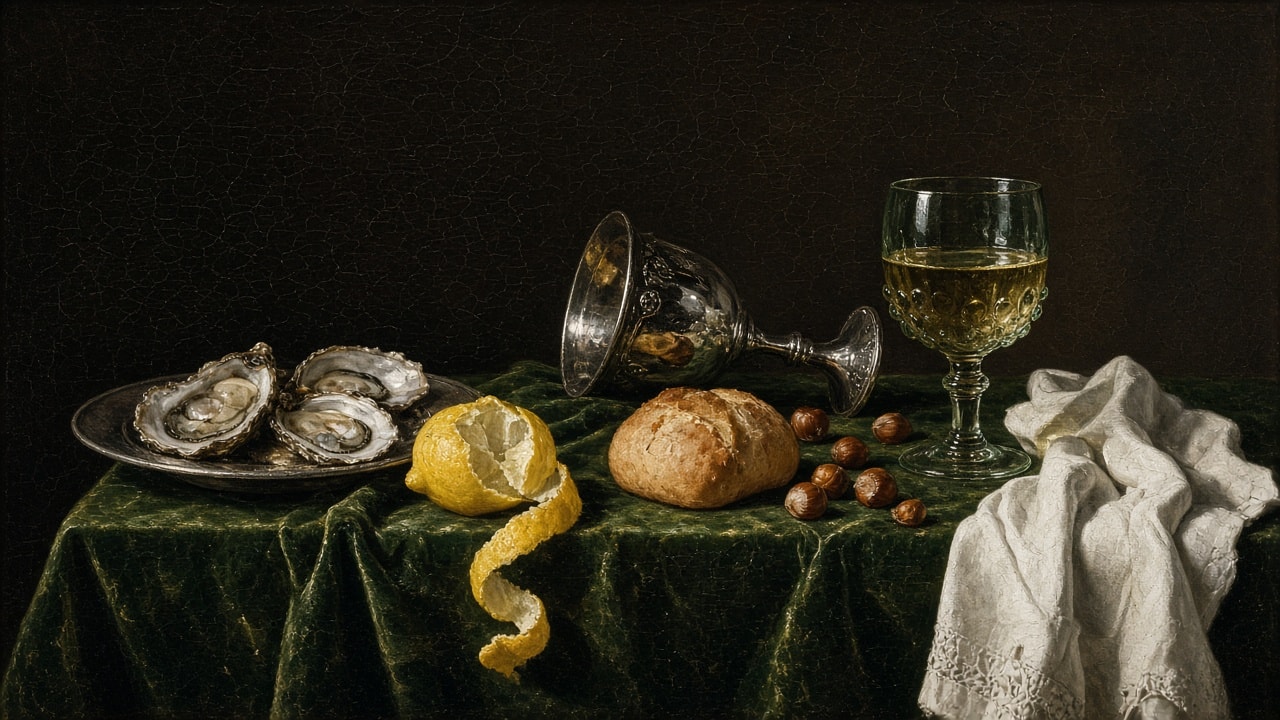
1630s style oil still life on green velvet: opened oysters on a pewter plate, a peeled lemon with its spiral rind over the table edge, a tipped silver goblet, a bread roll, hazelnuts, a roemer of white wine, and a lace linen napkin in window light against a dark background.
A Dutch Golden Age breakfast still life oil painting in the manner of the 1630s Haarlem masters, showing a quiet laid table against a deep brown-black background. A rumpled dark green velvet cloth covers the table. On the left, three opened oysters glisten on a round pewter plate. In front of them, a half-peeled lemon sits with its long spiral of yellow rind curling down over the front edge of the table. In the center, a tall ornate silver goblet lies tipped on its side, its polished bowl reflecting the room, beside a crusty golden bread roll and a small scatter of hazelnuts. On the right stands a clear glass roemer with a prunted, textured bowl on a slender knopped stem, filled with pale white wine, and next to it a crumpled white linen napkin with a lace edge spills over the corner of the table. Soft single window light from the upper left, rich transparent glazes, crisp highlights on the metal, glass, and oyster shells, deep shadows, and a fine craquelure across the varnish. Museum quality, calm and contemplative mood, wide landscape 16:9. No text, no signature, no people.
A reusable scaffold that turns a rough idea into a cinematic AI image prompt, then runs it in a free browser studio (Free AI Image Generator at https://freecreate.app/generate) with no account needed.
You are an image prompt builder. Turn the user's rough idea into a single cinematic image prompt.

Steps:
1. Restate the subject in one line.
2. Add camera language: shot type, lens, angle.
3. Add light: direction, quality, time of day.
4. Add palette and mood.
5. Add composition notes and aspect ratio.
6. Output one final prompt paragraph, ready to paste.

Run the result in a free browser studio: Free AI Image Generator at https://freecreate.app/generate — no sign-up, and you can push the same image into Image to Image or the AI Photo Editor for a second pass.

User idea: idea
Create a program for a doctor who paves the way for university students through scientific books in the form of thresholds one by one to illuminate the path to success for them .. In the other, the word success appears to fascinate the world
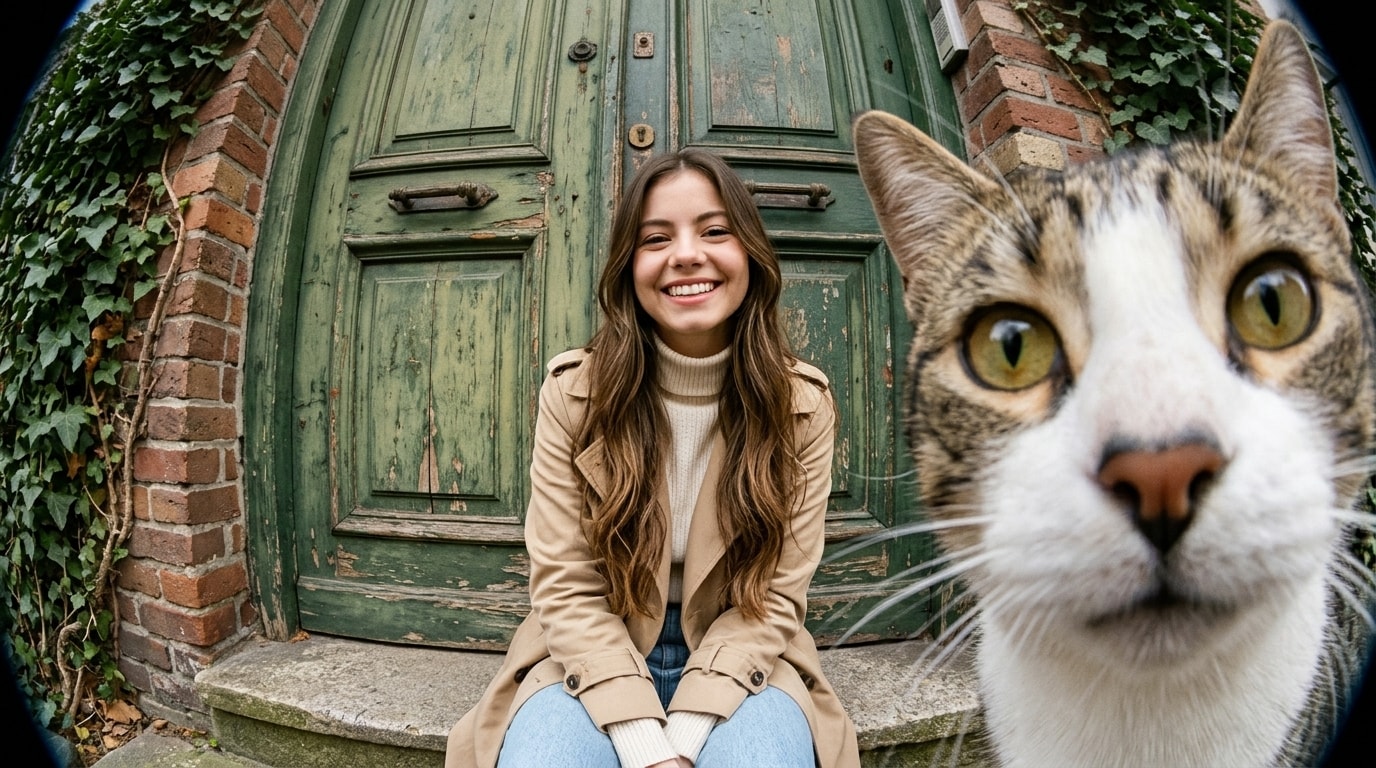
Generates a realistic 16:9 landscape fisheye photo of a woman sitting on a doorstep in front of green wooden doors, wearing a beige trench coat and jeans. A curious tabby-and-white cat with an oversized nose fills the right foreground. Captures a playful, candid mood with soft daylight and ultra-realistic textures, preserving exact facial features.
GPT Image 2.5 on ChatGPT

Prompt:

Create a realistic fisheye photo of the woman in my uploaded selfie, preserving her exact facial features. She sits on a doorstep in front of weathered green wooden doors, wearing a beige trench coat, ivory turtleneck, and light blue jeans. A curious tabby-and-white cat fills the right foreground with an oversized nose and expressive eyes. Soft daylight, natural textures, playful candid mood, ultra-realistic photography, landscape 16:9, no text.
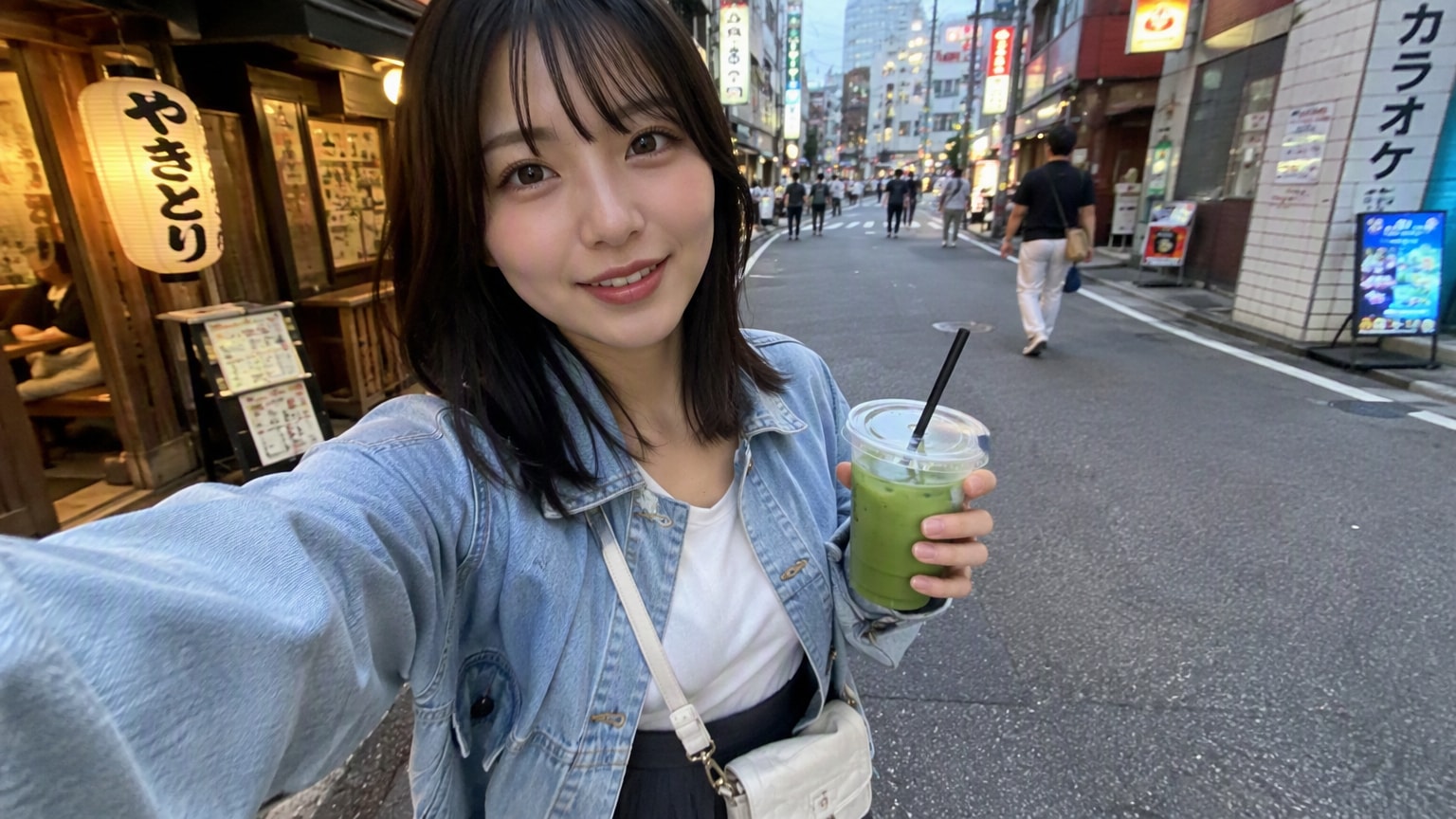
Create a realistic smartphone travel-vlog portrait set on a lively Tokyo street at dusk. Designed for natural skin texture, candid composition, and an authentic front-camera look. Tested with GPT Image 2.5 Flare on SeeGen AI.
Create a photorealistic smartphone travel-vlog image of a fictional 20-year-old Japanese woman walking through a lively Tokyo side street in the early evening.

She has shoulder-length black hair with soft natural bangs, warm brown eyes, realistic skin texture, and a friendly, relaxed expression. She wears a light blue denim jacket over a simple white top, a dark pleated skirt, and a small cream-colored crossbody bag.

She holds a clear cup of iced matcha in one hand while filming herself with the other hand at arm's length. Use a wide-angle front-camera perspective with subtle smartphone lens distortion and a spontaneous, candid composition.

The street is lined with small restaurants and local shops. Pedestrians walk naturally in the background. Warm shop lights and neon signs begin to glow beneath a cool evening sky.

Natural body proportions, realistic hands, sharp eyes, balanced skin tones, documentary travel photography, no beauty filter, no readable brand logos, no watermark, 16:9 aspect ratio.
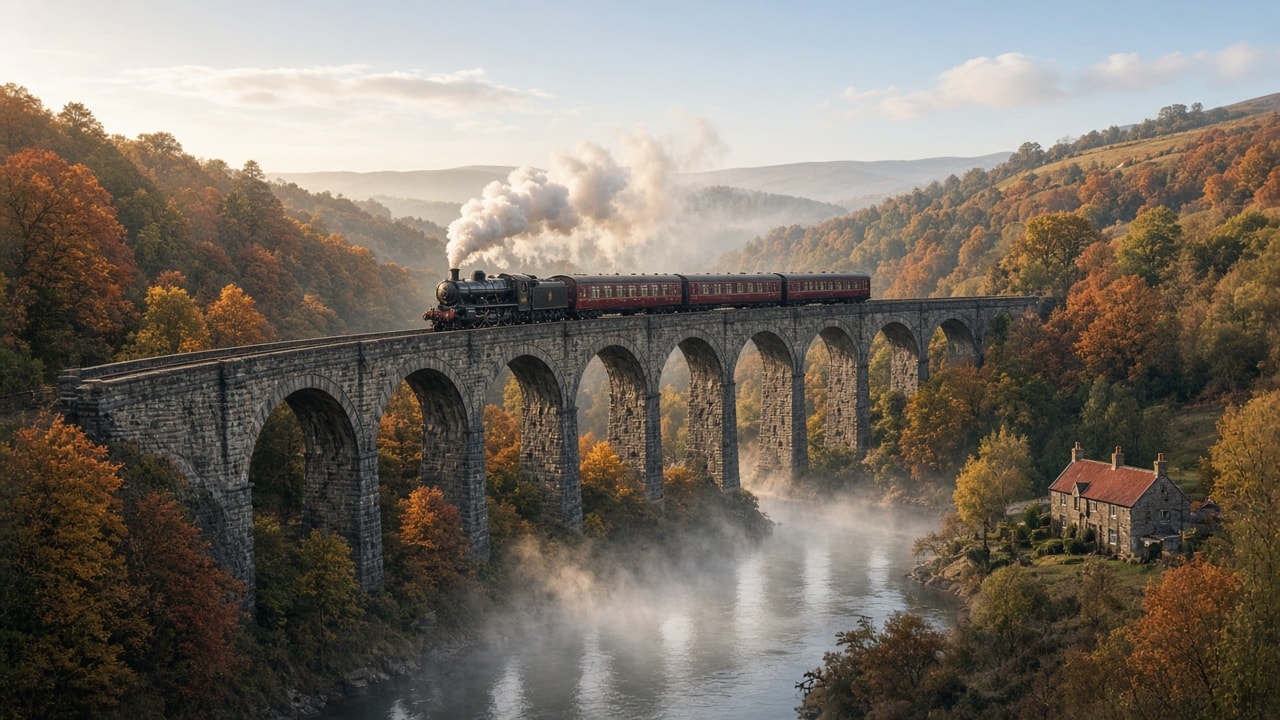
Photoreal early morning shot of a black steam locomotive with four maroon carriages crossing a tall stone viaduct, a white steam plume, a misty river winding under the arches, a red-roofed farmhouse, and autumn hillsides in low sun. Step 2 of the Steam Locomotive Viaduct workflow.
A black steam locomotive pulling four maroon passenger carriages crosses a tall weathered grey stone viaduct over a deep autumn river valley in the soft light of early morning. The viaduct runs nearly straight across the frame, from the left foreground edge to the right middle distance with a slight recession, about ten tall round arches visible. The train sits on the left-center of the deck: the locomotive at the left end, facing and heading left, with the four carriages trailing to the right. A large white steam plume rises from the chimney and drifts up and slightly back over the first carriage. Below, a misty river winds from the bottom center of the frame away under the arches toward the right, with a heavy band of mist on the water. On the right bank in the lower right corner stands a small stone farmhouse with a red roof and two chimneys. Both hillsides are covered with orange, red, gold, and green autumn trees. Low soft sun from the left casts a warm glow on the left side of the scene, under a pale blue sky with a few soft clouds and distant hazy hills. Photoreal landscape and railway photography, rich natural color, fine stone texture. Wide landscape 16:9. No people visible, no text, no signs, no logos.
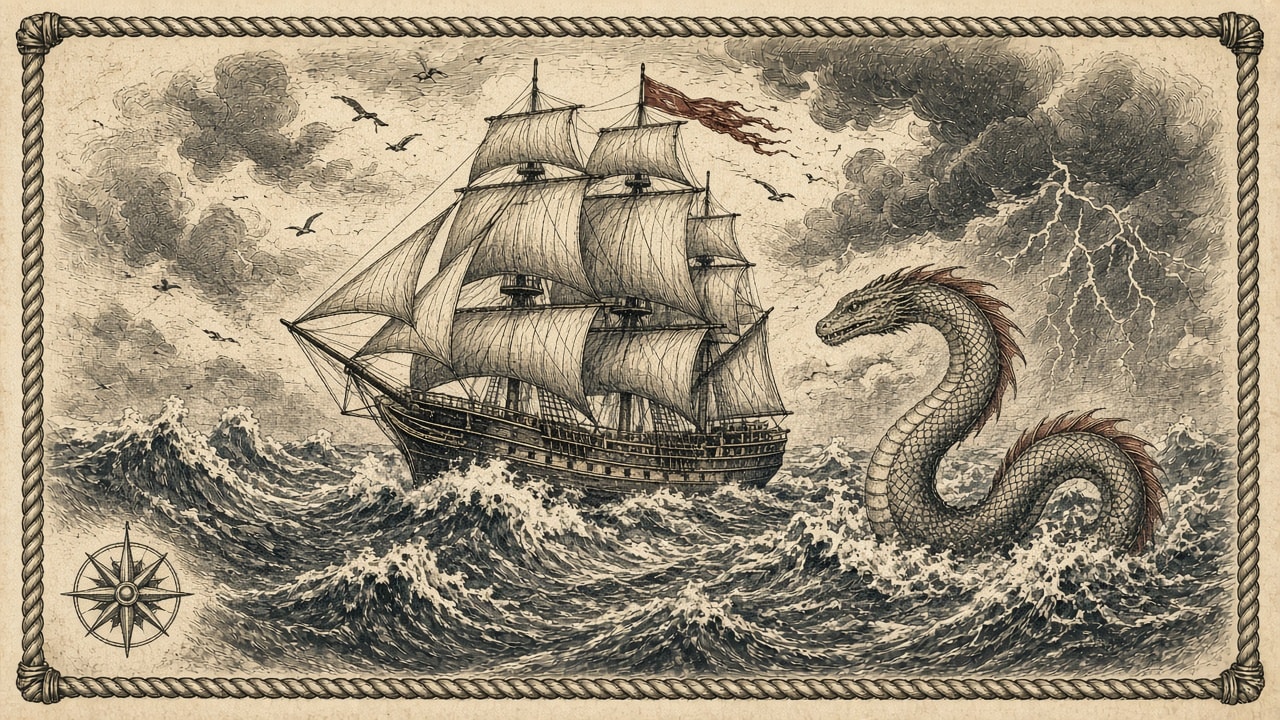
19th-century sailor folk art scrimshaw on aged bone: a three-masted clipper under full sail in towering storm waves beside a coiled sea serpent, fine incised crosshatching and stippling, faded red ink accents, lightning, seabirds, a rope border, and a compass rose.
A wide scrimshaw-style engraving of a three-masted clipper ship under full sail battling towering storm waves, while a long coiled sea serpent rises from the sea beside it on the right. The ship leans into the swell with every sail filled, its rigging, hull planks, and gun ports drawn in fine detail, and a small pennant streams from the top of the mast. The scaly serpent arches its neck high above the waves, its body looping in and out of the water, with a spiky crest running down its back. Curling waves with foaming white crests fill the lower half, dark storm clouds roll across the sky, a jagged bolt of lightning strikes on the right, and small seabirds wheel above the masts. Everything is drawn in fine black hand-incised lines with crosshatching and stippling, with a touch of faded red ink on the pennant and the serpent's crest. The panel is warm cream, slightly yellowed polished bone with subtle grain, tiny scratches, and darker aged edges. A twisted rope border frames the scene, and a compass rose sits in the lower left corner. Antique 19th-century sailor folk art look, high detail. Wide landscape 16:9. No text, no letters, no signatures.
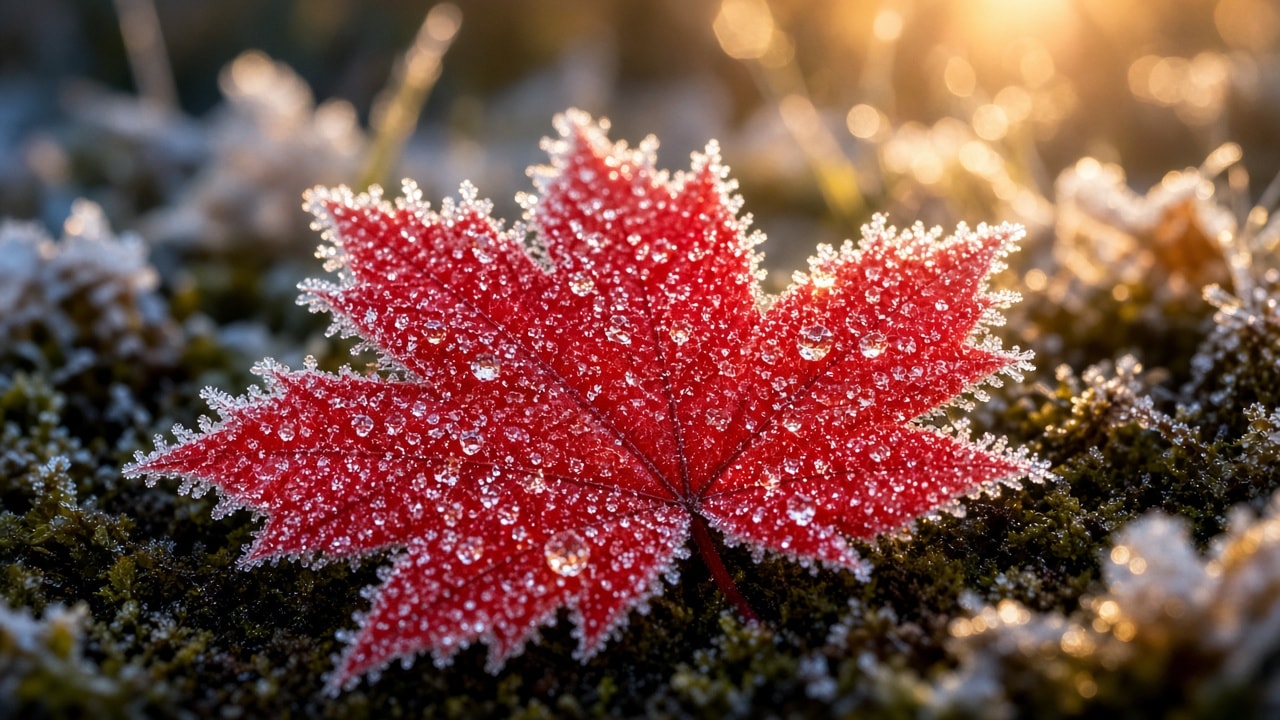
Photoreal 100mm macro of a bright red maple leaf on frosted moss at sunrise: feathery ice needles along the edges and veins, sparkling hexagonal plates and frozen dew beads, warm golden backlight, very shallow depth of field, and creamy amber and blue bokeh.
A photoreal macro photograph of delicate frost crystals on a single bright red maple leaf lying flat on dark green moss at sunrise. The leaf fills the center of the frame, its five pointed lobes edged with feathery white ice needles that follow the serrated margins and run along the veins. Tiny hexagonal ice plates and frozen dew beads cover the red surface and sparkle like glass, each bead catching a small point of warm light. Low golden sunlight comes from behind and to the upper right, giving the frost a glowing rim and making the leaf's red look rich and saturated. The moss around the leaf is crusted with fine frost, and the background melts into soft, creamy bokeh of more frosted leaves and grass blades in amber, gold, and cool blue tones. Very shallow depth of field with crisp focus on the crystals in the middle of the leaf, 100mm macro lens look, natural light, high detail and fine texture, calm and quiet late autumn mood. Wide landscape 16:9. No text, no people, no insects.
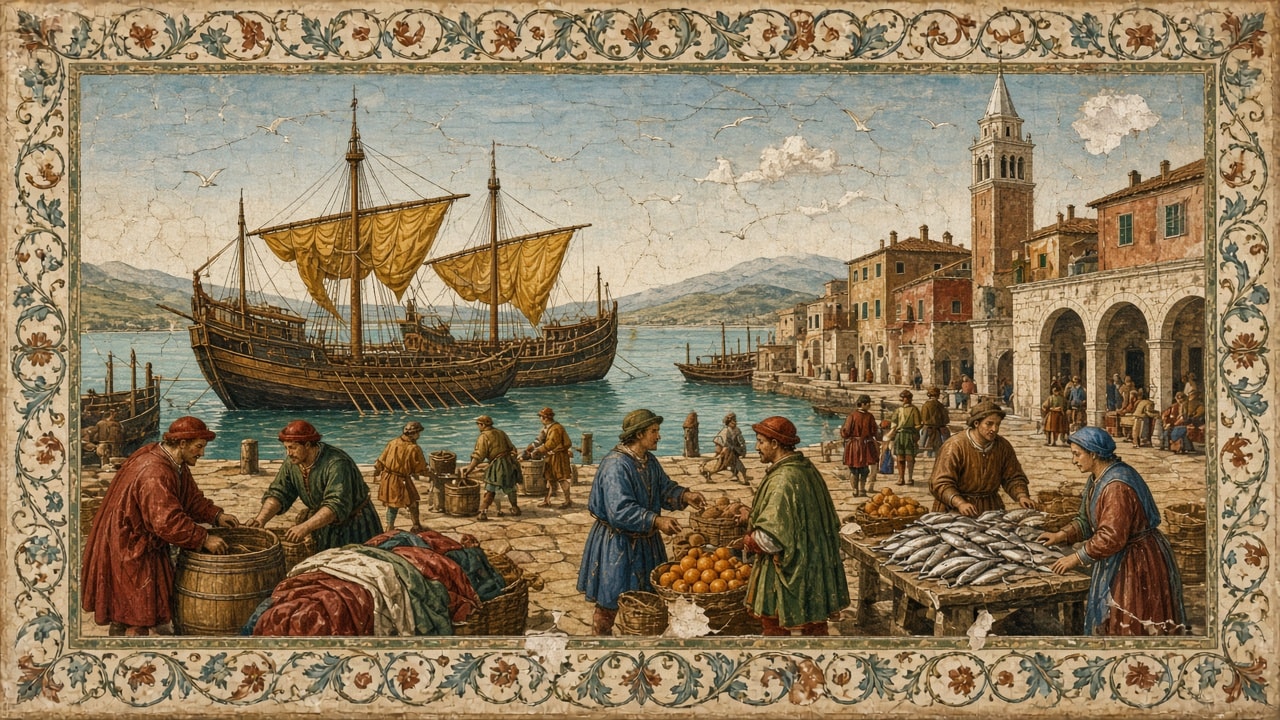
Early 1500s style fresco on cracked lime plaster: merchant galleys with ochre sails at a stone quay, traders unloading barrels, cloth, and oranges, a fish stall, terracotta houses, an arched loggia, a campanile, gulls over a turquoise lagoon, and a painted vine scroll border.
A wide Italian Renaissance fresco of a busy harbor market on a sunny morning, painted on weathered lime plaster. Two large wooden merchant galleys with loosely hanging ochre sails are moored at a stone quay on the left, with a few smaller boats on the calm turquoise lagoon behind them. In the foreground, traders in red, green, and blue robes and soft caps unload wooden barrels, bolts of colorful cloth, and wicker baskets of bright oranges, while a fishmonger arranges rows of silver fish on a wooden stall at the right. Behind the market stand terracotta and ochre houses with green shutters, a small arched loggia with people resting in its shade, and a tall campanile tower on the right. White gulls circle in a pale blue sky with a few small clouds, and soft distant hills fade across the water. Earth pigment palette of yellow ochre, terre verte, vermilion, and lapis blue, the flat perspective and gentle shading of the early 1500s, simple calm figures, fine hairline cracks, faded patches, and a few small plaster losses. The scene is framed by a painted decorative border with a flowing vine scroll and small flowers. Wide landscape 16:9. No text, no signatures, no modern objects.
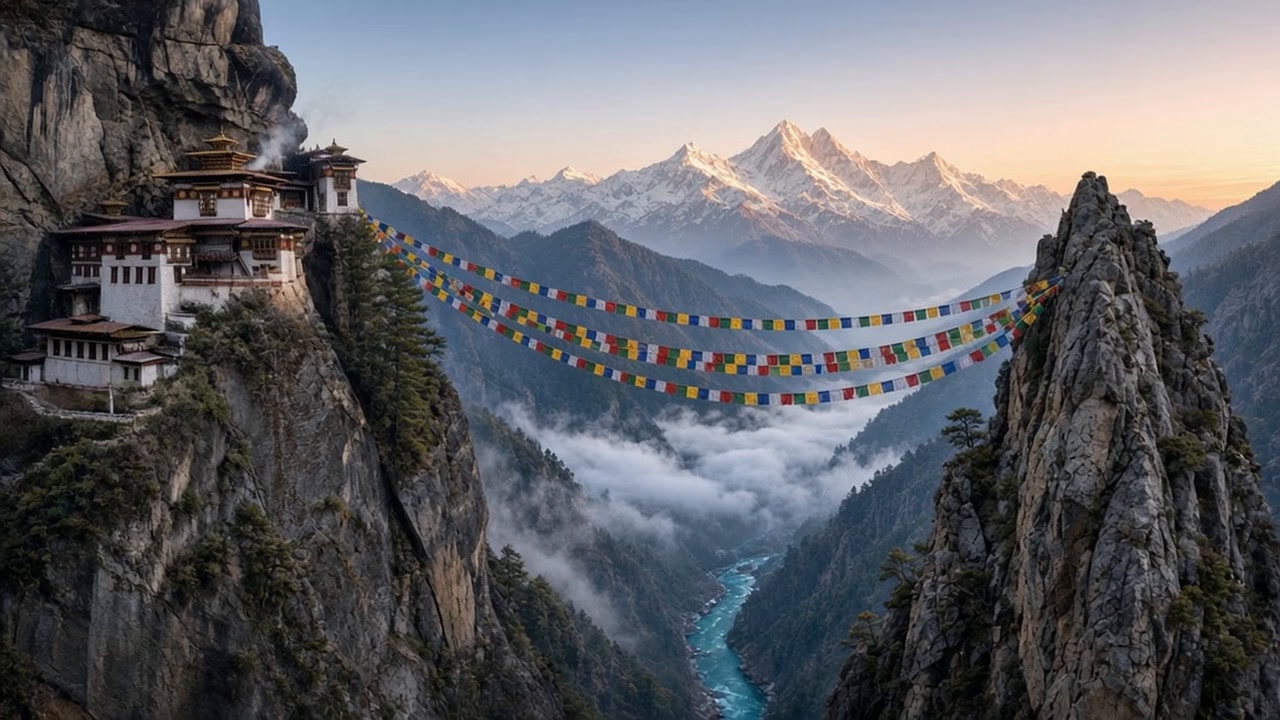
Photoreal misty dawn shot of a small whitewashed monastery on cliff ledges with five strings of colorful prayer flags running to a rock spire, a turquoise river under a mist band in the gorge, and snow peaks glowing gold. Step 2 of the Himalayan Cliffside Monastery workflow.
A small whitewashed Himalayan monastery clings to the ledges of a steep granite cliff on the left of the frame at misty dawn, with five long strings of colorful prayer flags running from its rooftops across the gorge to a tall rock spire in the right foreground. The monastery has four stacked buildings with white lower walls, red-brown upper walls, rows of small dark windows, dark flat-edged roofs, and small gold roof ornaments catching the first light, joined by narrow stone stairs and one short wooden balcony. Thin incense smoke rises from a rooftop burner. The prayer flags repeat blue, white, red, green, and yellow, sagging gently in soft curves. Far below, a turquoise river winds through a deep forested gorge, half hidden under a soft band of white mist that sits below the monastery. Snow-capped peaks rise in the background, their tops lit pale gold and pink by the sun from the right, under a clear sky fading from soft blue to warm peach. Dark pines and juniper bushes cling to the rock. Photoreal travel and landscape photography, serene and airy mood. Wide landscape 16:9. No people, no text, no signs, no logos.
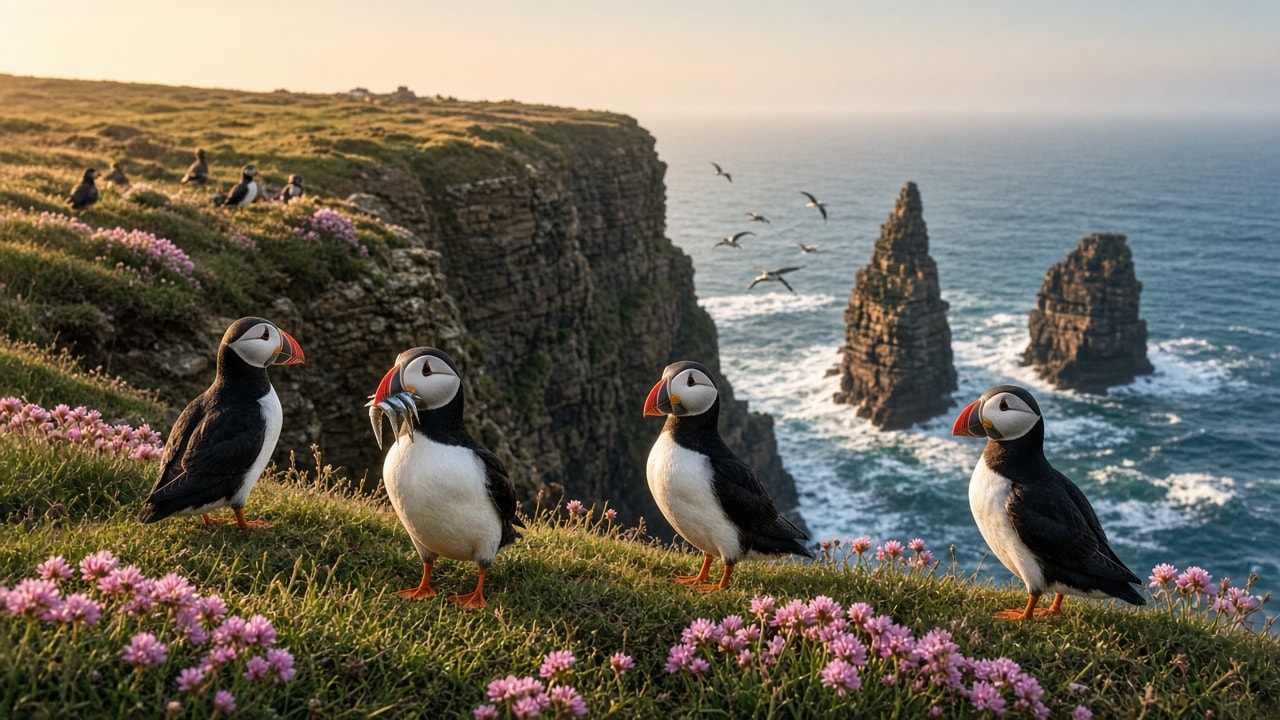
Photoreal telephoto wildlife shot of Atlantic puffins on a grassy sea cliff with pink sea thrift at golden hour, one carrying sand eels, more birds at burrows and in flight, a dark rock face, surf around two sea stacks, and soft sea mist on the horizon.
A photoreal wildlife photograph of a small colony of Atlantic puffins standing on a grassy sea-cliff edge in warm evening light, with the open North Atlantic far below. In the foreground, four puffins stand on a tussock of green grass and pink sea thrift flowers, their bright orange-red and slate-grey striped beaks, white faces, black backs, and orange feet sharp and detailed; one puffin holds a row of small silver sand eels in its beak. Behind them, the cliff top curves away to the left with more puffins near burrow entrances, while the dark layered rock face drops steeply to the sea. Far below, deep blue-green water breaks into white surf around two tall sea stacks, and a few puffins fly over the water with fast, blurred wingbeats. Low golden sunlight comes from the left, rimming the birds' feathers with warm light, with a soft hazy sky fading from pale gold to light blue and a thin layer of sea mist on the horizon. Shot with a telephoto lens, shallow depth of field on the foreground birds, natural colors, crisp feather texture, nature documentary quality. Wide landscape 16:9. No people, no text, no watermark, no logos.
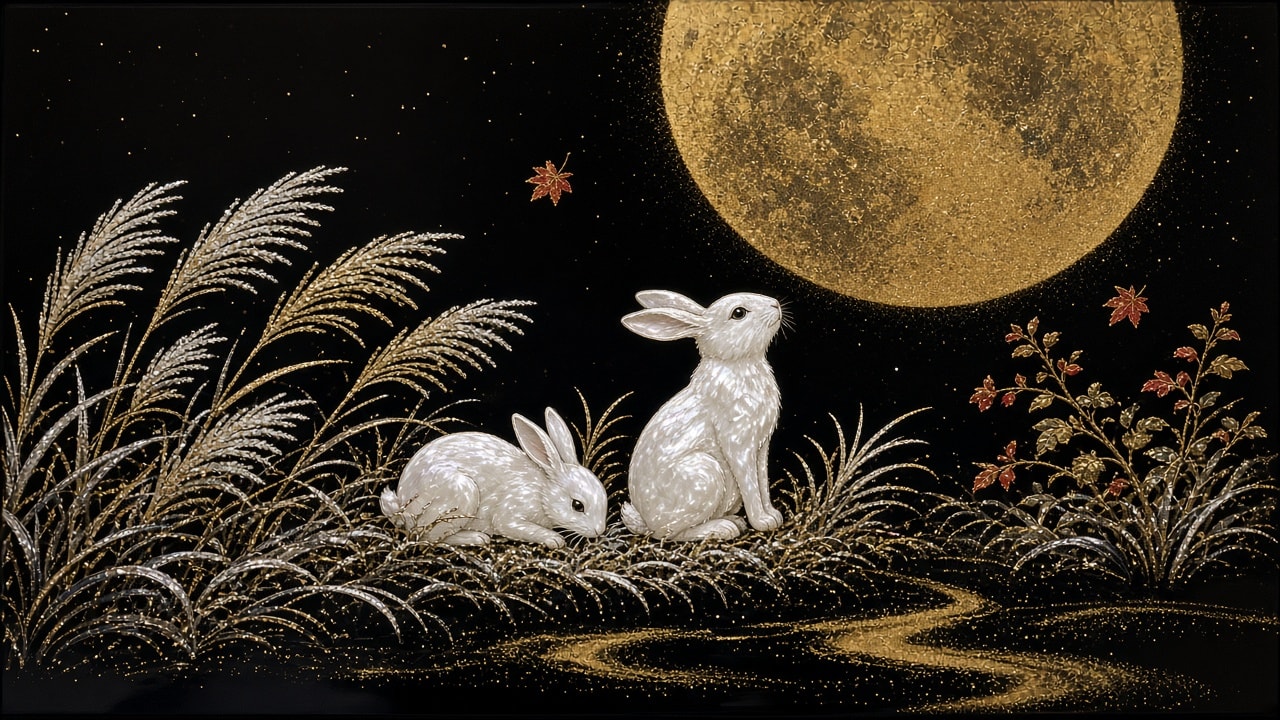
Japanese maki-e lacquer panel for autumn moon viewing: two white mother-of-pearl rabbits among silver pampas grass under a large gold-powder moon on deep black urushi, with bush clover, falling maple leaves, scattered gold flakes, and a flowing gold-dust stream line.
A wide Japanese maki-e lacquer panel showing two white rabbits sitting among silver pampas grass under a large full autumn moon. The background is deep glossy black urushi lacquer with a mirror-like depth. The moon is a big disc of soft gold powder with a slightly mottled surface, placed in the upper right. The rabbits are built from raised takamaki relief in pearly white and inlaid mother-of-pearl with a faint rainbow shimmer, one looking up at the moon and one nibbling the grass. Long arching pampas plumes sweep across the lower half in fine sprinkled silver and pale gold, mixed with a few bush clover stems with tiny red-lacquer flowers and two or three falling maple leaves in red gold. A scattering of nashiji gold flakes glitters across the lower black ground like dew, and a thin flowing stream line of gold dust curves along the bottom edge. Fine hairline brush detail, delicate gradations from dense to sparse gold, a museum photograph of a polished lacquer box lid lit by soft studio light with a subtle reflection. Quiet, elegant, autumn moon-viewing mood. Wide landscape 16:9. No text, no calligraphy, no signatures, no seals, no logos.
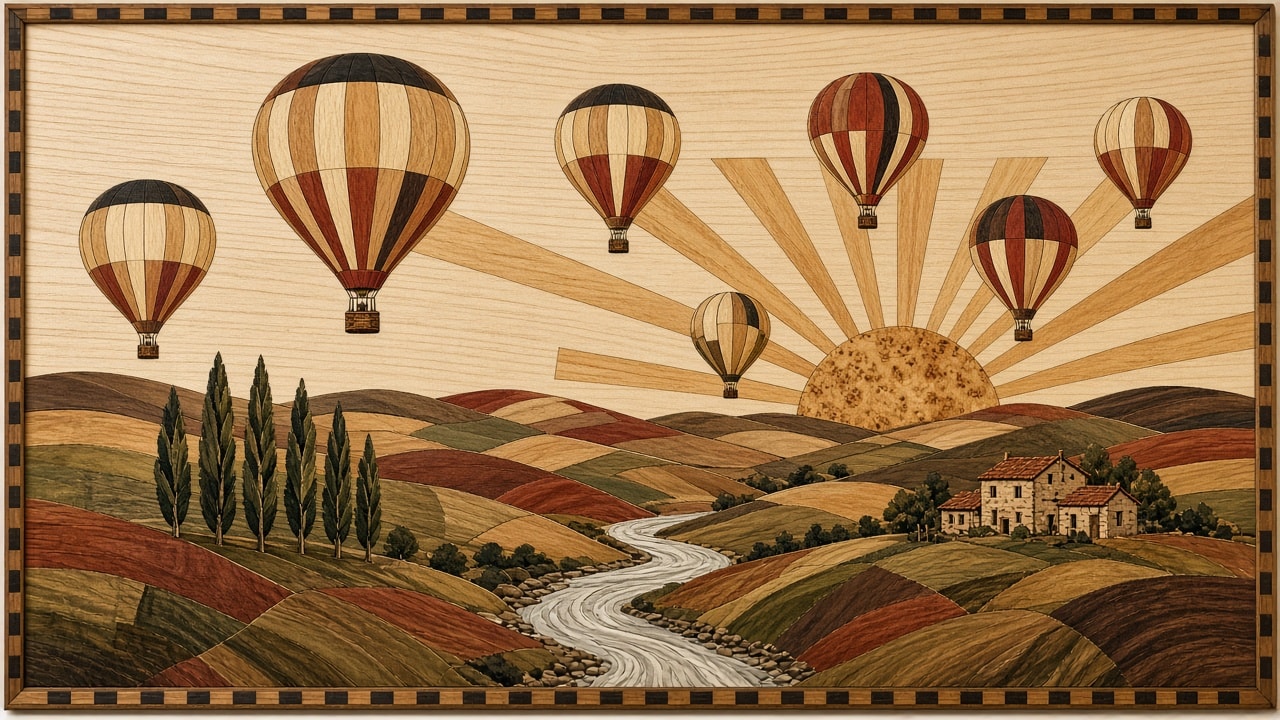
Decorative marquetry panel of seven hot air balloons over rolling hills at sunrise, pieced from maple, satinwood, padauk, walnut, and ebony veneers, with patchwork fields, poplars, a sycamore river, a burl half-sun, crisp hairline seams, a banded border, and a satin French-polish sheen.
A wide decorative marquetry panel made entirely of inlaid wood veneers, showing seven hot air balloons drifting over gently rolling hills at sunrise. Each balloon is pieced from contrasting veneer strips: pale maple, golden satinwood, honey oak, reddish padauk, dark walnut, and near-black ebony, arranged in bold curved gores with tiny wicker baskets below. The hills form soft layered bands of olive ash, warm cherry, and smoky oak, with a patchwork of small fields, a row of poplar trees, a winding river cut from silvery sycamore, and a tiny stone farmhouse with a red roof. A large half-sun of radiating burl veneer rises behind the far hills, and the sky is made of long sweeping strips of pale birch and light lacewood with visible natural grain. Every piece meets the next along crisp hairline seams, the grain direction changes between shapes to suggest light and movement, and a thin border of alternating light and dark banding frames the panel. Satin French-polish finish with a soft warm sheen, lit by gentle raking light that shows the wood texture. Calm, joyful, handcrafted mood. Wide landscape 16:9. No people, no text, no letters, no logos.
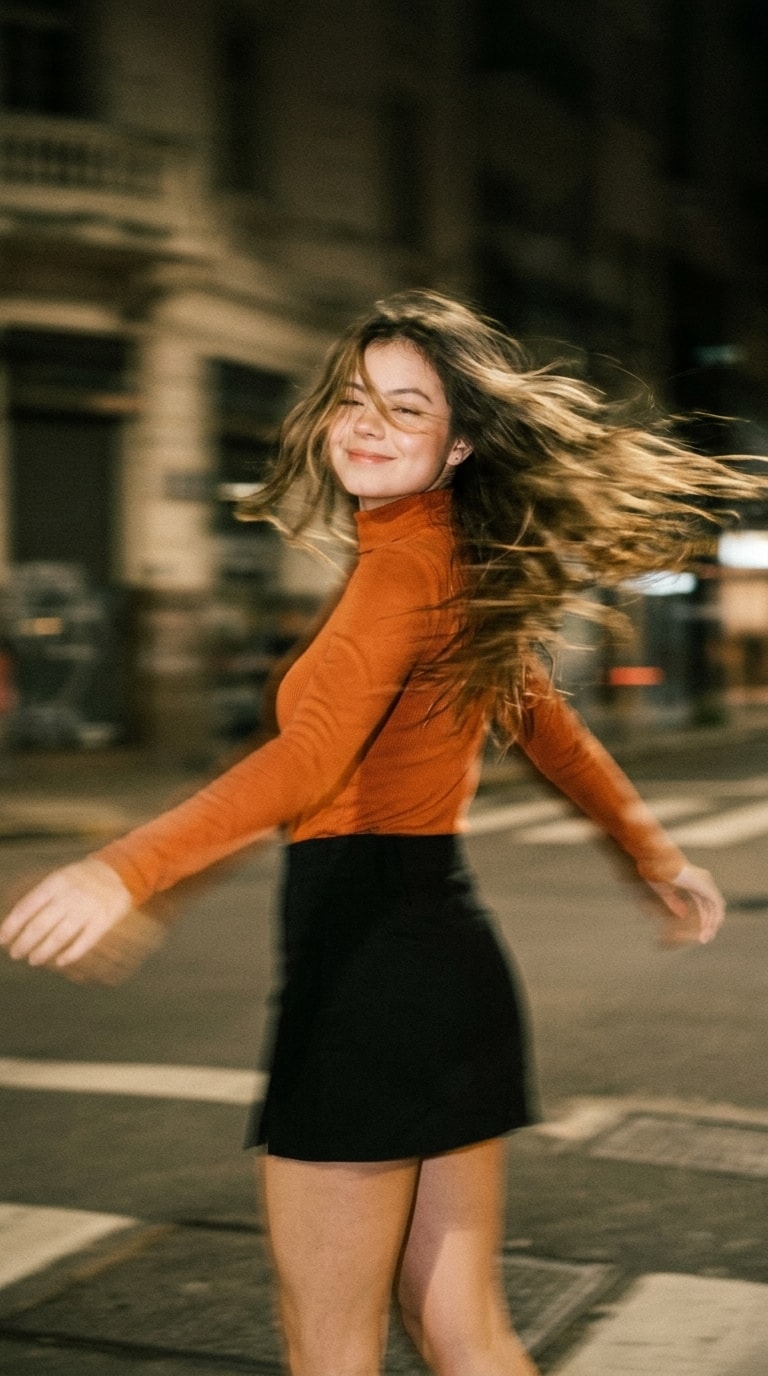
Generates a vertical 9:16 candid fashion portrait of an East Asian girl in an orange turtleneck and black mini skirt, spinning rapidly. It uses a very slow shutter speed to create extreme, realistic motion blur, ghost trails, and camera shake. The result is a dreamy, moody, underexposed aesthetic with heavy 35mm film grain, capturing dynamic movement in a photorealistic style.
Made with Nano Banana 2.1

Prompt:

Vertical 9:16 candid fashion portrait of a
beautiful East Asian girl wearing a fitted long-sleeve orange turtleneck and a black mini skirt, with long, messy, loose black hair. She spins rapidly while looking back at the camera, arms spread wide and hair flying. VERY SLOW SHUTTER SPEED 1/8–1/15 sec, extreme realistic motion blur, long ghost trails on arms and hair, blurred body, softly recognizable face, horizontal background streaks, camera shake, double-exposure effect, heavy 35mm film grain, dreamy, moody, underexposed, photorealistic. No CGI, no frozen motion, no sharp arms or hair.