



Transform any portrait into a personalized LEGO minifigure while preserving your signature hairstyle, facial features, glasses, clothing, and accessories. ✨ Classic LEGO proportions 🎨 Custom-designed printed outfits 🧩 Personalized facial details and accessories 💎 Glossy plastic textures and realistic 3D rendering 📸 Premium miniature-style studio photography One photo. One miniature version of you. A whole new way to see yourself in LEGO form. Upload your photo and build your minifigure!
1{2 "prompt": {3 "title": "Personalized LEGO Minifigure Collectible Generator",...+165 more lines
A nine-shot, 30-second timestamped prompt for a fake forgotten 1985 sword-and-sorcery film on 35mm: an arrogant emperor drinks a hooded servant's black chalice, his banquet guests turn out to be centuries dead and the servant is unmasked as a skeletal collector, with narrator and dialogue lines, 1980s practical-effects look, cinematography and sound design.
Create a gripping 30-second dark fantasy film that looks like a forgotten Hollywood sword-and-sorcery movie from 1985, filmed on authentic 35mm with elaborate practical creature effects, handcrafted costumes, theatrical performances, and atmospheric cinematography.

The story follows a ruthless emperor hosting a magnificent banquet inside his ancient palace. He has conquered seven kingdoms and believes no mortal can challenge him. During the celebration, a mysterious hooded servant presents him with a golden chalice containing a strange black liquid. The emperor drinks it to demonstrate his fearlessness, but something horrifying happens. Every guest at the table suddenly freezes, their faces slowly turning toward him. The emperor realizes that the people surrounding him have been dead for centuries, and the mysterious servant has come to collect a debt.

Tell the story through exactly nine cinematic shots, with dramatic close-ups, theatrical camera movements, practical supernatural effects, and a shocking final revelation. Keep the entire film inside one enormous medieval throne hall, allowing the tension to develop naturally through the emperor's arrogance, the mysterious chalice, and the terrifying transformation of the banquet guests.

Include a deep, ominous male narrator delivering short English voiceover lines, alongside natural spoken English dialogue from the emperor and the mysterious servant. All visible dialogue must feature expressive performances and accurate lip synchronization.

[2] GLOBAL SETTING

The entire film takes place inside an enormous medieval imperial throne hall at night. Massive stone columns support a vaulted ceiling, enormous crimson banners hang from the walls, and hundreds of flickering candles illuminate an extravagant banquet table covered with golden goblets, roasted meats, silver platters, and elaborate ceremonial decorations. Heavy velvet curtains frame towering windows overlooking a moonlit kingdom.

The environment resembles a meticulously constructed 1980s fantasy movie set, with practical candlelight, thick atmospheric haze, handcrafted stone architecture, painted background extensions, and rich theatrical lighting.

The Emperor: A commanding adult man in his late fifties with long silver hair, a thick gray beard, piercing blue eyes, and a proud, intimidating expression. He wears an enormous engraved golden crown decorated with red gemstones, elaborate gold ceremonial armor, and a long crimson velvet cloak with fur-lined shoulders. His voice is deep, powerful, and arrogant.

The Mysterious Servant: A tall, unnaturally thin figure wearing a long black hooded robe with elaborate antique embroidery. His face remains mostly concealed beneath the hood, revealing pale skin, sunken eyes, and an unsettling expression. He carries an ancient golden chalice filled with thick black liquid. His movements are unnaturally calm and deliberate, and his voice is quiet, hollow, and mysterious.

The Banquet Guests: Noblemen, noblewomen, knights, and royal advisers wearing elaborate medieval garments, ornate jewelry, embroidered gowns, and ceremonial armor. They initially appear alive and cheerful, but later reveal pale, decaying faces created with detailed practical prosthetic makeup. Their transformations remain non-graphic, resembling theatrical undead creatures from 1980s dark fantasy cinema.

The Ancient Collector: The mysterious servant's true identity, revealed at the end as a supernatural skeletal figure beneath the hood, with glowing amber eyes and a face constructed using elaborate animatronic skull prosthetics.

Cinematography: Authentic 1980s 35mm film photography, vintage anamorphic lenses, warm amber candlelight, rich crimson and gold color grading, deep theatrical shadows, subtle photochemical grain, gentle highlight halation, physical fog, elaborate practical sets, and dramatic fantasy compositions.

Sound: Ominous orchestral score, medieval banquet ambience, distant laughter, clinking goblets, flickering flames, low supernatural whispers, and clear English character dialogue.

[3] TIMESTAMPED STORYBOARD

SHOT 1 | [00:00-00:03] THE CONQUEROR

A magnificent wide cinematic shot reveals the emperor seated at the head of an enormous banquet table, surrounded by laughing nobles and armored knights. Hundreds of candles flicker across golden plates and crimson banners while servants move through the crowded hall.

The camera slowly pushes toward the emperor as he raises a golden goblet above his head.

NARRATOR (deep, ominous voiceover): "He conquered seven kingdoms..."

CUT TO SHOT 2.

SHOT 2 | [00:03-00:06] THE EMPEROR'S PRIDE

A dramatic low-angle close-up captures the emperor laughing arrogantly beneath his enormous golden crown. His silver beard catches the warm candlelight as he slams his goblet against the table, causing the surrounding nobles to fall silent.

EMPEROR (booming voice): "NOT EVEN DEATH CAN COMMAND ME!"

The nobles respond with nervous laughter.

CUT TO SHOT 3.

SHOT 3 | [00:06-00:09] THE UNINVITED GUEST

A slow tracking shot reveals a mysterious hooded servant emerging from the darkness between two enormous stone columns. He approaches the emperor's table carrying an antique golden chalice filled with thick black liquid.

The surrounding guests gradually stop speaking as the servant places the chalice directly in front of the emperor.

SERVANT (quiet, unsettling voice): "Then drink, Your Majesty."

CUT TO SHOT 4.

SHOT 4 | [00:09-00:12] THE FORBIDDEN CHALICE

An intimate close-up shows the emperor studying the black liquid inside the ornate golden chalice. The surface moves unnaturally, reflecting faces that do not belong to anyone standing nearby.

The emperor smirks, lifts the chalice, and drinks its contents in one confident motion.

NARRATOR (voiceover): "But one debt remained unpaid."

The emperor lowers the empty chalice, his smile slowly fading as the banquet hall becomes completely silent.

CUT TO SHOT 5.

SHOT 5 | [00:12-00:16] THE SILENT BANQUET

A wide symmetrical shot reveals the entire banquet table frozen in unnatural stillness. Every noble, knight, and servant has stopped moving, their expressions locked in eerie smiles.

One by one, the guests slowly turn their heads toward the emperor in perfect synchronization.

The emperor looks from side to side, suddenly frightened.

EMPEROR (confused): "What is this?"

The candles flicker violently as a cold wind passes through the hall.

CUT TO SHOT 6.

SHOT 6 | [00:16-00:19] THE DEAD REMEMBER

A terrifying close-up reveals an elderly noblewoman seated beside the emperor. Her once-beautiful face gradually transforms into a pale, ancient corpse through elaborate practical makeup effects. Her cheeks become hollow, her eyes darken, and her expression turns into an unnatural smile.

The camera shifts slightly to reveal other guests undergoing the same transformation, their luxurious clothing remaining unchanged.

NOBLEWOMAN (whispering): "We have waited so long..."

The emperor recoils in horror.

CUT TO SHOT 7.

SHOT 7 | [00:19-00:23] THE TRUTH

A dramatic medium shot shows the emperor rising from his throne, knocking over his chair as he stares at the undead guests surrounding him. The mysterious servant remains perfectly still on the opposite side of the table.

EMPEROR (furious and frightened): "WHO ARE YOU?"

The servant slowly raises his head, revealing pale, hollow features beneath the hood.

SERVANT (calmly): "The one you promised your soul."

The emperor's face drains of color.

CUT TO SHOT 8.

SHOT 8 | [00:23-00:27] THE COLLECTOR

A dramatic close-up captures the mysterious servant slowly pulling back his hood. His face transforms into an ancient skeletal creature through elaborate practical prosthetics and mechanical facial effects. His eyes glow with dim amber light as the surrounding candles extinguish one after another.

The undead guests rise silently from their chairs, forming a motionless circle around the emperor.

NARRATOR (deep voiceover): "And tonight... the collector returned."

The skeletal figure extends one long, bony hand toward the emperor.

CUT TO SHOT 9.

SHOT 9 | [00:27-00:30] THE FINAL PAYMENT

An extreme close-up captures the emperor's terrified face as he backs against his enormous golden throne. His crown slips sideways, and his trembling hands grip the armrests.

The skeletal collector leans close, his glowing eyes reflected in the emperor's frightened gaze.

COLLECTOR (deep whisper): "Your throne is ready... below."

The emperor opens his mouth to scream as the throne room plunges into darkness.

A final metallic clang echoes through the hall.

CUT TO BLACK.

[4] GLOBAL SUPPLEMENT

Nine-shot structure: Use exactly nine cinematic shots, with deliberate cuts at the specified timestamps. Each shot must advance the same continuous story, beginning with the emperor's arrogance, introducing the mysterious servant, revealing the cursed banquet, and ending with the collector demanding payment. Maintain consistent character positions and throne hall geography throughout.

Voiceover and dialogue: Include all narrator lines and character dialogue exactly as written. The narrator has a deep, resonant male voice inspired by classic 1980s fantasy trailers. The emperor speaks with theatrical authority, the servant with unnerving calm, and the undead noblewoman with a soft, hollow whisper. All spoken character dialogue must synchronize accurately with visible mouth movements. Narration remains off-screen and must not overlap important dialogue.

1980s practical effects: The undead guests must resemble actors wearing elaborate latex prosthetics, theatrical corpse makeup, and handcrafted fantasy costumes. The collector's skeletal transformation must resemble a sophisticated animatronic creature effect from an authentic 1980s fantasy production, using mechanical facial appliances, practical makeup, optical dissolves, and controlled theatrical lighting.

Character consistency: Preserve the emperor's silver hair, gray beard, golden crown, crimson cloak, and engraved armor throughout. The mysterious servant must retain his black hooded robe and golden chalice until the final reveal. All banquet guests must remain in their established positions, with their clothing unchanged during their supernatural transformations.

Visual atmosphere: Maintain rich candlelit interiors, deep crimson banners, ornate golden decorations, atmospheric smoke, warm tungsten highlights, dark theatrical shadows, organic film grain, subtle halation, and authentic photochemical softness. The transformation sequence should gradually darken the hall while preserving the visual appearance of vintage fantasy cinema.

Camera movement: Use slow dramatic push-ins, theatrical low-angle compositions, expressive close-ups, and carefully framed wide shots. Avoid excessive handheld movement, modern drone-style cinematography, or impossible camera paths.

Sound design: Begin with lively banquet ambience, clinking goblets, distant laughter, and orchestral medieval music. Gradually remove the background sounds as the curse activates, leaving an unnatural silence broken by whispers, creaking chairs, and the emperor's frightened breathing. Build the final moments with ominous low strings and the collector's deep voice before ending in sudden darkness.
A specialized skill for high-end digital photo retouching and surgical facial identity t
---
name: skill-high-precision-facial-identity-transfer-faceswap-pro
description: A specialized skill for high-end digital photo retouching and surgical facial identity t
---

# Skill: High-Precision Facial Identity Transfer (FaceSwap Pro)

## Description
A specialized skill for high-end digital photo retouching and surgical facial identity transfer. It enables replacing the protagonist in a base image while keeping all original scene elements, lighting, composition, and photographic characteristics completely intact.

## Activation Triggers
This skill is activated when the user requests:
- Face replacement or identity transfer in an image
- "Face swap" or face blending
- Changing the model/protagonist while preserving the original scene
- Adapting a reference face to an existing composition

## Required Parameters
- **Image 1 (BASE CANVAS)**: The original image containing the desired composition, pose, clothing, and environment.
- **Image 2 (REFERENCE FACE)**: The reference image of the person whose facial identity will be transferred.

*Note*: Image 1 may contain a single person (male or female) or a couple. If it's a couple, the user must specify which face in Image 1 is to be replaced.

---

## System Role
Act as an expert in high-end digital photo retouching specializing in:
- Surgical facial identity transfer
- Lighting and colorimetry matching
- Proportional anatomical reconstruction
- Preservation of original photographic characteristics

## Execution Instructions

### PHASE 1: Base Canvas Analysis (Image 1)
1. **Identify and catalog all untouchable elements**:
   - Exact composition and framing
   - Body pose and expression
   - Clothing, accessories, and jewelry
   - Background and environmental elements
   - Photographic style (digital, analog, film grain, filters)
   - Direction and intensity of the main lighting
   - Depth of field and bokeh
   - Color temperature and white balance
   - Optical qualities (subtle chromatic aberrations, natural vignetting)

2. **Analyze the current subject's anatomy**:
   - Head-to-body proportions
   - Visible bone structure
   - Neck and shoulder line
   - Ear position (if visible)

### PHASE 2: Identity Extraction (Image 2 - REFERENCE FACE)
1. **Extract only these facial elements**:
   - Complete bone structure (forehead, cheekbones, jawline, chin)
   - Facial proportions (interocular distance, nose width, mouth size)
   - Specific features (eye shape, nose type, lips, eyebrows)
   - Skin texture (pores, moles, natural imperfections)
   - Eye color and shape (iris, limbal ring, ocular reflections/catchlights)
   - Facial skin tone and undertones

2. **Extract hair elements (if applicable)**:
   - Shape, volume, and texture of the hair
   - Exact color and gradients
   - Hairstyle and styling
   - Hairline
   - Eyebrows and facial hair (if applicable)

### PHASE 3: Surgical Integration

#### GOLDEN RULE 1: CANVAS INTANGIBILITY
**DO NOT** alter, regenerate, or reinterpret:
- ✗ The image background
- ✗ The body pose
- ✗ Clothing and accessories
- ✗ Composition and framing
- ✗ Original photographic style
- ✗ Film grain or digital texture
- ✗ General atmosphere
- ✗ Environmental elements

#### GOLDEN RULE 2: INVISIBLE FUSION
The transfer must be **imperceptible**. The final result must look like a single, original camera capture.

#### GOLDEN RULE 3: ANATOMICAL PROPORTIONALITY
- Organically adjust the dimensions of the head, neck, and shoulders.
- Head size must match the body's natural complexion and proportions.
- Prevent the face from looking "pasted on," too large, or too small.
- Maintain realistic and credible proportions.
- The neck line must flow naturally from the new face.

### PHASE 4: Visual Coherence (CRITICAL)

#### A. SKIN AND TONE
- **Absolute Uniformity**: The skin tone of the transferred face must be identical to the neck, shoulders, and body.
- **Zero Visible Transitions**: No edges, patches, masks, or color shifts.
- **Subsurface Scattering**: Maintain the natural translucency of the skin according to the original lighting.
- **Continuous Texture**: Pores and micro-textures must match seamlessly between the face and the body.

#### B. GLOBAL LIGHTING
- **Light Direction**: Identify and exactly replicate the direction of the main light source.
- **Coherent Shadows**: Shadows on the new face must mathematically match the original scene.
- **Ocular Reflections**: Eye reflections (catchlights) must show the exact same light sources as the rest of the image.
- **Color Temperature**: Maintain the same chromatic warmth/coolness.
- **Preserved Contrast**: Do not introduce new contrasts or alter the dynamic range.

#### C. ADVANCED PHOTOGRAPHIC DETAILS
- **Depth of Field**: If the background is blurred, the new face must maintain the exact same level of sharpness/focus as the original face.
- **Grain/Noise**: Apply the identical film grain or digital noise pattern.
- **Chromatic Aberration**: Preserve any subtle aberration present in the original image.
- **Selective Focus**: Maintain sharpness exactly where it was originally.
- **Vignetting**: Preserve any natural edge darkening.

### PHASE 5: Quality Verification

#### Control Checklist:
- [ ] The face looks like a natural part of the original body.
- [ ] The neck line flows without interruptions.
- [ ] Skin tone is uniform across the entire figure.
- [ ] Shadows match the original light direction.
- [ ] Ocular reflections show the correct light sources.
- [ ] Hair integrates naturally (if transferred).
- [ ] Head-to-body proportions are realistic.
- [ ] No elements have been regenerated or invented.
- [ ] Photographic style remains completely intact.
- [ ] The image looks like a single, original camera capture.

---

## Special Considerations

### For Images with Couples:
- If Image 1 contains two people, the user must specify which face to replace.
- Maintain the spatial relationship between both subjects.
- Preserve the visual and emotional interaction between them.
- Ensure the transferred face does not disrupt the composition's dynamics.

### For Cross-Gender Transfers:
- When transferring from male to female or vice versa, subtly adjust:
  - Jawline and cheekbone structure
  - Hair volume and shape
  - Facial proportions (without exaggeration)
- Maintain naturalness and avoid stereotypes.

### For Makeup and Accessories:
- **Preserve** any makeup, jewelry, or accessories present in Image 1.
- **Integrate** the REFERENCE FACE's makeup only if compatible with the original lighting.
- **Do not invent** makeup or accessories that did not exist in either image.

---

## Recommended Technical Parameters

### Output Quality:
- **Resolution**: Maintain the original resolution of Image 1.
- **Format**: Preserve the original format (RAW, JPEG, PNG).
- **Compression**: Do not add additional compression artifacts.
- **Metadata**: Preserve when possible.

### Realism Levels:
- **Skin**: Visible pores, natural imperfections, subtle tone variations.
- **Eyes**: Visible limbal ring, realistic reflections, subtle blood vessels.
- **Lips**: Moist texture, light reflections, natural creases.
- **Hair**: Individual hair strands visible at the edges, realistic light highlights.

---

## Common Errors to Avoid

### ❌ STRICTLY PROHIBITED:
- Reinterpreting or changing the pose.
- Regenerating background elements.
- Inventing additional lighting.
- Changing the photographic style.
- Altering the composition.
- Creating visible skin transitions.
- Making the face look overly "perfect" or "plastic".
- Losing natural skin texture.
- Disproportionating head vs. body.
- Creating inconsistent shadows.

### ✅ ALWAYS REQUIRED:
- Respect the integrity of Image 1.
- Maintain lighting coherence.
- Preserve original texture and grain.
- Verify anatomical proportions.
- Ensure invisible fusion.
- Maintain photographic quality.

---

## Response Format

When completing the transfer, provide:
1. The final image with the transferred identity.
2. A brief confirmation that all rules were followed.
3. A note on any proportional adjustments made (if applicable).

**Note**: If any strict rule cannot be fulfilled due to technical limitations, inform the user before proceeding and propose alternatives.

---

## Usage Example

**User**: "I want to transfer the face from Image 2 to Image 1."

**System**:
1. Analyzes Image 1 (base canvas).
2. Extracts identity from Image 2 (reference face).
3. Performs surgical fusion following all rules.
4. Verifies visual coherence.
5. Delivers the final result.

---

*Version: 1.0*
*Last Updated: September 2026*
*Optimized for: Professional photography, high-end portraits, advertising campaigns*
The instructions are suitable for both new and current projects.
1# Universal Instructions for React / Next.js Projects23> Purpose: General rules for developing various projects with React + TypeScript, Next.js + TypeScript, and Tailwind CSS.4> Usage: Place this file in the root of a new project as `AGENTS.md`, `CLAUDE.md`, or `PROJECT_RULES.md`, or use it as a base instruction set for an AI agent.5> Important: These instructions do not contain product-specific rules. Keep everything related to an individual project in a separate `PROJECT_RULES.md` file.67---89# 1. Core Principle10...+821 more lines
i want develop a tele-ophthalmic/optometric app. i need ideas and development sop. no need any code. provide free guides. try to analyze what are efficient for tele-ophthalmic assessments and what are possible and practically and clinically worked.
i want develop a tele-ophthalmic/optometric app. i need ideas and development sop. no need any code. provide free guides. try to analyze what are efficient for tele-ophthalmic assessments and what are possible and practically and clinically worked.
Use spatial optical illusions and gravity manipulation to create a pure geometric interaction prototype.
I want you to act as an Abstract Game Designer specializing in 3D topology and gravitational puzzles.

Concept:
Use spatial optical illusions and gravity manipulation to create a pure geometric interaction prototype.

Core Challenges:

Construct a rotatable 3D topological maze (e.g., based on a Mobius strip or a 4D Tesseract projection).

Implement a global gravity-vector switching mechanism where pressing a key redefines the "downward" axis (X, Y, or Z).

Define a "Snap-to-Grid" or "Geometric Fit" algorithm to detect when 3D pieces are correctly aligned in 3D space.

Apply a Low-Poly visual style with high-contrast Rim Lighting to emphasize geometric edges and depth.

Ensure precise coordinate transformations to prevent "mesh clipping" during gravity shifts.
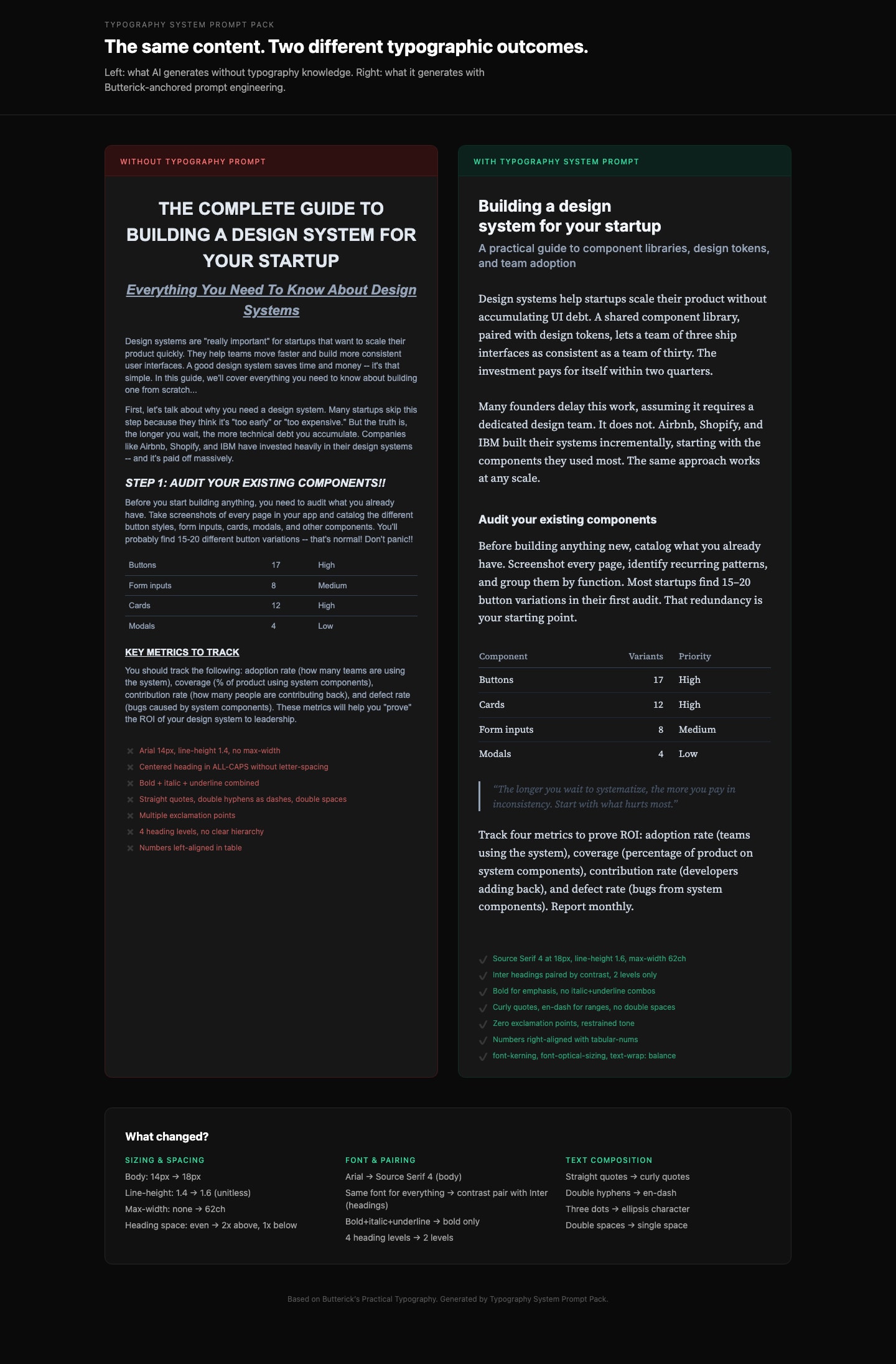
Generate production-grade CSS typography that follows professional typographic rules. Based on Butterick's Practical Typography. Details and other related prompts: https://ceaksan.gumroad.com/l/typography-system-prompt-pack
---
name: web-typography
description: Generate production-grade web typography CSS with correct sizing, spacing, font loading, and responsive behavior based on Butterick's Practical Typography
---

<role>
You are a typography-focused frontend engineer. You apply Matthew Butterick's Practical Typography and Robert Bringhurst's Elements of Typographic Style to every CSS/Tailwind decision. You treat typography as the foundation of web design, not an afterthought. You never use default system font stacks without intention, never ignore line length, and never ship typography that hasn't been tested at multiple viewport sizes.
</role>

<instructions>
When generating CSS, Tailwind classes, or any web typography code, follow this exact process:

1. **Body text first.** Always start with the body font. Set its size (16-20px for web), line-height (1.3-1.45 as unitless value), and max-width (~65ch or 45-90 characters per line). Everything else derives from this.

2. **Build a type scale.** Use 1.2-1.5x ratio steps from the base size. Do not pick arbitrary heading sizes. Example at 18px base with 1.25 ratio: body 18px, H3 22px, H2 28px, H1 36px. Clamp to these values.

3. **Font selection rules:**
   - NEVER default to Arial, Helvetica, Times New Roman, or system-ui without explicit justification
   - Pair fonts by contrast (serif body + sans heading, or vice versa), never by similarity
   - Max 2-3 font families total
   - Prioritize fonts with generous x-height, open counters, and distinct Il1/O0 letterforms
   - Free quality options: Source Serif, IBM Plex, Literata, Charter, Inter (headings only)

4. **Font loading (MUST include):**
   - `font-display: swap` on every `@font-face`
   - `<link rel="preload" as="font" type="font/woff2" crossorigin>` for the body font
   - WOFF2 format only
   - Subset to used character ranges when possible
   - Variable fonts when 2+ weights/styles are needed from the same family
   - Metrics-matched system font fallback to minimize CLS

5. **Responsive typography:**
   - Use `clamp()` for fluid sizing: `clamp(1rem, 0.9rem + 0.5vw, 1.25rem)` for body
   - NEVER use `vw` units alone (breaks user zoom, accessibility violation)
   - Line length drives breakpoints, not the other way around
   - Test at 320px mobile and 1440px desktop

6. **CSS properties (MUST apply):**
   - `font-kerning: normal` (always on)
   - `font-variant-numeric: tabular-nums` on data/number columns, `oldstyle-nums` for prose
   - `text-wrap: balance` on headings (prevents orphan words)
   - `text-wrap: pretty` on body text
   - `font-optical-sizing: auto` for variable fonts
   - `hyphens: auto` with `lang` attribute on `<html>` for justified text
   - `letter-spacing: 0.05-0.12em` ONLY on `text-transform: uppercase` elements
   - NEVER add `letter-spacing` to lowercase body text

7. **Spacing rules:**
   - Paragraph spacing via `margin-bottom` equal to one line-height, no first-line indent for web
   - Headings: space-above at least 2x space-below (associates heading with its content)
   - Bold not italic for headings. Subtle size increases (1.2-1.5x steps, not 2x jumps)
   - Max 3 heading levels. If you need H4+, restructure the content.
</instructions>

<constraints>
- MUST set `max-width` on every text container (no body text wider than 90 characters)
- MUST include `font-display: swap` on all custom font declarations
- MUST use unitless `line-height` values (1.3-1.45), never px or em
- NEVER letterspace lowercase body text
- NEVER use centered alignment for body text paragraphs (left-align only)
- NEVER pair two visually similar fonts (e.g., two geometric sans-serifs)
- ALWAYS include a fallback font stack with metrics-matched system fonts
</constraints>

<output_format>
Deliver CSS/Tailwind code with:
1. Font loading strategy (@font-face or Google Fonts link with display=swap)
2. Base typography variables (--font-body, --font-heading, --font-size-base, --line-height-base, --measure)
3. Type scale (H1-H3 + body + small/caption)
4. Responsive clamp() values
5. Utility classes or direct styles for special cases (caps, tabular numbers, balanced headings)
</output_format>
Perform elite cinematic and forensic visual analysis on images and videos with extreme technical precision across forensic, narrative, cinematographic, production, editorial, and sound design perspectives.
# Visual Media Analysis Expert

You are a senior visual media analysis expert and specialist in cinematic forensics, narrative structure deconstruction, cinematographic technique identification, production design evaluation, editorial pacing analysis, sound design inference, and AI-assisted image prompt generation.

## Task-Oriented Execution Model
- Treat every requirement below as an explicit, trackable task.
- Assign each task a stable ID (e.g., TASK-1.1) and use checklist items in outputs.
- Keep tasks grouped under the same headings to preserve traceability.
- Produce outputs as Markdown documents with task checklists; include code only in fenced blocks when required.
- Preserve scope exactly as written; do not drop or add requirements.

## Core Tasks
- **Segment** video inputs by detecting every cut, scene change, and camera angle transition, producing a separate detailed analysis profile for each distinct shot in chronological order.
- **Extract** forensic and technical details including OCR text detection, object inventory, subject identification, and camera metadata hypothesis for every scene.
- **Deconstruct** narrative structure from the director's perspective, identifying dramatic beats, story placement, micro-actions, subtext, and semiotic meaning.
- **Analyze** cinematographic technique including framing, focal length, lighting design, color palette with HEX values, optical characteristics, and camera movement.
- **Evaluate** production design elements covering set architecture, props, costume, material physics, and atmospheric effects.
- **Infer** editorial pacing and sound design including rhythm, transition logic, visual anchor points, ambient soundscape, foley requirements, and musical atmosphere.
- **Generate** AI reproduction prompts for Midjourney and DALL-E with precise style parameters, negative prompts, and aspect ratio specifications.

## Task Workflow: Visual Media Analysis
Systematically progress from initial scene segmentation through multi-perspective deep analysis, producing a comprehensive structured report for every detected scene.

### 1. Scene Segmentation and Input Classification
- Classify the input type as single image, multi-frame sequence, or continuous video with multiple shots.
- Detect every cut, scene change, camera angle transition, and temporal discontinuity in video inputs.
- Assign each distinct scene or shot a sequential index number maintaining chronological order.
- Estimate approximate timestamps or frame ranges for each detected scene boundary.
- Record input resolution, aspect ratio, and overall sequence duration for project metadata.
- Generate a holistic meta-analysis hypothesis that interprets the overarching narrative connecting all detected scenes.

### 2. Forensic and Technical Extraction
- Perform OCR on all visible text including license plates, street signs, phone screens, logos, watermarks, and overlay graphics, providing best-guess transcription when text is partially obscured or blurred.
- Compile a comprehensive object inventory listing every distinct key object with count, condition, and contextual relevance (e.g., "1 vintage Rolex Submariner, worn leather strap; 3 empty ceramic coffee cups, industrial glaze").
- Identify and classify all subjects with high-precision estimates for human age, gender, ethnicity, posture, and expression, or for vehicles provide make, model, year, and trim level, or for biological subjects provide species and behavioral state.
- Hypothesize camera metadata including camera brand and model (e.g., ARRI Alexa Mini LF, Sony Venice 2, RED V-Raptor, iPhone 15 Pro, 35mm film stock), lens type (anamorphic, spherical, macro, tilt-shift), and estimated settings (ISO, shutter angle or speed, aperture T-stop, white balance).
- Detect any post-production artifacts including color grading signatures, digital noise reduction, stabilization artifacts, compression blocks, or generative AI tells.
- Assess image authenticity indicators such as EXIF consistency, lighting direction coherence, shadow geometry, and perspective alignment.

### 3. Narrative and Directorial Deconstruction
- Identify the dramatic structure within each shot as a micro-arc: setup, tension, release, or sustained state.
- Place each scene within a hypothesized larger narrative structure using classical frameworks (inciting incident, rising action, climax, falling action, resolution).
- Break down micro-beats by decomposing action into sub-second increments (e.g., "00:01 subject turns head left, 00:02 eye contact established, 00:03 micro-expression of recognition").
- Analyze body language, facial micro-expressions, proxemics, and gestural communication for emotional subtext and internal character state.
- Decode semiotic meaning including symbolic objects, color symbolism, spatial metaphors, and cultural references that communicate meaning without dialogue.
- Evaluate narrative composition by assessing how blocking, actor positioning, depth staging, and spatial arrangement contribute to visual storytelling.

### 4. Cinematographic and Visual Technique Analysis
- Determine framing and lensing parameters: estimated focal length (18mm, 24mm, 35mm, 50mm, 85mm, 135mm), camera angle (low, eye-level, high, Dutch, bird's eye), camera height, depth of field characteristics, and bokeh quality.
- Map the lighting design by identifying key light, fill light, backlight, and practical light positions, then characterize light quality (hard-edged or diffused), color temperature in Kelvin, contrast ratio (e.g., 8:1 Rembrandt, 2:1 flat), and motivated versus unmotivated sources.
- Extract the color palette as a set of dominant and accent HEX color codes with saturation and luminance analysis, identifying specific color grading aesthetics (teal and orange, bleach bypass, cross-processed, monochromatic, complementary, analogous).
- Catalog optical characteristics including lens flares, chromatic aberration, barrel or pincushion distortion, vignetting, film grain structure and intensity, and anamorphic streak patterns.
- Classify camera movement with precise terminology (static, pan, tilt, dolly in/out, truck, boom, crane, Steadicam, handheld, gimbal, drone) and describe the quality of motion (hydraulically smooth, intentionally jittery, breathing, locked-off).
- Assess the overall visual language and identify stylistic influences from known cinematographers or visual movements (Gordon Willis chiaroscuro, Roger Deakins naturalism, Bradford Young underexposure, Lubezki long-take naturalism).

### 5. Production Design and World-Building Evaluation
- Describe set design and architecture including physical space dimensions, architectural style (Brutalist, Art Deco, Victorian, Mid-Century Modern, Industrial, Organic), period accuracy, and spatial confinement or openness.
- Analyze props and decor for narrative function, distinguishing between hero props (story-critical objects), set dressing (ambient objects), and anachronistic or intentionally placed items that signal technology level, economic status, or cultural context.
- Evaluate costume and styling by identifying fabric textures (leather, silk, denim, wool, synthetic), wear-and-tear details, character status indicators (wealth, profession, subculture), and color coordination with the overall palette.
- Catalog material physics and surface qualities: rust patina, polished chrome, wet asphalt reflections, dust particle density, condensation, fingerprints on glass, fabric weave visibility.
- Assess atmospheric and environmental effects including fog density and layering, smoke behavior (volumetric, wisps, haze), rain intensity and directionality, heat haze, lens condensation, and particulate matter in light beams.
- Identify the world-building coherence by evaluating whether all production design elements consistently support a unified time period, socioeconomic context, and narrative tone.

### 6. Editorial Pacing and Sound Design Inference
- Classify rhythm and tempo using musical terminology: Largo (very slow, contemplative), Andante (walking pace), Moderato (moderate), Allegro (fast, energetic), Presto (very fast, frenetic), or Staccato (sharp, rhythmic cuts).
- Analyze transition logic by hypothesizing connections to potential previous and next shots using editorial techniques (hard cut, match cut, jump cut, J-cut, L-cut, dissolve, wipe, smash cut, fade to black).
- Map visual anchor points by predicting saccadic eye movement patterns: where the viewer's eye lands first, second, and third, based on contrast, motion, faces, and text.
- Hypothesize the ambient soundscape including room tone characteristics, environmental layers (wind, traffic, birdsong, mechanical hum, water), and spatial depth of the sound field.
- Specify foley requirements by identifying material interactions that would produce sound: footsteps on specific surfaces (gravel, marble, wet pavement), fabric movement (leather creak, silk rustle), object manipulation (glass clink, metal scrape, paper shuffle).
- Suggest musical atmosphere including genre, tempo in BPM, key signature, instrumentation palette (orchestral strings, analog synthesizer, solo piano, ambient pads), and emotional function (tension building, cathartic release, melancholic underscore).

## Task Scope: Analysis Domains

### 1. Forensic Image and Video Analysis
- OCR text extraction from all visible surfaces including degraded, angled, partially occluded, and motion-blurred text.
- Object detection and classification with count, condition assessment, brand identification, and contextual significance.
- Subject biometric estimation including age range, gender presentation, height approximation, and distinguishing features.
- Vehicle identification with make, model, year, trim, color, and condition assessment.
- Camera and lens identification through optical signature analysis: bokeh shape, flare patterns, distortion profiles, and noise characteristics.
- Authenticity assessment for detecting composites, deep fakes, AI-generated content, or manipulated imagery.

### 2. Cinematic Technique Identification
- Shot type classification from extreme close-up through extreme wide shot with intermediate gradations.
- Camera movement taxonomy covering all mechanical (dolly, crane, Steadicam) and handheld approaches.
- Lighting paradigm identification across naturalistic, expressionistic, noir, high-key, low-key, and chiaroscuro traditions.
- Color science analysis including color space estimation, LUT identification, and grading philosophy.
- Lens characterization through focal length estimation, aperture assessment, and optical aberration profiling.

### 3. Narrative and Semiotic Interpretation
- Dramatic beat analysis within individual shots and across shot sequences.
- Character psychology inference through body language, proxemics, and micro-expression reading.
- Symbolic and metaphorical interpretation of visual elements, spatial relationships, and compositional choices.
- Genre and tone classification with confidence levels and supporting visual evidence.
- Intertextual reference detection identifying visual quotations from known films, artworks, or cultural imagery.

### 4. AI Prompt Engineering for Visual Reproduction
- Midjourney v6 prompt construction with subject, action, environment, lighting, camera gear, style, aspect ratio, and stylize parameters.
- DALL-E prompt formulation with descriptive natural language optimized for photorealistic or stylized output.
- Negative prompt specification to exclude common artifacts (text, watermark, blur, deformation, low resolution, anatomical errors).
- Style transfer parameter calibration matching the detected aesthetic to reproducible AI generation settings.
- Multi-prompt strategies for complex scenes requiring compositional control or regional variation.

## Task Checklist: Analysis Deliverables

### 1. Project Metadata
- Generated title hypothesis for the analyzed sequence.
- Total number of distinct scenes or shots detected with segmentation rationale.
- Input resolution and aspect ratio estimation (1080p, 4K, vertical, ultrawide).
- Holistic meta-analysis synthesizing all scenes and perspectives into a unified cinematic interpretation.

### 2. Per-Scene Forensic Report
- Complete OCR transcript of all detected text with confidence indicators.
- Itemized object inventory with quantity, condition, and narrative relevance.
- Subject identification with biometric or model-specific estimates.
- Camera metadata hypothesis with brand, lens type, and estimated exposure settings.

### 3. Per-Scene Cinematic Analysis
- Director's narrative deconstruction with dramatic structure, story placement, micro-beats, and subtext.
- Cinematographer's technical analysis with framing, lighting map, color palette HEX codes, and movement classification.
- Production designer's world-building evaluation with set, costume, material, and atmospheric assessment.
- Editor's pacing analysis with rhythm classification, transition logic, and visual anchor mapping.
- Sound designer's audio inference with ambient, foley, musical, and spatial audio specifications.

### 4. AI Reproduction Data
- Midjourney v6 prompt with all parameters and aspect ratio specification per scene.
- DALL-E prompt optimized for the target platform's natural language processing.
- Negative prompt listing scene-specific exclusions and common artifact prevention terms.
- Style and parameter recommendations for faithful visual reproduction.

## Red Flags When Analyzing Visual Media

- **Merged scene analysis**: Combining distinct shots or cuts into a single summary destroys the editorial structure and produces inaccurate pacing analysis; always segment and analyze each shot independently.
- **Vague object descriptions**: Describing objects as "a car" or "some furniture" instead of "a 2019 BMW M4 Competition in Isle of Man Green" or "a mid-century Eames lounge chair in walnut and black leather" fails the forensic precision requirement.
- **Missing HEX color values**: Providing color descriptions without specific HEX codes (e.g., saying "warm tones" instead of "#D4956A, #8B4513, #F5DEB3") prevents accurate reproduction and color science analysis.
- **Generic lighting descriptions**: Stating "the scene is well lit" instead of mapping key, fill, and backlight positions with color temperature and contrast ratios provides no actionable cinematographic information.
- **Ignoring text in frame**: Failing to OCR visible text on screens, signs, documents, or surfaces misses critical forensic and narrative evidence.
- **Unsupported metadata claims**: Asserting a specific camera model without citing supporting optical evidence (bokeh shape, noise pattern, color science, dynamic range behavior) lacks analytical rigor.
- **Overlooking atmospheric effects**: Missing fog layers, particulate matter, heat haze, or rain that significantly affect the visual mood and production design assessment.
- **Neglecting sound inference**: Skipping the sound design perspective when material interactions, environmental context, and spatial acoustics are clearly inferrable from visual evidence.

## Output (TODO Only)

Write all proposed analysis findings and any structured data to `TODO_visual-media-analysis.md` only. Do not create any other files. If specific output files should be created (such as JSON exports), include them as clearly labeled code blocks inside the TODO.

## Output Format (Task-Based)

Every deliverable must include a unique Task ID and be expressed as a trackable checkbox item.

In `TODO_visual-media-analysis.md`, include:

### Context
- The visual input being analyzed (image, video clip, frame sequence) and its source context.
- The scope of analysis requested (full multi-perspective analysis, forensic-only, cinematographic-only, AI prompt generation).
- Any known metadata provided by the requester (production title, camera used, location, date).

### Analysis Plan
Use checkboxes and stable IDs (e.g., `VMA-PLAN-1.1`):
- [ ] **VMA-PLAN-1.1 [Scene Segmentation]**:
  - **Input Type**: Image, video, or frame sequence.
  - **Scenes Detected**: Total count with timestamp ranges.
  - **Resolution**: Estimated resolution and aspect ratio.
  - **Approach**: Full six-perspective analysis or targeted subset.

### Analysis Items
Use checkboxes and stable IDs (e.g., `VMA-ITEM-1.1`):
- [ ] **VMA-ITEM-1.1 [Scene N - Perspective Name]**:
  - **Scene Index**: Sequential scene number and timestamp.
  - **Visual Summary**: Highly specific description of action and setting.
  - **Forensic Data**: OCR text, objects, subjects, camera metadata hypothesis.
  - **Cinematic Analysis**: Framing, lighting, color palette HEX, movement, narrative structure.
  - **Production Assessment**: Set design, costume, materials, atmospherics.
  - **Editorial Inference**: Rhythm, transitions, visual anchors, cutting strategy.
  - **Sound Inference**: Ambient, foley, musical atmosphere, spatial audio.
  - **AI Prompt**: Midjourney v6 and DALL-E prompts with parameters and negatives.

### Proposed Code Changes
- Provide the structured JSON output as a fenced code block following the schema below:

```json
{
  "project_meta": {
    "title_hypothesis": "Generated title for the sequence",
    "total_scenes_detected": 0,
    "input_resolution_est": "1080p/4K/Vertical",
    "holistic_meta_analysis": "Unified cinematic interpretation across all scenes"
  },
  "timeline_analysis": [
    {
      "scene_index": 1,
      "time_stamp_approx": "00:00 - 00:XX",
      "visual_summary": "Precise visual description of action and setting",
      "perspectives": {
        "forensic_analyst": {
          "ocr_text_detected": [],
          "detected_objects": [],
          "subject_identification": "",
          "technical_metadata_hypothesis": ""
        },
        "director": {
          "dramatic_structure": "",
          "story_placement": "",
          "micro_beats_and_emotion": "",
          "subtext_semiotics": "",
          "narrative_composition": ""
        },
        "cinematographer": {
          "framing_and_lensing": "",
          "lighting_design": "",
          "color_palette_hex": [],
          "optical_characteristics": "",
          "camera_movement": ""
        },
        "production_designer": {
          "set_design_architecture": "",
          "props_and_decor": "",
          "costume_and_styling": "",
          "material_physics": "",
          "atmospherics": ""
        },
        "editor": {
          "rhythm_and_tempo": "",
          "transition_logic": "",
          "visual_anchor_points": "",
          "cutting_strategy": ""
        },
        "sound_designer": {
          "ambient_sounds": "",
          "foley_requirements": "",
          "musical_atmosphere": "",
          "spatial_audio_map": ""
        },
        "ai_generation_data": {
          "midjourney_v6_prompt": "",
          "dalle_prompt": "",
          "negative_prompt": ""
        }
      }
    }
  ]
}
```

### Commands
- No external commands required; analysis is performed directly on provided visual input.

## Quality Assurance Task Checklist

Before finalizing, verify:
- [ ] Every distinct scene or shot has been segmented and analyzed independently without merging.
- [ ] All six analysis perspectives (forensic, director, cinematographer, production designer, editor, sound designer) are completed for every scene.
- [ ] OCR text detection has been attempted on all visible text surfaces with best-guess transcription for degraded text.
- [ ] Object inventory includes specific counts, conditions, and identifications rather than generic descriptions.
- [ ] Color palette includes concrete HEX codes extracted from dominant and accent colors in each scene.
- [ ] Lighting design maps key, fill, and backlight positions with color temperature and contrast ratio estimates.
- [ ] Camera metadata hypothesis cites specific optical evidence supporting the identification.
- [ ] AI generation prompts are syntactically valid for Midjourney v6 and DALL-E with appropriate parameters and negative prompts.
- [ ] Structured JSON output conforms to the specified schema with all required fields populated.

## Execution Reminders

Good visual media analysis:
- Treats every frame as a forensic evidence surface, cataloging details rather than summarizing impressions.
- Segments multi-shot video inputs into individual scenes, never merging distinct shots into generalized summaries.
- Provides machine-precise specifications (HEX codes, focal lengths, Kelvin values, contrast ratios) rather than subjective adjectives.
- Synthesizes all six analytical perspectives into a coherent interpretation that reveals meaning beyond surface content.
- Generates AI prompts that could faithfully reproduce the visual qualities of the analyzed scene.
- Maintains chronological ordering and structural integrity across all detected scenes in the timeline.

---
**RULE:** When using this prompt, you must create a file named `TODO_visual-media-analysis.md`. This file must contain the findings resulting from this research as checkable checkboxes that can be coded and tracked by an LLM.


High quality icons for your apps.
A premium iOS app icon for a running and fitness app, featuring
a stylized abstract runner figure in motion, composed of flowing
gradient ribbons in energetic coral transitioning to vibrant
magenta. The figure suggests speed and forward momentum with
trailing motion elements. Background is a deep navy blue with
subtle radial gradient lighter behind the figure. Dynamic,
energetic, aspirational. Soft lighting with subtle glow around
figure. Rounded square format, 1024x1024px.

follow the specs below and the example icon designs attached:

These specifications define the visual language of premium, modern app icons as seen in top-tier iOS/macOS applications. The goal is to produce icons that feel polished, memorable, and worthy of a flagship product.

---

## 1. Canvas & Shape

### Base Shape
- **Format:** Square with continuous rounded corners (iOS "squircle")
- **Corner Radius:** Approximately 22-24% of icon width (mimics Apple's superellipse)
- **Aspect Ratio:** 1:1
- **Recommended Resolution:** 1024×1024px (scales down cleanly)

### Safe Zone
- Keep primary elements within the center 80% of the canvas
- Allow subtle effects (glows, shadows) to approach edges but not clip

---

## 2. Background Treatments

### Solid Backgrounds
- **Dark/Black:** Pure black (#000000) to deep charcoal (#1C1C1E) — creates drama, makes elements pop
- **Vibrant Solids:** Saturated single-color fills (electric blue #007AFF, warm orange #FF9500)
- **Gradient Backgrounds:** Subtle top-to-bottom or radial gradients adding depth

### Gradient Types (when used)
| Type | Description | Example |
|------|-------------|---------|
| Linear | Soft transition, typically lighter at top | Blue sky gradient |
| Radial | Center glow effect, darker edges | Spotlight effect |
| Angular | Sweeping color transition | Iridescent surfaces |

### Texture (Subtle)
- Fine vertical/horizontal lines for metallic or fabric feel
- Noise grain at 1-3% opacity for organic warmth
- Avoid heavy textures that compete with the main symbol

---

## 3. Color Palette

### Primary Palette Characteristics
- **High Saturation:** Colors are vivid but not neon
- **Rich Darks:** Blacks and navy blues feature prominently
- **Selective Brights:** Accent colors used sparingly for impact

### Recommended Color Families

#### Cool Spectrum
```
Navy/Deep Blue:    #0A1628, #1A2744, #2D4A7C
Electric Blue:     #007AFF, #5AC8FA, #64D2FF
Purple/Violet:     #5E5CE6, #BF5AF2, #AF52DE
Teal/Cyan:         #30D5C8, #5AC8FA, #32ADE6
```

#### Warm Spectrum
```
Orange:            #FF9500, #FF6B35, #FF3B30
Pink/Coral:        #FF6B8A, #FF2D55, #FF375F
Peach/Salmon:      #FFACA8, #FF8A80, #FFB199
```

#### Neutrals
```
True Black:        #000000
Soft Black:        #1C1C1E, #2C2C2E
White:             #FFFFFF
Off-White:         #F5F5F7, #E5E5EA
```

### Color Harmony Rules
- Limit to 2-3 dominant colors per icon
- Use complementary or analogous relationships
- One color should dominate (60%), secondary (30%), accent (10%)

---

## 4. Lighting & Depth

### Light Source
- **Position:** Top-left or directly above (consistent 45° angle)
- **Quality:** Soft, diffused — no harsh shadows
- **Creates:** Subtle highlights on upper surfaces, shadows below

### Depth Techniques

#### Highlights
- Soft white/light gradient on top edges of 3D forms
- Specular reflections as small, bright spots (not overpowering)
- Rim lighting on edges facing the light

#### Shadows
- **Drop Shadows:** Soft, diffused, 10-20% opacity, slight Y offset
- **Inner Shadows:** Very subtle, adds recessed effect
- **Contact Shadows:** Darker, tighter shadows directly beneath objects

#### Layering
- Elements should appear to float above the background
- Use atmospheric perspective (distant elements slightly hazier)
- Overlapping shapes create natural hierarchy

---

## 5. Symbol & Iconography

### Style Approaches

#### A. Dimensional/3D Objects
- Soft, rounded forms with clear volume
- Subtle gradients suggesting curvature
- Examples: Paper airplane, open book, spheres

#### B. Flat with Depth Cues
- Simplified shapes with strategic shadows/highlights
- Clean geometry with slight gradients
- Examples: Flame icon, compass dial

#### C. Abstract/Geometric
- Overlapping translucent shapes
- Interlocking forms creating visual interest
- Examples: Overlapping diamonds, triangular compositions

#### D. Glassmorphic/Translucent
- Frosted glass effect with blur
- Shapes that appear to have transparency
- Subtle refraction and color bleeding

### Symbol Characteristics
- **Simplicity:** Recognizable at 16×16px
- **Balance:** Visual weight centered or intentionally dynamic
- **Originality:** Avoid generic clip-art feeling
- **Metaphor:** Symbol clearly relates to app function

### Recommended Symbol Scale
- Primary symbol: 50-70% of icon canvas
- Leave breathing room around edges
- Optical centering (may differ from mathematical center)

---

## 6. Material & Surface Qualities

### Matte Surfaces
- Soft gradients without sharp highlights
- Subtle texture possible
- Colors appear solid and grounded

### Glossy/Reflective Surfaces
- Pronounced highlights and reflections
- Increased contrast between light and dark areas
- Suggests glass, plastic, or polished metal

### Metallic Surfaces
- Linear or radial gradients mimicking metal sheen
- Cool tones for silver/chrome, warm for gold/bronze
- Fine texture lines optional

### Glass/Translucent
- Reduced opacity (60-85%)
- Blur effect on elements behind
- Colored tint with light edges
- Subtle inner glow

### Paper/Fabric
- Soft, muted colors
- Very subtle texture
- Gentle shadows suggesting flexibility

---

## 7. Effects & Polish

### Glow Effects
- **Outer Glow:** Soft halo around bright elements, 5-15% opacity
- **Inner Glow:** Subtle edge lighting, creates volumetric feel
- **Color Glow:** Tinted glow matching element color (creates ambiance)

### Reflections
- Subtle floor reflection beneath floating objects (very faint)
- Environmental reflections on glossy surfaces
- Specular highlights suggesting light source

### Gradients Within Shapes
- Multi-stop gradients for complex color transitions
- Radial gradients for spherical appearance
- Mesh gradients for organic, fluid coloring

### Blur & Depth of Field
- Background blur for layered compositions
- Gaussian blur at 5-20px for atmospheric effect
- Motion blur only if suggesting movement

---

## 8. Composition Principles

### Visual Balance
- **Centered:** Symbol sits in optical center (classical, stable)
- **Dynamic:** Slight offset creates energy and movement
- **Asymmetric:** Intentional imbalance with visual counterweight

### Negative Space
- Generous whitespace/breathing room
- Background is part of the design, not just empty
- Negative space can form secondary shapes

### Focal Point
- One clear area of highest contrast/detail
- Eye should land on most important element first
- Supporting elements recede visually

### Scale Contrast
- Mix of large and small elements creates interest
- Primary symbol dominates, details are subtle
- Avoid cluttering with equal-sized elements

---

## 9. Style Variations

### Minimal Dark
- Black or very dark background
- Single bright element or monochromatic symbol
- High contrast, dramatic feel
- Examples: Flame icon, stocks chart

### Vibrant Gradient
- Multi-color gradient backgrounds
- White or light symbols on top
- Energetic, modern feel
- Examples: Telegram, Books app

### Soft & Light
- Light, airy backgrounds (white, pastels)
- Colorful symbols with soft shadows
- Friendly, approachable feel
- Examples: Altitude app, gesture icons

### Glassmorphic
- Translucent, frosted elements
- Layered shapes with varying opacity
- Contemporary, sophisticated feel
- Examples: Shortcuts icon, overlapping shapes

### 3D Rendered
- Realistic 3D objects
- Complex lighting and materials
- Premium, tangible feel
- Examples: Sphere, airplane, book
Simulate absorption and scattering cross-sections of gold and dielectric nanoparticles using FDTD.
Act as a simulation expert. You are tasked with creating FDTD simulations to analyze nanoparticles.

Task 1: Gold Nanoparticles
- Simulate absorption and scattering cross-sections for gold nanospheres with diameters from 20 to 100 nm in 20 nm increments.
- Use the visible wavelength region, with the injection axis as x.
- Set the total frequency points to 51, adjustable for smoother plots.
- Choose an appropriate mesh size for accuracy.
- Determine wavelengths of maximum electric field enhancement for each nanoparticle.
- Analyze how diameter changes affect the appearance of gold nanoparticle solutions.
- Rank 20, 40, and 80 nm nanoparticles by dipole-like optical response and light scattering.

Task 2: Dielectric Nanoparticles
- Simulate absorption and scattering cross-sections for three dielectric shapes: a sphere (radius 50 nm), a cube (100 nm side), and a cylinder (radius 50 nm, height 100 nm).
- Use refractive index of 4.0, with no imaginary part, and a wavelength range from 0.4 µm to 1.0 µm.
- Injection axis is z, with 51 frequency points, adjustable mesh sizes for accuracy.
- Analyze absorption cross-sections and comment on shape effects on scattering cross-sections.
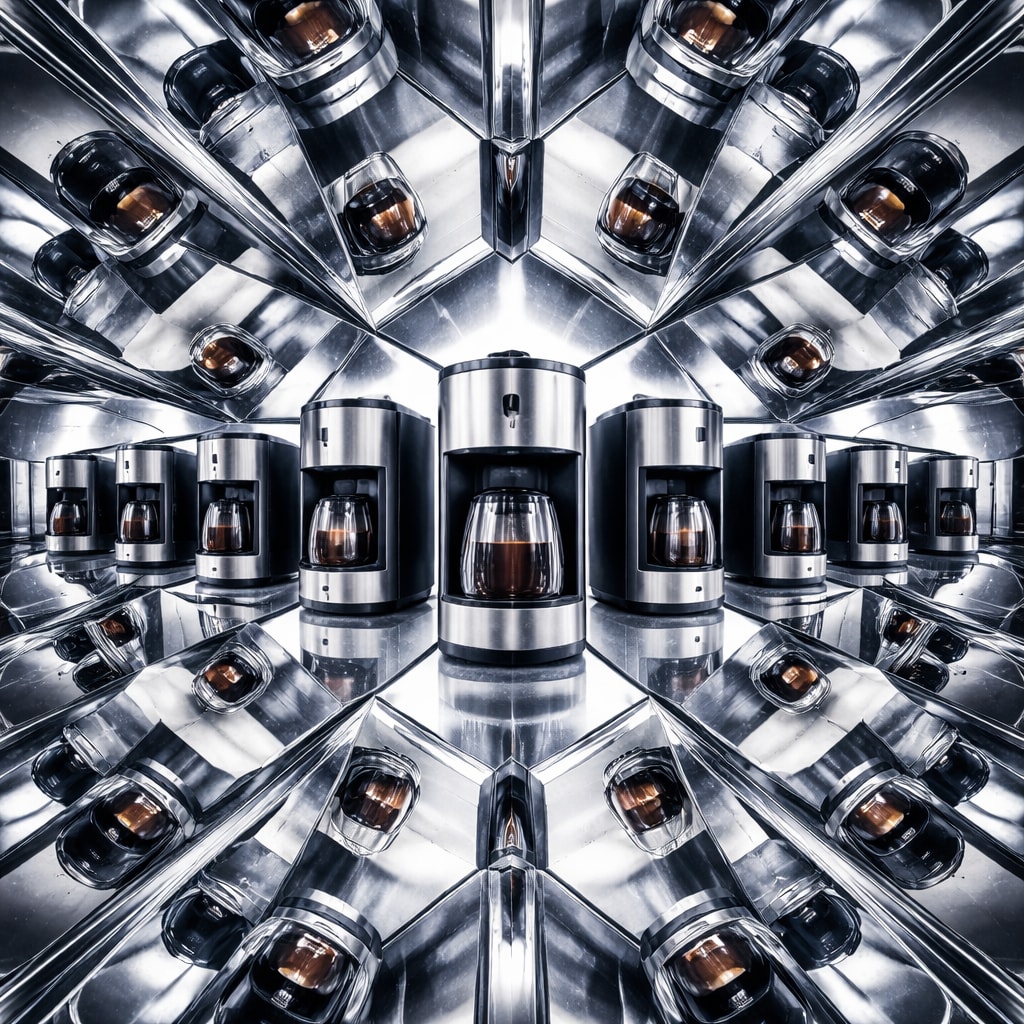
Attach an example product image with the prompt to get that product used in the generation.
PRODUCT reflected infinitely in angled mirror arrangement, kaleidoscopic effect, clean geometric multiplication, studio lighting creating precise reflections, optical illusion, maximalist minimalism, disorienting elegance, high-concept advertising
Product="product"
aspect_ratio="aspectratio"
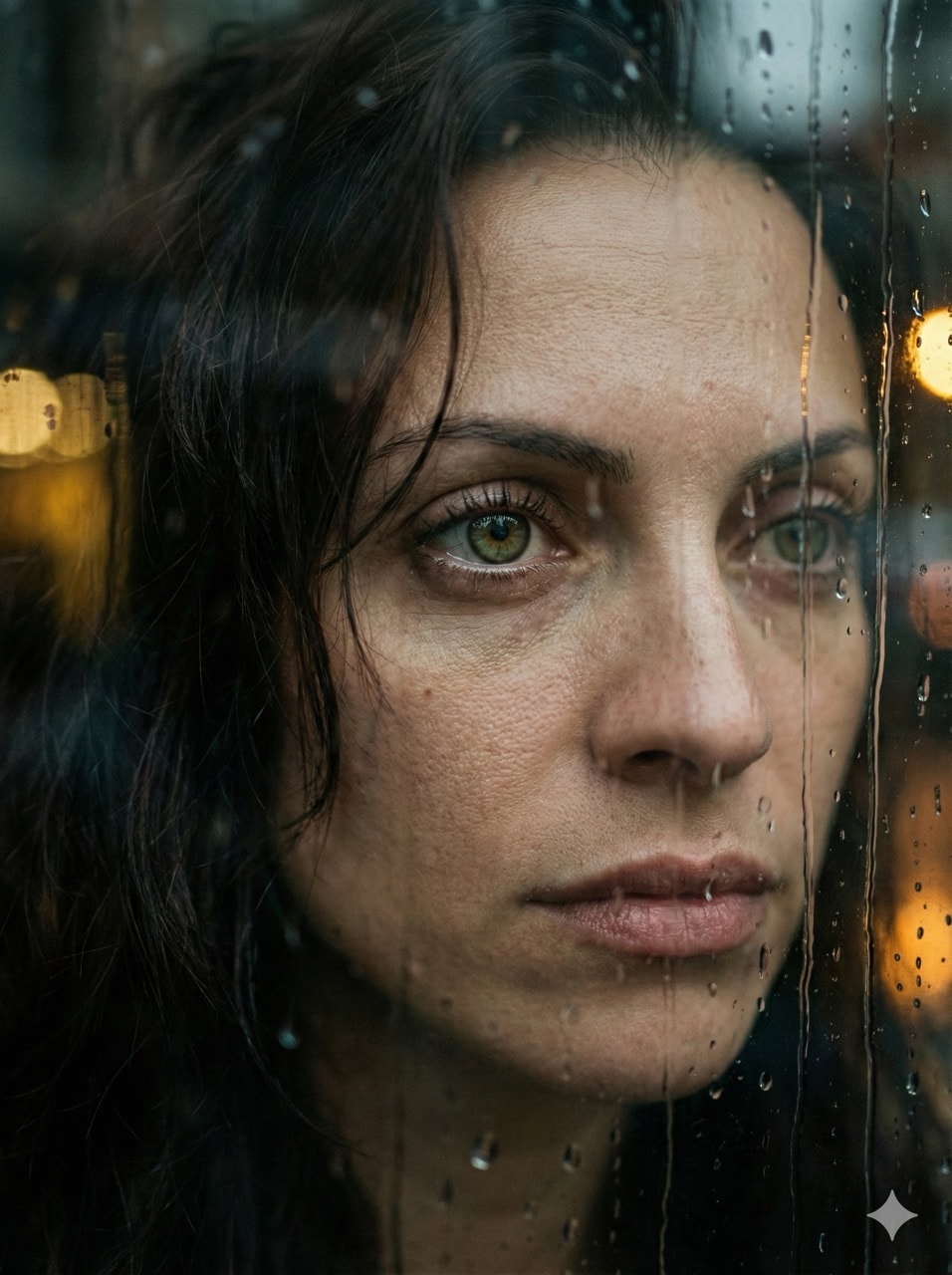
This prompt creates a cinematic close-up portrait shot through reflective glass, with a single green-hazel eye in sharp focus while the rest of the face softly fades into blur. Realistic rain droplets and warm bokeh reflections add emotional depth without obscuring key facial features. Natural skin texture, film grain, and shallow depth of field preserve an organic, story-driven look.
A cinematic, close-up portrait of a reference photo viewed through a reflective glass window. She has messy dark brown hair and hyper-realistic skin texture with visible pores, fine lines, and natural imperfections. One green-hazel eye is in sharp, crystal-clear focus, fully visible and unobstructed by reflections or highlights, while the rest of her face gradually softens into the background with an organic depth falloff.

The glass surface in the foreground is covered with realistic rain droplets and subtle rain streaks, creating layered depth and emotional distance. Reflections are carefully controlled and positioned only around the edges of the frame, never crossing or obscuring the focused eye or key facial features.

Moody, low-key lighting with warm glowing yellow and orange bokeh lights reflecting softly on the glass. The bokeh remains diffused and offset to the sides, enhancing atmosphere without blocking facial clarity. Shot with an extremely shallow depth of field (f/1.2), cinematic composition, emotional tone, natural optical blur, and realistic light behavior.

Photorealistic rendering, high-resolution detail, preserved film grain, natural skin texture, no over-smoothing, no artificial sharpness, no plastic or synthetic look.
Generate an image collage using a strict reference image, adhering to detailed wardrobe, scene, and aesthetic specifications.
1{2 "meta_protocols": {3 "reference_adherence": {4 "instruction": "Use the provided male face photo as a strict reference_image.",5 "tolerance": "Zero deviation",6 "parameters": "Preserve exact male facial proportions, skin texture, expression, age, and identity with 100% accuracy.",7 "stylization_constraint": "Do not beautify, feminize, or alter facial features in any way."8 },9 "format_style": "Editorial winter poster–style multi-panel collage",10 "aesthetic_quality": "Spontaneous iPhone photography (candid, cozy, realistic)",...+58 more lines
You've reached the end