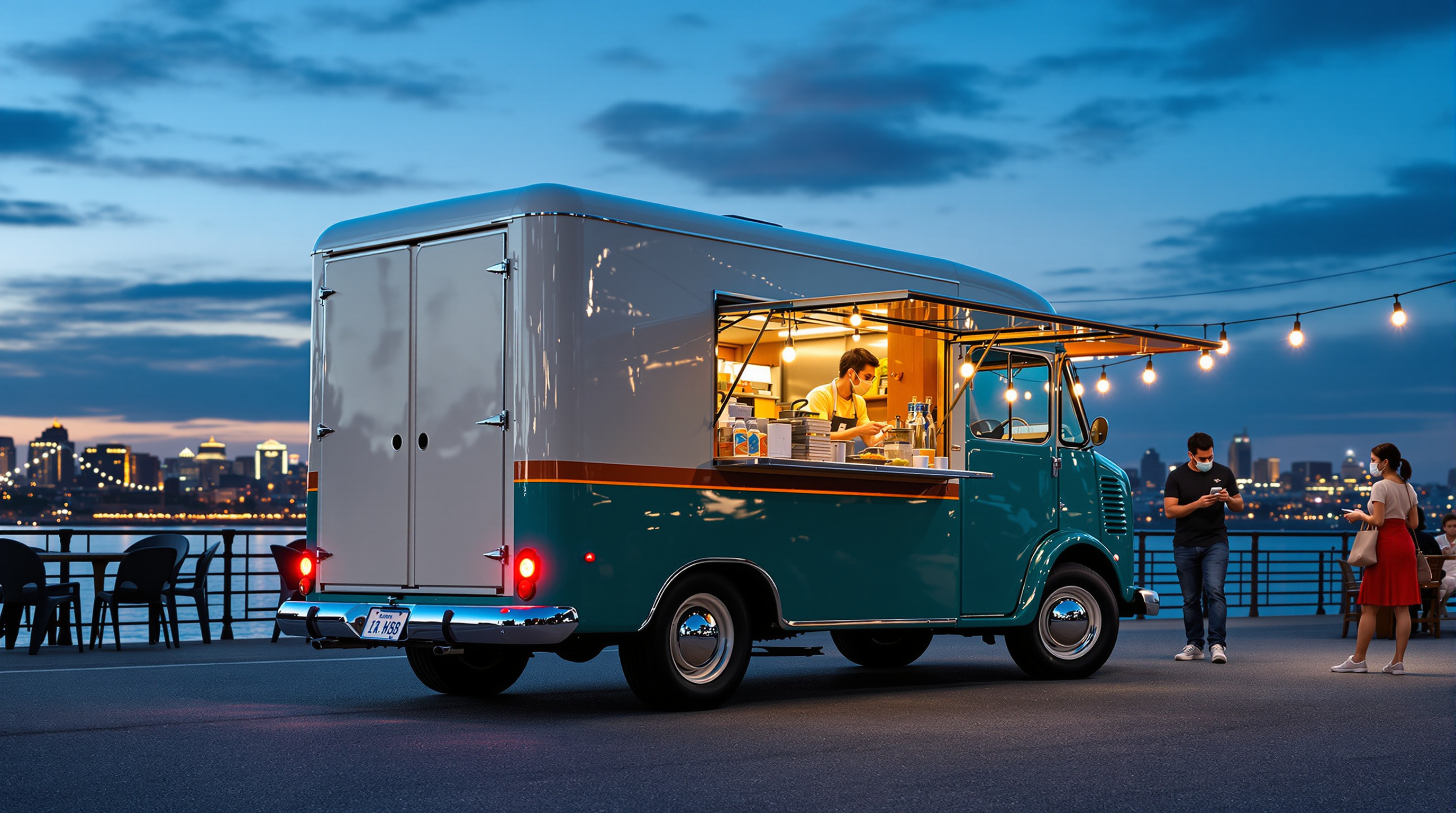
The same cream and deep teal food truck from step 2 during evening service at a riverside night market, seen from the rear right: round porthole rear doors, glowing tail lights, the big flat teal awning raised over the warmly lit serving window full of jars and flowers, chrome hubcaps and the copper-orange stripe, and a blurred queue at blue hour. Every fixed design detail is restated so the truck stays identical.
Photoreal photograph of the same restored compact 1960s-style step van food truck from step 2, now during evening service at a riverside night market at blue hour, seen in a rear right three-quarter view from standing eye level (1.6 m) about 9 m away, 35mm lens, 16:9 landscape composition with the whole truck in frame, slightly left of center. Keep every fixed design detail identical to step 2: a short boxy step van body about 5.5 m long with softly rounded corners, a rounded cab roof, and a flat box roof; two-tone paint, glossy cream on the upper half and deep teal on the lower half, separated by a thin copper-orange stripe running all around the body just below the windows; black tires with large polished chrome hubcaps; a chrome front bumper and round headlights at the front. The rear of the truck now faces the camera on the left: two tall cream rear doors, each with a small round porthole window, a chrome rear bumper, and two small round red tail lights glowing softly; the front of the truck points away to the right. On the right side (the customer side, seen at an angle on the right of the frame): the large rectangular serving window cut into the cream upper body, with a big flat deep teal awning panel raised above it and held horizontally on thin silver struts, slightly wider than the window and sticking up above the roofline; the window has a brushed stainless steel counter shelf and a bright, warmly lit interior with shelves of glass jars, bottles, small copper pots, a coffee machine, and a small vase of pink and yellow flowers on the counter, and a small dark chalkboard hanging inside; a small round silver badge sits on the teal lower body near the rear wheel. Warm light from the open window spills onto the ground. A cook in a dark apron works behind the counter, softly blurred. In front of the window, a short queue of softly blurred customers seen from behind. Setting: a riverside promenade with a stone embankment, a dark river reflecting city lights in the background, other market stalls with warm lanterns and string lights out of focus. Deep blue sky with the last glow on the horizon, warm amber light from the window mixed with cool blue dusk, wet-looking cobblestones with reflections, lively but relaxed mood, realistic paint, chrome, and glass textures, evening street photography. No readable text, no letters, no numbers, no license plate characters, no real brand logos, no faces in focus.
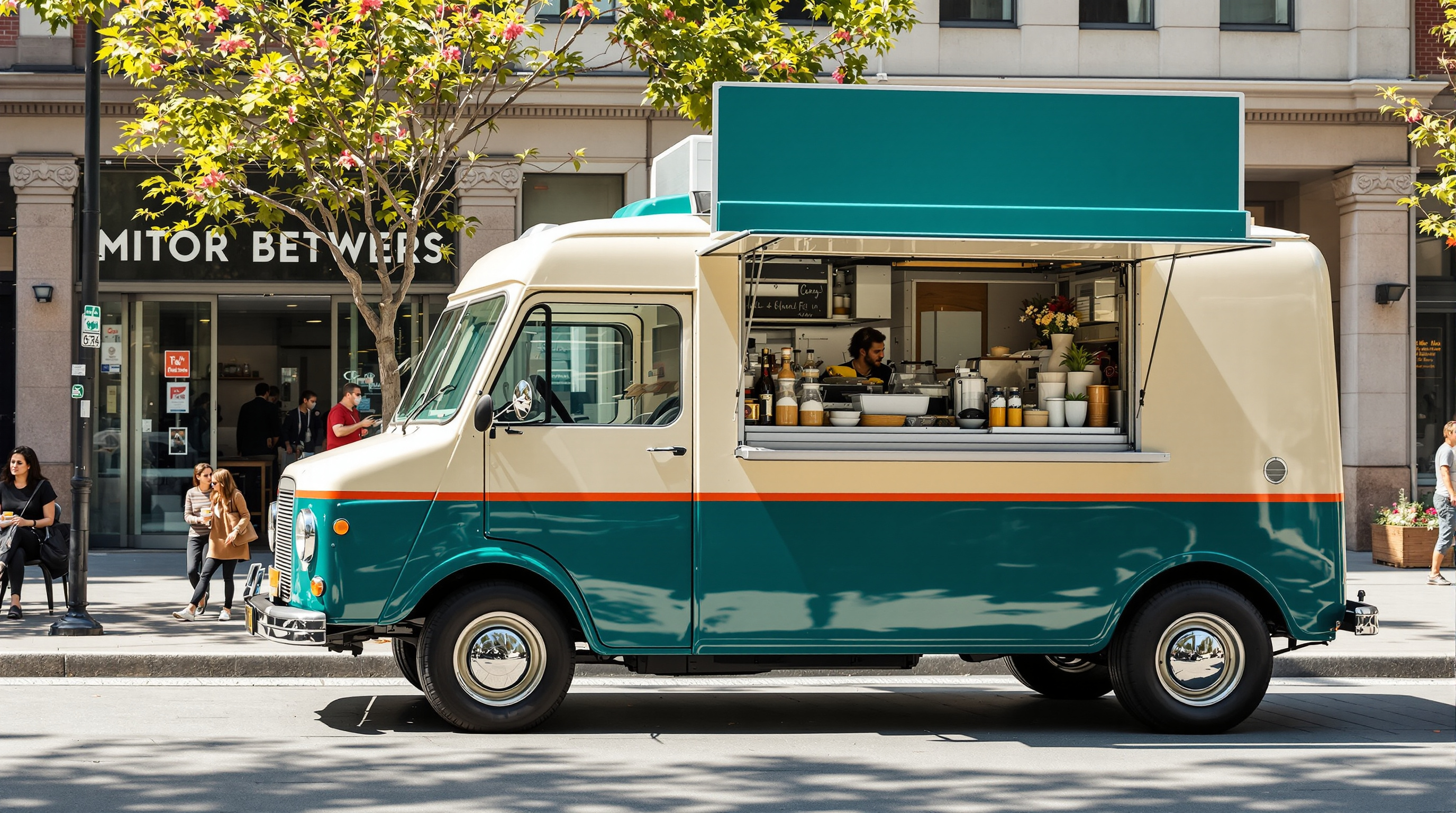
A photoreal street photo of a restored 1960s-style step van food truck in cream and deep teal with a copper-orange stripe, a propped-open teal serving hatch with a copper underside, a wordless sun-and-wheat emblem, a blank slate menu board with drawn icons, roof herb planter, and string lights, parked under plane trees at lunchtime. Example output of the Food Truck Concept Design Brief Builder (step 1).
Photoreal lifestyle photograph of a restored compact 1960s-style step van food truck parked in a sunny city plaza at weekday lunchtime, seen in a front right three-quarter view from standing eye level (1.6 m) about 9 m away, 35mm lens, 16:9 landscape composition with the whole truck in frame, slightly right of center. Fixed design details: a short boxy step van body about 5.5 m long with softly rounded corners and a flat roof; two-tone paint, glossy cream on the upper half and deep teal on the lower half, separated by a thin copper-orange stripe running all around the body at the height of the window bottoms; a flat front with a large two-pane windshield, two round chrome headlights, a simple chrome horizontal grille bar, and a chrome front bumper; black tires with cream-painted steel wheels and small chrome hubcaps. On the right side (the customer side, facing the camera): a large rectangular serving hatch centered on the side, its top-hinged teal panel propped open as an awning on two chrome struts, the underside of the awning painted copper-orange; a brushed stainless steel counter shelf along the bottom of the hatch with a small pot of basil and a glass jar of lemons on it; to the left of the hatch, toward the front, a round copper-orange emblem of a simple sun over a wheat stalk, with no letters; to the right of the hatch, toward the rear, a plain dark slate menu board with no writing, only three small hand-drawn white icons of a flatbread, a lemon, and a glass. Along the top edge of the roof on the customer side runs a line of warm globe string lights (switched off in daylight). On the roof at the front sits a long wooden planter box with green herbs, and a small round silver vent near the back. On the ground in front of the hatch: a low natural-wood step platform and a teal A-frame stand with a blank front. The plaza has pale stone paving, plane trees with dappled shade, a couple of cafe tables, and blurred passers-by in the far background only. Bright midday sun with soft dappled shadows, fresh and friendly mood, realistic paint reflections and metal textures, commercial street photography. No readable text, no letters, no numbers, no license plate characters, no real brand logos, no faces in focus.
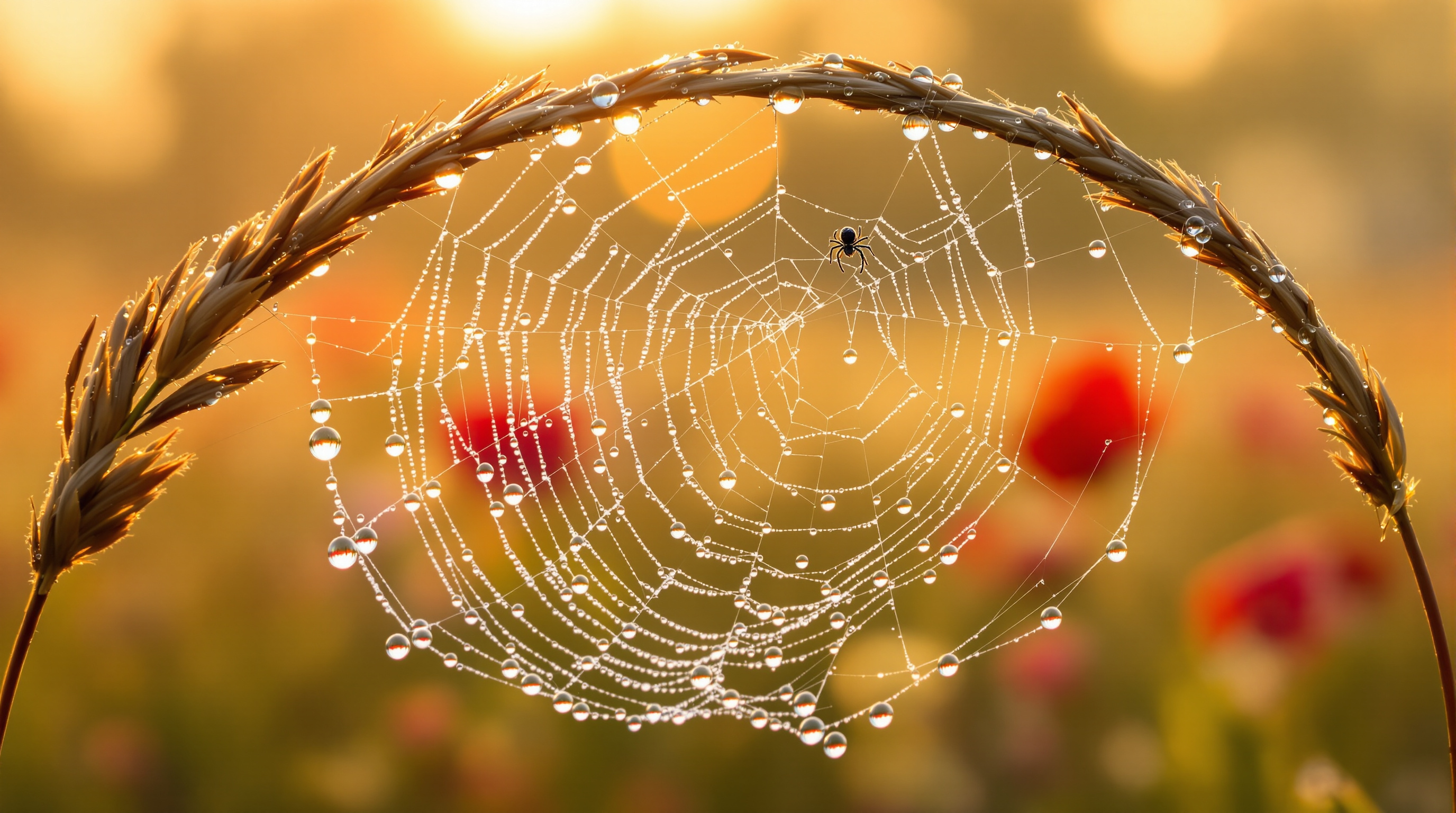
An extreme close-up nature photo of a dew-covered orb web between dry grass stems, where the sharpest drops each hold a tiny upside-down reflection of a golden sunrise meadow with poppies, with a razor-thin focus plane, rainbow refraction, and soft gold and green bokeh behind.
An extreme close-up macro photograph of an orb spider web covered in morning dew, stretched between two arching stems of dry meadow grass, composed as a wide 16:9 landscape. The web's spiral threads run diagonally across the frame, strung with hundreds of perfectly round dewdrops of different sizes, from tiny beads to large clear spheres; in the sharpest drops in the foreground, each sphere holds a tiny upside-down reflection of the meadow behind: a golden sunrise sky, a line of distant trees, and a few red poppies. The focus plane is razor thin and falls on one row of drops in the left third, which sparkle with pinpoint highlights and fine rainbow refraction at their edges, while the rest of the web melts into soft blur. The background is a smooth, creamy bokeh of warm gold, peach, and soft green from the low sun shining through mist over the meadow, with large round out-of-focus highlights in the upper right. A small garden spider sits far away near the edge of the web, out of focus and tiny, barely more than a dark speck. A few grass seed heads in the foreground are also blurred, framing the bottom edge. Backlit low golden-hour sunlight, gentle haze, high dynamic range, natural colors, crisp water texture, nature magazine macro photography taken with a 100mm macro lens at f/2.8, serene and delicate mood. No people, no text, no watermark.
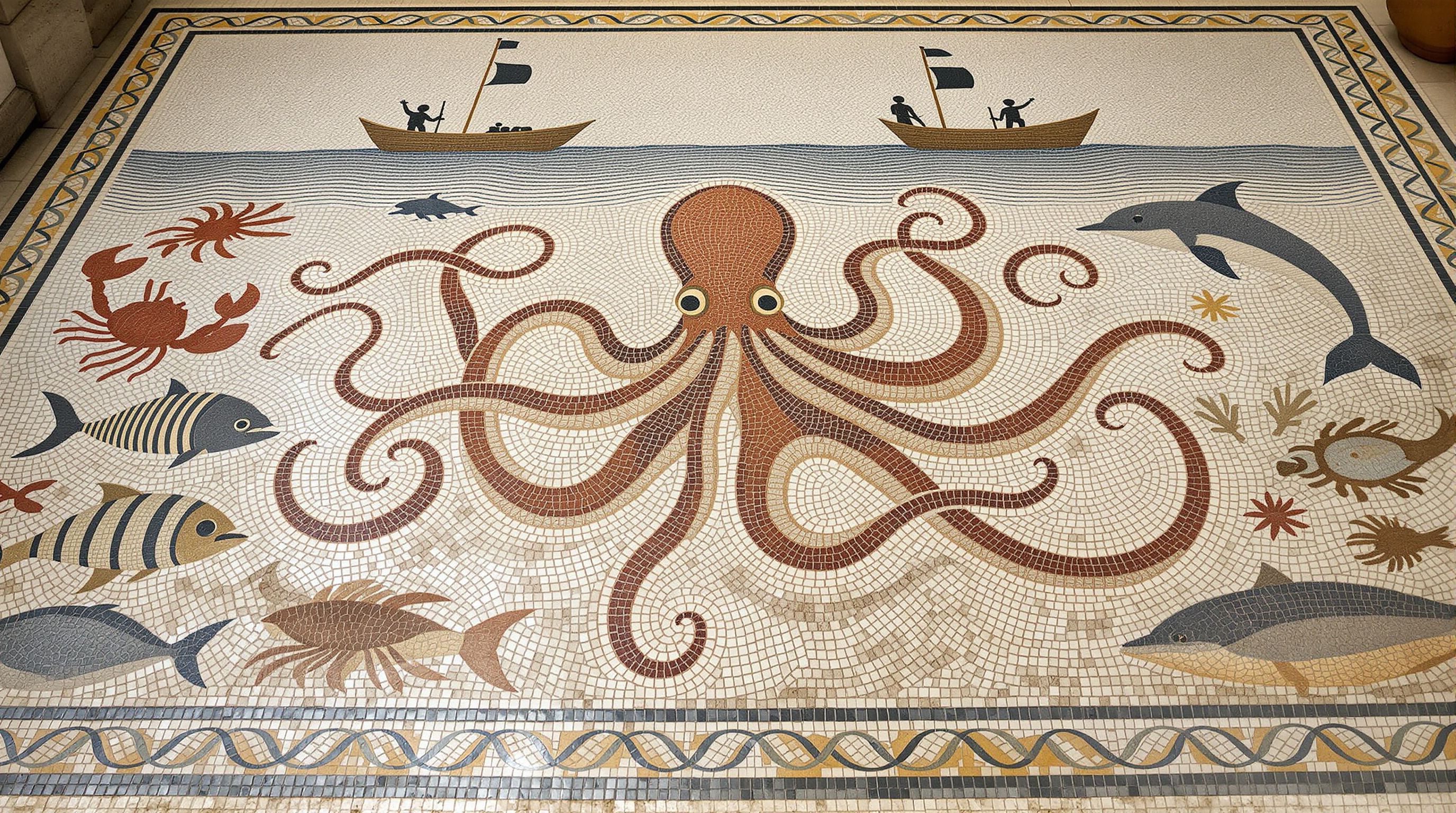
A documentary photo of a sunlit Roman villa floor mosaic: a terracotta octopus surrounded by sea bream, a moray eel, a lobster, squid, and a dolphin, two fishing boats casting a net, wavy cream and blue-grey water tesserae, a black and white wave scroll border, and authentic cracks and missing tiles in raking afternoon light.
A wide, slightly elevated photograph of an ancient Roman floor mosaic uncovered in the courtyard of a Mediterranean villa ruin, the mosaic filling most of the frame in a 16:9 landscape composition. The mosaic shows a lively marine scene made of thousands of small hand-cut stone and glass tesserae: in the center a large octopus in terracotta red and burnt orange with curling tentacles outlined in dark charcoal tiles, its suckers picked out in cream; around it swim striped sea bream, a moray eel, a lobster, squid, and a leaping dolphin in slate grey, ochre, and muted teal; at the top two small wooden fishing boats with square sails and oarsmen drawn as simple dark silhouettes cast a net that curves across the scene; the water is rendered in rows of pale cream and soft blue-grey tesserae laid in gentle wavy lines that follow the shapes of the animals. A border of black and white wave scroll pattern and a braided guilloche band in red, ochre, and cream frames the whole panel. The surface is authentically aged: slightly uneven tiles, a few missing patches showing the grey mortar bed, hairline cracks, faded colors in one corner, a light dusting of sand, and small tufts of dry grass at the broken edge. Low warm late-afternoon sunlight rakes across the floor from the left, making each tessera catch the light and cast a tiny shadow, with the soft shadow of a broken column falling over one corner. Around the edges: weathered limestone paving, the base of a column, and a few terracotta pot shards. Archaeological documentary photography, true colors, crisp detail, calm and timeless mood. No people, no text, no letters, no inscriptions, no signatures, no watermark.
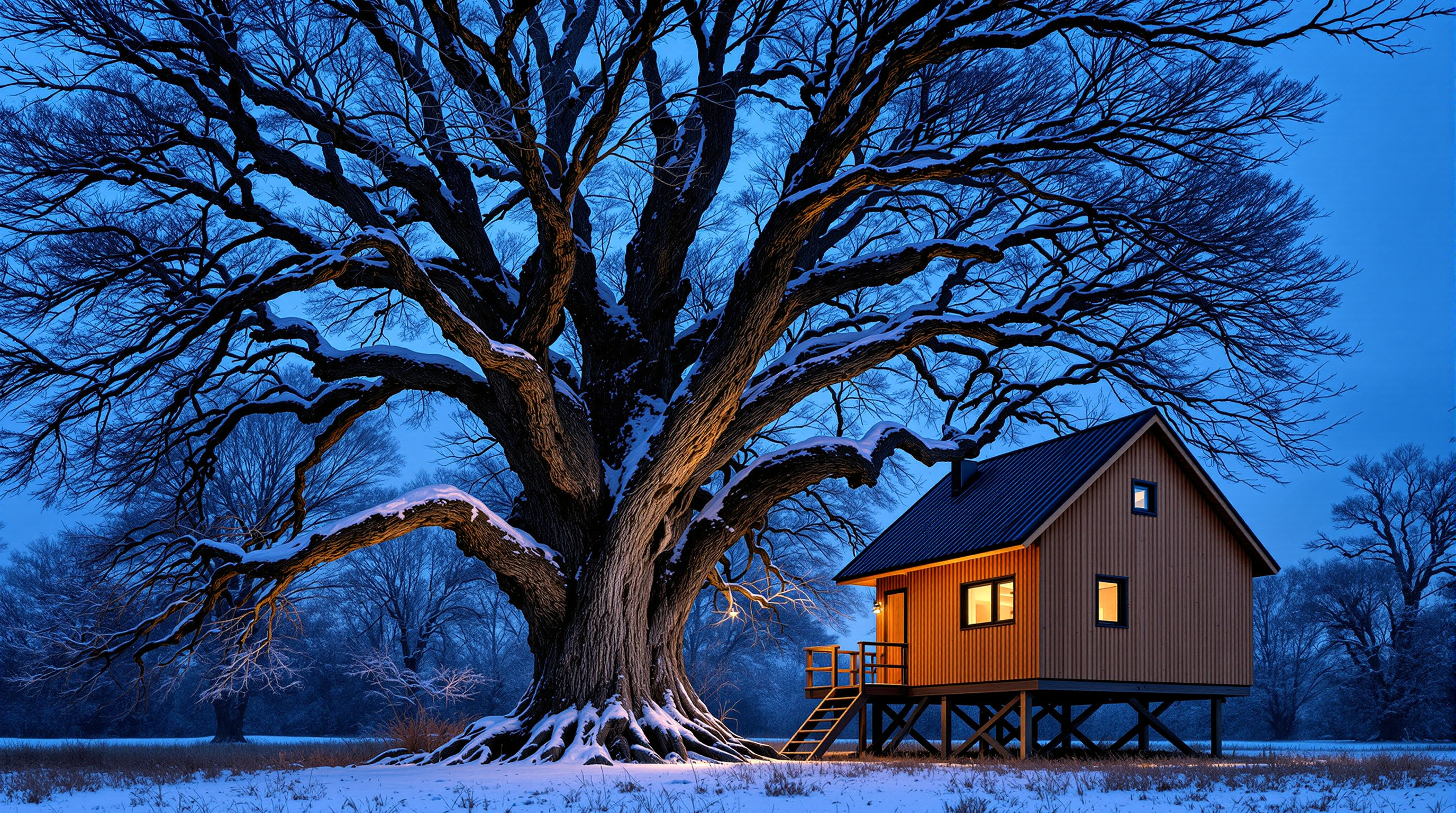
The same cedar treehouse cabin from step 2 on a snowy blue-hour evening, seen from the front right: the bare old oak lined with snow, glowing floor-to-ceiling windows and string lights on the deck, and snowy stairs with footprints in the foreground. Every fixed design detail is restated so the building stays identical.
Photoreal architectural photograph of the same small cedar treehouse cabin and old oak from step 2, now on a snowy winter evening at blue hour, seen from the meadow at the front right instead of from the left, camera at standing eye level (1.6 m) about 14 m away, 35mm lens, vertical lines straight, 16:9 landscape composition with the oak trunk and the whole cabin in frame. Keep every fixed design detail identical to step 2. Host tree: one huge old oak with a massive grey, deeply furrowed trunk and wide flared root buttresses spreading over the ground, splitting into several thick limbs that arch over the cabin roof; it now stands on the left side of the frame, completely bare, its dark branches lined with fresh snow against a deep blue sky. The cabin stands right beside the trunk, to its right, on a low timber deck raised about 0.6 m on short square timber posts. Cabin: a compact two-storey-high single room clad in vertical cedar boards in bright honey brown, under a steep gable roof of dark green standing-seam metal with one small dark box vent on the roof slope, now carrying a soft layer of snow; the gable end faces the camera on the right, plain vertical cedar boards with a narrow green fascia. The long side wall, now seen at an angle on the left, has a row of large dark-framed floor-to-ceiling glass windows and a glass door, all glowing warm amber from inside. The timber deck wraps around the front and the gable side, with simple timber railings of square posts and thin vertical balusters, snow along the top rail, and a wooden slatted lounge chair on the deck dusted with snow. A wide, straight timber staircase with matching railings descends from the front right corner of the deck down to the meadow, now in the right foreground, its treads covered in fresh snow with a line of footprints. Warm globe string lights hang along the deck railing, glowing. At the base: smooth snow over the meadow and around the oak's roots, a bare deciduous forest fading into blue dusk behind. Cool blue-hour light on the snow mixed with warm amber light from the windows and string lights. Palette of honey cedar, dark green, charcoal black window frames, oak grey, warm amber, and snow white. Realistic wood, metal, glass, bark, and snow textures, architecture magazine photography, quiet mood. No people, no text, no logos, no signs.
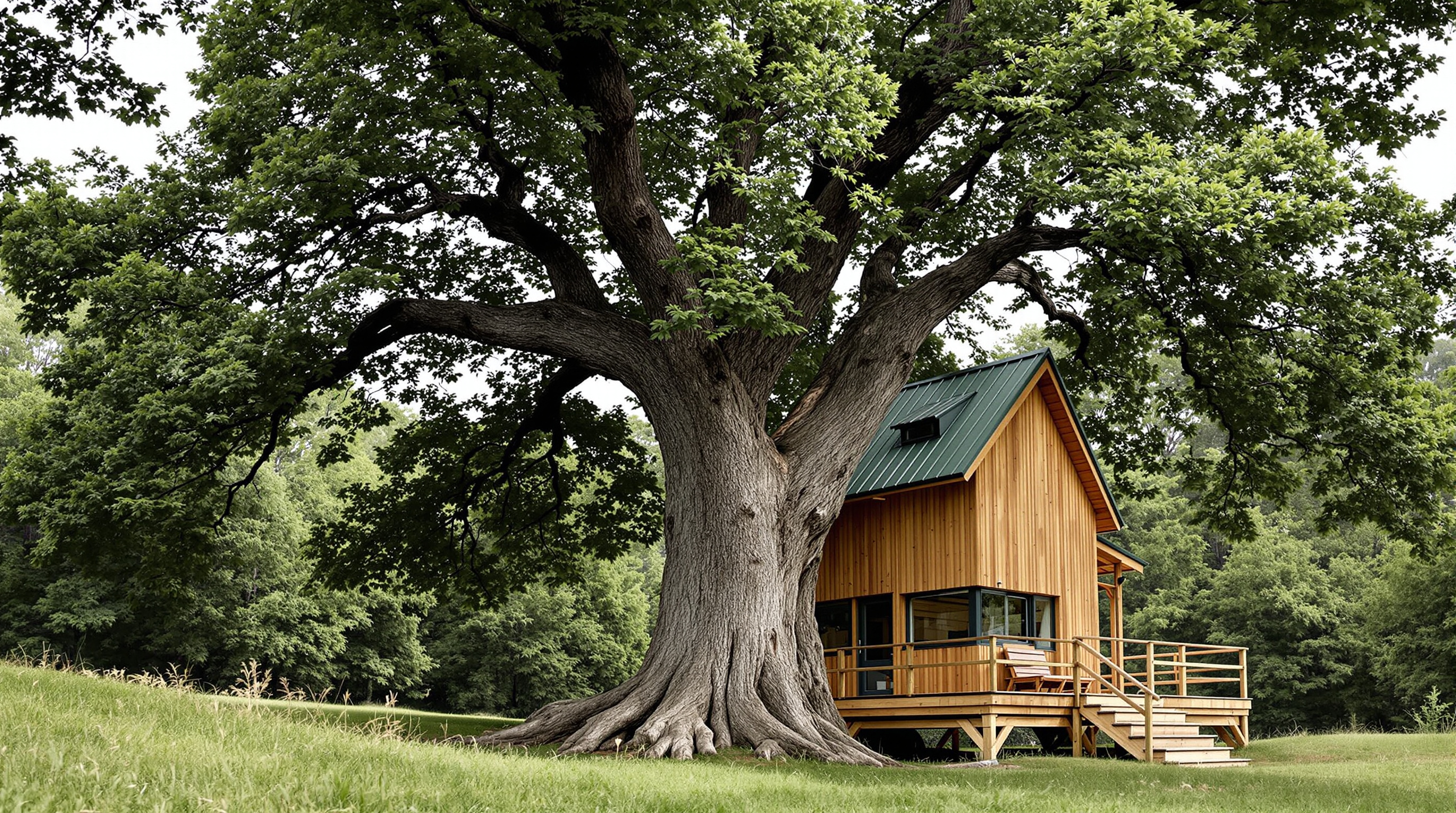
A photoreal architectural photo of a honey-cedar treehouse with a dark green metal gable roof, a wraparound black corner window, porthole, and teal-blue Dutch door, on a rope-railed deck in a huge old oak, with a rope swing and timber stairs in a sunny summer meadow. Example output of the Treehouse Retreat Concept Brief Builder (step 1).
Photoreal architectural photograph of a small timber treehouse retreat built into a single huge old oak tree, standing in a sloping summer meadow at the edge of a beech forest, seen from the meadow at the front left, camera at standing eye level (1.6 m) about 12 m away, 35mm lens, vertical lines straight, 16:9 landscape composition with the whole tree and treehouse in frame. The oak has a massive grey, deeply furrowed trunk about 1.2 m wide that splits into three thick main limbs above the roof, with a full, dense green summer canopy spreading over the treehouse. A square timber deck about 3.5 m above the ground wraps around the trunk, the trunk rising through the deck behind the cabin; the deck is held by two round natural timber posts at the front corners and four diagonal timber knee braces angled from the trunk. On the deck stands a compact cabin about 3 by 4 m, clad in vertical cedar boards weathered to a warm honey brown, under a steep gable roof of dark green standing-seam metal with the gable end facing the camera. Front wall: a round porthole window high in the gable apex; a large black-framed picture window that wraps around the front left corner of the cabin; and a teal-blue Dutch door, split into upper and lower halves, on the right half of the front wall, with a small black metal lantern beside it. A slim black stove chimney pipe rises from the right side of the roof. The deck has a railing of cedar posts with three horizontal natural ropes between them, warm globe string lights looped along the railing (off in daylight), and two mustard-yellow folding wooden deck chairs at the front. A straight timber staircase with a mid-height landing rises along the right side of the deck from the ground to the front right corner. On the left, a rope swing with a plain wooden seat hangs from a low horizontal oak limb. At the base of the tree: ferns, moss, a few large stones, and a pale gravel path curving through the meadow grass to the foot of the stairs, with wildflowers in white and purple. Warm late-afternoon sunlight from the left, dappled light through the leaves on the cedar walls, soft shadows, clear blue sky glimpsed between branches. Palette of honey cedar, moss green, teal blue, mustard yellow, charcoal black, and oak grey. Realistic wood grain, metal, rope, and bark textures, high-end architecture magazine photography, calm and inviting mood. No people, no text, no logos, no signs.
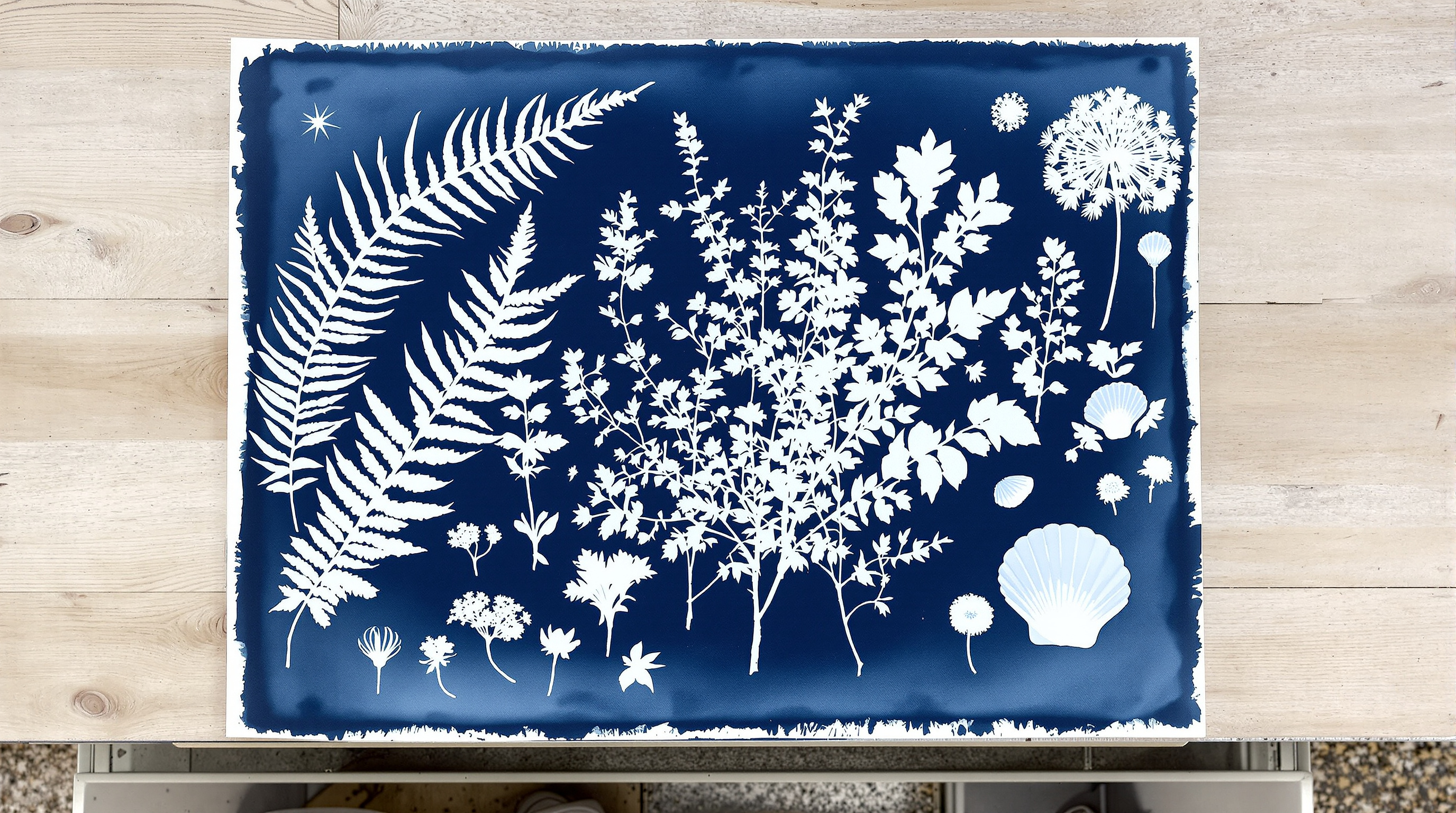
A flat-lay photo of a handmade cyanotype on cotton paper: white silhouettes of ferns, sea lavender, bladderwrack seaweed, ginkgo leaves, and a scallop shell glowing on deep Prussian blue, with brushy hand-coated borders and printmaking tools on a pale oak table.
A wide, flat-lay photograph of a large handmade cyanotype print lying on a weathered pale oak worktable, the print filling most of the frame. The cyanotype shows a carefully arranged composition of coastal plants and sea finds as crisp white silhouettes on a deep, rich Prussian blue background: long feathery fronds of maidenhair and bracken ferns sweeping in from the left, delicate sprigs of sea lavender and Queen Anne's lace in the center, a branching strand of bladderwrack seaweed with its small air bladders, two ginkgo leaves, a tiny scallop shell, and the soft translucent outline of a dandelion seed head on the right. Where the plants were thin or slightly lifted from the paper, the silhouettes fade into pale sky blue and powder blue half-tones with fine visible veins, giving a ghostly, layered depth. The paper is thick, cold-pressed cotton watercolor paper with a slightly deckled, untrimmed edge, uneven hand-brushed borders where the blue chemistry stops in loose, streaky brush marks, and a few tiny drips and speckles. Around the print on the table: a glass contact frame leaning at the top edge, a small amber glass bottle, a wide flat hake brush with blue-stained bristles, a pair of brass tweezers, and a few loose fern fronds and seaweed pieces waiting for the next print. Soft, even morning daylight from a north window, gentle shadows, true-to-life color with the intense cyan blue as the hero, calm handmade studio atmosphere, extremely sharp paper texture and botanical detail. Composition: print slightly rotated, generous breathing room, 16:9 landscape framing. No people, no hands, no text, no labels, no signature, no watermark.
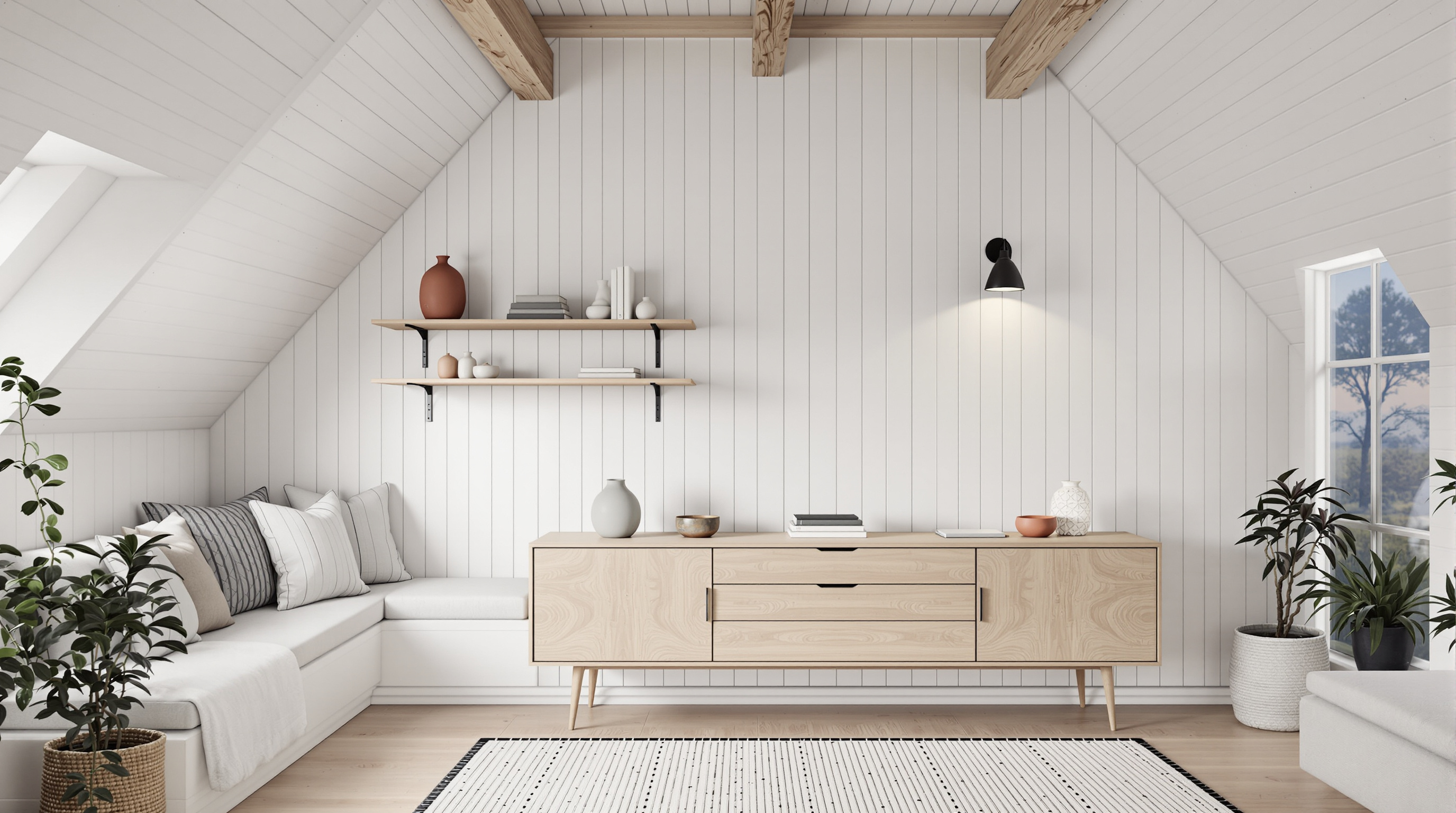
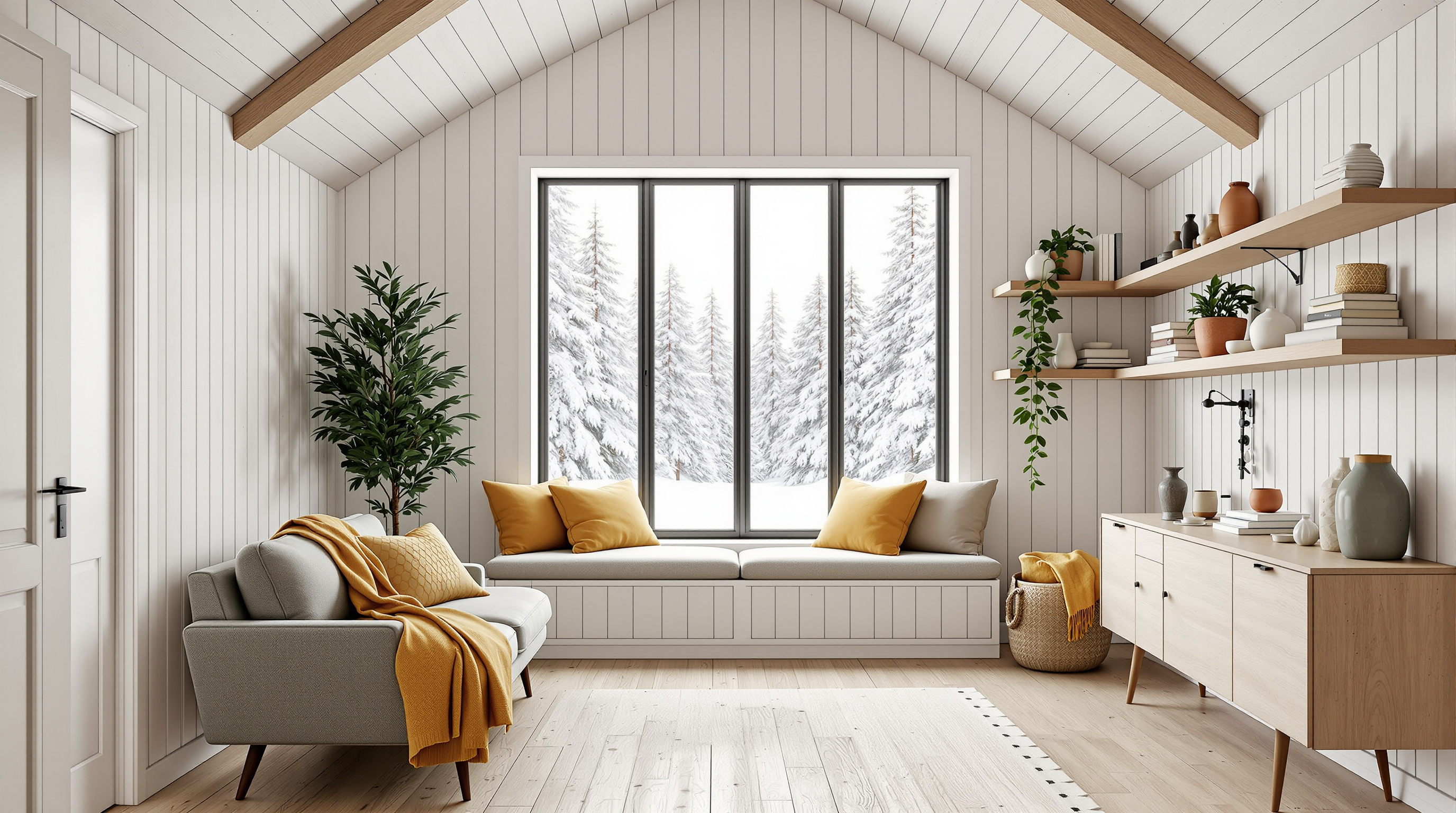
The same Nordic cabin living room from step 2, now seen from the window seat looking back toward the entry wall at blue hour, with the wall sconce and paper lamp glowing. Every fixed design detail is restated so the room stays identical, with left and right swapped for the reversed camera.
Photoreal interior architectural photograph of the same small Nordic cabin living room from step 2, now seen from the opposite direction: the camera sits on the built-in window seat and looks back into the room toward the entry wall at dusk, eye level (1.2 m), 24mm lens, vertical lines straight. Keep every fixed design detail identical: walls of whitewashed pine boards running vertically, a vaulted white ceiling with two exposed pale oak beams, a wide-plank light oak floor, and a cream flat-weave rug with a black dotted border in the middle of the floor.

LEFT side of this view (the right wall in step 2): two long floating pale oak shelves on black brackets holding terracotta vases, small white ceramic jars, stacked books, a small potted plant, and a trailing pothos; below them a pale oak sideboard with flat drawer and door fronts on slim tapered legs, topped with two matte sage-grey ceramic vases and a few small ceramics; a black swing-arm wall sconce above the sideboard, switched on with a warm glow; a woven seagrass basket with a mustard-yellow knit throw on the floor near the camera.

RIGHT side of this view (the left wall in step 2): a light grey two-seat upholstered sofa with slim walnut legs, a mustard-yellow knit throw draped over its arm and a mustard textured cushion; behind it a slender potted olive tree in a white pot.

Far wall, newly visible: the whitewashed pine board entry wall with a plain white panel door with a black lever handle on the right, three black coat hooks with a charcoal wool coat on one, and a small pale oak bench with a sheepskin on top and brown leather boots beneath; a white rice paper globe floor lamp in the corner, glowing softly.

Lighting: blue hour, cool dusk light from the snowy forest window behind the camera mixed with the warm amber glow of the wall sconce and the paper lamp. Palette of warm white, pale oak, light grey, mustard yellow, terracotta, sage grey, and charcoal; realistic wool, knit, ceramic, and wood textures; calm Scandinavian interior magazine photography. No people, no text, no logos, no clutter. 16:9 wide composition.
A photoreal interior concept render of a small Nordic cabin living room seen from the entry door in soft winter daylight: sage-green boucle sofa, rust leather sling chair by a black wood stove, walnut coffee table, paper globe pendant, and a picture window onto a snowy pine forest. Example output of the Room Makeover Concept Brief Builder (step 1).
Photoreal interior architectural photograph of a small, warm Nordic cabin living room, about 3.5 by 4.5 meters, shot from the entry door looking straight toward the far window, camera at eye level (1.4 m), 24mm lens, vertical lines perfectly straight. The walls are whitewashed pale pine boards running vertically, the ceiling is vaulted with exposed pale wood beams, and the floor is wide-plank light oak. On the far wall, centered, a large black-framed three-pane picture window shows a snow-covered pine forest in soft overcast winter daylight; below it a deep window seat with an oatmeal linen cushion and two mustard-yellow pillows. In the far left corner, a potted olive tree in a terracotta pot. Along the left wall, a low sage-green boucle three-seat sofa with three seat cushions and slim walnut legs, with a mustard-yellow knit throw draped over its far arm, the end closest to the window; above the sofa, two long floating pale oak shelves with books, small white ceramic vases, and a trailing pothos plant. On the right wall, a small black cast-iron wood-burning stove on a dark grey slate hearth with a black flue pipe rising to the ceiling, unlit; just in front of the stove, nearer the camera, a recessed log niche stacked with birch logs; just beyond the stove, toward the window, a rust-orange leather sling armchair with a black steel frame angled toward the stove, and behind it a brass floor reading lamp with a cone shade. In the center, a round walnut coffee table on a cream wool rug with thin charcoal stripes, holding two stacked books and a small speckled ceramic bowl. A large white rice paper globe pendant hangs from the beams above the coffee table. Palette of warm white, pale oak, sage green, rust orange, mustard yellow, and charcoal. Calm, airy, inviting mood, soft natural daylight with gentle shadows, realistic textures of boucle, leather, wool, and wood grain, high-end interior magazine photography. No people, no text, no logos, no clutter. 16:9 wide composition.
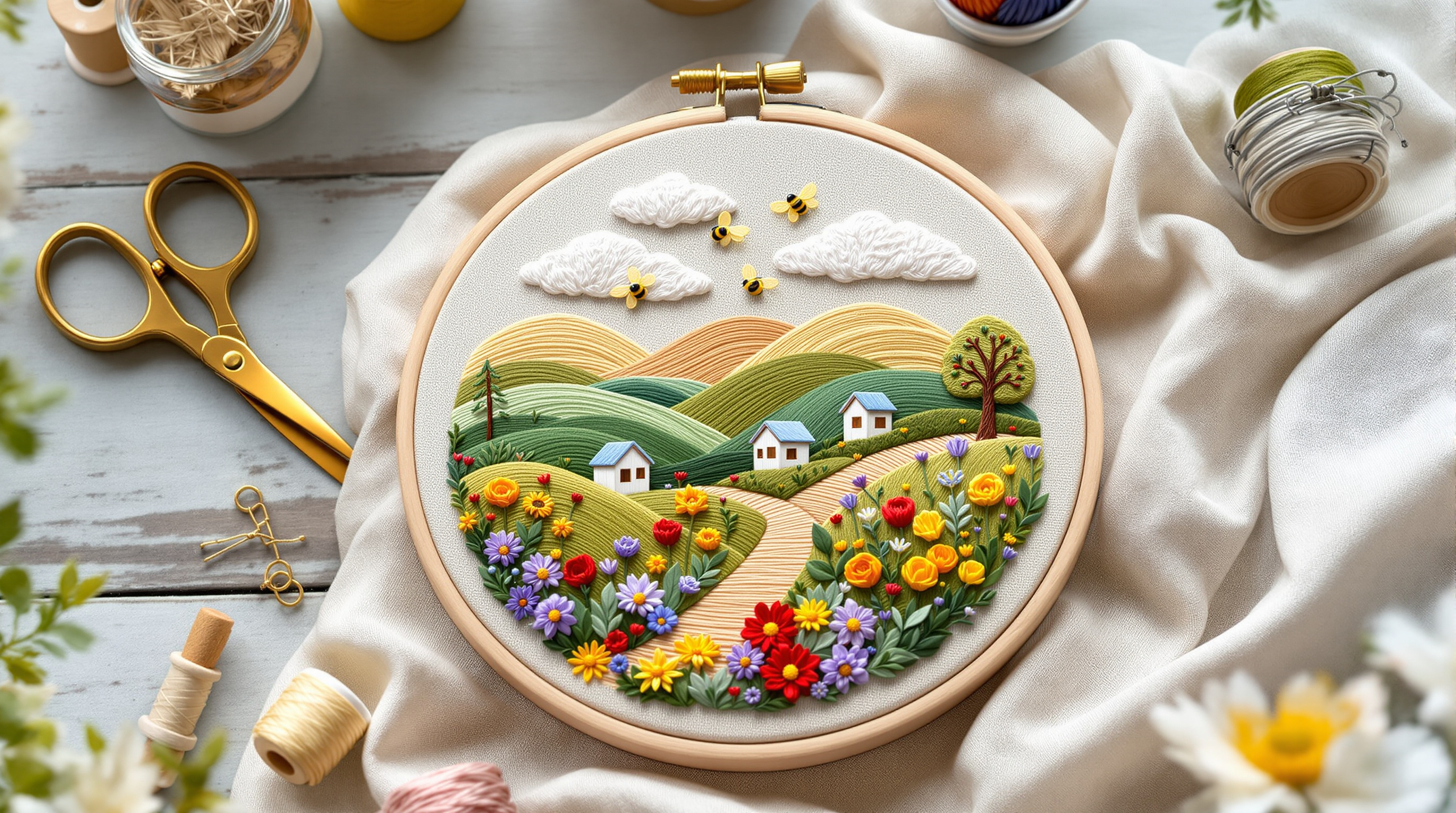
A macro photograph of a finished embroidery hoop showing a stitched hillside meadow with tiny white beehives, French knot wildflowers, and organza-winged bees on linen, styled on an oak table with scissors, floss, and dried lavender in soft window light.
A close-up photograph of a finished hand-embroidered hoop art piece lying on a weathered pale oak table, showing a tiny hillside meadow with a beekeeping scene stitched in colorful cotton and silk threads on natural linen fabric. Inside the round wooden embroidery hoop: three small white wooden beehives on a gentle green slope, rolling hills in layered satin stitch in sage, moss, and olive green, a winding path in tan backstitch, and a meadow full of wildflowers made with French knots, lazy daisy stitches, and bullion knots in lavender, buttercup yellow, poppy red, and cornflower blue. Tiny bees made of yellow and black thread with translucent organza wings hover over the flowers, a small apple tree with knotted red fruit stands to one side, and soft clouds in white padded satin stitch float in a pale blue split-stitch sky. Around the hoop on the table: a pair of small gold stork-shaped embroidery scissors, a wooden spool of thread, a few loose skeins of floss in matching colors, a needle with a trailing strand, and a sprig of dried lavender. Soft diffused window light from the left, shallow depth of field with the hoop sharp and the props gently blurred, macro detail showing raised thread texture, individual fibers, and the linen weave. Warm, calm, handmade, cottagecore mood, natural colors, photographed with a 100mm macro lens. No people, no hands, no text, no brand labels on the thread. Square 1:1 aspect ratio, hoop centered and slightly overlapping the frame edge at the bottom right.
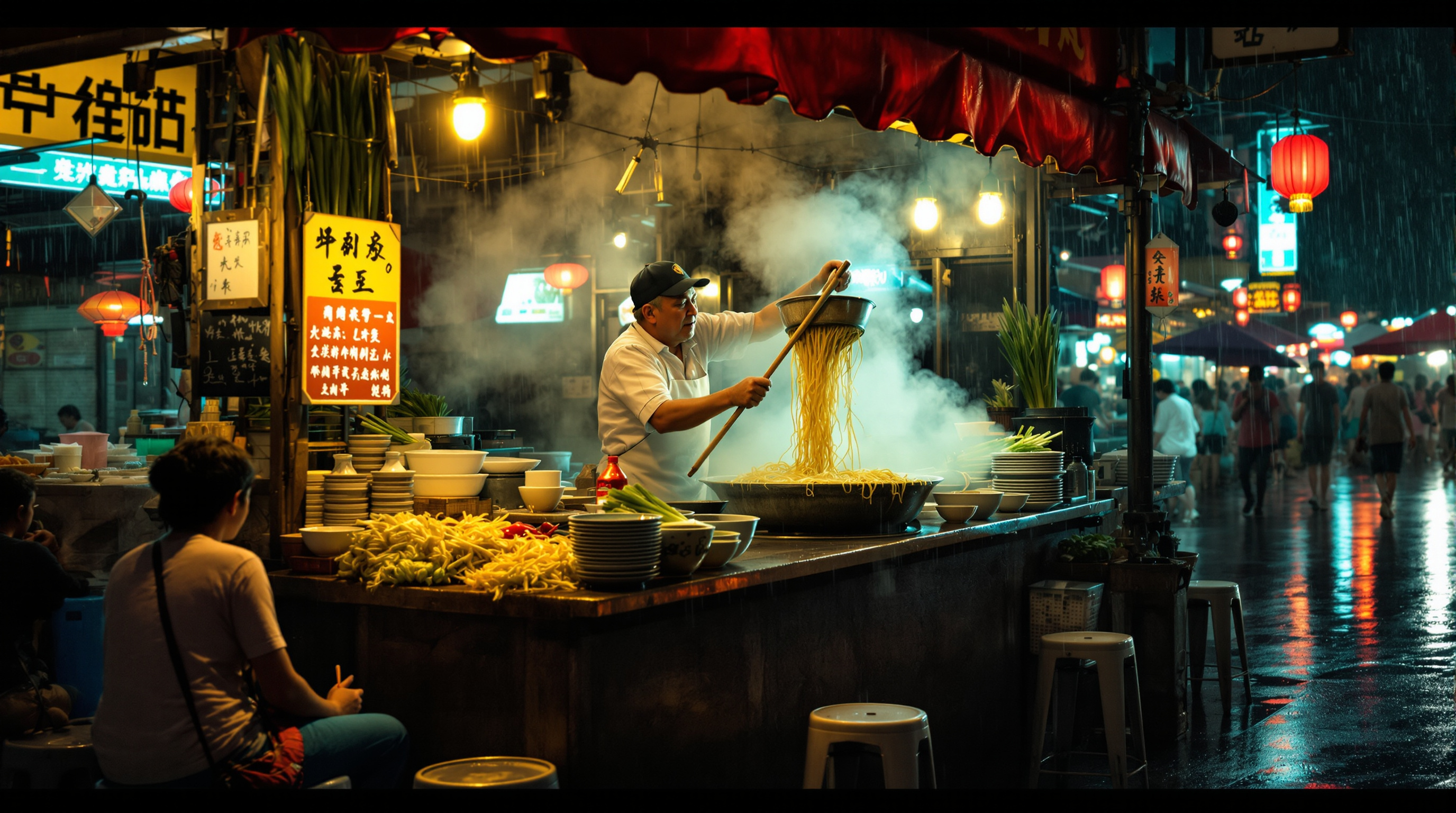
A photoreal, cinematic street photograph of a cook lifting fresh noodles from a steaming pot at a rainy night market stall, with warm bulbs, glowing steam, and colorful reflections on wet pavement.
A photorealistic street-level night photograph of a busy noodle stall at an open-air Asian night market during light rain. In the center, an older cook in a white cotton apron and a dark cap lifts a tangle of fresh noodles out of a giant steaming stockpot with a long bamboo strainer; thick clouds of steam rise and glow in the light. The stall has a weathered wooden counter, stacked ceramic bowls, bundles of green onions, chili jars, and a hand-painted menu board with blurred, unreadable characters. Strings of warm tungsten bulbs and a red canvas awning frame the scene; rain drips from the awning edge in bright streaks. Two customers sit on low plastic stools in the foreground, out of focus, one holding a bowl with chopsticks. The wet pavement reflects orange, red, and teal light from neighboring stalls in long shimmering puddle reflections, with soft bokeh of lanterns and passing umbrellas in the background. Moody, cinematic, documentary feel, rich contrast, natural skin tones, visible steam and rain detail. Shot on a full-frame camera with a 35mm lens at f/1.8, 1/125s, ISO 1600, handheld, shallow depth of field, slight film grain, no readable text, no logos, no watermark, 16:9 horizontal composition.
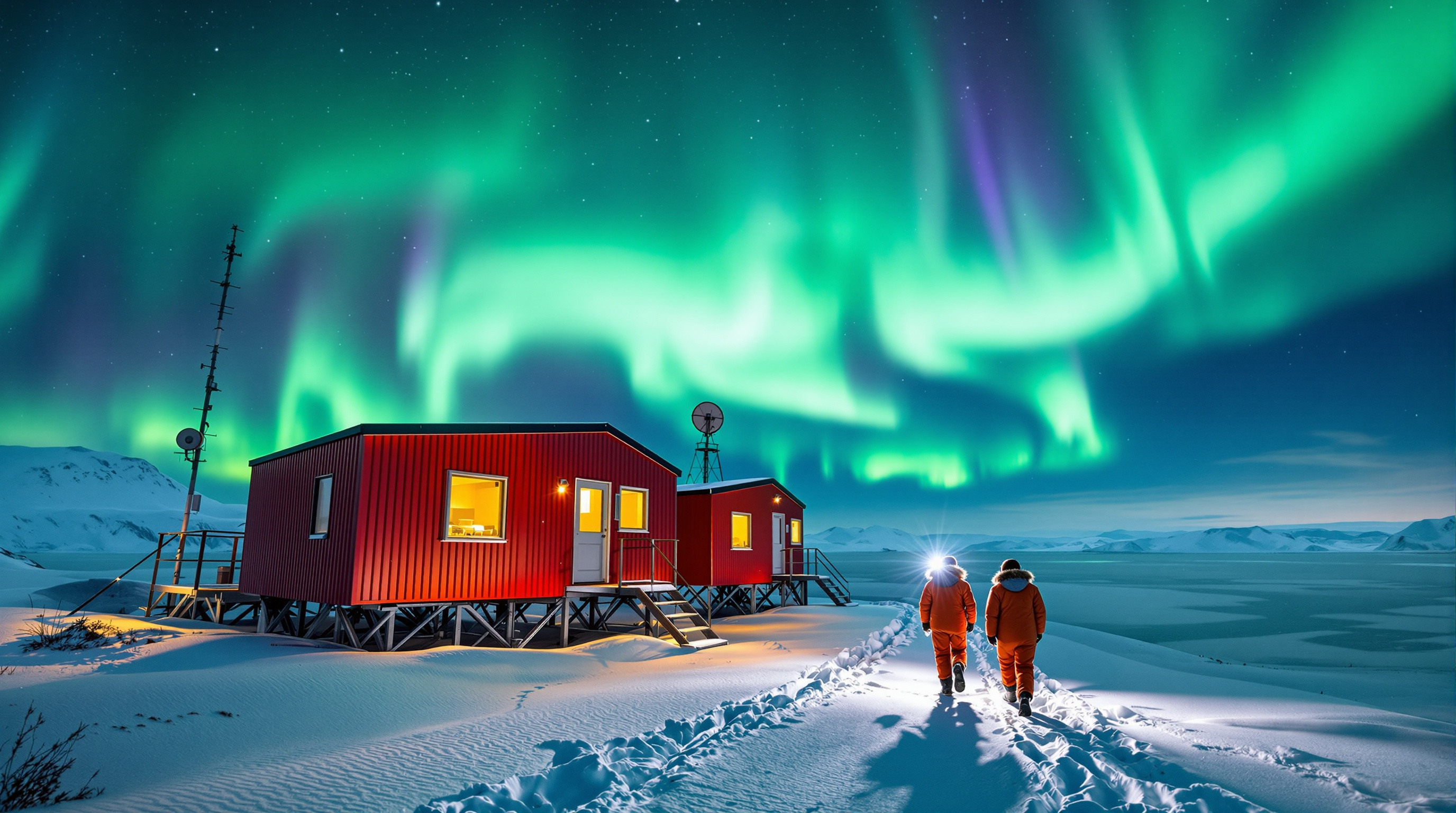
A photoreal, wide-angle night photograph of a small polar research station on a snowy ridge, with warm cabin windows, a lone scientist with a headlamp, and a vivid green-and-violet aurora rippling over the sky.
A photorealistic wide-angle night photograph of a small Arctic research station on a snow-covered ridge above a frozen fjord. Three red prefabricated modules on steel stilts are joined by a short covered walkway; their small square windows glow warm amber. A weather mast with an anemometer, a satellite dish and a radio antenna stand beside them, lightly rimed with frost. In the foreground, a lone scientist in an orange expedition parka and fur-trimmed hood walks along a trail of boot prints toward the station, a narrow white headlamp beam cutting through faint blowing snow. Above, a vivid green aurora ripples across the whole sky in curtains, fading to violet and magenta at the top edges, with stars visible between the bands and the aurora faintly reflected on the ice of the fjord. Deep blue polar night, crisp cold air, subtle snow texture. Shot on a full-frame camera with a 16mm lens, 10-second exposure, f/2.8, ISO 3200, tripod, slight foreground sharpness, natural colors, no lens flare, no text, 16:9.
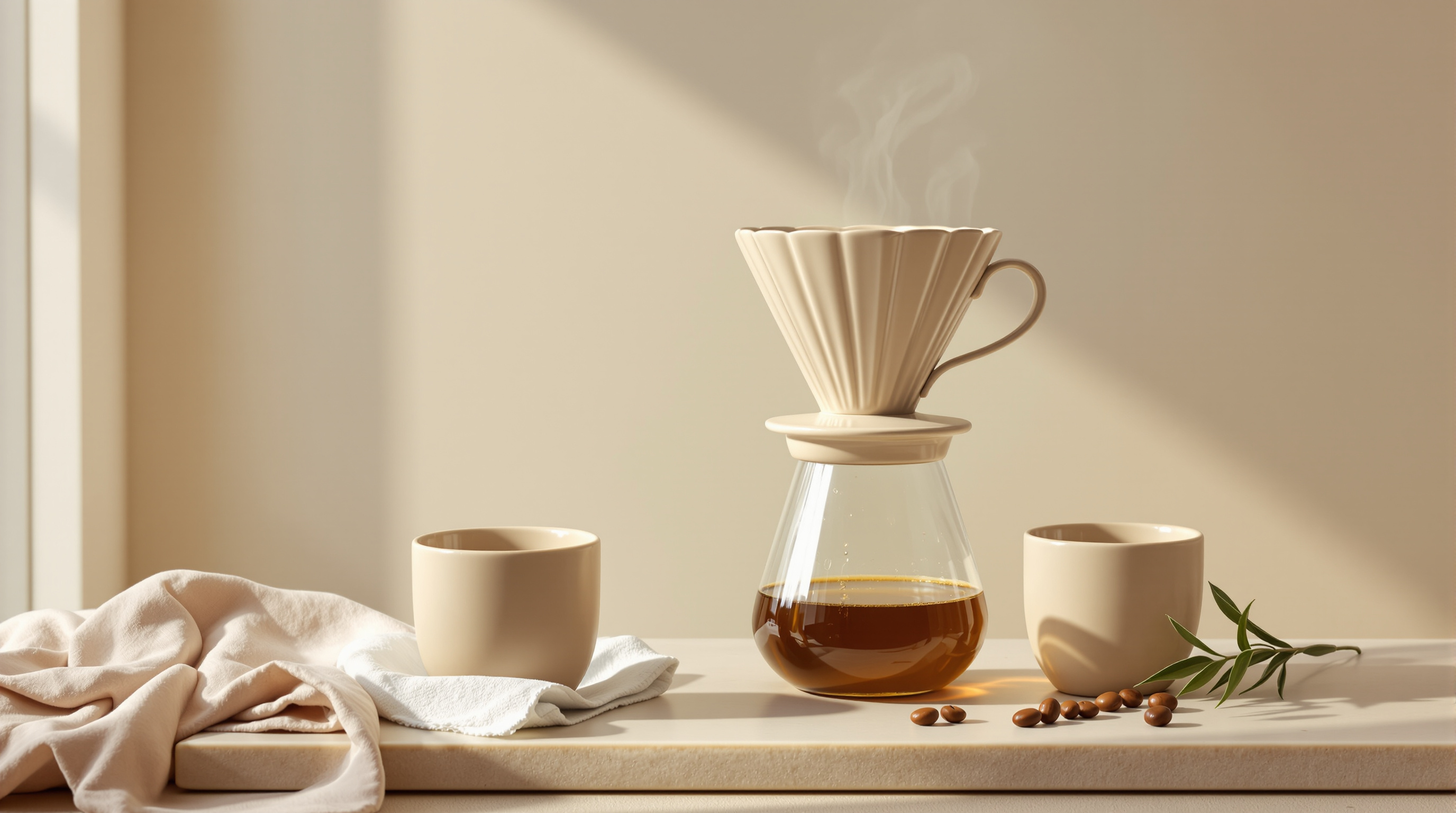
A warm, minimal e-commerce hero photograph of a sand-beige ceramic pour-over set on travertine, lit by soft window light, with clean space on the right for a headline. It is the example output of the Product Hero Shot Brief Builder (step 1).
Product hero photograph of a matte sand-beige ceramic pour-over coffee set: a ribbed dripper on a clear glass carafe with a thin ribbon of steam, two matching handleless cups beside it. Set on a honed travertine slab against a cream plaster wall. Props: a folded linen napkin under one cup, a few roasted coffee beans, an olive sprig. Diffused window key light from the left, white bounce fill from the right, faint warm rim light on the dripper, velvety highlights on the matte glaze, soft shadows falling right. Full-frame camera, 85mm lens, f/5.6, focus on the dripper rim, elevated three-quarter angle. Palette: sand beige, cream, terracotta, espresso brown, olive green. Calm, warm, handcrafted morning mood. Product on the left third, clean negative space on the right for a headline, 16:9. No logos, no text, no hands, no clutter.
Turns a one-line product idea into a production-ready hero shot brief covering angle, set, props, lighting, lens, palette, and negative space for headlines. It finishes with a paste-ready image prompt and three variations. Step 1 of a text → image workflow.
Act as a commercial product photographer and art director. Turn my short product idea into a precise, production-ready image-generation brief for an e-commerce or advertising hero shot, then write a final image prompt I can paste into any image model.

Product idea: a matte ceramic pour-over coffee set for a small roastery's spring launch
Where the image will be used: website hero banner with headline space on the right
Brand feel (3-5 words): calm, warm, handcrafted, modern
Aspect ratio: 16:9
Must include / must avoid: show a little steam; no logos or text

Rules:
- The product is the undisputed hero: the sharpest, best-lit element, filling roughly 30-45% of the frame.
- Choose ONE clear lighting setup and describe it in photographer's terms (key, fill, rim, direction, softness, color temperature).
- Props support the story without competing: at most 3, each with a reason.
- Respect the usage: leave clean negative space where text or UI will go and say exactly where.
- Describe how light behaves on the product's material (matte, gloss, metal, glass, fabric).
- Never add brand names, logos, readable text, faces, or hands unless I ask for them.
- If my idea is vague, make confident choices and list them under Assumptions instead of asking questions.

Output exactly this format:

HERO SHOT BRIEF: <product name>
1. Product & hero detail: <what is shown; which feature is emphasized>
2. Angle & framing: <camera height, angle, distance, crop>
3. Surface & set: <surface material, background, depth>
4. Props (max 3): <prop - why it is there>
5. Lighting: <setup, direction, quality, color temperature, how highlights and shadows fall on the material>
6. Camera & lens: <format, focal length, aperture, focus point, depth of field>
7. Color palette: <3-5 named colors>
8. Mood & story: <one sentence>
9. Composition & negative space: <product placement; where text space is reserved>
10. Aspect ratio: <ratio>
11. Avoid: <comma-separated negatives>
Assumptions: <bullets, or "none">

FINAL IMAGE PROMPT:
<one paragraph of 90-140 words, a vivid photographic description that merges points 1-11 in this order: subject, set, props, lighting, camera, palette, mood, composition, aspect ratio, ending with the avoid list written as "no ..." phrases>

VARIATIONS (one line each):
- Lifestyle: <same product in a lived-in scene>
- Minimal: <seamless studio version>
- Seasonal: <a seasonal or campaign twist>
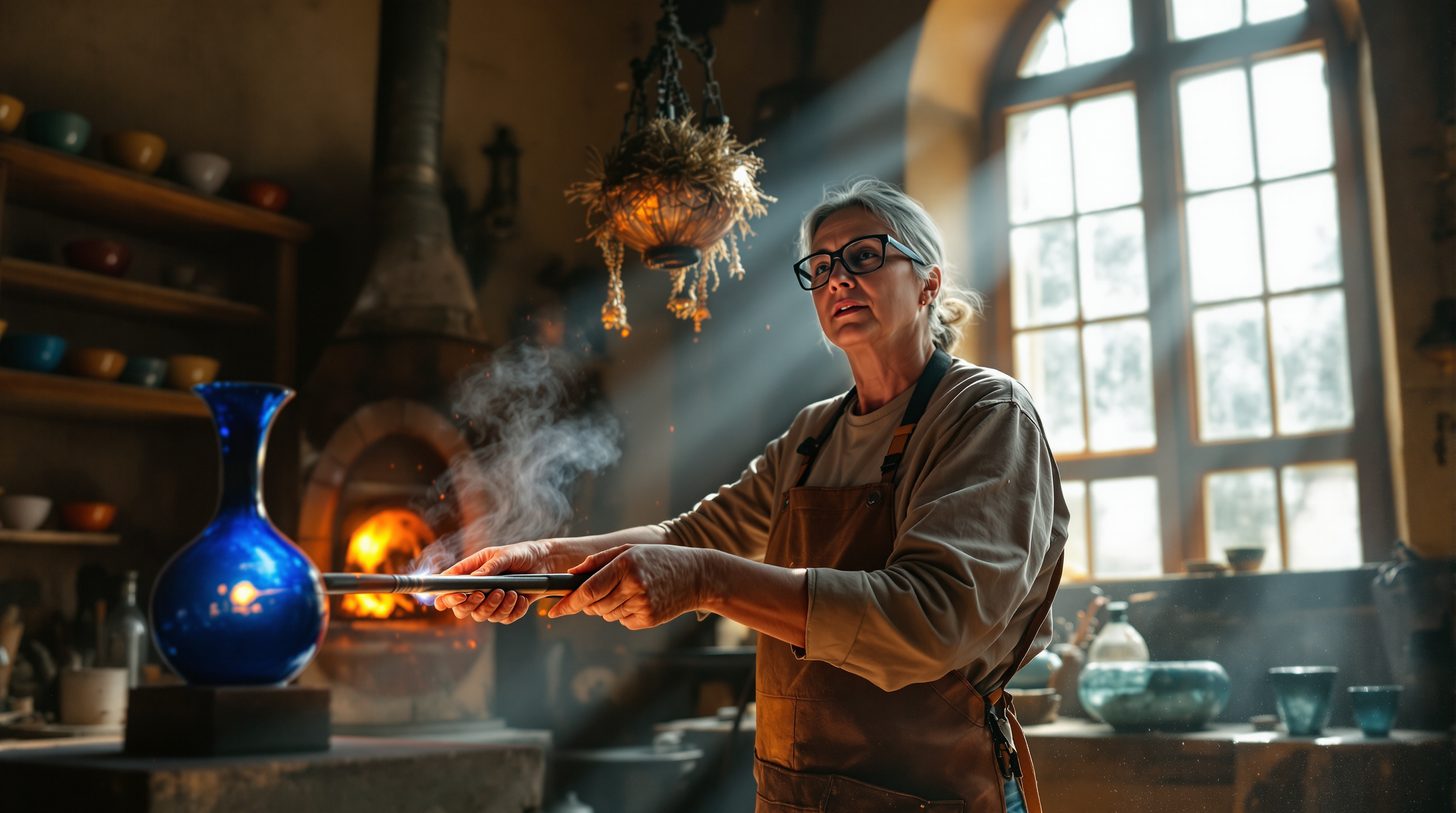
A photorealistic documentary-style portrait of a glassblower turning a glowing cobalt vase in a sunlit stone workshop. Warm furnace glow plays against cool window light, with dusty light shafts and a 35mm shallow depth of field. Family-friendly.
Photorealistic environmental portrait of a middle-aged glassblower in a sunlit stone workshop, turning a glowing cobalt-blue vase on the end of a long steel blowpipe. The molten glass radiates orange-gold heat that lights her focused face, leather apron, rolled-up sleeves, and the tinted safety glasses pushed up into her graying hair. Behind her the furnace mouth burns bright, while shafts of late-afternoon sun cut through dusty air from a tall arched window, catching drifting particles and heat shimmer. Wooden shelves of finished bowls in amber, teal, and smoky green catch soft rim light. Shot on a full-frame camera with a 35mm lens at f/2, eye level, rule-of-thirds composition with the glowing vase on the left third, shallow depth of field, rich contrast between cool window light and warm furnace glow. Documentary craft photography, natural skin texture, calm and reverent mood, no text, no logos.
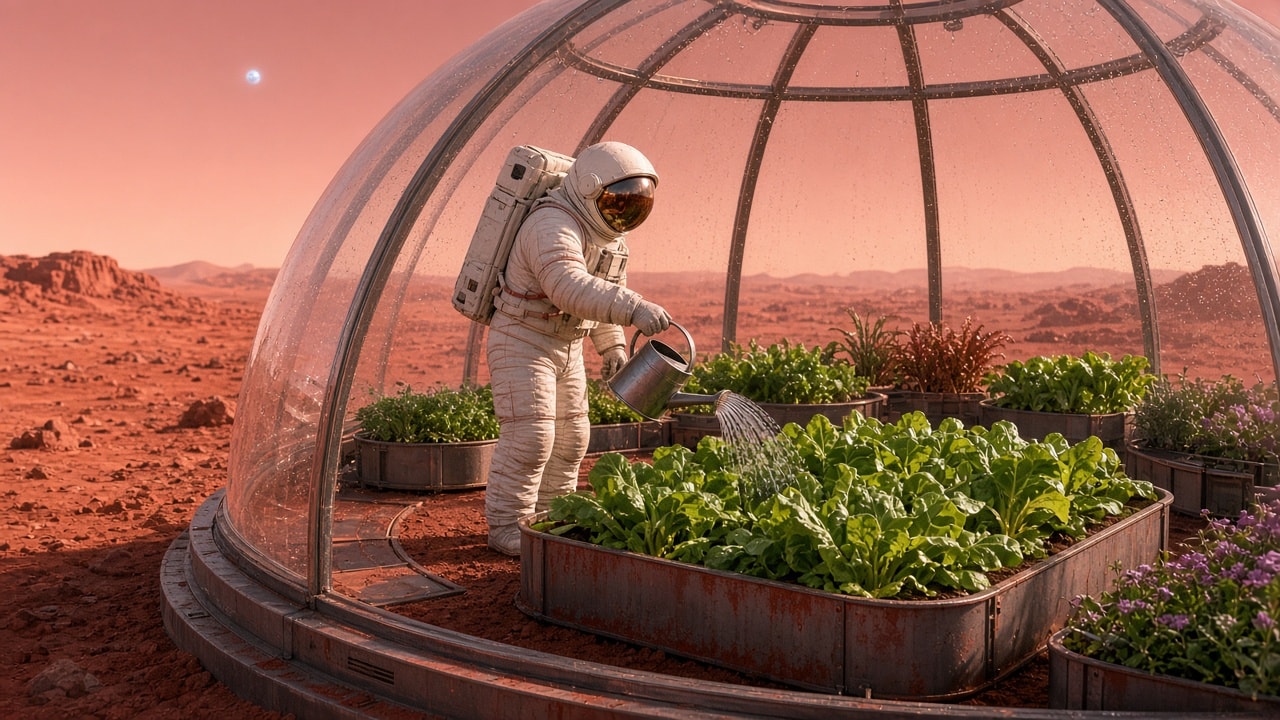
Charming photoreal scene of a small astronaut carefully watering vegetables in a glass-domed rooftop garden on a red-dust Mars habitat, Earthrise optional, hopeful sci-fi mood.
Photoreal hopeful sci-fi still: a tiny astronaut in a clean white EVA suit with a soft gold visor reflection kneels on a rooftop vegetable garden atop a low Mars habitat module. Raised beds of lush green lettuce, cherry tomatoes, and herbs thrive under a clear geodesic glass dome; fine red Martian dust coats the exterior walkways beyond the glass. The astronaut holds a small watering can, focused on a tomato plant. Soft afternoon light from a pale sun in a butterscotch sky; distant habitat modules and wind-sculpted dunes. Warm interior grow-lights glow faintly for contrast. Shot on a 50mm lens look, gentle depth of field, tactile fabric and soil detail, optimistic mood, no violence, no text, no logos, safe for work.

A handmade paper-craft diorama of a lighthouse on a stormy cliff. Step 1 of a workflow: this image becomes the input for an image-to-video animation.
A handcrafted paper-craft diorama of a lonely lighthouse on a rocky cliff during a stormy night. Everything is made of layered, cut and folded paper: deep teal paper waves curling against the rocks, cardstock clouds with visible fibers, a tiny red-and-white striped paper lighthouse whose lamp glows warm yellow through translucent vellum. Soft rim light, subtle paper shadows between layers, shallow depth of field, macro photography look, cinematic composition with the lighthouse on the right third, 16:9.
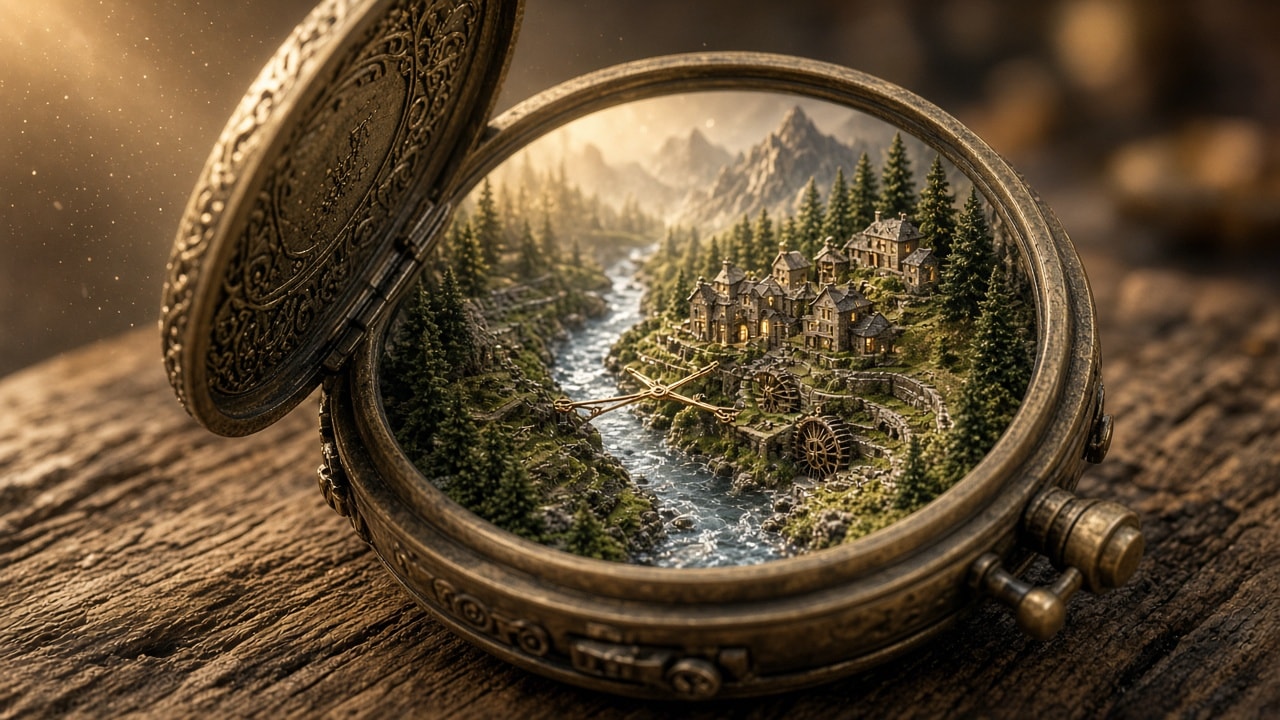
A macro photo of a tiny, living landscape built inside an open antique pocket watch, with gears turning into terrain and clock hands as bridges. Change the scene variable to put any world inside.
Ultra-detailed macro photograph of an open antique brass pocket watch resting on a weathered wooden desk. Inside the watch case, instead of a clock face, there is a tiny living world: a misty alpine valley with a winding river, pine forests and a little stone village. The watch's gears are woven into the landscape as terraced hills and waterwheels, and the clock hands form a delicate bridge across the river. Tiny warm lights glow in the village windows. Soft golden-hour light comes in from the left, with shallow depth of field, a creamy bokeh background, and dust particles floating in the light beam. The engraved lid is open and casts a gentle shadow. Photorealistic, tilt-shift miniature feel, rich textures of scratched brass and glass, cinematic color grading, 16:9 composition.
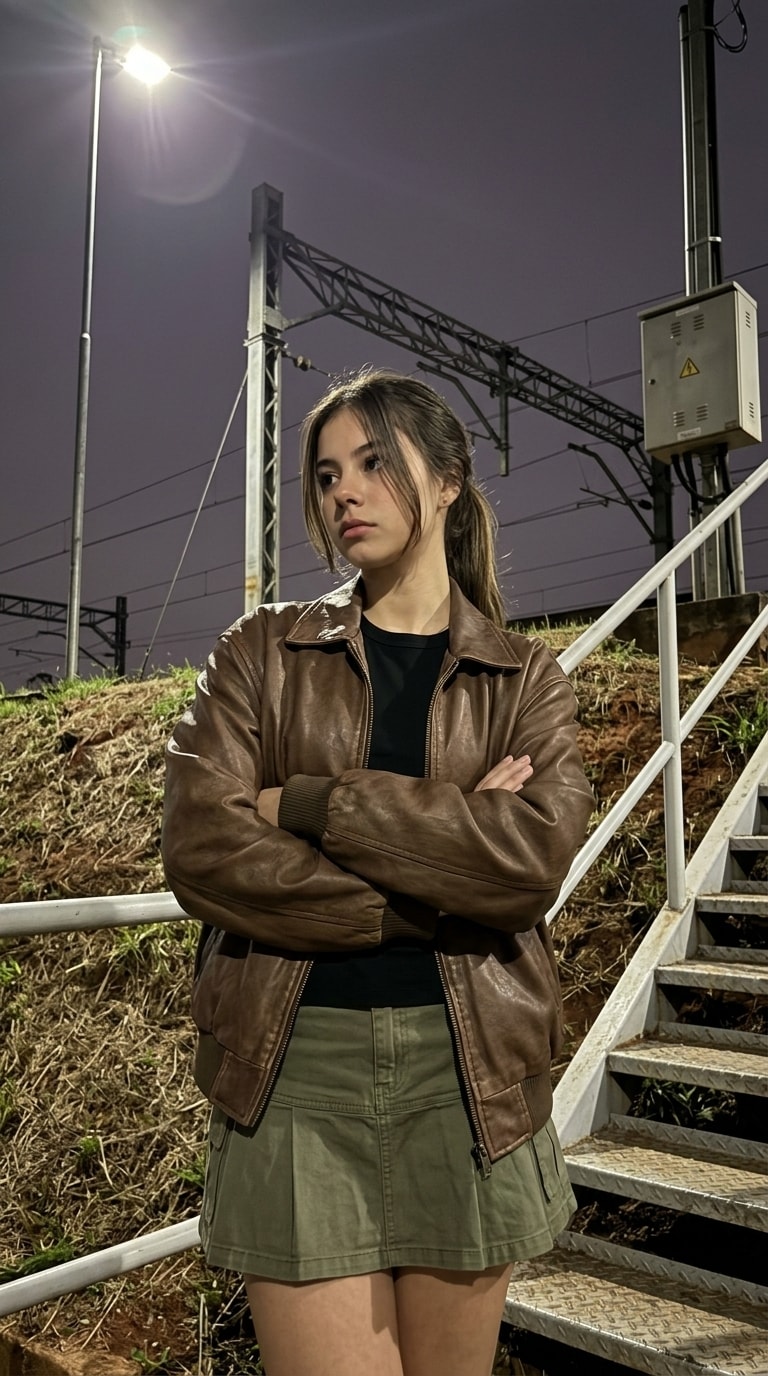
Generates a photorealistic, vertical 9:16 nighttime portrait of a young woman in an industrial railway setting. She wears an oversized brown leather bomber jacket and olive green mini skirt, standing with crossed arms and a pensive expression. Illuminated by harsh, cinematic streetlamp lighting with subtle lens flare against a dark, moody urban backdrop. Captures a gritty, high-detail 8K aesthetic optimized for Stable Diffusion with precise pose and identity control.
1A vertical nighttime photograph of a young woman standing outdoors2next to metal stairs near a railway. She has light skin, brown hair3pulled back into a low ponytail with loose strands framing her face...+80 more lines
Guide to using jangling sounds effectively to attract deer for observation or photography.
Act as a Wildlife Enthusiast. You have expertise in attracting deer using sound techniques. Your task is to provide a guide on using jangling sounds to attract deer.

You will:
- Explain the types of sounds effective for attracting deer
- Describe the best times and locations to use these sounds
- Include safety tips for observing deer without causing distress

Rules:
- Ensure the methods are ethical and non-invasive
- Provide tips for both beginners and experienced enthusiasts