A naive Hinterglasmalerei reverse glass painting: nine chrome-yellow sunflowers in a cobalt-blue jug painted with white daisies, bold black outlines and flat colors behind glossy old glass, a crinkled gold-leaf background, a red-and-white dot border and a dark wooden frame.
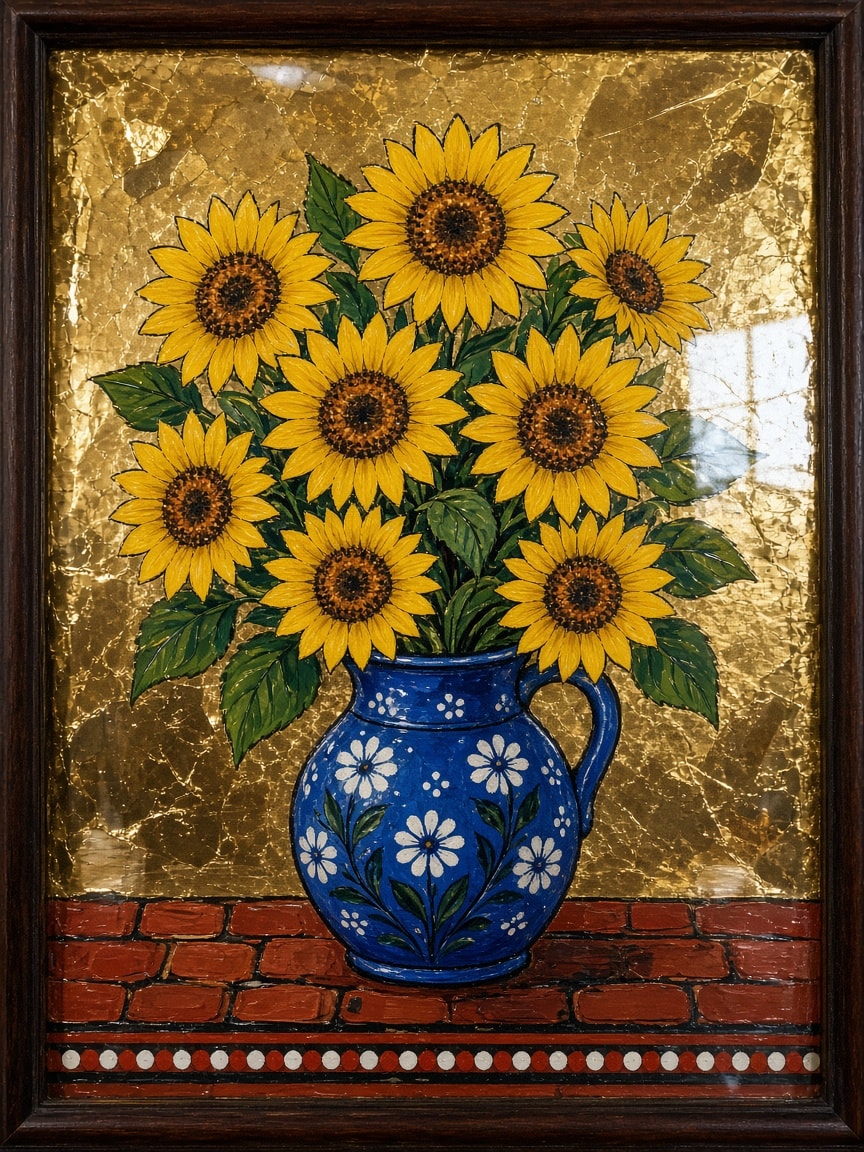
A folk-art reverse glass painting (Hinterglasmalerei) of a bouquet of sunflowers in a cobalt-blue jug, painted on the back of an old glass pane and seen from the front, so the colors sit behind a glossy glass surface. Vertical 3:4 composition.

Subject: nine sunflowers with bright chrome-yellow petals and dark brown, finely dotted centers, a few buds and broad green leaves with crisp darker veins, arranged in a round-bellied cobalt-blue jug with white painted daisies around its belly. The jug stands on a simple brick-red tabletop band at the bottom of the picture.

Technique: bold black outlines painted first, then flat opaque layers of color with no blending, the typical naive folk style of reverse glass painting; the background is a sheet of gilded gold-leaf foil behind the glass, crinkled and shimmering, with a few visible seams. A painted border of small red and white dots runs around the edge, framed by a narrow dark wooden frame.

Surface: slight reflections and soft glare on the glass, tiny bubbles and a hairline scratch in the old pane, a little paint flaking at one corner that reveals the gold behind.

Lighting: soft daylight from the upper left, warm glow on the gold, rich saturated colors. No people, no text.
Audits foreground/background color pairs for WCAG 2.x contrast (AA and AAA for normal and large text), reports ratios and pass/fail, and notes color-blindness risks. Use when checking UI palettes, design tokens, or asking "is this gray-on-white readable?". Includes a stdlib Python contrast checker with --self-test.
Create a feature testing page design for Enterprise WeChat/DingTalk focusing on address book management, calendar/schedule management, and message sending/receiving. The design should be user-friendly, sleek, and have a technological appeal.
Turns a year of scattered family photos into a printed photo book plan: finds the best shots per month, removes duplicates and blurry ones, writes short captions and keeps the order and budget simple.