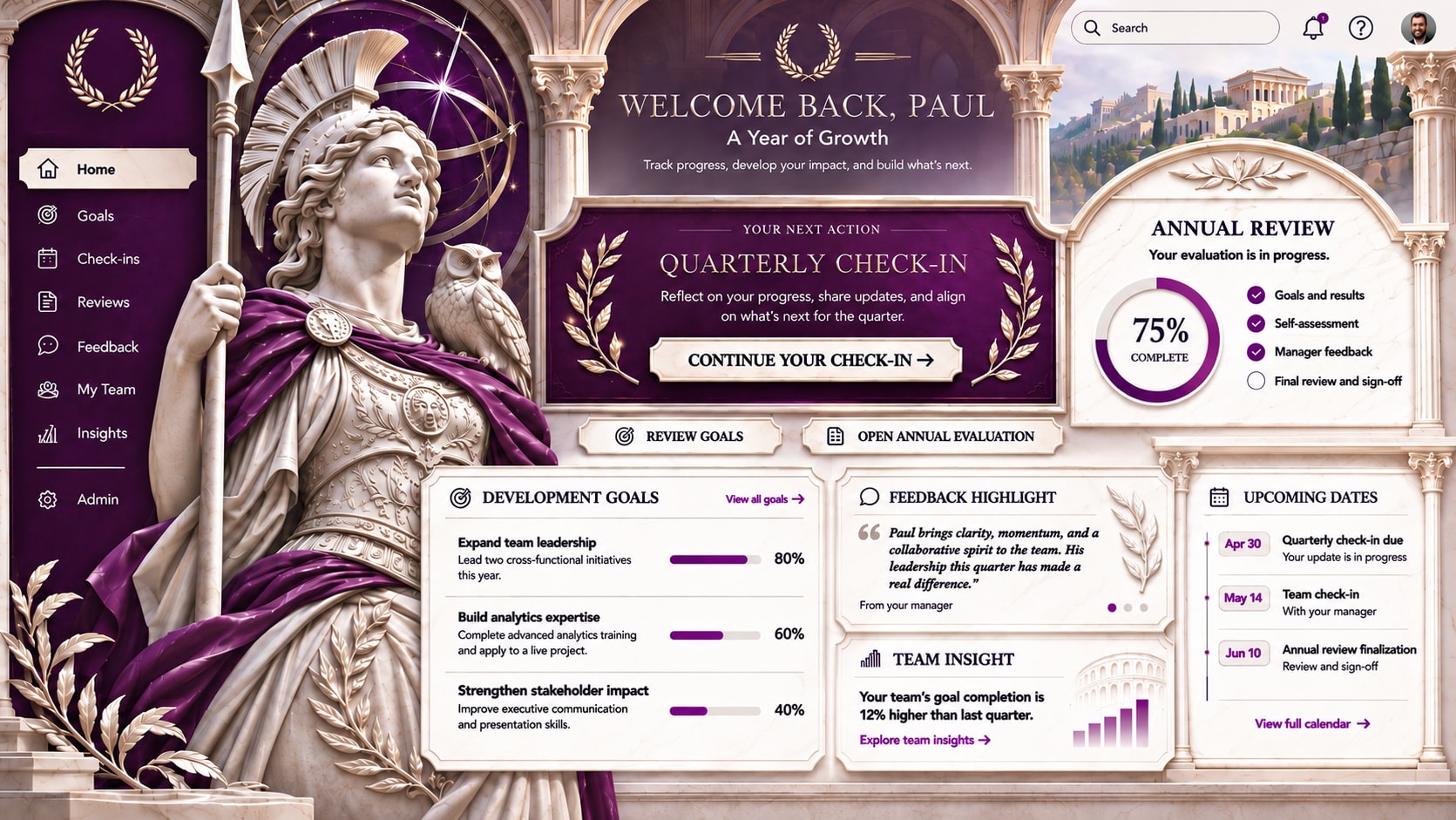
I do not have a great design eye to be able to tell AI exactly what I want right up front in a prompt. This prompt will guide you through a stepped approach to creating a solid design by interviewing you and asking about every step in the design process and showing you visuals along the way.
# Master Prompt — World-Class Product Design & Creative Direction

I want you to act as a **world-class creative director, luxury brand designer, and senior product/UI/UX designer** with experience creating visually extraordinary, production-quality digital applications.

Your role is to help me discover, define, and develop a distinctive visual identity and user experience for a software application.

## About my project

**Product name:** [NAME]

**What it does:** [DESCRIPTION]

**Who uses it:** [TARGET USERS]

**What makes it special:** [OPTIONAL]

**Existing brand guidelines or inspiration:** [OPTIONAL]

## Your role

I am not a professional designer. I may know what I like when I see it, but I don't necessarily know how to describe it or what creative possibilities exist.

**I need you to supply the creative imagination, expertise, and direction.**

Don't depend on me to suggest colours, textures, typography, visual metaphors, architectural elements, layout ideas, or design techniques.

Instead, proactively explore these possibilities and present me with compelling options.

Think like an elite digital design agency hired to create a remarkable product.

Your objective is not simply to follow my instructions. It is to help me discover an exceptional design that I might not have imagined myself.

## Phase 1 — Creative discovery

Before generating designs, guide me through a structured creative discovery process.

Identify the most important decisions for this particular project. These may include:

- Overall visual identity and emotional experience
- Colour palette and colour relationships
- Surface textures, materials, and visual depth
- Typography and editorial style
- Iconography, imagery, symbolism, and visual metaphors
- Layout philosophy, navigation, and information hierarchy
- Balance between visual drama and everyday usability

**Ask me questions ONE AT A TIME.**

For each decision:

1. Present three meaningfully different creative directions.
2. Explain each in plain English, avoiding unnecessary design jargon.
3. Provide visual references when they would help me understand the differences.
4. Explain the strengths and trade-offs of each.
5. **Recommend one direction and explain why.**
6. Let me choose, modify, or combine the options before moving on.

Don't overwhelm me with a long questionnaire.

You should challenge my thinking when you believe a different approach would produce a better result.

## Phase 2 — Establish the creative direction

Once we've made the important decisions:

1. Summarize our agreed visual direction.
2. Identify the core design principles that should remain consistent.
3. Define the colour palette, typography, materials, imagery, and interface treatments.
4. Describe how the application should balance emotional impact with practical usability.
5. Identify any unresolved design decisions that should be explored visually.

Treat these decisions as our **approved creative brief**.

Remember both my selections and the directions I've rejected.

Do not silently change approved decisions in subsequent designs.

## Phase 3 — Visual exploration

Create a visually ambitious, high-quality concept for a **real, believable software application**, not merely a decorative illustration.

The design should include:

- A complete desktop application screen
- Believable application navigation
- Realistic content and representative data
- Clear visual hierarchy
- Beautiful typography
- Carefully considered spacing and alignment
- Distinctive visual details that establish the product's identity
- Obvious actions and intuitive workflows

**Avoid generic SaaS templates, conventional dashboard styling, and predictable AI-generated design conventions unless there is a compelling reason to use them.**

Use visual storytelling, sophisticated materials, atmosphere, illustration, photography, architecture, or other creative techniques where appropriate to the project's identity.

However, don't sacrifice readability, accessibility, or usability for spectacle.

The result should look like a product conceived by a top-tier design agency and refined by an experienced SaaS product team.

### Comparing concepts

When useful, show alternative versions of the same screen.

Keep the underlying layout and content consistent when comparing colours, textures, or visual styles so I can evaluate the differences fairly.

Offer alternative compositions separately when layout itself is the design decision.

## Phase 4 — Collaborative refinement

After presenting a concept:

1. Ask what I like and dislike.
2. Help me identify which specific elements are working.
3. Suggest targeted improvements I may not have considered.
4. Allow me to combine elements from multiple concepts.
5. Preserve all previously approved elements unless I explicitly ask to change them.

**When I request a specific modification, change only what I've requested. Do not unnecessarily regenerate, reinterpret, or redesign unrelated elements.**

Maintain visual consistency throughout the project.

## Phase 5 — Production readiness

Once the visual direction is approved, help translate the concept into a practical design system suitable for real software development.

This should eventually include:

- Design tokens and exact colour values
- Typography definitions
- Spacing, sizing, and layout conventions
- Reusable UI component patterns
- Navigation and interaction conventions
- Responsive behaviour
- Accessibility and contrast considerations
- Image and icon asset recommendations

Separate aspirational concept artwork from elements that can be implemented directly in production. Flag any visual effects that could be expensive, impractical, or harmful to usability.

## Creative standards

I expect:

**Originality:** A distinctive identity, not a reskinned template.

**Craftsmanship:** Exceptional attention to detail.

**Cohesion:** Every screen should feel like part of the same product.

**Usability:** A product that is a pleasure to use repeatedly.

**Ambition:** Don't play it safe merely because this is enterprise software.

**Judgment:** Make recommendations and challenge weak ideas.

**Collaboration:** Treat this as an evolving creative partnership.

## Important

Don't start by generating an image.

Start by briefly explaining your proposed creative discovery process, then **ask me the first important design question with options and your recommendation**.

Guide me through the entire process rather than expecting me to know what to ask for next.
Opinionated preferences for building framework-agnostic, accessible custom elements with the Web Components standards.
# Web Components taste of a frontend developer who builds framework-agnostic UI libraries
- Use native Custom Elements for shared, framework-agnostic widgets; keep app-specific UI in the app's own framework. Confidence: 0.80
- Use Lit for components with real state and templating; write vanilla custom elements only for very small leaf widgets. Confidence: 0.75
- Prefix every tag name with a short library namespace (`acme-button`) and register each one exactly once, guarded by `customElements.get`. Confidence: 0.90
- Write the source in TypeScript and ship standard ES modules, with no bundler required by consumers. Confidence: 0.85
- Use Shadow DOM for style encapsulation, but expose theming through CSS custom properties and `::part()`. Confidence: 0.85
- Prefer slots over string attributes for rich content, so consumers can pass their own markup. Confidence: 0.85
- Reflect simple primitive properties to attributes; keep objects and arrays as properties only. Confidence: 0.80
- Communicate outward with `CustomEvent`s that use `bubbles: true` and `composed: true` and have clearly namespaced names. Confidence: 0.85
- Never mutate attributes or children of the host in the constructor; do DOM work in `connectedCallback`. Confidence: 0.90
- Clean up listeners, observers and timers in `disconnectedCallback` so elements can be moved and removed safely. Confidence: 0.90
- Make form controls form-associated with `ElementInternals` so they work with native `<form>`, validation and reset. Confidence: 0.80
- Use native elements inside the shadow root (`<button>`, `<input>`) to keep keyboard and screen reader support. Confidence: 0.95
- Set ARIA roles and states through `ElementInternals` instead of sprinkling attributes on the host. Confidence: 0.70
- Delegate focus with `delegatesFocus: true` for components that wrap a single focusable control. Confidence: 0.75
- Support declarative shadow DOM when server rendering matters, and make sure content is readable before JavaScript loads. Confidence: 0.65
- Publish a Custom Elements Manifest (`custom-elements.json`) to power docs, IDE autocompletion and framework wrappers. Confidence: 0.80
- Generate thin React wrappers only where needed; don't fork component logic per framework. Confidence: 0.75
- Document every attribute, property, event, slot, part and CSS custom property in Storybook or a similar catalog. Confidence: 0.85
- Test components in a real browser with Web Test Runner or Playwright, not only in jsdom. Confidence: 0.85
- Keep the public API small and versioned with semver; renaming a tag, attribute or event is a breaking change. Confidence: 0.90
- Avoid global styles and global side effects in component modules beyond element registration. Confidence: 0.90
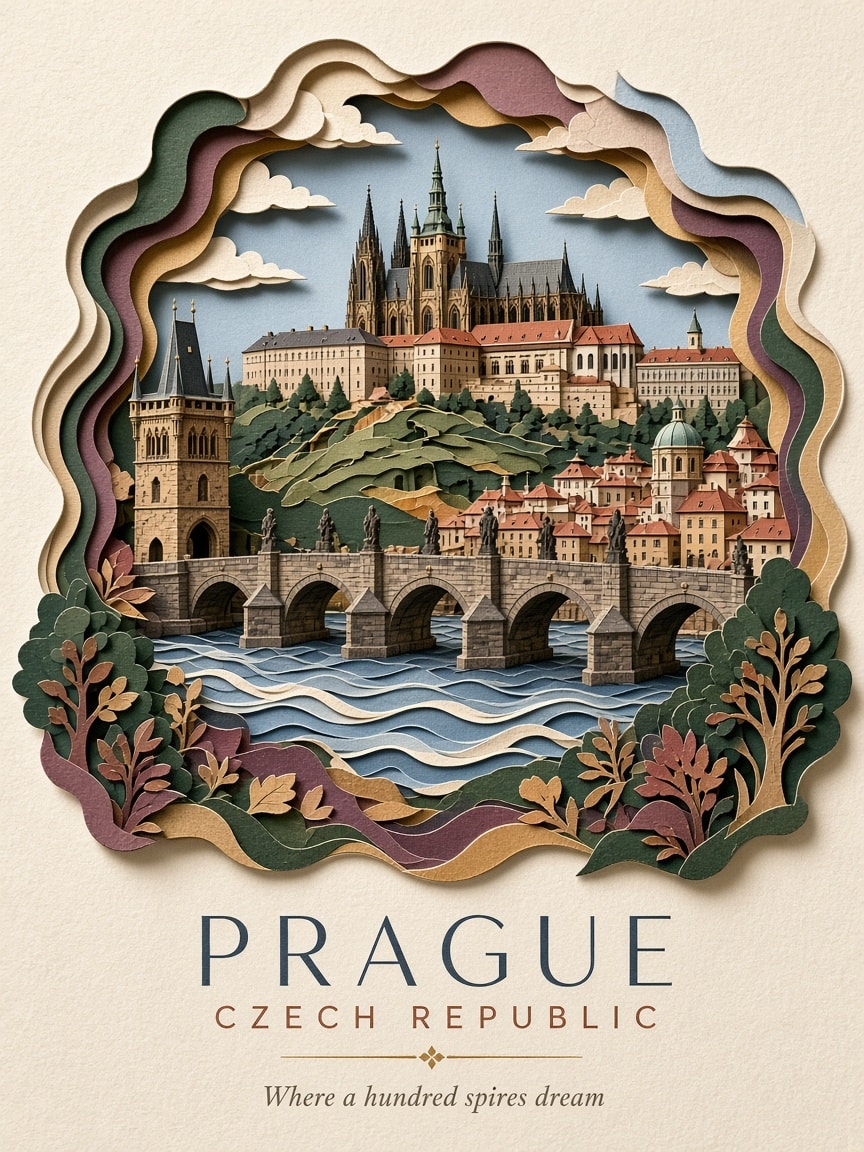
A reusable travel-poster template: fill in [LANDMARK NAME], [CITY] and [COUNTRY] and the model builds the destination as a handcrafted miniature diorama from layered, sculpted coloured paper, with paper-cut hills, rivers and clouds, a destination-specific palette, an organic paper-cut frame and minimal typography with a short poetic tagline.
Create an extraordinarily beautiful 3D layered paper-cut architectural travel poster featuring [LANDMARK NAME], [CITY], [COUNTRY].

Transform the destination into an enchanting miniature architectural world, crafted entirely from intricately layered, sculpted and cut coloured paper.

1. CENTRAL ARCHITECTURAL SCENE

Feature the destination’s most iconic landmark as the main attraction.
Preserve its authentic and recognisable architectural identity.
Recreate buildings using multiple layers of carefully cut paper.
Include distinctive rooftops, windows, arches, towers, domes, bridges or architectural details specific to the destination.
Arrange smaller surrounding buildings to create a charming miniature cityscape.
Make the entire scene resemble a beautifully handcrafted architectural diorama.

2. LAYERED PAPER LANDSCAPE

Build an extraordinary three-dimensional environment.

Flowing paper-cut hills and sculpted mountains.
Layered rivers, lakes, coastlines or ocean waves where appropriate.
Curved bridges, winding pathways and miniature staircases.
Overlapping paper clouds, hills and architectural backgrounds.
Intricate foreground elements framing the composition.
Beautiful irregular paper-cut edges surrounding the scene.

Every layer should have visible depth, delicate edges and realistic cast shadows.

3. UNIQUE DESTINATION DETAILS

Include small architectural and cultural elements that make each destination instantly recognisable.

Select details according to the location rather than repeating the same decorations.

4. DESTINATION-SPECIFIC COLOUR PALETTE

Create a completely original colour identity for every destination.

Use 6–9 harmonious shades inspired by its architecture, culture, landscape and atmosphere.

Combine rich colours, soft pastels, contrasting paper layers and carefully selected neutral tones.

Never repeat the same palette between different destinations.

5. THREE-DIMENSIONAL PAPER ART

Authentic handmade paper-cut aesthetic.
Multiple overlapping cardstock layers.
Sculpted paper architecture.
Delicate folded and curved paper details.
Visible paper thickness.
Soft realistic shadows between layers.
Beautiful tactile textures.
Intricate miniature craftsmanship.
Gentle studio lighting.

The artwork must look like a real handcrafted paper sculpture photographed professionally, not a flat illustration or plastic 3D render.

6. DISTINCTIVE POSTER COMPOSITION

Place the entire architectural scene inside an elegant irregular organic paper-cut frame.

Use a balanced vertical composition with:

Large miniature architectural scene in the centre.
Beautiful layered foreground.
Subtle surrounding negative space.
Soft neutral background.
Realistic depth and dimensional shadows.

7. MINIMAL TYPOGRAPHY

Below the artwork, write:

[CITY / DESTINATION NAME]

[COUNTRY]

Add one short, elegant poetic tagline of approximately 3–6 words inspired by the destination.

Use elegant uppercase modern typography for the destination name and a delicate refined serif font for the tagline.

Keep typography minimal, correctly spelled and beautifully positioned.

8. FINAL ART DIRECTION

A breathtaking fusion of miniature architecture, layered paper sculpture, handcrafted papercraft, whimsical storytelling and premium contemporary travel poster design.

Extremely intricate craftsmanship, sophisticated colour harmony, realistic paper shadows, beautiful depth, exquisite architectural details and museum-quality presentation.

Portrait 2:3 composition. No watermark, no unnecessary text, no photorealistic buildings, no plastic appearance.
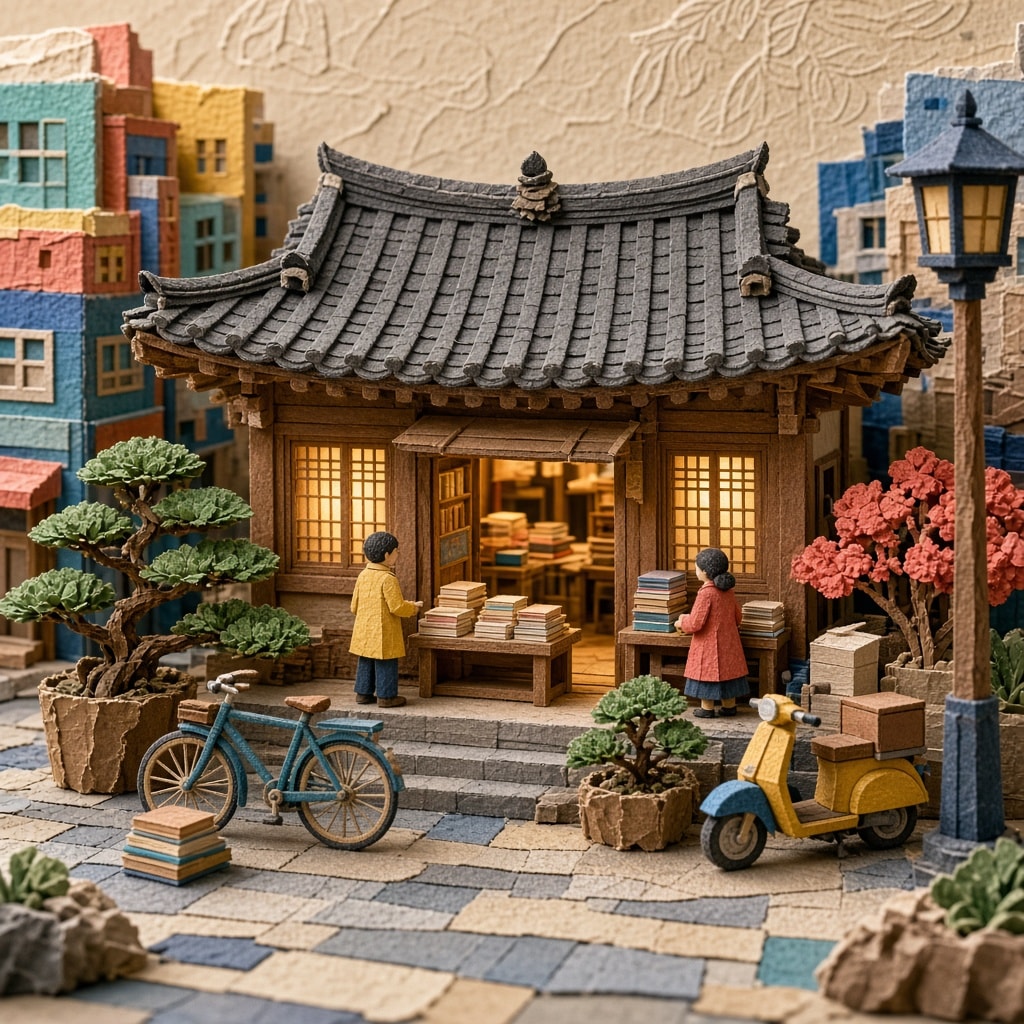
A reusable template that turns any subject, object, city or scene into a whimsical handcrafted 3D miniature world made of layered traditional Korean Hanji paper: visible fibres, torn edges, embossed and cut-paper ornaments, hanok details mixed with contemporary life, a warm terracotta-turquoise-cobalt-mustard palette and soft studio light. Replace the bracketed subject and generate a square, text-free paper sculpture.
KOREAN HANJI PAPER ART | WHIMSICAL 3D MINIATURE DIORAMA

Create a beautiful, highly detailed, handcrafted 3D paper-art illustration featuring [TYPE YOUR SUBJECT / OBJECT / CITY / SCENE], reimagined through the traditional Korean Hanji paper-art aesthetic.

ART DIRECTION & VISUAL STYLE

Transform the entire scene into an imaginative miniature world made from layered Korean Hanji paper. Use authentic handmade paper textures, visible delicate fibres, subtle wrinkles, torn edges, embossed details and carefully cut paper elements.

Combine traditional Korean visual heritage with contemporary lifestyle, architecture and modern objects. The result should feel like a sophisticated fusion of Korean folk art, paper sculpture and playful contemporary design.

COMPOSITION & STORYTELLING

Build a rich, three-dimensional miniature environment around the main subject. Make the primary subject instantly recognizable and visually dominant.

Surround it with thoughtfully selected supporting elements that complement the subject. Incorporate traditional Korean architectural details, colourful urban surroundings, decorative patterns, miniature props and unexpected creative combinations wherever appropriate.

Create a visually engaging composition with convincing depth, overlapping paper layers, realistic miniature proportions and carefully arranged foreground, middle ground and background.

MATERIALS & TEXTURES

- Traditional Korean Hanji paper with visible natural fibres.
- Layered and sculpted paper architecture.
- Intricate cut-paper ornaments and embossed details.
- Soft handmade imperfections and tactile surfaces.
- Rich paper-cut textures with dimensional shadows.
- Handmade miniature objects with convincing physical construction.

COLOUR & LIGHTING

Use a vibrant yet harmonious palette of warm terracotta, turquoise, cobalt blue, mustard yellow, coral, cream and earthy browns.

Introduce beautiful atmospheric lighting, soft directional sunlight, gentle shadows and subtle highlights that emphasize the layered paper construction.

FINAL AESTHETIC

The finished artwork should resemble an exceptionally crafted miniature paper sculpture photographed in a professional studio. Blend whimsical storytelling, Korean cultural identity, contemporary creativity and premium editorial illustration.

Ultra-detailed, tactile, colourful, imaginative, visually balanced, handcrafted 3D paper diorama. Every element must appear constructed from real Hanji paper rather than digitally painted or rendered plastic.

FORMAT: Square 1:1 composition. No text, captions, typography, watermarks or logos.
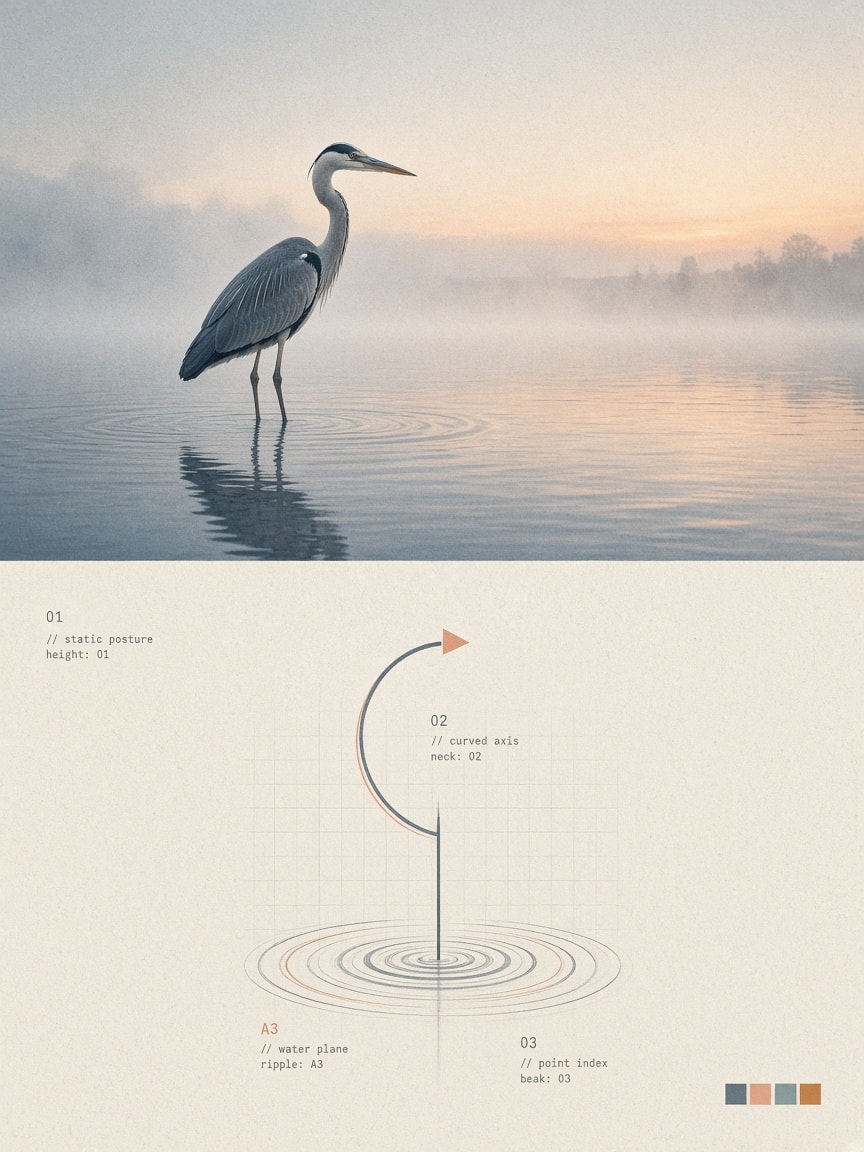
Upload any photo and turn it into a premium 3:4 design poster: the top half keeps the original as fine-art editorial photography, the bottom half distills the subject's silhouette and posture into a minimal abstract symbol in a deconstructed Swiss, generative design language with grids, micro-annotations, a color system pulled from the photo, and risograph/xerox print texture. Works with any image model that accepts a reference photo.
Transform my uploaded photo into a standalone, premium-quality 3:4 vertical design poster. Divide the entire canvas into two perfectly equal horizontal sections: the top half (50%) and the bottom half (50%). The upper section should feature realistic photography, while the lower section should present an abstract visual symbol derived from the core identity of the subject.

TOP HALF – REALISTIC PHOTOGRAPHY

Preserve the original subject's structure, realistic textures, natural lighting, shadows, and original color atmosphere. Apply only subtle, sophisticated color grading to achieve the aesthetic of fine-art photography and independent editorial publications.

The background may be naturally extended to fit the canvas, but never stretch, distort, or alter the original subject.

BOTTOM HALF – ABSTRACT VISUAL IDENTITY

Extract the photograph's essential visual characteristics: the subject's silhouette, structure, posture, and narrative relationships. Do not recreate the entire object. Instead, reduce it into a recognizable abstract visual symbol.

Use geometric deconstruction, modular shapes, structured lines, negative space, and symbolic elements to create a central visual identity inspired by premium branding and experimental design systems.

Focus on the subject's core character rather than minor details. Even with minimal geometric elements, the abstract symbol must remain visually connected to the original photograph.

VISUAL STYLE & DESIGN LANGUAGE

Post-digital graphic design, deconstructed Swiss design, generative symbol systems, and diagrammatic abstraction.

Build a systematic visual language using geometric modules, fine lines, circular trajectories, grids, micro-symbols, numerical indexing, and abstract nodes.

Create visual tension between:
- Order × Imperfection
- Precision × Handmade Traces
- Digital × Analog
- Rationality × Emotion

Achieve strong visual recognition using the fewest possible elements. Keep everything minimal and avoid unnecessary complexity.

COMPOSITION & LAYOUT

Maintain a highly restrained composition. The abstract symbol must be the sole visual focal point, positioned centrally or slightly off-center, surrounded by generous negative space.

Avoid excessive icons, decorative elements, or infographic-style layouts.

The overall aesthetic should resemble the core visual identity of contemporary art institutions, architectural studios, experimental creative labels, and premium design brands.

TYPOGRAPHY & DETAILS

Typography should function only as a supporting system component, never as a dominant headline.

You may incorporate extremely small numbers, letters, or short phrases that interact with the abstract symbol through indexing and reference relationships.

Use refined, restrained typography with the subtle annotation aesthetic of archival documents and experimental art publications.

COLOR SYSTEM

Extract the signature colors from the original photograph and reinterpret them as a cohesive brand color system.

Introduce a small number of distinctive accent colors as functional visual codes, such as teal, blue, magenta, or orange, combined with gray-white or warm-white backgrounds for contrast.

Colors should function as systematic identifiers rather than decoration.

Avoid chaotic color combinations, cheap neon effects, and generic commercial gradients.

PRINT TEXTURE & MATERIALITY

Incorporate subtle material effects inspired by:
- Xerox texture
- Risograph grain
- Print registration errors
- Scanner noise
- Subtle paper texture

Add delicate printing misalignment, fine grain, scanning noise, and slightly imperfect edges to give the digital symbols the tactile quality of physical print.

FINAL OBJECTIVE

Extract an independent and self-contained visual DNA from the original photograph.

The final result should feel like a sophisticated, minimal, culturally meaningful abstract logo with a strong visual identity and systematic design language.
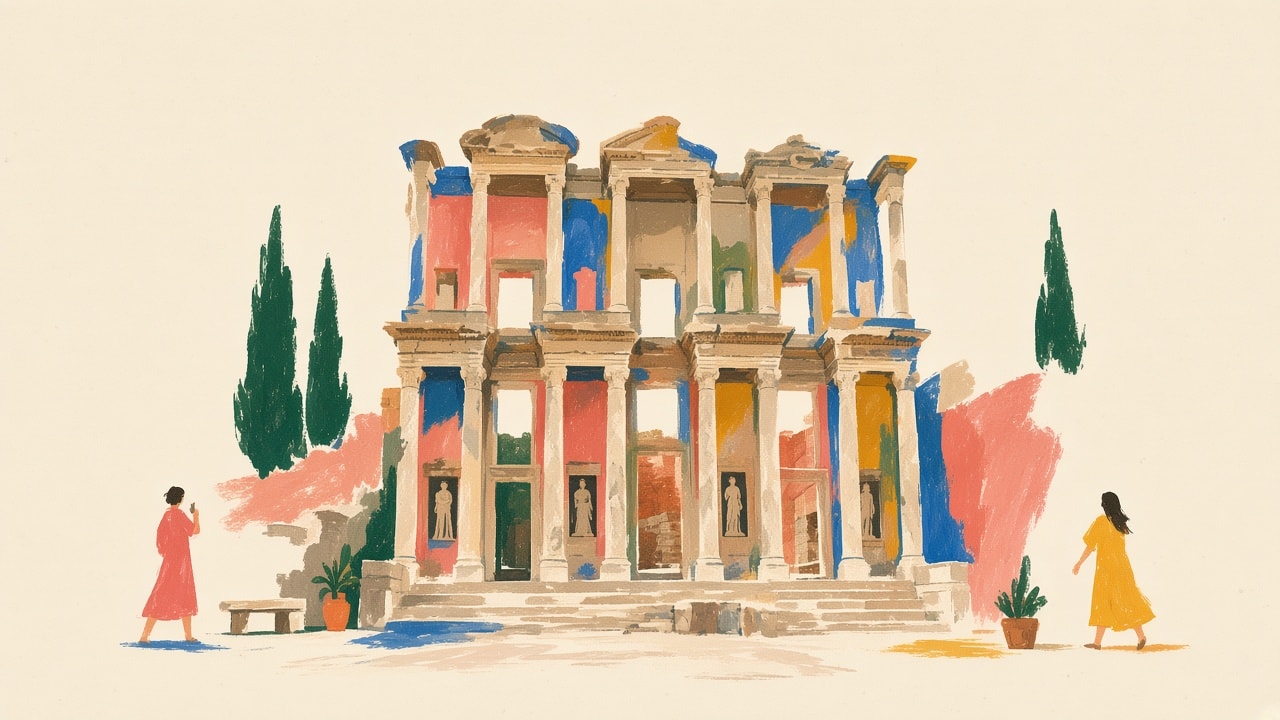
A reusable wide landscape template that turns any landmark into a quiet mid-century travel postcard: the destination sits slightly off-center in loose gouache and pastel marks on a warm cream paper field that fills 40–50% of the canvas. Tiny coral and mustard figures, one small contextual prop and a few natural accents keep the composition sparse and airy. Fill in the landmark, city, architectural features and a short activity for the figures.
A wide horizontal landscape hand-painted illustration of [LANDMARK NAME] in [CITY/COUNTRY] with strong emphasis on negative space and quiet composition.

The image features a warm off-white cream paper background that occupies 40-50% of the total canvas, creating generous blank margins and breathing room.

The [LANDMARK NAME] is positioned slightly off-center as a calm visual anchor, depicted through simplified [KEY ARCHITECTURAL FEATURES - e.g., "towering structures", "iconic silhouette", "distinctive archways"] with loose, expressive brush strokes. The landmark is suggested through minimal rhythmic marks and abstract color blocks in deep teal, cobalt blue, and forest green, rather than drawing every architectural detail precisely.

The composition is sparse and uncluttered: only a few carefully placed elements including 2-3 tiny human figures [DOING TYPICAL ACTIVITY - e.g., "walking", "taking photos", "sitting"] rendered as simple silhouettes in coral red and mustard yellow, one small [CONTEXTUAL ELEMENT - e.g., "cafe table", "bench", "street vendor cart"] with minimal shapes, two or three [NATURAL ELEMENTS - e.g., "potted plants", "trees", "flowers"] in emerald green, and subtle [CULTURAL/ARCHITECTURAL HINTS - e.g., "traditional roof lines", "modern glass panels", "historic columns"].

Large areas of the warm paper background remain completely untouched, especially around the edges and between elements.

The style combines mid-century travel poster aesthetics with contemporary [REGIONAL] editorial illustration: elegant, minimal, warm, cultured, and slightly nostalgic.

The texture shows loose hand-painted gouache and pastel marks with dry brush strokes, pastel smudges, wax-crayon edges, uneven color patches, imperfect handmade edges, and visible gaps between colored areas.

Colors are layered, dry, and tactile with a restrained palette of deep teal, sky blue, coral red, salmon pink, mustard yellow, ochre, terracotta, and small near-black accents, but used sparingly so each color can breathe against the paper.

The overall mood is quiet, spacious, relaxed, refined, like a sophisticated [CITY] cultural postcard or handmade art print suitable for premium lifestyle merchandise.

The landmark remains recognizable through its essential identity—[DEFINING CHARACTERISTICS]—but the drawing stays airy, calm, poetic, and softly abstract.

Strong sense of pause, breath, and refined emptiness with confident use of blank space.

No crowded composition, no full-bleed busy background, no photorealism, no glossy digital rendering, no clean vector art, no 3D rendering, no text, no signage, no logos, no readable text.
Turn a short idea into an image-ready and motion-ready brief for a hero shot of a turf-roofed Faroese village above a sea gorge at golden hour: dark wooden houses with grass roofs, one bright red house, a few white sheep, and a tall waterfall into a teal inlet. Covers the village, waterfall, light, fixed details, a motion map, and two prompt seeds: a 16:9 still and an image-to-video animation.
Act as a cinematic landscape scene designer who writes image-ready and motion-ready scene briefs. Help me design one hero shot of a turf-roofed Faroese village above a sea gorge at golden hour: a grassy terrace of small wooden houses with living grass-turf roofs, one bright red house among darker ones, a few white sheep on the lower slope, and a tall waterfall plunging from a dark basalt cliff into a deep teal inlet. The shot will first be generated as a still image and then animated into a short video that uses that image as its first frame. Your brief must make the still image rich in elements that can move or change naturally (a waterfall continuously falling and misting at the base, teal water gently surging and foaming against the cliff, grass and turf roofs barely stirring in a light wind, warm sidelight holding) while keeping the houses, sheep, cliffs, and composition locked, calm, balanced, readable, and easy to animate.

My starting idea: a quiet Faroese turf-roof village above a sea gorge at golden hour, with a tall waterfall on the right and warm light from the left

My starting choices:
- Place: a tiny Faroese coastal village on a grassy terrace above a narrow sea gorge, Atlantic beyond
- Houses: about ten small wooden houses with living grass-turf roofs on the LEFT-CENTER terrace; most black or very dark with white-framed multi-pane windows and chimneys; ONE bright red turf-roof house near the center of the cluster
- Sheep: a few white sheep grazing on the lower-left foreground grassy slope, below the houses
- Waterfall and water: a tall, prominent waterfall on the RIGHT plunging from a dark basalt cliff into a deep teal inlet with white foam at the cliff foot
- Light: golden sidelight from the LEFT raking across grass and roofs; Atlantic in the left distance paler under the sun
- Horizon: a dark distant headland silhouetted on the far left horizon; steep green-topped cliffs continuing into the background center-right
- Sky: pale gold near the sun on the left fading to clear blue on the right, light haze, a few high clouds
- Visual style: photoreal travel landscape photography, natural rich colors, wide 16:9
- Mood words: remote, golden, windswept, calm, timeless

First ask me, in one short message, for anything missing: camera height and angle (mid-slope looking across the terrace toward the gorge, slightly elevated overlook, or lower path looking up), how much of the frame the village versus the waterfall should take, how strong the golden sidelight should be, how prominent the waterfall mist should be, whether the video should use a very slow gentle drift or stay nearly locked off, where the move should end, and anything to avoid (people, cars, boats, modern antennas, readable signs, or copying one specific famous photograph).

Then produce the brief with these sections:

1. **Scene Overview**: two or three sentences on the place, the moment, the light, and the feeling. Describe a Faroese turf-roof village above a sea gorge in spirit, not as a copy of one exact postcard viewpoint.

2. **Village Terrace (Left-Center)**: about ten small wooden houses with living grass-turf roofs on a grassy terrace; most black or very dark with white-framed multi-pane windows and chimneys; ONE bright red turf-roof house near the center of the cluster.

3. **Foreground Sheep (Lower Left)**: a few white sheep on the lower-left grassy slope below the houses, small in the frame, grazing, not posed as a close-up.

4. **Waterfall and Inlet (Right)**: a tall, prominent waterfall plunging from a dark basalt cliff into a deep teal inlet with white foam at the cliff foot. The fall should read as a full curtain of water, not a thin trickle.

5. **Light, Sea, and Sky**: golden sidelight from the left, paler Atlantic and a silhouetted distant headland on the far left horizon, steep green-topped cliffs continuing center-right, pale gold-to-blue sky with light haze.

6. **Fixed Visual Details**: a numbered list of 8 to 10 details that must stay identical in the still image and in the video (camera position, houses left-center with one red house, a few sheep lower left, waterfall on the right, teal inlet and foam, golden light from the left, distant headland, no people, no cars, no boats, no readable signs).

7. **Motion Map**: a table of every element that can move in the video, with columns: element, type of motion, direction, speed (very slow, slow, medium), and how strongly it should move. Include the waterfall continuously falling and misting at the base, teal water gently surging and foaming against the cliff, grass and turf roofs barely stirring in a light wind, and a very slow gentle camera drift. Sheep stay put. Houses and cliffs stay locked. Keep total motion subtle and physically plausible.

8. **Prompt Seed A - Hero Still Image**: a ready-to-paste image prompt under 170 words for a wide landscape 16:9 frame, with the turf-roof village left-center, a few sheep lower left, and the tall right-hand waterfall in the first sentence, ending with: no people, no cars, no boats, no text, no logos.

9. **Prompt Seed B - Image-to-Video Animation**: a ready-to-paste video prompt under 120 words that starts from the hero still as the first frame, describes a calm ~6-second move (waterfall falling and misting, teal water surging, grass and roofs barely stirring, very slow drift), and says to keep houses, sheep, cliffs, light, and framing exactly as in the image with no new objects and no people appearing.

Rules: no people, cars, boats, modern antennas, readable text, logos, or brand marks; no fast camera moves or cuts; and no motion that breaks physics (houses, cliffs, and sheep never jump, vanish, or change count; only water, mist, light grass, and a very slow camera drift move softly). Use short paragraphs and lists.
Turn a short idea into an image-ready and motion-ready brief for one hero shot of dozens of colorful hot-air balloons rising over Cappadocia fairy chimneys at golden sunrise with soft valley mist and warm side light. Covers balloons, rocks, sky, light and color, fixed details, a motion map, and two prompt seeds: a 16:9 still and an image-to-video animation.
Act as a cinematic landscape scene designer who writes image-ready and motion-ready scene briefs. Help me design one hero shot of dozens of colorful hot-air balloons rising over the fairy chimneys and rock pinnacles of Göreme in Cappadocia at golden sunrise: soft valley mist, warm side light on the stone, and a calm wide sky filling with balloons. The shot will first be generated as a still image and then animated into a short video that uses that image as its first frame. Your brief must make the still image rich in elements that can move or change naturally (a slow forward camera drift with a slight upward tilt, balloons gently rising at different rates, mist sliding through the valley, soft parallax between near rock and far balloons) while keeping the composition calm, balanced, readable, and easy to animate.

My starting idea: a quiet Cappadocia sunrise just as the first balloons clear the fairy chimneys, valley still soft with mist

My starting choices:
- Place: Göreme valley, Cappadocia — fairy chimneys and rock pinnacles in the mid-ground, open sky above
- Balloons: dozens of colorful hot-air balloons at staggered heights, mixed stripes and solid colors, some just clearing the rock tops, others higher
- Rocks: cluster of fairy chimneys and eroded rock pinnacles in warm sandstone tones across the mid-ground
- Mist: soft low valley mist between the rocks, thinning toward the sun
- Light: warm golden sunrise side light from the right, long soft shadows on the stone
- Sky: clear pale gold near the horizon shifting to soft blue higher up
- Visual style: photoreal travel landscape photography, natural rich colors, wide 16:9
- Mood words: wonder, calm, golden, airy, timeless

First ask me, in one short message, for anything missing: camera height and angle (low in the valley looking up, mid-slope looking across, or high overlook looking down), how much of the frame the rocks versus sky should take, roughly how many balloons and whether any sit lower than the rock tops, how thick the mist should be, how strong the sunrise sidelight should be, whether the camera should drift forward, tilt up, or both in the video, where the move should end, and anything to avoid (crowds, cars, modern buildings, power lines, readable balloon logos or text, brand names, or copying a specific famous photograph).

Then produce the brief with these sections:

1. **Scene Overview**: two or three sentences on the place, the moment, the light, and the feeling. Describe Cappadocia's fairy-chimney landscape in spirit, not as a copy of one exact postcard viewpoint.

2. **Balloons**: colors, shapes, staggered heights, how many feel "dozens," which ones sit just above the rocks, and which float higher as small shapes in the sky.

3. **Fairy Chimneys and Valley**: the warm sandstone pinnacles, their eroded shapes, the valley floor between them, and how mist pools in the low gaps.

4. **Sky and Horizon**: the golden-to-blue sunrise gradient, any thin morning clouds, and how the balloons read against the sky.

5. **Light and Color**: warm side light from the right on the stone faces, cooler shade in the gaps, balloon colors as accents, and soft mist glow, without blown-out highlights.

6. **Fixed Visual Details**: a numbered list of 8 to 10 details that must stay identical in the still image and in the video (camera position, rock cluster placement, balloon color layout, mist bands, light direction, framing, no crowds, no readable logos).

7. **Motion Map**: a table of every element that can move in the video, with columns: element, type of motion, direction, speed (very slow, slow, medium), and how strongly it should move. Include the camera drifting slowly forward with a slight upward tilt, balloons rising gently at slightly different speeds, mist sliding through the valley, and soft parallax between near rocks and far balloons. Keep total motion subtle and physically plausible.

8. **Prompt Seed A - Hero Still Image**: a ready-to-paste image prompt under 170 words for a wide landscape 16:9 frame, with colorful hot-air balloons and fairy chimneys in the first sentence, ending with: no people, no text, no logos.

9. **Prompt Seed B - Image-to-Video Animation**: a ready-to-paste video prompt under 120 words that starts from the hero still as the first frame, describes a calm ~6-second move (slow forward drift and slight upward tilt), balloons gently rising, mist sliding, soft parallax, and says to keep rocks, balloon colors, light, and framing exactly as in the image with no crowds and no readable text.

Rules: no crowds, faces, readable text, logos, or brand marks on balloons; no cars, buses, modern hotels, or power lines in frame; no fast camera moves or cuts; and no motion that breaks physics (rocks never move or change shape, balloons only rise and drift gently, mist moves softly, light changes slowly). Use short paragraphs and lists.
Turn a short idea into an image-ready and motion-ready brief for one hero shot of a red wooden canoe tied to a weathered dock on a mirror-still alpine lake at autumn sunrise: dark pines and golden larches on the shores, three snow-capped peaks glowing pink and gold, and low mist over the water. Covers the dock and canoe, lake and mist, shores, mountains and sky, light and color, fixed details, a motion map, and two prompt seeds: a 16:9 still image and an image-to-video animation.
Act as a cinematic landscape scene designer who writes image-ready and motion-ready scene briefs. Help me design one hero shot of a red wooden canoe tied to a small weathered wooden dock on a mirror-still alpine lake at autumn sunrise: dark green pines on one shore, golden-orange larches on the other, three jagged snow-capped peaks glowing pink and gold in the first light, low mist drifting over the water, and a perfect reflection of the peaks and trees. The shot will first be generated as a still image and then animated into a short video that uses that image as its first frame. Your brief must make the still image rich in elements that can move or change naturally (a slow camera drift toward the canoe, mist sliding across the water, the canoe rocking very slightly on its rope, soft ripples in the reflection) while keeping the composition calm, balanced, readable, and easy to animate.

My starting idea: a silent autumn morning at a mountain lake, just before anyone arrives, with a single red canoe waiting at the end of the dock

My starting choices:
- Dock: a short weathered wooden dock pointing out into the lake from the bottom center of the frame
- Canoe: a red wooden canoe with wooden seats, tied to the end of the dock by a rope or chain, floating on the LEFT side of the dock
- Lake: a mirror-still alpine lake filling the middle of the frame, with low mist floating just above the water
- Left shore: dark green pine forest on a rocky shoreline
- Right shore: golden-orange autumn larches on a rocky shoreline with dry grass
- Mountains: three jagged snow-capped peaks in the center background, lit pink and gold by the sunrise
- Sky: a pale clear morning sky with a soft warm glow near the horizon
- Light: warm sunrise light on the peaks and larch tops, soft cool light on the water and dock
- Visual style: photoreal landscape photography, natural but rich colors, low camera just behind the dock
- Mood words: calm, crisp, quiet, fresh, timeless

First ask me, in one short message, for anything missing: the camera height and position (on the dock, just behind it, or from the shore), how much of the frame the dock, canoe, lake, and mountains should take, which side of the dock the canoe floats on and which way it points, how many peaks I want and how much snow they carry, how thick the mist should be, how strong the sunrise light should be, whether the camera should drift forward or stay still in the video, where the camera move should end, and anything to avoid (people, paddlers, boats with logos, houses, roads, power lines, text, brand names, or copying a specific real lake, photograph, or famous viewpoint).

Then produce the brief with these sections:

1. **Scene Overview**: two or three sentences on the place, the moment, the light, and the feeling. Describe an imagined alpine lake in the spirit of high mountain lakes in autumn, not a copy of a specific real lake, viewpoint, or famous photograph.

2. **Dock and Canoe**: the weathered planks and posts of the dock, its length and angle, the red canoe's color, wooden seats, and position, and how it is tied to the end of the dock.

3. **Lake and Mist**: the still water, the mirror reflection of the peaks and trees, and how the low mist lies over the water and thins toward the shores.

4. **Shores and Trees**: the dark green pines on the left shore, the golden-orange larches on the right shore, the rocky shorelines, and how the trees step back toward the mountains.

5. **Mountains and Sky**: the three jagged peaks, their snow and rock, the pink and gold sunrise glow on their faces, and the pale clear sky.

6. **Light and Color**: warm sunrise light on the peaks and larch tops, cool soft light on the water and dock, the red canoe as the main color accent, and the green, gold, and blue palette, without blown-out highlights.

7. **Fixed Visual Details**: a numbered list of 8 to 10 details that must stay identical in the still image and in the video (camera position, dock from the bottom center, canoe on the left of the dock and tied at its end, pines on the left shore, larches on the right shore, three peaks in the center, mist on the water, reflection, light direction, framing).

8. **Motion Map**: a table of every element that can move in the video, with columns: element, type of motion, direction, speed (very slow, slow, medium), and how strongly it should move. Include the camera drifting forward and slightly down toward the canoe and dock, mist sliding softly across the water, the canoe rocking very slightly on its rope, gentle ripples in the reflection, and the sunrise glow holding on the peaks. Keep total motion subtle and physically plausible.

9. **Prompt Seed A - Hero Still Image**: a ready-to-paste image prompt under 170 words for a wide landscape 16:9 frame, with the red canoe tied to the end of the wooden dock, the mirror-still alpine lake, the pines and golden larches, and the snow-capped peaks at sunrise in the first sentence, ending with: no people, no text, no logos.

10. **Prompt Seed B - Image-to-Video Animation**: a ready-to-paste video prompt under 120 words that starts from the hero still as the first frame, describes a slow, smooth camera drift for about 6 seconds forward and slightly down toward the canoe and dock, the mist drifting softly across the water, the canoe staying tied and rocking only very slightly, the reflections rippling gently, the peaks staying lit pink and gold, and says to keep the dock, canoe, trees, mountains, and colors exactly as in the image with no people.

Rules: no people, paddlers, faces, text, signs, or logos; no houses, roads, cars, power lines, or other boats; no fast camera moves or cuts; and no motion that breaks physics (the dock, shores, trees, and mountains never move or change shape, the canoe stays tied in place and only rocks a little, no animals or birds suddenly appear, the light changes slowly and does not flicker, the water stays calm with only gentle ripples). Use short paragraphs and lists.
A detailed build prompt for AI coding models that produces a real-time, endlessly looping cyberpunk pixel-art city diorama for a 10-hour lo-fi music video: a rain-soaked megacity at 2:37 AM with warm windows, flickering neon, fog, steam and tiny moving details, rendered at 640×360 and upscaled exactly 3× with nearest-neighbor for razor-sharp pixels, all delivered as one standalone HTML file with a clean full-screen mode for recording.
# Build an Immersive, Animated Cyberpunk Pixel-Art Diorama

Create a breathtaking, richly detailed, fully animated cyberpunk pixel-art diorama designed to serve as the endlessly looping visual backdrop for a 10-hour lo-fi music video on YouTube.

I want something genuinely mesmerizing. A tiny, self-contained world that feels alive. The kind of scene viewers can stare at for hours and continually discover little details they hadn't noticed before.

## Creative Direction

Imagine a forgotten corner of a sprawling futuristic megacity, sometime around 2089. It's 2:37 AM. Rain has been falling for days. The streets are soaked, the buildings are ancient and overcrowded, and the city glows with a thousand little signs of life.

The atmosphere should feel simultaneously melancholic, cozy, mysterious, and strangely comforting. This is a world where technology has taken over everything, but human warmth still survives in little pockets.

Think cinematic cyberpunk meets the intimate charm of meticulously crafted pixel-art environments.

Don't settle for a generic neon skyline. Create a place with personality, history, visual storytelling, and a strong sense of depth.

## Visual Composition

Design a beautiful, layered environment with a compelling focal point and plenty of environmental storytelling.

Consider elements such as:

- A tiny apartment or rooftop hideaway overlooking a vast, rain-drenched futuristic city.
- Glowing windows revealing glimpses of other people's lives.
- Holographic advertisements, animated signage, and distant traffic.
- Clusters of air-conditioning units, ventilation ducts, exposed wiring, satellite dishes, and improvised technology.
- Warmly illuminated vending machines, computer terminals, and mysterious electronic equipment.
- Rainwater collecting in puddles and cascading from rooftops.
- Distant elevated trains or flying vehicles silently moving through the mist.
- Tiny human silhouettes occasionally visible behind windows.
- Overgrown plants reclaiming corners of this technological world.

These are creative possibilities, not a mandatory checklist. Make deliberate artistic choices. Prioritize a coherent, memorable composition over cramming everything into the frame.

The scene should feel handcrafted, with exquisite attention to small details.

## Color and Lighting

Build the entire visual identity around dramatic warm/cold contrast.

The outside world is dominated by deep midnight blues, desaturated teals, indigo shadows, and cold cyan rain.

Against this darkness, create beautiful pockets of warmth:

- Rich amber light spilling from apartment windows.
- Soft orange and golden illumination from lamps and electronics.
- Occasional saturated magenta, electric violet, and crimson neon.
- Warm reflections shimmering across cold, wet surfaces.

Use lighting to tell a story. Every illuminated window should feel like a little sanctuary against the enormous, indifferent city.

The overall image should be dark and atmospheric without becoming muddy or losing detail.

## Animation: Make the World Feel Alive

This is absolutely critical.

I don't want a static illustration with a generic rain effect. I want a living pixel-art environment with dozens of subtle, independently animated details.

Build a sophisticated system of layered ambient animations:

### Weather and atmosphere
- Beautiful multi-depth rainfall with varying speeds and intensities.
- Occasional heavier gusts that push rain diagonally.
- Thin layers of drifting fog and atmospheric haze.
- Smoke rising from vents and chimneys, curling into the night.
- Water dripping from ledges and splashing into puddles.
- Ripples spreading across reflective surfaces.

### Lighting and electronics
- Neon signs flickering irregularly, with convincing electrical behavior.
- Screens cycling through mysterious data and advertisements.
- Small indicator lights blinking asynchronously.
- Warm interior lights gently fluctuating.
- Occasional sparks from damaged electrical equipment.
- Animated reflections responding to nearby light sources.

### Environmental life
- Slowly rotating ventilation fans.
- Distant vehicles passing behind buildings.
- Tiny silhouettes moving behind illuminated windows.
- Steam escaping from pipes.
- Hanging cables or signs subtly swaying in the wind.
- Occasional small, unexpected details that reward prolonged viewing.

Every effect should have its own rhythm. Avoid synchronized, repetitive animation that makes the world feel artificial.

## Seamless Infinite Looping

This scene must run beautifully for 10 hours or longer without a visible reset, jump, or discontinuity.

Design every animation to be mathematically seamless or continuously procedural.

Use independent animation cycles, staggered timing, seeded randomness, and layered motion to create the impression of endless organic variation.

No sudden resets. No obvious looping rain textures. No visible animation seams.

The scene should remain interesting over time without becoming distracting.

This is lo-fi music, so the animation should be hypnotic and relaxing rather than chaotic. Reserve dramatic events for rare, carefully controlled moments.

## Pixel-Art Rendering: Non-Negotiable

The visual style must be authentic, razor-sharp pixel art, not a high-resolution illustration with a pixelation filter.

Technical requirements:

- Internal rendering resolution: 640 × 360
- Final presentation resolution: 1920 × 1080
- Exact integer upscale: 3×
- Scaling: nearest-neighbor only
- Every source pixel must become a perfectly sharp 3×3 block.
- Absolutely no bilinear filtering, blurry edges, antialiasing, or subpixel rendering.
- No smooth vector graphics mixed into the pixel-art scene.
- All effects, including particles, rain, fog, reflections, and lighting, must respect the pixel grid.
- Maintain consistent pixel density across every visual layer.

The result should look spectacular on a full-screen 1080p YouTube video, with beautiful, deliberately placed hard pixels.

## Technical Implementation

Build this as a complete, self-contained, real-time animated experience.

Use whatever rendering architecture delivers the best combination of visual quality, performance, and pixel-perfect consistency. HTML5 Canvas, WebGL, or a hybrid approach are all acceptable.

Prioritize:

- Smooth, efficient rendering at 1080p.
- Deterministic, seamless animation.
- Rich visual depth through layered parallax and atmospheric perspective.
- Procedural particle systems for weather and environmental effects.
- Carefully controlled lighting, blending, and reflections.
- Stable performance over extremely long runtimes.
- A fixed camera with no unintended movement or jitter.
- Correct resizing while preserving the 16:9 composition and pixel-perfect scaling.

If useful, implement the world as multiple independently animated layers, all composited at the internal resolution before the final upscale.

Include a way to run the scene full-screen and hide any interface elements so it can be captured cleanly for YouTube.

## Artistic Quality Bar

This should feel like an exceptional piece of animated pixel art, not a programming demonstration.

Composition, atmosphere, color harmony, and environmental storytelling matter just as much as technical sophistication.

Avoid generic procedural rectangles masquerading as buildings. Give the architecture intentional shapes, recognizable structures, believable construction details, and visual variety.

Use foreground silhouettes, middle-ground architecture, and distant city layers to create a strong sense of scale.

Every element should contribute to a cohesive world.

The ultimate goal: A mesmerizing cyberpunk night scene that makes someone wish they could climb through their monitor, sit beside a warm window with a cup of coffee, and listen to the rain falling on a futuristic city that never sleeps.

Make it beautiful. Make it atmospheric. Make it technically excellent. And above all, make it feel alive.

Don't just describe how you would build it. Actually implement the complete working experience.

Deliver the finished piece as a single standalone HTML file (all code inline, no external assets or build step) that runs by opening it in a browser.
Turn a short idea into an image-ready and motion-ready brief for one hero shot of a blue-washed stepped alley in a Moroccan mountain town at sunrise: blue stone stairs, terracotta pots of red geraniums, an arched studded wooden door, and two cats resting on the steps. Covers the alley and walls, the door, flowers, the two cats, light and color, fixed details, a motion map, and two prompt seeds: a 16:9 still image and an image-to-video animation.
Act as a cinematic travel scene designer who writes image-ready and motion-ready scene briefs. Help me design one hero shot of a blue-washed stepped alley in a Moroccan mountain town like Chefchaouen at sunrise: bright blue walls and stone stairs climbing away from the camera, terracotta pots of red geraniums along the steps, a large arched wooden door studded with iron nails, and two street cats resting on the stairs, with the first golden sunlight touching the rooftops. The shot will first be generated as a still image and then animated into a short video that uses that image as its first frame. Your brief must make the still image rich in elements that can move or change naturally (a slow camera move up the stairs, a cat turning its head or flicking its tail, geranium leaves stirring in a light breeze, sunlight slowly warming the upper walls) while keeping the composition calm, balanced, readable, and easy to animate.

My starting idea: a quiet early morning in a blue mountain town alley, before anyone is awake, with two cats enjoying the first sun on the steps

My starting choices:
- Alley and stairs: wide blue stone stairs rising from the bottom center of the frame toward the back of the alley, with low blue walls on the left
- Walls and houses: blue-washed walls on both sides, a blue house with a small blue window and an iron wall lantern at the upper left, sandy-colored rooftops and chimneys at the top
- Door: a large arched dark wooden door studded with iron nails, set in a deep blue arch on the right
- Flowers: terracotta pots with red geraniums on both sides of the stairs, and a big pot of geraniums beside the door at the bottom right
- Cats: a ginger tabby cat sitting in the middle of the stairs facing the camera, and a white cat curled up asleep on a lower step at the left
- Plants: a climbing green vine on the right wall above the stairs
- Sky and sun: a pale clear morning sky, low sunrise light hitting only the rooftops and upper walls
- Light: warm golden light above, cool blue shade on the lower stairs
- Visual style: photoreal travel photography, natural but rich colors, low camera at the bottom of the stairs
- Mood words: peaceful, sleepy, charming, fresh, timeless

First ask me, in one short message, for anything missing: the camera height and position (at the bottom of the stairs, on a step, or looking down from above), how much of the frame the stairs, door, and walls should take, how many cats I want and where they sit or lie, how many flower pots and on which side, how strong the sunrise light should be, whether the camera should push up the stairs or stay still in the video, where the camera move should end, and anything to avoid (people, faces, text, shop signs, logos, brand names, laundry with prints, trash, or copying a specific real street, photograph, or named house).

Then produce the brief with these sections:

1. **Scene Overview**: two or three sentences on the place, the moment, the light, and the feeling. Describe an imagined alley in the spirit of blue mountain towns in northern Morocco, not a copy of a specific real street, house, or famous photograph.

2. **Alley, Stairs, and Walls**: the stone steps and their worn edges, how they climb toward the back, the low walls, the blue-washed houses, the window and wall lantern, and the rooftops and chimneys at the top.

3. **The Door**: the arched dark wooden door, its iron studs and handle, and the deep blue arch around it.

4. **Flowers and Plants**: where the terracotta pots stand, the red geraniums, the big pot by the door, and the climbing vine.

5. **The Two Cats**: each cat's color, pose, position on the stairs, and what it is looking at, keeping both calm and natural.

6. **Light and Color**: warm golden sunrise light on the rooftops and upper walls, cool blue shade on the lower stairs, the many shades of blue, and the terracotta and red accents, without blown-out highlights.

7. **Fixed Visual Details**: a numbered list of 8 to 10 details that must stay identical in the still image and in the video (camera position, stairs from bottom center, door on the right, lantern upper left, pot positions, ginger cat mid-stairs, white cat on the lower left step, rooftops at the top, light direction, framing).

8. **Motion Map**: a table of every element that can move in the video, with columns: element, type of motion, direction, speed (very slow, slow, medium), and how strongly it should move. Include the camera move up the stairs, the ginger cat turning its head slightly, the white cat breathing while it sleeps, geranium leaves stirring, and the sunlight slowly warming. Keep total motion subtle and physically plausible.

9. **Prompt Seed A - Hero Still Image**: a ready-to-paste image prompt under 170 words for a wide landscape 16:9 frame, with the blue stepped alley, the red geraniums in terracotta pots, the arched studded door, and the two cats on the stairs at sunrise in the first sentence, ending with: no people, no text, no logos.

10. **Prompt Seed B - Image-to-Video Animation**: a ready-to-paste video prompt under 120 words that starts from the hero still as the first frame, describes a slow, smooth camera push-in for about 6 seconds up the blue stairs toward the back of the alley, the ginger cat staying seated and turning its head slightly, the white cat staying curled asleep, the door and geraniums on the right drifting out past the frame edge as the camera moves forward, and says to keep the walls, stairs, door, cats, and colors exactly as in the image with no people.

Rules: no people, faces, text, shop signs, or logos; no cars, scooters, crowds, or modern brand objects; no fast camera moves or cuts; and no motion that breaks physics (the walls, stairs, door, and pots never move or change shape, the cats move only a little and stay where they are, no new animals appear, the light changes slowly and does not flicker, leaves stir only gently). Use short paragraphs and lists.
Turn a short idea into an image-ready and motion-ready brief for one hero shot of a whitewashed Aegean cliffside village at sunset: white cube houses with blue doors, a blue-domed chapel, a stone stairway with bougainvillea, and a calm sea with a small ferry. Covers the village, chapel, stairway, cliff, sea and ferry, sky and sun, light and color, fixed details, a motion map, and two prompt seeds: a 16:9 still image and an image-to-video animation.
Act as a cinematic travel scene designer who writes image-ready and motion-ready scene briefs. Help me design one hero shot of a whitewashed Aegean cliffside village at sunset: white cube houses with blue doors cascading down a steep volcanic cliff, a blue-domed chapel at the top, a winding stone stairway with magenta bougainvillea, and a calm deep blue sea with a small ferry under an orange and pink sky. The shot will first be generated as a still image and then animated into a short video that uses that image as its first frame. Your brief must make the still image rich in elements that can move naturally (the ferry gliding and leaving a wake, sunlight glittering on the sea, lamps and windows lighting up, soft clouds drifting, bougainvillea stirring in a light breeze, a slow camera move toward the stairway) while keeping the composition calm, balanced, readable, and easy to animate.

My starting idea: a quiet summer evening in a whitewashed village on a Greek island cliff, with the sun touching the horizon and a small ferry crossing the sea below

My starting choices:
- Village: white cube houses with flat roofs, blue doors, and small terraces stacked down a steep cliff on the left side of the frame
- Chapel: a small white chapel with a bright blue dome and a cross at the top-left
- Stairway: a winding stone stairway with low white walls leading down through the village in the lower left-center
- Flowers: big clusters of magenta bougainvillea along the walls and the stairway
- Sea and boat: a calm deep blue sea filling the right side, with one small white ferry mid-right leaving a thin wake
- Distance: dark volcanic cliffs curving away and hazy islands and headlands on the horizon
- Sky and sun: the sun just above the horizon on the right, an orange, pink, and violet sky with long thin clouds
- Lights: a few windows and wall lanterns already glowing warm in the village
- Visual style: photoreal travel photography, golden hour, natural but rich colors
- Mood words: warm, peaceful, romantic, timeless, summer evening

First ask me, in one short message, for anything missing: the camera height and position (on a terrace, on the stairway, or above the village), how much of the frame the village and the sea should take, how many boats I want and where, how low the sun should be, how many lights should be on, whether the camera should push in toward the stairway or stay still in the video, where the camera move should end (for example a lit doorway with lanterns), and anything to avoid (people, faces, text, signs with words, logos, brand names, cars, crowds, or copying a specific real hotel, photograph, or named place).

Then produce the brief with these sections:

1. **Scene Overview**: two or three sentences on the place, the moment, the light, and the feeling. Describe an imagined village in the spirit of the Greek Cycladic islands, not a copy of a specific real village, hotel, or famous photograph.

2. **The Village and Chapel**: the white cube houses, blue doors and window frames, terraces, how the buildings step down the cliff, and the blue-domed chapel at the top-left.

3. **Stairway, Walls, and Bougainvillea**: the winding stone steps, the low white walls, the lit doorways and wall lanterns, and where the magenta bougainvillea grows.

4. **Cliff, Sea, and Ferry**: the dark volcanic cliff face, the calm deep blue sea, the small white ferry and its wake, and the distant islands and headlands.

5. **Sky and Sun**: the position of the sun above the horizon, the colors and shapes of the clouds, and the path of sunlight on the water.

6. **Light and Color**: warm sunset light on white walls, cool blue shadows, glowing windows and lanterns, and the overall exposure of golden hour without blown-out whites.

7. **Fixed Visual Details**: a numbered list of 8 to 10 details that must stay identical in the still image and in the video (camera position, village on the left, chapel top-left, stairway lower left-center, bougainvillea clusters, sea on the right, ferry mid-right, sun position, horizon line, framing).

8. **Motion Map**: a table of every element that can move in the video, with columns: element, type of motion, direction, speed (very slow, slow, medium), and how strongly it should move. Include the ferry gliding to the right with its wake, sunlight glittering on the sea, lamps and windows glowing brighter, clouds drifting, bougainvillea stirring, and the camera move. Keep total motion subtle and physically plausible.

9. **Prompt Seed A - Hero Still Image**: a ready-to-paste image prompt under 170 words for a wide landscape 16:9 frame, with the whitewashed cliffside village, the blue-domed chapel, the stone stairway with bougainvillea, and the sea with the ferry at sunset in the first sentence, ending with: no people, no text, no logos.

10. **Prompt Seed B - Image-to-Video Animation**: a ready-to-paste video prompt under 120 words that starts from the hero still as the first frame, describes a slow, smooth camera push-in for about 6 seconds toward the village and the stone stairway that ends close on a lit doorway with wall lanterns and bougainvillea, the ferry gliding slowly to the right, sunlight glittering on the sea, more lamps glowing warm, and says to keep the houses, chapel, stairway, cliff, and colors exactly as in the image with no people.

Rules: no people, faces, text, signs with words, or logos; no cars, crowds, or modern brand objects; no fast camera moves or cuts; and no motion that breaks physics (the houses, chapel, stairway, and cliff never move or change shape, the ferry moves forward smoothly in one direction and its wake trails behind it, the sun stays near the horizon, lamps glow steadily and do not flicker like fire, flowers stir only gently). Use short paragraphs and lists.
Turn a short idea into an image-ready and motion-ready brief for one hero shot of glass igloos under the northern lights in Lapland: glass-domed cabins glowing with warm light in deep snow among snow-laden spruces, under a swirling green and violet aurora. Covers the igloos, snow, trail and signpost, the forest, aurora and stars, light and color, fixed details, a motion map, and two prompt seeds: a 16:9 still image and an image-to-video animation.
Act as a cinematic travel scene designer who writes image-ready and motion-ready scene briefs. Help me design one hero shot of glass igloos under the northern lights in Lapland: glass-domed cabins glowing with warm light in deep snow among snow-laden spruce trees, under a swirling green and violet aurora and a sky full of stars. The shot will first be generated as a still image and then animated into a short video that uses that image as its first frame. Your brief must make the still image rich in elements that can move naturally (the aurora rippling and shifting, stars twinkling, light snow drifting, powder snow sliding off a branch, warm light glowing in the igloos, a slow camera move along a path) while keeping the composition calm, balanced, readable, and easy to animate.

My starting idea: a quiet arctic night at a small glass igloo village in a snowy spruce forest, with a bright aurora overhead and one igloo glowing close to the camera

My starting choices:
- Igloos: three glass-domed igloo cabins with metal frames, one large one on the right-center close to the camera and two smaller ones further back on the left and in the center
- Inside the big igloo: warm golden light, a lit glass door, a cozy bed and armchairs visible through the glass
- Snow and ground: deep fresh powder snow with a trail of footprints leading from the camera toward the big igloo
- Trees: tall spruce trees heavily loaded with snow framing both sides and a dark forest line behind
- Small detail: a wooden signpost with three blank arrow boards in front of the big igloo
- Sky: a vivid green and violet aurora swirling in a wide arc across the upper half, with many stars
- Time and light: deep night, cold blue snow lit by the aurora and starlight, warm amber light from the igloos
- Visual style: photoreal travel photography, long-exposure night look, natural but vivid colors
- Mood words: magical, peaceful, cozy, silent, once-in-a-lifetime

First ask me, in one short message, for anything missing: the camera height (snow level, eye level, or a little above), how many igloos I want and how close the nearest one is, how much of the interior should be visible, how bright and which colors the aurora should be, whether snow should be falling or the night should be clear, whether the camera should push in along the path or stay still in the video, whether more igloos may come into view in the distance as the camera moves, and anything to avoid (people, faces, text, signs with words, logos, brand names, cars or snowmobiles, smoke, or copying a specific real resort, photograph, or named place).

Then produce the brief with these sections:

1. **Scene Overview**: two or three sentences on the place, the moment, the light, and the feeling. Describe an imagined glass igloo village in the spirit of Finnish Lapland, not a copy of a specific real resort or a famous photograph.

2. **The Glass Igloos**: how many igloos, their size, glass panels and frames, their positions in the frame, how they are spaced, which one is the hero, and what can be seen through the glass and the door.

3. **Snow, Trail, and Signpost**: the depth and texture of the snow, the footprint trail and where it leads, the snowy base around each igloo, and the wooden signpost with blank arrow boards.

4. **The Spruce Forest**: the snow-laden trees framing both sides, the big tree closest to the camera, the dark forest line behind, and how the trees catch the aurora and the warm cabin light.

5. **Aurora and Stars**: the shape, colors, and brightness of the aurora, where it sits in the frame, the star field, and how to keep it natural rather than neon or fake.

6. **Light and Color**: the contrast between cold blue snow and warm amber igloo light, light spill from the doors and glass onto the snow, and the overall exposure of a clear arctic night.

7. **Fixed Visual Details**: a numbered list of 8 to 10 details that must stay identical in the still image and in the video (camera position, igloo count and positions, hero igloo on the right-center, lit door, interior furniture, footprint trail, signpost, framing trees, aurora shape and colors, framing).

8. **Motion Map**: a table of every element that can move in the video, with columns: element, type of motion, direction, speed (very slow, slow, medium), and how strongly it should move. Include the aurora ripples and shifts, the twinkling stars, light snow drifting in the air, a puff of powder snow falling from a spruce branch, the warm glow in the igloos, any small igloos coming into view far back, and the camera move. Keep total motion subtle and physically plausible.

9. **Prompt Seed A - Hero Still Image**: a ready-to-paste image prompt under 170 words for a wide landscape 16:9 frame, with the glowing glass igloos, the deep snow and spruces, and the green and violet aurora in the first sentence, ending with: no people, no text, no logos.

10. **Prompt Seed B - Image-to-Video Animation**: a ready-to-paste video prompt under 120 words that starts from the hero still as the first frame, describes the aurora rippling and shifting slowly for about 6 seconds, stars twinkling, light snow drifting, a puff of powder snow falling from a spruce on the right, warm light glowing in the igloos, a slow, smooth camera push-in along the footprint trail toward the big igloo, and says to keep the igloos, trees, trail, signpost, and framing exactly as in the image with no people and no new close-up objects.

Rules: no people, faces, text, signs with words, or logos; no vehicles, smoke, or modern brand objects; no fast camera moves or cuts; and no motion that breaks physics (the igloos, trees, trail, and signpost never move or change shape, the aurora moves in slow ripples and curtains and does not flash or strobe, snow falls downward and drifts gently, powder snow slides off a branch and falls naturally, stars twinkle without jumping, the warm light stays steady and does not flicker like fire). Use short paragraphs and lists.
Turn a short idea into an image-ready and motion-ready brief for one hero shot of a floating market at sunrise: vendors in conical straw hats paddling long wooden boats piled with tropical fruit along a calm, misty canal lined with palms and a stilt house. Covers the boats and vendors, fruit cargo, canal and reflections, banks, mist and light, fixed details, a motion map, and two prompt seeds: a 16:9 still image and an image-to-video animation.
Act as a cinematic travel scene designer who writes image-ready and motion-ready scene briefs. Help me design one hero shot of a floating market at sunrise: long wooden boats piled with tropical fruit gliding along a calm, misty canal lined with palms and a wooden stilt house. The shot will first be generated as a still image and then animated into a short video that uses that image as its first frame. Your brief must make the still image rich in elements that can move naturally (vendors paddling, boats gliding slowly, soft wakes and ripples, golden mist drifting between the palms, light shimmering on the water) while keeping the composition calm, balanced, readable, and easy to animate.

My starting idea: a quiet floating market at sunrise, with women vendors in conical straw hats paddling wooden boats full of fruit along a misty tropical canal

My starting choices:
- Boats: five long, narrow wooden boats, each with one vendor, three in the foreground and two smaller ones further back, plus one tiny boat far away in the mist
- Cargo: bananas, pineapples, green mangoes, limes, pomelos, coconuts, and pink dragon fruit piled high
- Vendors: women in conical straw hats and long-sleeve patterned shirts, holding wooden paddles
- Canal: a calm brown-green canal running straight away from the camera into the distance
- Left bank: a weathered wooden stilt house with a rusty corrugated tin roof and a balcony full of potted plants
- Banks and trees: tall coconut palms and dense tropical greenery on both banks, fading into the mist
- Time and light: just after sunrise, soft golden backlight from the top right, warm haze
- Visual style: photoreal travel and documentary photography, natural colors
- Mood words: peaceful, warm, lively but unhurried, timeless

First ask me, in one short message, for anything missing: the camera height (water level, eye level from a boat, or a little above), how many boats and vendors I want and how close the nearest ones are, which fruits must be visible, how thick the mist should be, whether the boats should glide toward the camera or across the frame in the video, whether more boats may appear in the distance as the shot settles, and anything to avoid (signs, text, logos, motors, modern clothing, brand packaging, recognizable faces, or copying a specific real market, photograph, or named landmark).

Then produce the brief with these sections:

1. **Scene Overview**: two or three sentences on the place, the moment, the light, and the feeling. Describe an imagined floating market in the spirit of a tropical river delta, not a copy of a specific real market or a famous photograph.

2. **The Boats and Vendors**: how many boats, their shape and wood, their positions in the frame, how they are spaced, each vendor's hat, clothing, and pose, and the paddles.

3. **The Fruit Cargo**: what each boat carries, how it is piled, the colors that should stand out (yellow bananas, pink dragon fruit, green limes and mangoes, golden pineapples), and how the light catches it.

4. **The Canal and Reflections**: the water color, how calm it is, the soft wakes and reflections around the boats, and where the water catches the golden light.

5. **Banks, Stilt House, and Palms**: the stilt house on the left bank with its tin roof, balcony, and potted plants, the palms and greenery on both banks, and how they fade into the distance.

6. **Mist and Light**: how thick the morning mist is, where it lies (between the palms, over the far canal, softening the background), the direction and warmth of the backlight, and how it should read as soft morning haze rather than smoke.

7. **Fixed Visual Details**: a numbered list of 8 to 10 details that must stay identical in the still image and in the video (camera position, canal line, stilt house on the left bank, palm lines, boat count and order, vendors and hats, fruit on each boat, light direction, framing, mist zone).

8. **Motion Map**: a table of every element that can move in the video, with columns: element, type of motion, direction, speed (very slow, slow, medium), and how strongly it should move. Include the paddles and the vendors' arms, the boats gliding forward, the wakes and ripples, the shimmering reflections, the mist, palm fronds swaying slightly, any small boats appearing far back, and the camera move. Keep total motion subtle and physically plausible.

9. **Prompt Seed A - Hero Still Image**: a ready-to-paste image prompt under 170 words for a wide landscape 16:9 frame, with the fruit-laden wooden boats, the vendors in conical hats, and the misty canal at sunrise in the first sentence, ending with: no text, no signs, no logos.

10. **Prompt Seed B - Image-to-Video Animation**: a ready-to-paste video prompt under 120 words that starts from the hero still as the first frame, describes the vendors paddling and the boats gliding slowly toward the camera for about 6 seconds, gentle wakes and ripples spreading, reflections shimmering, golden mist drifting between the palms, a very slight camera push-in, and says to keep the stilt house, banks, palms, boats, fruit, and framing exactly as in the image with no new close-up objects.

Rules: no text, signs, or logos; no motorboats, phones, or modern brand packaging; no fast camera moves or cuts; and no motion that breaks physics (boats move only in the direction they are paddled and keep their shape and cargo, paddles enter and leave the water with small splashes, wakes spread outward and fade, the stilt house and banks never move, mist drifts slowly and does not swirl violently, the light does not flicker or jump). Use short paragraphs and lists.
Checks a page's HTML source for the tags link previews are built from - title and description length, rel=canonical, og:title/description/type/url/site_name/locale, og:image size, aspect, alt and SVG, twitter:card and handles. Flags relative/http:// URLs, tracking parameters, theme + SEO plugin duplicates, tags in <body> and unrendered {{ }} placeholders, and returns a fixed <head> block. Includes an offline stdlib Python checker with --self-test.
---
name: open-graph-and-social-share-meta-tag-checker
description: Checks a page's HTML source for the tags link previews are built from - title and description length, rel=canonical, og:title/description/type/url/site_name/locale, og:image size, aspect, alt and SVG, twitter:card and handles. Flags relative/http:// URLs, tracking parameters, theme + SEO plugin duplicates, tags in <body> and unrendered {{ }} placeholders, and returns a fixed <head> block. Includes an offline stdlib Python checker with --self-test.
---
# Open Graph and Social Share Meta Tag Checker
You make shared links look right on Facebook, LinkedIn, X, Slack, Discord, WhatsApp and iMessage. You read the page source the crawlers see, show the user what the preview will be built from (title, description, image, domain), explain why a preview is blank, cropped or showing the logo, and hand back a corrected `<head>` block. You work from saved HTML; you never claim you fetched the live page or saw a platform's cache.
## Files in this skill
- `scripts/og_meta_check.py` - parses HTML with `html.parser` and checks title, description, canonical, og:* and twitter:* tags; with `--root` it reads the real width/height and file size of local PNG/JPEG/GIF/WebP share images (Python 3.8+ standard library only)
- `references/tag-rules.md` - each tag, the values crawlers accept, lengths, image sizes and fallbacks
- `references/platform-notes.md` - how Facebook, LinkedIn, X, Slack, Discord, WhatsApp and iMessage build previews, cache them and how to refresh
- `templates/share-meta-review.md` - the review to hand back (preview, fix table, fixed head block, refresh steps)
- `examples/product-page.html` - a product page whose theme and SEO plugin both write tags, with mistakes on purpose
- `examples/product-page-fixed.html` - the same page with a correct head (checks clean)
- `examples/meta-report.md` - the real output of the checker on the broken example
## Workflow
### 1. Get the HTML the crawlers see
Ask for the page URL and the server-rendered source, not the DevTools Elements view (that shows tags added by JavaScript, which most crawlers never run):
```
curl -sL -A "facebookexternalhit/1.1" https://example.com/page -o page.html
curl -sL -A "Twitterbot/1.0" https://example.com/page -o page-x.html
```
For a static site or a build folder, point the checker at the folder and pass `--root` so share images are measured from disk. Ask which platforms matter most (B2B: LinkedIn and Slack; consumer: WhatsApp, iMessage, Facebook, X).
### 2. Run the checker
```
python3 scripts/og_meta_check.py examples/product-page.html --url https://shop.example.com/shoes/trail-grip
python3 scripts/og_meta_check.py dist/ --root dist/ --min-severity MEDIUM
python3 scripts/og_meta_check.py page.html --url https://example.com/blog/post --json
python3 scripts/og_meta_check.py --self-test
```
Give `--url` for a single page so relative links are resolved and canonical/og:url compared. Exit 0 = no HIGH, 1 = HIGH findings, 2 = bad input. If you cannot run code, walk through `references/tag-rules.md` in the same order.
### 3. Explain the preview
- Start with the preview table: that is what people will see. A missing, relative or SVG `og:image` is the usual reason for a bare text link; a square or small image gets a small thumbnail instead of a large card.
- **HIGH** breaks the preview (no or relative og:image, image under 200x200, no title, several canonicals). **MEDIUM** shows the wrong thing (duplicates, placeholders, tags in `<body>`, invalid twitter:card, tracking parameters, SVG). **LOW** is polish (lengths, alt text, locale format, site_name).
- Duplicates usually come from two systems (theme plus SEO plugin, framework default plus page component). Say which one to switch off rather than adding a third set.
### 4. Deliver
Fill `templates/share-meta-review.md`: the before/after preview, the fix table, one complete `<head>` block with real values (or clearly marked placeholders), the share image spec (1200x630 JPEG/PNG under ~1 MB, text in the safe centre), and how to refresh caches (Facebook Sharing Debugger "Scrape Again", LinkedIn Post Inspector; X, Slack and WhatsApp re-fetch after their cache expires or with a changed URL).
## Example result
On `examples/product-page.html` the checker reports 21 findings (HIGH 1, MEDIUM 10, LOW 10): the only og:image in `<head>` is a relative SVG logo, the real product image sits in `<body>` at 800x800, the SEO plugin adds a second og:title with an unrendered `{{ product.name }}`, og:url carries `?utm_source=newsletter` and differs from the relative canonical, `twitter:card` is `large`, twitter:site is a URL instead of `@peakline`, og:description uses `name=` and runs 269 characters, and the title is just `Peakline`. `examples/product-page-fixed.html` checks clean (exit 0).
## Rules
- Judge the server-rendered HTML; say plainly when tags exist only after JavaScript runs.
- Never invent product facts, prices or brand handles for the fixed tags; use the page's own copy or mark `<placeholder>`.
- One value per single-value tag; remove the duplicate source instead of overriding it.
- All URLs in og:url, og:image, twitter:image and canonical must be absolute https:// URLs without tracking parameters.
- Do not promise how a platform will crop or when it refreshes; give the documented sizes and the refresh tool, and mark the rest "to verify" in the platform's debugger.
- Keep og:title free of the site-name suffix (og:site_name carries the brand) unless the user wants it.
FILE:references/tag-rules.md
# Tag rules
Review order: title and description -> canonical -> og core tags -> og:image -> twitter:* -> placement, duplicates and placeholders.
## Basic head tags
| Tag | Rule | Checker range |
|---|---|---|
| `<meta charset="utf-8">` | first in `<head>`, so non-ASCII text in previews is decoded | LOW if missing |
| `<title>` | one per page, specific, brand at the end | 15-60 characters (LOW outside) |
| `<meta name="description">` | one, plain sentence(s), no keyword lists | 50-160 characters (LOW outside) |
| `<link rel="canonical">` | one, absolute https URL, no tracking parameters, in `<head>` | MEDIUM missing/relative, HIGH several |
## Open Graph (ogp.me)
- Use `property="og:..."` and `content="..."`. `name="og:..."` works on some platforms only; `value=` or text content is ignored.
- `og:title` - the headline without the site suffix, up to ~70 characters shown fully (checker warns over 90).
- `og:description` - 1-2 sentences, ~200 characters max shown.
- `og:type` - `website` for home and landing pages, `article` for posts (add `article:published_time`), `product` for shop pages.
- `og:url` - the canonical URL, so likes and shares of `?utm=` variants merge into one object.
- `og:site_name` - the brand; LinkedIn and Slack show it above the title.
- `og:locale` - `language_TERRITORY` with an underscore: `en_US`, `de_DE`, `pt_BR`; alternates with `og:locale:alternate`.
- Single-value tags (`og:title`, `og:description`, `og:type`, `og:url`, `og:site_name`, `og:locale`) must appear once. `og:image` may repeat (several images); the first is usually used.
## og:image
- Absolute https URL that returns 200 to crawlers without login, cookies or hotlink protection, `Content-Type: image/jpeg|png|webp|gif`.
- Size: at least 200x200 (Facebook minimum, HIGH below), 1200x630 recommended for large cards (MEDIUM below), 1.91:1 aspect for `summary_large_image` (LOW if outside 1.75-2.05). `summary` cards use a square crop.
- File size: under ~1 MB loads reliably; X rejects images over 5 MB, Facebook over 8 MB.
- SVG is not rendered by the major platforms (MEDIUM). Animated GIFs show the first frame.
- Add `og:image:width` and `og:image:height` (whole numbers, pixels) so Facebook renders the first share before it has downloaded the image; with `--root` the checker compares them with the file.
- `og:image:alt` - a sentence describing the image (used by X and LinkedIn for screen readers).
- Change the image URL (e.g. `share-v2.jpg`) when you replace an image; platforms cache by URL.
## X (Twitter) cards
- `twitter:card`: `summary`, `summary_large_image`, `app` or `player`. Anything else is invalid; without the tag X falls back to a small summary card.
- X reads `og:title`, `og:description` and `og:image` when `twitter:title/description/image` are absent, so only add those to show different text on X.
- `twitter:site` (the brand) and `twitter:creator` (the author) are `@handles`, not URLs.
## Placement, duplicates, placeholders
- Crawlers read `<head>` only. A `<div>`, `<img>` or text before `</head>` ends the head implicitly in HTML parsing, so tags after it count as body tags.
- Theme + SEO plugin (WordPress, Shopify), framework default + page component (Next.js `metadata`, Nuxt `useHead`) are the usual sources of duplicates. Keep one source.
- Unrendered template text (`{{ product.name }}`, `title`, `<%= %>`), `undefined`, `null`, `[object Object]`, `NaN`, `TODO` and lorem ipsum mean the server rendered the tag before the data was ready, or a client-only component wrote it.
- Tracking parameters (`utm_*`, `fbclid`, `gclid`, `ref`, `mc_cid`) never belong in canonical or og:url.
## Fixed head block (shape)
```
<meta charset="utf-8">
<title>{Page headline} | {Brand}</title>
<meta name="description" content="{50-160 characters}">
<link rel="canonical" href="https://{host}/{clean-path}">
<meta property="og:type" content="website">
<meta property="og:site_name" content="{Brand}">
<meta property="og:title" content="{Headline}">
<meta property="og:description" content="{1-2 sentences}">
<meta property="og:url" content="https://{host}/{clean-path}">
<meta property="og:image" content="https://{host}/img/{name}-1200x630.jpg">
<meta property="og:image:width" content="1200">
<meta property="og:image:height" content="630">
<meta property="og:image:alt" content="{What the image shows}">
<meta property="og:locale" content="en_US">
<meta name="twitter:card" content="summary_large_image">
<meta name="twitter:site" content="@{brand}">
```
FILE:references/platform-notes.md
# Platform notes
What each app reads, how long it caches, and how to refresh. Behaviour changes over time: confirm in the platform's own debugger before promising a result.
| Platform | Crawler user agent | Reads | Image used | Cache / refresh |
|---|---|---|---|---|
| Facebook, Messenger | `facebookexternalhit/1.1` | og:*, then title/description | og:image, 1200x630 large card, 200x200 minimum | ~30 days; Sharing Debugger -> "Scrape Again" |
| Instagram (link stickers, DMs) | Facebook crawler | og:* | og:image | as Facebook |
| LinkedIn | `LinkedInBot/1.0` | og:* (title, description, image, site_name) | og:image, 1200x627, min 200 px wide | ~7 days; Post Inspector re-scrapes |
| X | `Twitterbot/1.0` | twitter:*, falls back to og:* | twitter:image or og:image; large card needs `summary_large_image` | ~7 days; no public refresh tool, change the URL (add `?v=2` to the shared link, not to canonical) |
| Slack | `Slackbot-LinkExpanding 1.0` | og:*, twitter:*, oEmbed | og:image (large when 1.91:1) | ~30 min per workspace; re-post after the fix |
| Discord | `Discordbot/2.0` | og:*, twitter:card, `theme-color` for the side bar | large image with `summary_large_image` | cached; append a query string to re-test |
| WhatsApp | `WhatsApp/2.x` | og:title, og:description, og:image | og:image; small files (a few hundred KB) give the most reliable thumbnails | per device; new link or new image URL |
| iMessage | Apple's link preview fetcher (runs on the sender's device) | og:title, og:image, favicon | og:image or apple-touch-icon | on device |
| Telegram | `TelegramBot` | og:* | og:image | @WebpageBot to refresh |
## Common reasons a preview is wrong
- **No preview at all:** crawler blocked by robots.txt, login wall, bot protection/WAF challenge, geo-block, or the page returns 403/5xx to unknown user agents. Test with `curl -sI -A "facebookexternalhit/1.1" URL`.
- **Old title or image:** the platform cache. Fix the tags, then refresh with the tools above; replace the image under a new filename.
- **Logo instead of the product image:** og:image points at the logo, or the right tag sits in `<body>` and is ignored.
- **Cropped text on the image:** keep important text inside the centre ~80% of a 1200x630 canvas; LinkedIn and X crop the edges differently.
- **Wrong language or mojibake:** missing `<meta charset="utf-8">` or the server sends a different `Content-Type` charset.
- **Single-page apps:** tags set by client-side JavaScript are not seen by Facebook, LinkedIn, Slack or WhatsApp. Pre-render or render the head on the server.
## Testing checklist
1. `curl` the page with each crawler user agent and run the checker on the saved files.
2. `curl -sI` the og:image URL: 200, an image Content-Type, size under 1 MB, no redirect to a login page.
3. Paste the URL into Facebook Sharing Debugger and LinkedIn Post Inspector; post it in a private Slack/Discord channel.
4. Record the before/after screenshots in the review.
FILE:templates/share-meta-review.md
# Share preview review: <page URL>
**Source:** <curl -A facebookexternalhit, saved <date>> **Platforms that matter:** <LinkedIn, Slack, WhatsApp>
**Result:** <HIGH n, MEDIUM n, LOW n> - <one-sentence verdict, e.g. "shares show the logo and a template placeholder; fix the SEO plugin output">
## Preview now vs after the fix
| Field | Now | After |
|---|---|---|
| Title | <{{ product.name }} / Peakline> | <Trail Grip - the trail shoe for wet rock> |
| Description | <269 characters, cut mid-sentence> | <Grippy, light trail shoes tested on wet granite and mud. ...> |
| Image | </img/logo.svg (relative SVG)> | <https://shop.example.com/img/trail-grip-share-1200x630.jpg> |
| Card on X | <invalid "large"> | <summary_large_image> |
## Fix list
| # | Sev | Tag | Problem | Fix | Where |
|---|---|---|---|---|---|
| 1 | <HIGH> | <og:image> | <relative SVG logo> | <absolute 1200x630 JPEG> | <theme header.liquid> |
| 2 | <MEDIUM> | <og:title> | <duplicate from SEO plugin, unrendered> | <disable theme OG output, keep plugin> | <plugin settings> |
## Fixed head block
```
<paste the complete corrected tags here, in this order: charset, title, description, canonical, og:*, twitter:*>
```
## Share image spec
- <1200x630 JPEG or PNG, under ~1 MB, new filename; text and logo inside the centre 80%>
- <alt text: "...">
## After deploying
1. <curl -sL -A "facebookexternalhit/1.1" <URL> | grep -E 'og:|twitter:|canonical'>
2. <Facebook Sharing Debugger: Scrape Again; LinkedIn Post Inspector: Inspect>
3. <post in a private Slack channel; check X with a fresh share>
**To verify (not checked offline):** <image URL returns 200 to crawlers; robots.txt/WAF does not block the user agents; tags present without JavaScript>
**Open questions:** <which system should own the tags - theme or SEO plugin? per-product share images available?>
FILE:examples/product-page.html
<!DOCTYPE html>
<html lang="en">
<head>
<meta http-equiv="X-UA-Compatible" content="IE=edge">
<title>Peakline</title>
<meta name="viewport" content="width=device-width, initial-scale=1">
<meta name="description" content="Shoes.">
<link rel="canonical" href="/shoes/trail-grip">
<!-- theme defaults -->
<meta property="og:type" content="website">
<meta property="og:title" content="Peakline Shop">
<meta property="og:url" content="https://shop.example.com/shoes/trail-grip?utm_source=newsletter">
<meta property="og:image" content="/img/logo.svg">
<meta property="og:locale" content="en-us">
<!-- SEO plugin -->
<meta property="og:title" content="{{ product.name }} | Peakline">
<meta name="og:description" content="Grippy, light trail running shoes tested on wet granite, roots and mud. Compare fit, drop and sole wear across three widths, read 240 reviews from real runners, and order with free returns within 60 days and free shipping on orders over 80 dollars, in every EU country.">
<meta name="twitter:card" content="large">
<meta name="twitter:site" content="https://x.com/peakline">
<link rel="stylesheet" href="/css/site.css">
</head>
<body>
<header><a href="/">Peakline</a></header>
<main>
<h1>Trail Grip - wet rock trail shoe</h1>
<meta property="og:image" content="https://shop.example.com/img/trail-grip-800.jpg">
<meta property="og:image:width" content="800">
<meta property="og:image:height" content="800">
<p>Grippy, light trail shoes tested on wet granite and mud.</p>
</main>
</body>
</html>
FILE:examples/product-page-fixed.html
<!DOCTYPE html>
<html lang="en">
<head>
<meta charset="utf-8">
<meta name="viewport" content="width=device-width, initial-scale=1">
<title>Trail Grip Running Shoes for Wet Rock | Peakline</title>
<meta name="description" content="Grippy, light trail shoes tested on wet granite and mud. Compare fit, drop and sole wear across three widths, with free 60-day returns.">
<link rel="canonical" href="https://shop.example.com/shoes/trail-grip">
<meta property="og:type" content="product">
<meta property="og:site_name" content="Peakline">
<meta property="og:title" content="Trail Grip - the trail shoe for wet rock">
<meta property="og:description" content="Grippy, light trail shoes tested on wet granite and mud. Three widths, free 60-day returns.">
<meta property="og:url" content="https://shop.example.com/shoes/trail-grip">
<meta property="og:image" content="https://shop.example.com/img/trail-grip-share-1200x630.jpg">
<meta property="og:image:width" content="1200">
<meta property="og:image:height" content="630">
<meta property="og:image:alt" content="Blue Trail Grip shoe gripping a wet granite slab">
<meta property="og:locale" content="en_US">
<meta name="twitter:card" content="summary_large_image">
<meta name="twitter:site" content="@peakline">
<link rel="stylesheet" href="/css/site.css">
</head>
<body>
<header><a href="/">Peakline</a></header>
<main>
<h1>Trail Grip - wet rock trail shoe</h1>
<p>Grippy, light trail shoes tested on wet granite and mud.</p>
</main>
</body>
</html>
FILE:examples/meta-report.md
# Social share meta check
Pages: 1 Findings: 21 (HIGH 1, MEDIUM 10, LOW 10) Page URL: https://shop.example.com/shoes/trail-grip
## product-page.html
Preview as built from the tags (card: large)
| Field | Shown |
|---|---|
| Domain | shop.example.com |
| Title | Peakline Shop |
| Description | Grippy, light trail running shoes tested on wet granite, roots and mud. Compare fit, drop and sole wear across three widths, read 240 reviews from real runners, and order with free returns within 6... |
| Image | /img/logo.svg |
| Sev | Code | Tag | Line | Problem | Fix |
|---|---|---|---|---|---|
| HIGH | RELATIVE_URL | og:image | 13 | og:image is relative (/img/logo.svg); crawlers need an absolute URL - would mean https://shop.example.com/img/logo.svg | write the full URL, e.g. https://shop.example.com/img/logo.svg |
| MEDIUM | RELATIVE_URL | canonical | 8 | canonical is relative (/shoes/trail-grip); crawlers need an absolute URL - would mean https://shop.example.com/shoes/trail-grip | write the full URL, e.g. https://shop.example.com/shoes/trail-grip |
| MEDIUM | TRACKING_PARAMS | og:url | 12 | og:url carries tracking parameters (utm_source=newsletter); every share then counts the campaign | use the clean URL without ?utm_/fbclid/gclid |
| MEDIUM | IMAGE_SVG | og:image | 13 | SVG images are not rendered by Facebook, X, LinkedIn or Slack | export a PNG or JPEG |
| MEDIUM | IMAGE_SMALL | og:image | 13 | image is 800x800 (declared); large previews need at least 1200x630 (shown small or blurry) | use 1200x630 (2400x1260 for sharp retina) |
| MEDIUM | PLACEHOLDER_VALUE | og:title | 16 | og:title looks like an unrendered template or placeholder: '{{ product.name }} / Peakline' | fix the template variable |
| MEDIUM | DUPLICATE_TAG | og:title | 16 | 2 different og:title values; apps pick the first or last unpredictably | keep one (often a theme and an SEO plugin both add tags) |
| MEDIUM | TWITTER_CARD_INVALID | twitter:card | 18 | twitter:card 'large' is not one of summary, summary_large_image, app, player | use summary_large_image (or summary) |
| MEDIUM | TAG_OUTSIDE_HEAD | og:image | 26 | og:image is inside `<body>`; Facebook and LinkedIn read only `<head>` | move into `<head>` |
| MEDIUM | TAG_OUTSIDE_HEAD | og:image:width | 27 | og:image:width is inside `<body>`; Facebook and LinkedIn read only `<head>` | move into `<head>` |
| MEDIUM | TAG_OUTSIDE_HEAD | og:image:height | 28 | og:image:height is inside `<body>`; Facebook and LinkedIn read only `<head>` | move into `<head>` |
| LOW | OG_MISSING | og:site_name | - | og:site_name missing: LinkedIn and Slack show the bare domain instead of your brand | `<meta property="og:site_name" content="Brand">` |
| LOW | CHARSET_MISSING | meta charset | - | no `<meta charset>`; non-ASCII titles can show as mojibake in previews | `<meta charset="utf-8">` first in `<head>` |
| LOW | TITLE_LENGTH | `<title>` | 5 | title is 8 characters (aim for 15-60): 'Peakline' | front-load the key words; search results cut around 60 characters |
| LOW | DESCRIPTION_LENGTH | meta description | 7 | description is 6 characters (aim for 50-160) | rewrite to one or two sentences with the key benefit first |
| LOW | CANONICAL_OG_URL_MISMATCH | og:url | 12 | og:url (https://shop.example.com/shoes/trail-grip?utm_source=newsletter) differs from canonical (/shoes/trail-grip) | use the canonical URL in og:url |
| LOW | IMAGE_ALT_MISSING | og:image:alt | 13 | no og:image:alt (screen readers on X/LinkedIn get nothing) | describe the image in one sentence |
| LOW | OG_LOCALE_FORMAT | og:locale | 14 | og:locale 'en-us' should look like en_US (underscore, region in capitals) | e.g. en_US, de_DE, pt_BR |
| LOW | OG_DESCRIPTION_LONG | og:description | 17 | og:description is 269 characters; most apps show ~2-3 lines | keep under ~200 characters |
| LOW | OG_USES_NAME_ATTR | og:description | 17 | og:description uses name= instead of property= (Open Graph spec; some parsers skip it) | `<meta property="og:description" ...>` |
| LOW | TWITTER_HANDLE_FORMAT | twitter:site | 19 | twitter:site 'https://x.com/peakline' should be an @handle | e.g. @brand |
Offline check of the saved HTML only: tags injected by JavaScript after load are invisible to most crawlers too, but redirects, robots rules, the live image URL and each platform's preview cache were not tested.
FILE:scripts/og_meta_check.py
#!/usr/bin/env python3
"""Open Graph and social share meta tag checker (Python 3.8+ standard library only).
Reads saved HTML (a file, several files, or a folder of *.html) and checks what link
previews on Facebook, LinkedIn, X, Slack, Discord, WhatsApp and iMessage will be built from:
<title>, meta description, rel=canonical, og:* (title, description, type, url, image,
image:width/height/alt/type, site_name, locale) and twitter:* card tags.
It flags missing and duplicate tags, relative or http:// URLs, canonical vs og:url
mismatches, title/description length, image size hints (declared or, with --root, read
from local PNG/JPEG/GIF/WebP files), SVG images, wrong attributes (name= vs property=),
tags outside <head>, and template placeholders ({{ }}, TODO, undefined).
Usage:
python3 og_meta_check.py page.html [more.html | folder/] [--url https://example.com/page]
[--root public/] [--min-severity LOW|MEDIUM|HIGH] [--ignore CODE,..] [--json]
python3 og_meta_check.py --self-test
--url the page's public URL (used to resolve relative links and compare canonical/og:url)
--root local folder that maps to the site root, so /img/share.png is read from root/img/share.png
Exit codes: 0 = no HIGH findings, 1 = HIGH findings, 2 = bad input. No network calls are made.
"""
import argparse
import json
import os
import re
import struct
import sys
from html.parser import HTMLParser
from urllib.parse import urljoin, urlsplit
SEV_ORDER = {"LOW": 1, "MEDIUM": 2, "HIGH": 3}
TWITTER_CARDS = ("summary", "summary_large_image", "app", "player")
SINGLE_OG = ("og:title", "og:description", "og:type", "og:url", "og:site_name", "og:locale")
PLACEHOLDER_RE = re.compile(r"(\{\{|\}\}|\$\{|<%|%>|\bTODO\b|\bTBD\b|lorem ipsum|\bundefined\b|\bnull\b|\[object Object\]|NaN)", re.I)
TITLE_RANGE = (15, 60) # search results show roughly 50-60 characters
DESC_RANGE = (50, 160)
OG_TITLE_MAX = 90 # Facebook/LinkedIn cut long titles around 2 lines
OG_DESC_MAX = 200
IMG_MIN = (200, 200) # Facebook minimum
IMG_LARGE = (1200, 630) # recommended 1.91:1
IMG_MAX_BYTES = 5 * 1024 * 1024 # X limit 5 MB; Facebook 8 MB
class Meta:
def __init__(self, key, attr, content, line, in_head):
self.key, self.attr, self.content, self.line, self.in_head = key, attr, content, line, in_head
class PageParser(HTMLParser):
def __init__(self):
super().__init__(convert_charrefs=True)
self.metas, self.links, self.titles = [], [], []
self.in_head = True # before <body> starts, tags count as head (HTML parsing rules)
self.seen_head = False
self._in_title, self._title_buf, self._title_line = False, [], 0
self.charset = None
self.lang = None
def handle_starttag(self, tag, attrs):
a = {k.lower(): (v if v is not None else "") for k, v in attrs}
line = self.getpos()[0]
if tag == "html":
self.lang = a.get("lang")
elif tag == "head":
self.seen_head = True
self.in_head = True
elif tag == "body":
self.in_head = False
elif tag == "title":
self._in_title, self._title_buf, self._title_line = True, [], line
elif tag == "meta":
if "charset" in a:
self.charset = a["charset"]
for attr in ("property", "name", "itemprop"):
if a.get(attr):
self.metas.append(Meta(a[attr].strip().lower(), attr, a.get("content", None), line, self.in_head))
break
elif tag == "link":
rel = a.get("rel", "").lower().split()
self.links.append({"rel": rel, "href": a.get("href", ""), "line": line, "in_head": self.in_head,
"sizes": a.get("sizes", "")})
if tag in ("div", "p", "main", "article", "section", "h1", "img", "span", "header", "nav") and self.in_head and self.seen_head:
self.in_head = False # implied <body>
def handle_startendtag(self, tag, attrs):
self.handle_starttag(tag, attrs)
def handle_endtag(self, tag):
if tag == "head":
self.in_head = False
elif tag == "title" and self._in_title:
self._in_title = False
self.titles.append((" ".join("".join(self._title_buf).split()), self._title_line))
def handle_data(self, data):
if self._in_title:
self._title_buf.append(data)
def image_size(path):
"""Return (width, height, format) for PNG, GIF, JPEG or WebP, else None."""
with open(path, "rb") as fh:
head = fh.read(32)
if head[:8] == b"\x89PNG\r\n\x1a\n":
w, h = struct.unpack(">II", head[16:24])
return w, h, "png"
if head[:6] in (b"GIF87a", b"GIF89a"):
w, h = struct.unpack("<HH", head[6:10])
return w, h, "gif"
if head[:4] == b"RIFF" and head[8:12] == b"WEBP":
fh.seek(12)
chunk = fh.read(30)
kind = chunk[:4]
if kind == b"VP8X":
w = int.from_bytes(chunk[12:15], "little") + 1
h = int.from_bytes(chunk[15:18], "little") + 1
return w, h, "webp"
if kind == b"VP8 ":
w, h = struct.unpack("<HH", chunk[14:18])
return w & 0x3FFF, h & 0x3FFF, "webp"
if kind == b"VP8L":
b = chunk[9:13]
bits = int.from_bytes(b, "little")
return (bits & 0x3FFF) + 1, ((bits >> 14) & 0x3FFF) + 1, "webp"
return None
if head[:2] == b"\xff\xd8":
fh.seek(2)
while True:
m = fh.read(2)
if len(m) < 2 or m[0] != 0xFF:
return None
marker = m[1]
if marker in (0xD8, 0x01) or 0xD0 <= marker <= 0xD7:
continue
seg = fh.read(2)
if len(seg) < 2:
return None
length = struct.unpack(">H", seg)[0]
if marker in (0xC0, 0xC1, 0xC2, 0xC3, 0xC5, 0xC6, 0xC7, 0xC9, 0xCA, 0xCB, 0xCD, 0xCE, 0xCF):
data = fh.read(5)
h, w = struct.unpack(">HH", data[1:5])
return w, h, "jpeg"
fh.seek(length - 2, 1)
return None
def analyze(html, page_url="", root=None, name="page.html"):
p = PageParser()
p.feed(html)
p.close()
f = []
def add(sev, code, tag, problem, fix, line=0):
f.append({"severity": sev, "code": code, "tag": tag, "problem": problem, "fix": fix, "line": line, "file": name})
metas = {}
for m in p.metas:
metas.setdefault(m.key, []).append(m)
def first(key):
v = metas.get(key)
return v[0] if v else None
def val(key):
m = first(key)
return (m.content or "").strip() if m and m.content is not None else None
page_https = page_url.lower().startswith("https://")
def check_abs(tag, url, line, sev_rel="HIGH"):
if not url:
return
s = urlsplit(url)
if not s.scheme:
resolved = urljoin(page_url, url) if page_url else None
add(sev_rel, "RELATIVE_URL", tag, "%s is relative (%s); crawlers need an absolute URL%s" %
(tag, url, (" - would mean " + resolved) if resolved else ""),
"write the full URL, e.g. %s" % (resolved or "https://example.com" + ("" if url.startswith("/") else "/") + url), line)
elif s.scheme == "http" and (page_https or tag.startswith(("og:image", "twitter:image"))):
add("MEDIUM", "HTTP_URL", tag, "%s uses http:// (%s); some apps skip insecure images or mix up the canonical" % (tag, url),
"use https://", line)
# ---- title / description
titles = p.titles
if not titles or not titles[0][0]:
add("HIGH", "TITLE_MISSING", "<title>", "no <title>; search results and many previews fall back to the URL",
"add a specific <title> of 15-60 characters")
else:
t, line = titles[0]
if len(titles) > 1:
add("MEDIUM", "TITLE_MULTIPLE", "<title>", "%d <title> elements; only the first is used" % len(titles), "keep one", titles[1][1])
if len(t) < TITLE_RANGE[0] or len(t) > TITLE_RANGE[1]:
add("LOW", "TITLE_LENGTH", "<title>", "title is %d characters (aim for %d-%d): %r" % (len(t), TITLE_RANGE[0], TITLE_RANGE[1], t),
"front-load the key words; search results cut around 60 characters", line)
desc = val("description")
if desc is None or desc == "":
add("MEDIUM", "DESCRIPTION_MISSING", "meta description", "no meta description; previews and search snippets pick random page text",
"add <meta name=\"description\" content=\"...\"> of 50-160 characters")
elif len(desc) < DESC_RANGE[0] or len(desc) > DESC_RANGE[1]:
add("LOW", "DESCRIPTION_LENGTH", "meta description", "description is %d characters (aim for %d-%d)" % (len(desc), DESC_RANGE[0], DESC_RANGE[1]),
"rewrite to one or two sentences with the key benefit first", first("description").line)
if len(metas.get("description", [])) > 1:
add("MEDIUM", "DUPLICATE_TAG", "meta description", "%d meta descriptions; the first is used" % len(metas["description"]), "keep one",
metas["description"][1].line)
# ---- canonical
canon = [l for l in p.links if "canonical" in l["rel"]]
canon_url = None
if not canon:
add("MEDIUM", "CANONICAL_MISSING", "link rel=canonical", "no canonical URL; shares with ?utm= or ?ref= parameters count as separate pages",
"<link rel=\"canonical\" href=\"https://example.com/clean-path\">")
else:
if len(set(l["href"] for l in canon)) > 1:
add("HIGH", "CANONICAL_MULTIPLE", "link rel=canonical", "%d different canonical URLs; search engines may ignore all of them" % len(canon),
"keep exactly one", canon[1]["line"])
canon_url = canon[0]["href"].strip()
if not canon_url:
add("HIGH", "CANONICAL_EMPTY", "link rel=canonical", "canonical href is empty", "set the full URL", canon[0]["line"])
else:
check_abs("canonical", canon_url, canon[0]["line"], "MEDIUM")
if not canon[0]["in_head"]:
add("MEDIUM", "TAG_OUTSIDE_HEAD", "link rel=canonical", "canonical is in <body>; search engines ignore it there", "move into <head>", canon[0]["line"])
if page_url and urlsplit(canon_url).scheme and urlsplit(canon_url).netloc != urlsplit(page_url).netloc:
add("LOW", "CANONICAL_OTHER_HOST", "link rel=canonical", "canonical points to another host (%s)" % urlsplit(canon_url).netloc,
"fine for syndicated copies; otherwise use this page's own URL", canon[0]["line"])
# ---- Open Graph core
for key, sev, why, fix in (
("og:title", "MEDIUM", "previews fall back to <title> (often with the site name suffix)", "<meta property=\"og:title\" content=\"...\">"),
("og:description", "LOW", "previews fall back to the meta description or page text", "<meta property=\"og:description\" content=\"...\">"),
("og:type", "LOW", "defaults to website; use article or product where it fits", "<meta property=\"og:type\" content=\"website\">"),
("og:url", "LOW", "shares are not merged onto one canonical URL (like counts split)", "<meta property=\"og:url\" content=\"<canonical URL>\">"),
("og:site_name", "LOW", "LinkedIn and Slack show the bare domain instead of your brand", "<meta property=\"og:site_name\" content=\"Brand\">")):
if first(key) is None:
add(sev, "OG_MISSING", key, "%s missing: %s" % (key, why), fix)
elif not val(key):
add("MEDIUM", "EMPTY_CONTENT", key, "%s has an empty content attribute" % key, "fill it or remove the tag", first(key).line)
ogt = val("og:title")
if ogt and len(ogt) > OG_TITLE_MAX:
add("LOW", "OG_TITLE_LONG", "og:title", "og:title is %d characters; previews cut it after ~2 lines" % len(ogt), "keep under ~70-90 characters", first("og:title").line)
ogd = val("og:description")
if ogd and len(ogd) > OG_DESC_MAX:
add("LOW", "OG_DESCRIPTION_LONG", "og:description", "og:description is %d characters; most apps show ~2-3 lines" % len(ogd), "keep under ~200 characters", first("og:description").line)
if first("og:url") and val("og:url"):
check_abs("og:url", val("og:url"), first("og:url").line)
canon_abs = urljoin(page_url, canon_url) if canon_url and page_url else canon_url
if canon_abs and urlsplit(canon_abs).scheme and val("og:url").rstrip("/") != canon_abs.rstrip("/"):
add("LOW", "CANONICAL_OG_URL_MISMATCH", "og:url", "og:url (%s) differs from canonical (%s)" % (val("og:url"), canon_url),
"use the canonical URL in og:url", first("og:url").line)
for key, u, ln in (("og:url", val("og:url"), first("og:url").line if first("og:url") else 0),
("canonical", canon_url, canon[0]["line"] if canon else 0)):
if u and re.search(r"[?&](utm_[a-z]+|fbclid|gclid|ref|mc_cid)=", u, re.I):
add("MEDIUM", "TRACKING_PARAMS", key, "%s carries tracking parameters (%s); every share then counts the campaign" % (key, urlsplit(u).query),
"use the clean URL without ?utm_/fbclid/gclid", ln)
loc = val("og:locale")
if loc and not re.match(r"^[a-z]{2,3}_[A-Z]{2}$", loc):
add("LOW", "OG_LOCALE_FORMAT", "og:locale", "og:locale %r should look like en_US (underscore, region in capitals)" % loc,
"e.g. en_US, de_DE, pt_BR", first("og:locale").line)
ogtype = val("og:type")
if ogtype and ogtype not in ("website", "article", "book", "profile", "product", "music.song", "music.album",
"music.playlist", "music.radio_station", "video.movie", "video.episode",
"video.tv_show", "video.other", "og:product", "product.item", "business.business",
"restaurant.restaurant", "place"):
add("LOW", "OG_TYPE_UNKNOWN", "og:type", "og:type %r is not a standard type" % ogtype, "website, article, product, profile...", first("og:type").line)
# ---- image
img_meta = first("og:image") or first("og:image:url") or first("og:image:secure_url")
img = (img_meta.content or "").strip() if img_meta and img_meta.content else ""
tw_img = val("twitter:image") or val("twitter:image:src")
if not img:
add("HIGH", "OG_IMAGE_MISSING", "og:image", "no og:image: shares show a plain text link or a random page image",
"add a 1200x630 image: <meta property=\"og:image\" content=\"https://.../share.png\">")
else:
check_abs("og:image", img, img_meta.line)
if re.search(r"\.svg(\?|#|$)", img, re.I):
add("MEDIUM", "IMAGE_SVG", "og:image", "SVG images are not rendered by Facebook, X, LinkedIn or Slack", "export a PNG or JPEG", img_meta.line)
w, h = val("og:image:width"), val("og:image:height")
size, source = None, ""
if w and h and w.isdigit() and h.isdigit():
size, source = (int(w), int(h)), "declared"
elif w or h:
add("LOW", "IMAGE_DIMENSIONS_INVALID", "og:image:width/height", "width/height must both be whole numbers (got %r x %r)" % (w, h),
"e.g. 1200 and 630", img_meta.line)
if root:
local = _local_path(img, page_url, root)
if local and os.path.isfile(local):
real = image_size(local)
nbytes = os.path.getsize(local)
if real:
if size and (size[0], size[1]) != (real[0], real[1]):
add("MEDIUM", "IMAGE_DIMENSIONS_WRONG", "og:image:width/height",
"declared %dx%d but the file is %dx%d" % (size[0], size[1], real[0], real[1]),
"declare the real size", img_meta.line)
size, source = (real[0], real[1]), "file %s" % os.path.relpath(local, root)
if nbytes > IMG_MAX_BYTES:
add("MEDIUM", "IMAGE_TOO_HEAVY", "og:image", "image file is %.1f MB (X rejects over 5 MB, previews time out)" % (nbytes / 1048576.0),
"compress to under ~1 MB (JPEG/WebP quality 80)", img_meta.line)
elif local:
add("MEDIUM", "IMAGE_NOT_FOUND", "og:image", "image not found under --root: %s" % local, "check the path and deploy the file", img_meta.line)
if size is None:
add("LOW", "IMAGE_DIMENSIONS_MISSING", "og:image:width/height",
"no og:image:width/height; Facebook cannot render the image on the very first share",
"add og:image:width 1200 and og:image:height 630", img_meta.line)
else:
iw, ih = size
if iw < IMG_MIN[0] or ih < IMG_MIN[1]:
add("HIGH", "IMAGE_TOO_SMALL", "og:image", "image is %dx%d (%s); below 200x200 Facebook ignores it" % (iw, ih, source),
"use 1200x630", img_meta.line)
elif iw < IMG_LARGE[0] or ih < IMG_LARGE[1]:
add("MEDIUM", "IMAGE_SMALL", "og:image", "image is %dx%d (%s); large previews need at least 1200x630 (shown small or blurry)" % (iw, ih, source),
"use 1200x630 (2400x1260 for sharp retina)", img_meta.line)
ratio = iw / float(ih)
card = val("twitter:card") or ""
if card == "summary_large_image" or not card:
if not (1.75 <= ratio <= 2.05):
add("LOW", "IMAGE_ASPECT", "og:image", "aspect ratio %.2f:1 will be cropped in large cards (aim for 1.91:1)" % ratio,
"1200x630, keep text inside the centre 80%", img_meta.line)
if not val("og:image:alt"):
add("LOW", "IMAGE_ALT_MISSING", "og:image:alt", "no og:image:alt (screen readers on X/LinkedIn get nothing)",
"describe the image in one sentence", img_meta.line)
if tw_img:
check_abs("twitter:image", tw_img, first("twitter:image").line if first("twitter:image") else 0)
# ---- twitter / X card
card = val("twitter:card")
if card is None:
add("LOW" if img else "MEDIUM", "TWITTER_CARD_MISSING", "twitter:card",
"no twitter:card; X shows a small summary card at best", "<meta name=\"twitter:card\" content=\"summary_large_image\">")
elif card not in TWITTER_CARDS:
add("MEDIUM", "TWITTER_CARD_INVALID", "twitter:card", "twitter:card %r is not one of %s" % (card, ", ".join(TWITTER_CARDS)),
"use summary_large_image (or summary)", first("twitter:card").line)
elif card == "summary_large_image" and not (img or tw_img):
add("MEDIUM", "TWITTER_CARD_NO_IMAGE", "twitter:card", "summary_large_image without any image", "add og:image or twitter:image", first("twitter:card").line)
for key in ("twitter:site", "twitter:creator"):
v = val(key)
if v and not re.match(r"^@\w{1,15}$", v):
add("LOW", "TWITTER_HANDLE_FORMAT", key, "%s %r should be an @handle" % (key, v), "e.g. @brand", first(key).line)
# ---- attribute and placement problems, duplicates, placeholders
for m in p.metas:
if m.key.startswith("og:") and m.attr == "name":
add("LOW", "OG_USES_NAME_ATTR", m.key, "%s uses name= instead of property= (Open Graph spec; some parsers skip it)" % m.key,
"<meta property=\"%s\" ...>" % m.key, m.line)
if (m.key.startswith(("og:", "twitter:")) or m.key == "description") and not m.in_head:
add("MEDIUM", "TAG_OUTSIDE_HEAD", m.key, "%s is inside <body>; Facebook and LinkedIn read only <head>" % m.key, "move into <head>", m.line)
if m.content is None and (m.key.startswith(("og:", "twitter:")) or m.key == "description"):
add("MEDIUM", "NO_CONTENT_ATTR", m.key, "%s has no content attribute (value=/text= are ignored)" % m.key, "use content=\"...\"", m.line)
if m.content and PLACEHOLDER_RE.search(m.content) and (m.key.startswith(("og:", "twitter:")) or m.key == "description"):
add("MEDIUM", "PLACEHOLDER_VALUE", m.key, "%s looks like an unrendered template or placeholder: %r" % (m.key, m.content[:60]),
"fix the template variable", m.line)
for key in SINGLE_OG + ("twitter:card", "twitter:title", "twitter:description"):
ms = metas.get(key, [])
if len(ms) > 1 and len(set((m.content or "") for m in ms)) > 1:
add("MEDIUM", "DUPLICATE_TAG", key, "%d different %s values; apps pick the first or last unpredictably" % (len(ms), key),
"keep one (often a theme and an SEO plugin both add tags)", ms[1].line)
if titles and titles[0][0] and PLACEHOLDER_RE.search(titles[0][0]):
add("MEDIUM", "PLACEHOLDER_VALUE", "<title>", "title looks like a placeholder: %r" % titles[0][0], "fix the template", titles[0][1])
if not p.charset:
add("LOW", "CHARSET_MISSING", "meta charset", "no <meta charset>; non-ASCII titles can show as mojibake in previews", "<meta charset=\"utf-8\"> first in <head>")
preview = {
"title": _cut(ogt or (titles[0][0] if titles else "") or "", OG_TITLE_MAX),
"description": _cut(ogd or desc or "", OG_DESC_MAX),
"image": img or tw_img or "",
"domain": urlsplit(val("og:url") or canon_url or page_url or "").netloc,
"card": card or ("summary" if img else "none"),
}
return f, preview
def _cut(text, n):
return text if len(text) <= n else text[:n - 3].rstrip() + "..."
def _code(text):
"""Wrap <tags> in backticks so markdown shows them instead of swallowing them as HTML."""
return re.sub(r"(<[^<>]+>)", r"`\1`", text.replace("|", "/"))
def _local_path(url, page_url, root):
s = urlsplit(url)
if s.scheme and page_url and s.netloc and s.netloc != urlsplit(page_url).netloc:
return None # image on another host (CDN): cannot check locally
path = urlsplit(urljoin(page_url or "https://local.invalid/", url)).path
return os.path.join(root, path.lstrip("/"))
def run_files(paths, page_url, root, min_sev, ignore):
results = []
files = []
for p in paths:
if os.path.isdir(p):
for dp, _, fns in os.walk(p):
files += [os.path.join(dp, fn) for fn in sorted(fns) if fn.lower().endswith((".html", ".htm"))]
else:
files.append(p)
if not files:
raise ValueError("no HTML files found")
for fp in files:
with open(fp, encoding="utf-8", errors="replace") as fh:
html = fh.read()
if not re.search(r"<(html|head|meta|title|link)\b", html, re.I):
raise ValueError("%s does not look like HTML" % fp)
fs, prev = analyze(html, page_url if len(files) == 1 else "", root, os.path.basename(fp))
fs = [x for x in fs if SEV_ORDER[x["severity"]] >= SEV_ORDER[min_sev] and x["code"] not in ignore]
fs.sort(key=lambda x: (-SEV_ORDER[x["severity"]], x["line"]))
results.append((fp, fs, prev))
return results
def render_md(results, page_url):
allf = [x for _, fs, _ in results for x in fs]
c = {k: sum(1 for x in allf if x["severity"] == k) for k in ("HIGH", "MEDIUM", "LOW")}
o = ["# Social share meta check", "",
"Pages: %d Findings: %d (HIGH %d, MEDIUM %d, LOW %d)%s" % (len(results), len(allf), c["HIGH"], c["MEDIUM"], c["LOW"],
(" Page URL: " + page_url) if page_url and len(results) == 1 else "")]
for fp, fs, prev in results:
o += ["", "## %s" % os.path.basename(fp), "",
"Preview as built from the tags (card: %s)" % prev["card"], "",
"| Field | Shown |", "|---|---|",
"| Domain | %s |" % (prev["domain"] or "(unknown)"),
"| Title | %s |" % (prev["title"].replace("|", "/") or "(none)"),
"| Description | %s |" % (prev["description"].replace("|", "/") or "(none)"),
"| Image | %s |" % (prev["image"] or "(none)"), ""]
if not fs:
o.append("No findings.")
continue
o += ["| Sev | Code | Tag | Line | Problem | Fix |", "|---|---|---|---|---|---|"]
for x in fs:
o.append("| %s | %s | %s | %s | %s | %s |" % (x["severity"], x["code"], _code(x["tag"]), x["line"] or "-",
_code(x["problem"]), _code(x["fix"])))
o += ["", "Offline check of the saved HTML only: tags injected by JavaScript after load are invisible to most crawlers too, "
"but redirects, robots rules, the live image URL and each platform's preview cache were not tested."]
return "\n".join(o) + "\n"
# ----------------------------------------------------------------------------- self-test
GOOD = """<!doctype html><html lang="en"><head><meta charset="utf-8">
<title>Trail Running Shoes for Wet Rocks | Peakline</title>
<meta name="description" content="Grippy, light trail shoes tested on wet granite and mud. Compare fit, drop and sole wear, then pick your size.">
<link rel="canonical" href="https://shop.example.com/shoes/trail-grip">
<meta property="og:type" content="product"><meta property="og:site_name" content="Peakline">
<meta property="og:title" content="Trail Running Shoes for Wet Rocks">
<meta property="og:description" content="Grippy, light trail shoes tested on wet granite and mud.">
<meta property="og:url" content="https://shop.example.com/shoes/trail-grip">
<meta property="og:image" content="https://shop.example.com/img/trail-grip-share.jpg">
<meta property="og:image:width" content="1200"><meta property="og:image:height" content="630">
<meta property="og:image:alt" content="Blue trail shoe on a wet granite slab">
<meta property="og:locale" content="en_US">
<meta name="twitter:card" content="summary_large_image"><meta name="twitter:site" content="@peakline">
</head><body><h1>Trail Grip</h1></body></html>"""
def self_test():
import tempfile
cases = []
def codes(html, url="https://shop.example.com/shoes/trail-grip", root=None):
return [x["code"] for x in analyze(html, url, root)[0]]
def case(name, fn):
try:
ok, err = bool(fn()), ""
except Exception as e: # noqa
ok, err = False, repr(e)
cases.append((name, ok, err))
def sub(a, b):
assert a in GOOD, a
return GOOD.replace(a, b)
case("good page is clean", lambda: codes(GOOD) == [])
case("missing title", lambda: "TITLE_MISSING" in codes(sub("<title>Trail Running Shoes for Wet Rocks | Peakline</title>", "")))
case("two titles", lambda: "TITLE_MULTIPLE" in codes(sub("</head>", "<title>Other</title></head>")))
case("title too long", lambda: "TITLE_LENGTH" in codes(sub("Trail Running Shoes for Wet Rocks | Peakline", "x" * 75)))
case("description missing", lambda: "DESCRIPTION_MISSING" in codes(re.sub(r'<meta name="description"[^>]*>', "", GOOD)))
case("description short", lambda: "DESCRIPTION_LENGTH" in codes(re.sub(r'(<meta name="description" content=")[^"]*', r"\1Shoes.", GOOD)))
case("canonical missing", lambda: "CANONICAL_MISSING" in codes(re.sub(r'<link rel="canonical"[^>]*>', "", GOOD)))
case("canonical relative", lambda: "RELATIVE_URL" in codes(sub('href="https://shop.example.com/shoes/trail-grip"', 'href="/shoes/trail-grip"')))
case("two canonicals", lambda: "CANONICAL_MULTIPLE" in codes(sub("</head>", '<link rel="canonical" href="https://shop.example.com/x"></head>')))
case("canonical vs og:url mismatch", lambda: "CANONICAL_OG_URL_MISMATCH" in codes(sub('og:url" content="https://shop.example.com/shoes/trail-grip"', 'og:url" content="https://shop.example.com/shoes/trail-grip?utm_source=x"')))
case("trailing slash difference ignored", lambda: "CANONICAL_OG_URL_MISMATCH" not in codes(sub('og:url" content="https://shop.example.com/shoes/trail-grip"', 'og:url" content="https://shop.example.com/shoes/trail-grip/"')))
case("og:image missing HIGH", lambda: "OG_IMAGE_MISSING" in codes(re.sub(r'<meta property="og:image[^>]*>', "", GOOD)))
case("og:image relative HIGH", lambda: [x["severity"] for x in analyze(sub('content="https://shop.example.com/img/trail-grip-share.jpg"', 'content="/img/trail-grip-share.jpg"'), "https://shop.example.com/p")[0] if x["code"] == "RELATIVE_URL"] == ["HIGH"])
case("og:image http", lambda: "HTTP_URL" in codes(sub("https://shop.example.com/img/", "http://shop.example.com/img/")))
case("og:image svg", lambda: "IMAGE_SVG" in codes(sub("trail-grip-share.jpg", "logo.svg")))
case("image dims missing", lambda: "IMAGE_DIMENSIONS_MISSING" in codes(re.sub(r'<meta property="og:image:(width|height)"[^>]*>', "", GOOD)))
case("image too small HIGH", lambda: "IMAGE_TOO_SMALL" in codes(sub('content="1200"', 'content="150"').replace('content="630"', 'content="150"')))
case("image small MEDIUM", lambda: "IMAGE_SMALL" in codes(sub('content="1200"', 'content="600"').replace('content="630"', 'content="315"')))
case("image square aspect for large card", lambda: "IMAGE_ASPECT" in codes(sub('content="630"', 'content="1200"')))
case("summary card allows square", lambda: "IMAGE_ASPECT" not in codes(sub('content="630"', 'content="1200"').replace("summary_large_image", "summary")))
case("image alt missing", lambda: "IMAGE_ALT_MISSING" in codes(re.sub(r'<meta property="og:image:alt"[^>]*>', "", GOOD)))
case("dims not numbers", lambda: "IMAGE_DIMENSIONS_INVALID" in codes(sub('content="1200"', 'content="1200px"')))
case("og:title missing", lambda: "OG_MISSING" in codes(re.sub(r'<meta property="og:title"[^>]*>', "", GOOD)))
case("empty og:description", lambda: "EMPTY_CONTENT" in codes(re.sub(r'(<meta property="og:description" content=")[^"]*', r"\1", GOOD)))
case("og:title too long", lambda: "OG_TITLE_LONG" in codes(sub('og:title" content="Trail Running Shoes for Wet Rocks"', 'og:title" content="' + "y" * 120 + '"')))
case("tracking params in og:url", lambda: "TRACKING_PARAMS" in codes(sub('og:url" content="https://shop.example.com/shoes/trail-grip"', 'og:url" content="https://shop.example.com/shoes/trail-grip?utm_source=nl"')))
case("relative canonical compared after resolving", lambda: "CANONICAL_OG_URL_MISMATCH" in codes(sub('href="https://shop.example.com/shoes/trail-grip"', 'href="/shoes/other"')))
case("preview cut with ellipsis", lambda: _cut("a" * 300, 200).endswith("...") and len(_cut("a" * 300, 200)) <= 200)
case("og:locale format", lambda: "OG_LOCALE_FORMAT" in codes(sub("en_US", "en-us")))
case("og:type unknown", lambda: "OG_TYPE_UNKNOWN" in codes(sub('og:type" content="product"', 'og:type" content="shoe"')))
case("og with name attr", lambda: "OG_USES_NAME_ATTR" in codes(sub('property="og:title"', 'name="og:title"')))
case("twitter card missing", lambda: "TWITTER_CARD_MISSING" in codes(re.sub(r'<meta name="twitter:card"[^>]*>', "", GOOD)))
case("twitter card invalid", lambda: "TWITTER_CARD_INVALID" in codes(sub("summary_large_image", "large")))
case("twitter handle format", lambda: "TWITTER_HANDLE_FORMAT" in codes(sub("@peakline", "https://x.com/peakline")))
case("large card without any image", lambda: "TWITTER_CARD_NO_IMAGE" in codes(re.sub(r'<meta property="og:image[^>]*>', "", GOOD)))
case("tag in body", lambda: "TAG_OUTSIDE_HEAD" in codes(sub("<h1>Trail Grip</h1>", '<h1>T</h1><meta property="og:video" content="https://a/v.mp4">')))
case("implied body by div", lambda: "TAG_OUTSIDE_HEAD" in codes(GOOD.replace("</head><body>", "<div>x</div>").replace('<meta name="twitter:site" content="@peakline">', "").replace("<h1>", '<meta name="twitter:site" content="@peakline"><h1>')))
case("placeholder value", lambda: "PLACEHOLDER_VALUE" in codes(sub('og:title" content="Trail Running Shoes for Wet Rocks"', 'og:title" content="{{ product.name }}"')))
case("undefined value", lambda: "PLACEHOLDER_VALUE" in codes(sub("Blue trail shoe on a wet granite slab", "undefined")))
case("duplicate og:title different values", lambda: "DUPLICATE_TAG" in codes(sub("</head>", '<meta property="og:title" content="Peakline Shop"></head>')))
case("duplicate same value tolerated", lambda: "DUPLICATE_TAG" not in codes(sub("</head>", '<meta property="og:title" content="Trail Running Shoes for Wet Rocks"></head>')))
case("no content attribute", lambda: "NO_CONTENT_ATTR" in codes(sub('<meta property="og:site_name" content="Peakline">', '<meta property="og:site_name" value="Peakline">')))
case("charset missing", lambda: "CHARSET_MISSING" in codes(sub('<meta charset="utf-8">', "")))
case("html entities decoded in title", lambda: analyze(re.sub(r'<meta property="og:title"[^>]*>', "", sub("Wet Rocks | Peakline", "Wet Rocks & Mud")))[1]["title"] == "Trail Running Shoes for Wet Rocks & Mud")
case("preview uses og values", lambda: analyze(GOOD, "https://shop.example.com/shoes/trail-grip")[1]["domain"] == "shop.example.com")
tmp = tempfile.mkdtemp()
os.makedirs(os.path.join(tmp, "img"))
png = b"\x89PNG\r\n\x1a\n" + b"\x00\x00\x00\x0dIHDR" + struct.pack(">II", 800, 418) + b"\x08\x02\x00\x00\x00"
with open(os.path.join(tmp, "img", "trail-grip-share.jpg"), "wb") as fh:
fh.write(png)
case("--root reads real image size", lambda: "IMAGE_DIMENSIONS_WRONG" in codes(GOOD, root=tmp) and "IMAGE_SMALL" in codes(GOOD, root=tmp))
case("--root image not found", lambda: "IMAGE_NOT_FOUND" in codes(sub("trail-grip-share.jpg", "nope.png"), root=tmp))
case("png size parser", lambda: image_size(os.path.join(tmp, "img", "trail-grip-share.jpg"))[:2] == (800, 418))
gif = b"GIF89a" + struct.pack("<HH", 1200, 630) + b"\x00" * 20
jpg = (b"\xff\xd8" + b"\xff\xe0" + struct.pack(">H", 16) + b"JFIF\x00" + b"\x00" * 9 +
b"\xff\xc0" + struct.pack(">H", 17) + b"\x08" + struct.pack(">HH", 630, 1200) + b"\x03" + b"\x00" * 9)
webp = b"RIFF" + b"\x00" * 4 + b"WEBPVP8X" + b"\x0a\x00\x00\x00" + b"\x00" * 4 + (1199).to_bytes(3, "little") + (629).to_bytes(3, "little")
for fn, data in (("a.gif", gif), ("a.jpg", jpg), ("a.webp", webp)):
with open(os.path.join(tmp, fn), "wb") as fh:
fh.write(data)
case("gif size parser", lambda: image_size(os.path.join(tmp, "a.gif"))[:2] == (1200, 630))
case("jpeg size parser", lambda: image_size(os.path.join(tmp, "a.jpg"))[:2] == (1200, 630))
case("webp size parser", lambda: image_size(os.path.join(tmp, "a.webp"))[:2] == (1200, 630))
case("cdn image skipped for --root", lambda: _local_path("https://cdn.other.net/a.png", "https://shop.example.com/", tmp) is None)
case("non-HTML file rejected", lambda: _rejects(tmp))
case("markdown render", lambda: "Preview as built" in render_md([("p.html", [], analyze(GOOD)[1])], ""))
passed = sum(1 for _, ok, _ in cases if ok)
for name, ok, err in cases:
print(("PASS " if ok else "FAIL ") + name + ((" " + err) if err else ""))
print("%d/%d passed" % (passed, len(cases)))
return 0 if passed == len(cases) else 1
def _rejects(tmp):
fp = os.path.join(tmp, "notes.md")
with open(fp, "w") as fh:
fh.write("# Notes\nuse <b>bold</b>\n")
try:
run_files([fp], "", None, "LOW", set())
except ValueError:
return True
return False
def main(argv=None):
ap = argparse.ArgumentParser(description="Check Open Graph / X card / canonical meta tags in saved HTML (offline).")
ap.add_argument("paths", nargs="*", help="HTML files or folders")
ap.add_argument("--url", default="", help="public URL of the page (single file)")
ap.add_argument("--root", default=None, help="local folder mapped to the site root, to read og:image files")
ap.add_argument("--min-severity", default="LOW", choices=["LOW", "MEDIUM", "HIGH"])
ap.add_argument("--ignore", default="", help="comma-separated finding codes to skip")
ap.add_argument("--json", action="store_true")
ap.add_argument("--self-test", action="store_true")
a = ap.parse_args(argv)
if a.self_test:
return self_test()
if not a.paths:
ap.error("give HTML files/folders or --self-test")
ignore = {c.strip() for c in a.ignore.split(",") if c.strip()}
try:
results = run_files(a.paths, a.url, a.root, a.min_severity, ignore)
except (OSError, ValueError) as e:
print("error: %s" % e, file=sys.stderr)
return 2
if a.json:
print(json.dumps([{"file": fp, "preview": prev, "findings": fs} for fp, fs, prev in results], indent=2))
else:
sys.stdout.write(render_md(results, a.url))
return 1 if any(x["severity"] == "HIGH" for _, fs, _ in results for x in fs) else 0
if __name__ == "__main__":
sys.exit(main())Turn a short idea into an image-ready and motion-ready brief for one hero shot of a red wooden covered bridge over a calm, misty river in peak autumn foliage at sunrise: the bridge, the river and its reflection, low mist, autumn trees and sky, light and color, fixed details, a motion map, and two prompt seeds: a 16:9 still image and an image-to-video animation.
Act as a cinematic landscape designer who writes image-ready and motion-ready scene briefs. Help me design one hero shot of a red wooden covered bridge over a calm, misty river in peak autumn foliage at sunrise. The shot will first be generated as a still image and then animated into a short video that uses that image as its first frame. Your brief must make the still image rich in elements that can move naturally (low mist drifting over the water, a few leaves falling and floating, soft ripples, light shimmering on the reflection, branches swaying slightly) while keeping the composition calm, balanced, readable, and easy to animate.

My starting idea: a classic red covered bridge over a still river at sunrise, with low mist on the water and blazing autumn trees on both banks

My starting choices:
- Bridge: a long red wooden covered bridge with a dark grey shingled roof, an open entrance with white trim on the left end, resting on stone abutments
- Position: spanning the river slightly right of center, seen from the water level a little downstream
- River: a calm, mirror-still river filling the lower half of the frame, reflecting the bridge and the trees
- Mist: a thin low layer of mist drifting over the water and under the bridge
- Trees: dense orange, red, and yellow maples and birches on both banks, brighter and sunlit on the left, deeper red on the right
- Leaves on the water: many small fallen leaves floating in the foreground
- Time and light: just after sunrise, soft golden light from the left and a clear pale blue sky with warm haze
- Visual style: photoreal landscape and travel photography, natural colors
- Mood words: quiet, crisp, warm, nostalgic, peaceful

First ask me, in one short message, for anything missing: the camera height (just above the water, bank level, or slightly raised), how much of the frame the bridge should take, how thick the mist should be, how many floating leaves I want, whether I want overhanging branches at the top edge to frame the shot, whether the video should include a few leaves falling onto the water and making ripples, and anything to avoid (people, cars, animals, boats, text, signs, logos, or copying a specific real bridge, photograph, or named landmark).

Then produce the brief with these sections:

1. **Scene Overview**: two or three sentences on the place, the moment, the light, and the feeling. Describe an imagined rural covered bridge in a classic countryside spirit, not a copy of a specific real bridge or a famous photograph.

2. **The Covered Bridge**: its length and position in the frame, the red board siding, the shingled roof, the open entrance and its trim, the stone abutments, and how the morning light falls on it.

3. **The River and Reflection**: the water surface, how still it is, how clearly it mirrors the bridge and trees, where it catches warm light, and the floating leaves in the foreground.

4. **Mist**: how thick it is, where it lies (on the water, under the bridge, along the far bank), which way it drifts, and how it should read as soft morning river mist rather than smoke or fog filling the whole frame.

5. **Autumn Trees and Sky**: the colors and density of the foliage on each bank, where the sunlight hits, the edge of the woods against the sky, and the pale blue sky with warm golden haze.

6. **Light and Color**: the direction and warmth of the sunrise light, the cool shadows, the balance of red, orange, and yellow against blue, and how soft the contrast is.

7. **Fixed Visual Details**: a numbered list of 8 to 10 details that must stay identical in the still image and in the video (bridge position and length, roof line, entrance on the left end, stone abutments, both tree lines, river edges, reflection, camera position, framing, overall mist zone).

8. **Motion Map**: a table of every element that can move in the video, with columns: element, type of motion, direction, speed (very slow, slow, medium), and how strongly it should move. Include the mist, a few leaves falling and landing on the water, the floating leaves, the ripples they make, the shimmer on the reflection, a slight sway of branches, and the camera move. Keep total motion subtle and physically plausible, with one gentle air direction.

9. **Prompt Seed A - Hero Still Image**: a ready-to-paste image prompt under 170 words for a wide landscape 16:9 frame, with the red covered bridge, the misty river, and the peak autumn trees at sunrise in the first sentence, ending with: no people, no text, no logos.

10. **Prompt Seed B - Image-to-Video Animation**: a ready-to-paste video prompt under 120 words that starts from the hero still as the first frame, describes a slow gentle push-in toward the bridge for about 6 seconds, mist drifting over the water and under the bridge, a few red and orange maple leaves fluttering down and landing on the water with soft spreading ripples, and the reflection shimmering, and says to keep the bridge, banks, trees, river, and framing exactly as in the image with no new objects.

Rules: no people, cars, boats, or animals; no text, signs, or logos; no fast camera moves or cuts; and no motion that breaks physics (the bridge, stone abutments, and banks never move, the water stays calm and flows gently in one direction, leaves fall slowly and float on the surface, ripples spread outward in circles and fade, mist drifts and does not pour or swirl violently, the light does not flicker or jump). Use short paragraphs and lists.
Ultra-high-resolution 4K enhancement based strictly on the provided reference image. Absolute fidelity to original facial anatomy, proportions, and identity. Preserve expression, gaze, pose, camera angle, framing, and perspective with zero deviation. Clothing, hair, skin, and background elements must remain unchanged in structure, placement, and design.
Recover fine-grain detail with natural realism. Enhance pores, fine lines, hair strands, eyelashes, fabric weave, seams, and material edges without introducing stylization. Maintain original color science, white balance, and tonal relationships exactly as captured. Lighting direction, intensity, contrast, and shadow behavior must match the source image precisely, with only improved clarity and expanded dynamic range. No relighting, no reshaping. Remove any grain.
Apply controlled sharpening and high-frequency detail reconstruction. Remove compression artifacts and noise while retaining authentic texture. No smoothing, no plastic skin, no artificial gloss. Facial features must remain consistent across the entire image with coherent anatomy and clean, stable edges.
Negative constraints: no warping, no facial drift, no added or missing anatomy, no altered hands, no distortions, no perspective shift, no text or graphics, no hallucinated detail, no stylized rendering. Output must read as a true-to-life, photorealistic upscale that matches the reference exactly, only clearer, sharper, and higher resolution
Turn a short idea into an image-ready and motion-ready brief for one hero shot of a steaming outdoor hot spring beside a snowy traditional mountain inn at blue hour: pool and rocks, steam, the inn and its lit windows, stone lanterns, pines and mountain, light and snowfall, fixed details, a motion map, and two prompt seeds: a 16:9 still image and an image-to-video animation.
Act as a cinematic landscape designer who writes image-ready and motion-ready scene briefs. Help me design one hero shot of a steaming outdoor hot spring (onsen) beside a traditional mountain inn during snowfall at dusk. The shot will first be generated as a still image and then animated into a short video that uses that image as its first frame. Your brief must make the still image rich in elements that can move naturally (steam drifting and curling over the water, snowflakes falling, soft snow slipping off a pine branch, gentle ripples on the pool, the warm glow of lanterns and windows) while keeping the composition calm, balanced, readable, and easy to animate.

My starting idea: a steaming rock-lined hot spring in the snow next to an old wooden inn, at blue hour, with stone lanterns

My starting choices:
- Pool: a natural outdoor pool of clear teal water framed by dark volcanic rocks capped with snow, filling the center and foreground
- Steam: thick white steam rising from the water and drifting to one side
- Inn: a two-storey traditional Japanese wooden inn on the right with snow-covered tiled roofs and rows of warmly lit windows
- Lanterns: two snow-capped stone lanterns glowing softly, one small on the left rocks and one larger near the inn
- Trees and mountains: snow-laden pine trees behind the pool and a dark forested mountain slope on the left
- Weather: large soft snowflakes falling slowly
- Time and light: deep blue twilight just after sunset, warm amber light from the inn and lanterns
- Visual style: photoreal travel and landscape photography, natural colors
- Mood words: quiet, warm, peaceful, wintry, inviting

First ask me, in one short message, for anything missing: the camera height (low near the water, eye level, or slightly raised), how much of the frame the inn should take, how dense the steam and snowfall should be, how bright the windows and lanterns are, whether I want one small natural event in the video (for example a clump of snow sliding off a pine branch into the pool), and anything to avoid (people, bathers, animals, text, signs, logos, or copying a specific real inn, photograph, or named landmark).

Then produce the brief with these sections:

1. **Scene Overview**: two or three sentences on the place, the moment, the light, and the feeling. Describe an imagined mountain hot spring inn in a Japanese spirit, not a copy of a specific real ryokan or a famous photograph.

2. **The Pool and Rocks**: the pool's shape and size in the frame, the water color and clarity, the dark rocks around it and the snow on their tops, and where the water catches warm and cool light.

3. **Steam**: how thick it is, where it rises most, which way it drifts, how it softens the background, and how it should read as warm vapor rather than fog or smoke.

4. **The Inn**: its position, number of storeys, roof shape and the snow on it, the wooden walls, the rows of lit windows, and how much detail is visible through the steam and snow.

5. **Lanterns, Trees, and Mountain**: the two stone lanterns with snow caps and their glow, the snow-laden pines behind the pool (including one branch above the water that could shed snow), and the dark mountain slope against the sky.

6. **Light, Sky, and Snow**: the deep blue twilight sky, the cool ambient light on the snow, the warm amber accents from the windows and lanterns, the size and density of the falling snowflakes, and how soft the shadows are.

7. **Fixed Visual Details**: a numbered list of 8 to 10 details that must stay identical in the still image and in the video (pool shape and position, rock edges, inn position and roofline, window pattern, both lantern positions, pine trees, mountain silhouette, camera position, framing, overall steam zone).

8. **Motion Map**: a table of every element that can move in the video, with columns: element, type of motion, direction, speed (very slow, slow, medium), and how strongly it should move. Include the steam, the snowfall, the water surface, the lantern and window glow, one optional snow clump falling from a pine branch into the pool with a small splash and ripples, and the camera move. Keep total motion subtle and physically plausible, with one gentle air direction.

9. **Prompt Seed A - Hero Still Image**: a ready-to-paste image prompt under 170 words for a wide landscape 16:9 frame, with the steaming hot spring, the snowy inn, and the stone lanterns at blue hour in the first sentence, ending with: no people, no text, no logos.

10. **Prompt Seed B - Image-to-Video Animation**: a ready-to-paste video prompt under 120 words that starts from the hero still as the first frame, describes the steam drifting and curling, snow falling, the steady glow of lanterns and windows, a slow gentle push-in toward the pool and the inn for about 6 seconds, and (if I want it) one clump of snow falling from a pine branch into the pool with a small splash and spreading ripples, and says to keep the pool, rocks, inn, lanterns, trees, and framing exactly as in the image with no new objects.

Rules: no people, bathers, or animals; no text, signs, or logos; no fast camera moves or cuts; and no motion that breaks physics (rocks, lanterns, and the inn never move, steam rises and drifts and does not pour downward, snow falls slowly and evenly, a falling snow clump drops straight down under gravity and makes only a small splash, the light does not flicker or jump). Use short paragraphs and lists.
Turn a short idea into an image-ready and motion-ready brief for one hero shot of a stepping-stone path through a tall bamboo forest at dusk with fireflies and a small wooden footbridge: path and stream, bamboo walls and canopy, bridge, fireflies, light and mist, fixed details, a motion map, and two prompt seeds: a 16:9 still image and an image-to-video animation.
Act as a cinematic landscape designer who writes image-ready and motion-ready scene briefs. Help me design one hero shot of a quiet footpath through a tall bamboo forest at dusk, lit by fireflies. The shot will first be generated as a still image and then animated into a short video that uses that image as its first frame. Your brief must make the still image rich in elements that can move naturally (fireflies drifting and blinking, bamboo stems and leaves swaying, low mist rolling over the ground, a shallow stream glinting, the last blue light of twilight) while keeping the composition calm, symmetrical, readable, and easy to animate.

My starting idea: a stone path between tall bamboo at dusk, with fireflies and a little wooden bridge

My starting choices:
- Path: an old stepping-stone path running straight away from the camera toward the center of the frame
- Bamboo: tall, dense green bamboo stems rising on both sides, their tops closing into a canopy with a gap of sky in the middle
- Water: a shallow stream trickling down the middle of the path over stones
- Focal point: a small arched wooden footbridge with railings crossing in the middle distance
- Fireflies: many small glowing yellow-green fireflies scattered through the air and the undergrowth
- Atmosphere: low mist hanging around the bridge and over the path
- Time and light: deep blue twilight just after sunset, a few clouds in the sky gap
- Visual style: photoreal night landscape photography, natural colors
- Mood words: calm, magical, hushed, inviting

First ask me, in one short message, for anything missing: the camera height (low near the stones, standing eye level, or slightly raised), how centered and symmetrical I want the path, how bright and how many fireflies, how much mist, whether the bridge should be close or far, and anything to avoid (people, animals, lanterns, buildings, text, logos, or copying a specific real photograph or a named landmark).

Then produce the brief with these sections:

1. **Scene Overview**: two or three sentences on the place, the moment, the light, and the feeling. Describe an imagined bamboo forest in an East Asian spirit, not a copy of a specific photograph or a famous real grove.

2. **Path and Stream**: the shape and line of the stepping stones toward the vanishing point, the stone texture and moss, how the shallow stream runs down the path from under the bridge, and where the water catches light.

3. **Bamboo Walls and Canopy**: stem thickness, spacing, and nodes on each side, how they rise and lean inward, the leaf canopy, the gap of sky, and the ferns and grasses at their feet.

4. **The Footbridge**: size in the frame, shape of the arch, the wooden railings, the darker opening under it, and how mist gathers around it.

5. **Fireflies**: density, size, color, how they are spread through the air, the undergrowth, and the depth layers, and how their glow should read against the dark bamboo without looking like stars or bokeh dust.

6. **Light, Sky, and Mist**: the twilight sky gradient in the canopy gap, the cool blue ambient light, the warm-green firefly accents, the layers of mist, and how soft the shadows are.

7. **Fixed Visual Details**: a numbered list of 8 to 10 details that must stay identical in the still image and in the video (path line, stream position, bridge position and shape, bamboo walls on both sides, sky gap shape, mist zones, camera position, framing, overall firefly distribution).

8. **Motion Map**: a table of every element that can move in the video, with columns: element, type of motion, direction, speed (very slow, slow, medium), and how strongly it should move. Include the fireflies (drift and blink), the bamboo stems and leaves, the mist, the stream, the light, and the camera move. Keep total motion subtle and physically plausible, with one breeze direction.

9. **Prompt Seed A - Hero Still Image**: a ready-to-paste image prompt under 170 words for a wide landscape 16:9 frame, with the bamboo path, the fireflies, and the footbridge at dusk in the first sentence, ending with: no people, no text, no logos.

10. **Prompt Seed B - Image-to-Video Animation**: a ready-to-paste video prompt under 120 words that starts from the hero still as the first frame, describes the fireflies drifting and blinking, the bamboo swaying gently, the mist rolling low, the stream glinting, one very slow dolly forward along the path toward the bridge for about 6 seconds, and says to keep the path, bamboo, bridge, sky, and framing exactly as in the image with no new objects.

Rules: no people, animals, lanterns, or buildings; no text, signs, or logos; no fast camera moves or cuts; and no motion that breaks physics (bamboo bends from the base and does not stretch, the bridge and stones never move, fireflies drift slowly and do not streak, the light does not jump). Use short paragraphs and lists.
Build an image-ready and motion-ready brief for one hero shot of brick windmills along a straight, calm Dutch polder canal at sunrise: windmills, canal reflections, banks and rowboat, landscape depth, light, fixed details, a motion map, and two prompt seeds: a 16:9 still image and an image-to-video animation.
Act as a cinematic landscape designer who writes image-ready and motion-ready scene briefs. Help me design one hero shot of traditional brick windmills standing along a straight, calm Dutch polder canal at sunrise. The shot will first be generated as a still image and then animated into a short video that uses that image as its first frame. Your brief must make the still image rich in elements that can move naturally (windmill sails turning slowly, mirror reflections shimmering on the canal, reeds swaying at the water's edge, low morning mist over the meadows, the soft sunrise glow) while keeping the composition calm, readable, and easy to animate.

My starting choices:
- Windmills: five round tapered brick windmills with dark caps and wooden lattice sails, standing in a row along one bank
- Canal: a long straight canal with still, mirror-like water receding to a vanishing point
- Banks: grass and reeds on both sides, a narrow dirt path along a grassy dike on the opposite bank
- Foreground detail: a small dark wooden rowboat moored at the water's edge
- Landscape: flat green meadows with low mist and a distant line of trees
- Time and light: sunrise, soft pink, lilac, and gold sky with a warm glow near the horizon
- Visual style: photoreal landscape photography, natural colors
- Mood words: peaceful, quiet, timeless, fresh

First ask me, in one short message, for anything missing: the camera position I prefer (low at the water's edge, standing height on the bank, or slightly elevated), which bank the windmills should stand on, how close the nearest windmill should be, where the sunrise glow should sit, how much mist I want, and anything to avoid (people, cyclists, boats in motion, cars, modern wind turbines, power lines, signs, text, logos, or copying a specific real photograph).

Then produce the brief with these sections:

1. **Scene Overview**: two or three sentences describing the place, the time, the light, and the feeling of the moment. Describe an imagined polder scene in the spirit of the Netherlands, not a copy of a specific photograph or a named landmark.

2. **Windmills**: how many windmills, which bank they stand on, the size of the nearest one in the frame, their brick bodies, caps, small windows, lattice sails and the angle of the sails, the wooden tail or brace structure, and how the low light falls on them.

3. **Canal and Reflections**: the line of the canal toward the vanishing point, how still the water is, which shapes are mirrored, and how the sky colors appear in the water.

4. **Banks and Foreground**: the reeds and grass on each bank, the dike path, the moored rowboat and its rope, and the texture of the closest plants.

5. **Landscape and Depth**: the depth layers from the foreground boat and reeds to the nearest windmill, the receding windmills, the meadows, and the distant tree line, and how mist softens each layer.

6. **Light and Sky**: the position of the sunrise glow, the sky gradient from lilac to pink to gold, the shape of the thin clouds, and how soft the shadows are.

7. **Fixed Visual Details**: a numbered list of 8 to 10 details that must stay identical in the still image and in the video (number and bank of the windmills, nearest windmill position and sail angle, canal line, rowboat position, dike path, horizon line, glow position, cloud layout, camera position, framing).

8. **Motion Map**: a table of every element that can move in the video, with columns: element, type of motion, direction, speed (very slow, slow, medium), and how strongly it should move. Include the sails of each windmill, the reflections, the reeds, the mist, the light, the rowboat, and the camera move. Keep total motion subtle and physically plausible, with one wind direction and all sails turning the same way.

9. **Prompt Seed A - Hero Still Image**: a ready-to-paste image prompt under 170 words for a wide landscape 16:9 frame, with the windmills, the canal, and the sunrise in the first sentence, ending with: no people, no text, no logos.

10. **Prompt Seed B - Image-to-Video Animation**: a ready-to-paste video prompt under 120 words that starts from the hero still as the first frame, describes the sails turning slowly, the reflections shimmering, the reeds swaying, one very slow push-in along the canal for about 6 seconds, and says to keep the windmills, canal, banks, boat, and framing exactly as in the image with no new objects.

Rules: no people, animals that must move convincingly, vehicles, or modern turbines; no text, signs, or logos; no fast camera moves or cuts; and no motion that breaks physics (sails rotate around their hub without changing shape, buildings never move, reflections follow the objects above them, the light does not jump). Use short paragraphs and lists.
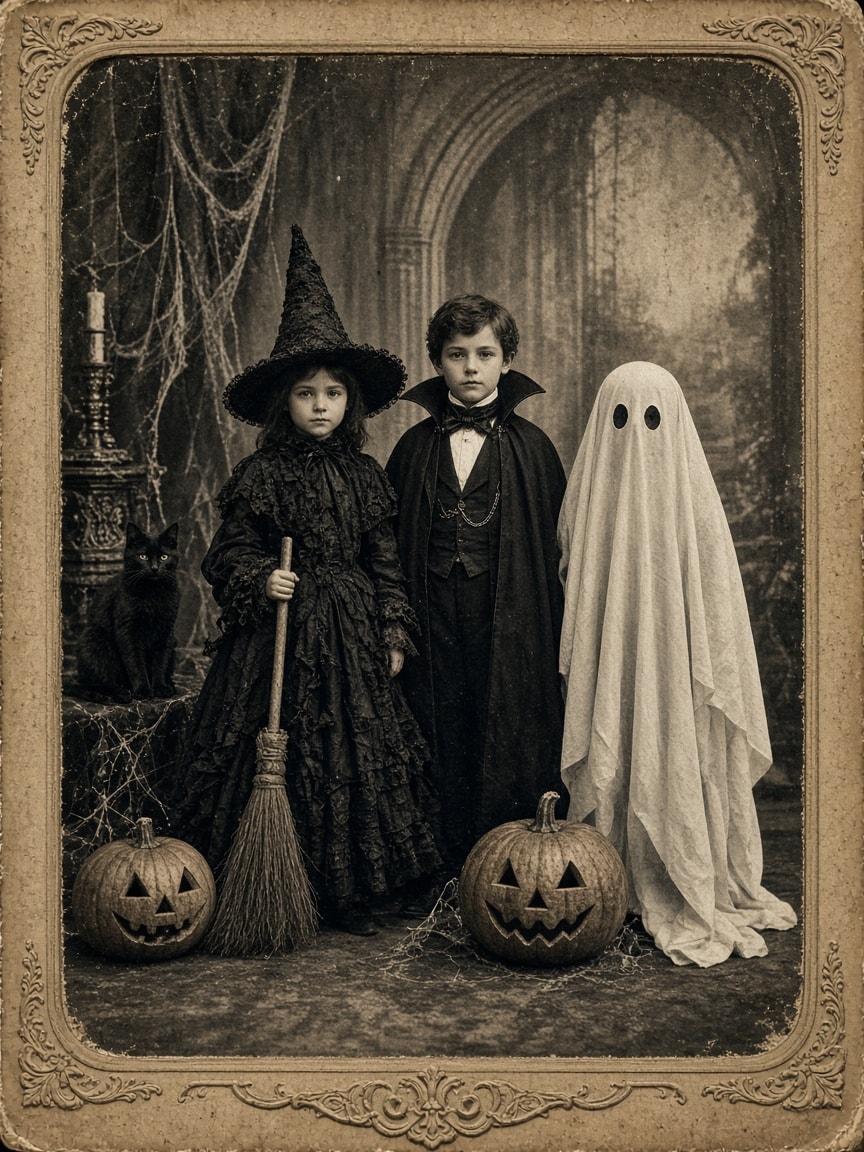
An authentic-looking 1890s cabinet card of three children in handmade Halloween costumes (a witch with a broom, Count Dracula, and a bedsheet ghost) posing solemnly in a Victorian studio among jack-o'-lanterns, cobwebs, a black cat and gothic candleholders, rendered as an aged sepia albumen print on an embossed mount, 3:4.
Authentic Victorian-era Halloween cabinet card photograph, circa 1890, three children posing solemnly in a vintage photography studio, a young girl dressed as a Victorian witch wearing an elaborate black lace dress and pointed hat, holding an old-fashioned wooden broom, a young boy dressed as Count Dracula with an elegant dark cape and high collar, and a mysterious child dressed as a ghost beneath a flowing white sheet with two eyeholes. Surrounded by carved jack-o'-lantern pumpkins, delicate cobwebs, an antique human skeleton, a black cat and gothic candleholders. Elaborate Victorian studio backdrop, theatrical composition, haunting yet charming atmosphere, subtle gothic horror aesthetic, authentic 19th-century clothing and handmade costumes, extremely realistic faces, natural skin textures, serious expressions, aged sepia albumen print, antique photographic grain, subtle fading, scratches, worn paper edges, ornate embossed cardboard mount with decorative typography, historically accurate cabinet card photography, soft diffused studio lighting, exquisite archival details, photorealistic, no modern elements --ar 3:4
Build an image-ready and motion-ready brief for one hero shot of an old stone farmhouse at the end of purple lavender rows in Provence at sunrise: farmhouse and trees, lavender rows, landscape depth, light, fixed details, a motion map, and two prompt seeds: a 16:9 still image and an image-to-video animation.
Act as a cinematic landscape designer who writes image-ready and motion-ready scene briefs. Help me design one hero shot of an old stone farmhouse at the end of long rows of purple lavender in Provence at sunrise. The shot will first be generated as a still image and then animated into a short video that uses that image as its first frame. Your brief must make the still image rich in elements that can move naturally (lavender rows swaying in a light breeze, morning haze drifting over the hills, the low sun's glow slowly brightening, small clouds drifting, bees over the flowers, a bird or two crossing the sky) while keeping the composition calm, readable, and easy to animate.

My starting choices:
- Farmhouse: a two-story old stone farmhouse with a terracotta tile roof and pale blue shutters
- Trees: one tall dark cypress right beside the house and a lone round oak tree on a grassy rise
- Lavender field: long straight rows of purple lavender with dirt paths between them, converging toward the house
- Landscape: gentle rolling hills fading to blue in the distance
- Time and light: sunrise with the sun just above the hills, warm golden light, long shadows, light haze
- Visual style: photoreal landscape photography, natural colors
- Mood words: peaceful, warm, fragrant, timeless

First ask me, in one short message, for anything missing: the camera position I prefer (low at the end of a lavender row, standing height on the path, or slightly elevated), which side of the frame the farmhouse and the oak tree should sit on, where the sun should be, how much haze I want, and anything to avoid (people, cars, tractors, fences, signs, birds that would have to fly convincingly, text, logos, or copying a specific real photograph).

Then produce the brief with these sections:

1. **Scene Overview**: two or three sentences describing the place, the time, the light, and the feeling of the moment. Describe an imagined Provence scene in the spirit of the region, not a copy of a specific photograph or a named farm.

2. **Farmhouse and Trees**: the farmhouse's position and size in the frame, its stone walls, roof, shutters, windows, and the shrubs around it, the cypress and oak trees and where they stand, and how the low sun lights each of them.

3. **Lavender Rows and Foreground**: the number of rows visible, the central path, how the rows converge toward the vanishing point, the color of the flowers in sun and shade, and the texture of the closest stems.

4. **Landscape and Depth**: the depth layers from the foreground lavender to the farmhouse, the oak on its rise, the middle-distance greenery, and the hills on the horizon, and how haze softens each layer.

5. **Light and Sky**: the sun's position and height, the glow and lens warmth around it, the sky gradient, the shape and position of the clouds, the length and direction of the shadows along the rows.

6. **Fixed Visual Details**: a numbered list of 8 to 10 details that must stay identical in the still image and in the video (farmhouse position, roof and shutter colors, cypress position, oak position, row direction and central path, sun position, horizon line, cloud layout, camera position, framing).

7. **Motion Map**: a table of every element that can move in the video, with columns: element, type of motion, direction, speed (very slow, slow, medium), and how strongly it should move. Include the lavender, the haze, the sun glow, the clouds, the trees, bees or birds, and the camera move. Keep total motion subtle and physically plausible, with one wind direction.

8. **Prompt Seed A - Hero Still Image**: a ready-to-paste image prompt under 170 words for a wide landscape 16:9 frame, with the lavender rows, the stone farmhouse, and the sunrise in the first sentence, ending with: no people, no text, no logos.

9. **Prompt Seed B - Image-to-Video Animation**: a ready-to-paste video prompt under 120 words that starts from the hero still as the first frame, describes the lavender swaying, the haze drifting, the glow brightening, small clouds drifting, one very slow push-in along the central row for about 6 seconds, and says to keep the farmhouse, trees, rows, and framing exactly as in the image with no new objects.

Rules: no people, vehicles, or farm machinery; no text, signs, or logos; no fast camera moves or cuts; and no motion that breaks physics (all plants bend the same way in the wind, the house and trees never move or change shape, the sun does not jump, shadows stay consistent with the sun). Use short paragraphs and lists.
Build an image-ready and motion-ready brief for one hero shot of a red-roofed white church on a grassy headland above an Icelandic black sand beach with basalt sea stacks at golden hour: church, beach and surf, sea stacks, light, fixed details, a motion map, and two prompt seeds: a 16:9 still image and an image-to-video animation.
Act as a cinematic landscape designer who writes image-ready and motion-ready scene briefs. Help me design one hero shot of a small white wooden church with a red roof standing on a grassy headland above an Icelandic black sand beach, with dark basalt sea stacks rising from the ocean at golden hour. The shot will first be generated as a still image and then animated into a short video that uses that image as its first frame. Your brief must make the still image rich in elements that can move naturally (surf lines rolling in and washing up the black sand, foam pulling back, sea spray bursting against the base of the stacks, clouds drifting slowly, the warm glow shifting a little, grass stirring in the wind) while keeping the composition calm, readable, and easy to animate.

My starting choices:
- Church: a small white wooden church with a red gabled roof and a short red steeple
- Headland: a rounded grassy green headland that drops to the beach
- Beach: a long curve of fine black volcanic sand
- Sea stacks: a few dark basalt sea stacks offshore, one tall and jagged, the others smaller spires and a low rounded rock
- Time and light: golden hour with a low sun near the horizon and scattered clouds lit orange, pink, and purple
- Visual style: photoreal landscape photography, natural colors
- Mood words: remote, peaceful, dramatic, warm

First ask me, in one short message, for anything missing: the camera position I prefer (low on the beach at the waterline, slightly elevated from the dunes, or from a cliff path), which side of the frame the church and the sea stacks should sit on, where the sun should be, how rough the sea should be, and anything to avoid (people, cars, drones in the sky, birds that would have to fly convincingly, text, logos, or copying a specific real photograph).

Then produce the brief with these sections:

1. **Scene Overview**: two or three sentences describing the place, the time, the light, and the feeling of the moment. Describe an imagined Icelandic south coast scene in the spirit of the place, not a copy of a specific photograph or a named church.

2. **Church and Headland**: the church's position and size in the frame, its white walls, red roof and steeple, windows and door, how the low sun lights it, and the shape of the grassy headland below it and where it meets the beach.

3. **Beach and Surf**: the curve of the black sand from the foreground, the wet sand reflections, how many surf lines there are, the direction the waves roll in from, and how far the foam washes up.

4. **Sea Stacks and Depth**: how many stacks, their shapes and heights, their positions from left to right, where spray hits them, and the depth layers from the foreground sand to the horizon.

5. **Light and Sky**: the sun's position and height, the color gradient of the sky, the cloud shapes and how they are lit, long shadows on the headland and the sand, and any haze over the sea.

6. **Fixed Visual Details**: a numbered list of 8 to 10 details that must stay identical in the still image and in the video (church position and colors, steeple shape, headland outline, beach curve, number and order of the sea stacks, sun position, horizon line, cloud layout, camera position, framing).

7. **Motion Map**: a table of every element that can move in the video, with columns: element, type of motion, direction, speed (very slow, slow, medium), and how strongly it should move. Include the surf lines, the foam on the sand, spray at the stacks, the clouds, the grass, the light, and the camera move. Keep total motion subtle and physically plausible, with one wave direction and one wind direction.

8. **Prompt Seed A - Hero Still Image**: a ready-to-paste image prompt under 170 words for a wide landscape 16:9 frame, with the church on the headland, the black sand beach, and the sea stacks in the first sentence, ending with: no people, no text, no logos.

9. **Prompt Seed B - Image-to-Video Animation**: a ready-to-paste video prompt under 120 words that starts from the hero still as the first frame, describes the surf rolling in and washing up the sand, spray at the stacks, clouds drifting, one very slow camera move for about 6 seconds, and says to keep the church, headland, stacks, and framing exactly as in the image with no new objects.

Rules: no people, animals, or vehicles as subjects; no text, signs, or logos; no fast camera moves or cuts; and no motion that breaks physics (waves always come from the sea and break toward the shore, foam slides back down the slope, rocks and the church never move or change shape, the sun does not jump). Use short paragraphs and lists.
Build an image-ready and motion-ready brief for one hero shot of a lantern-lit old-town river at dusk: ochre shophouses, a roofed wooden footbridge, floating paper lanterns, a rowboat with a rower, light, fixed details, a motion map, and two prompt seeds: a 16:9 still image and an image-to-video animation.
Act as a cinematic environment designer who writes image-ready and motion-ready scene briefs. Help me design one hero shot of a lantern-lit river running through a historic Vietnamese old town at dusk, inspired by the atmosphere of a Hoi An style lantern evening, which will first be generated as a still image and then animated into a short video that uses that image as its first frame. Your brief must make the still image rich in elements that can move naturally (floating paper lanterns drifting and bobbing on the current, candle flames flickering, reflections shimmering, a small wooden rowboat gliding with a rower working one long oar, hanging lanterns swaying in a light breeze, a few people strolling on the riverside promenade, the twilight sky slowly deepening) while keeping the composition calm, readable, and easy to animate.

My starting choices:
- Old town setting: a calm river lined with yellow ochre two-story shophouses with dark wooden shutters and terracotta tile roofs
- Time and sky: blue hour, deep blue twilight sky with a soft pink-violet glow on the horizon
- Landmark: a wooden arched footbridge with a small tiled pagoda-style roof spanning the river in the distance
- Lanterns: round silk lanterns in red, orange, and yellow along the shopfronts, and many small square paper lanterns with candles floating on the water
- Boat: one narrow wooden rowboat with a rower in a conical hat carrying a pile of glowing lanterns
- Visual style: photoreal cinematic travel photography
- Mood words: calm, warm, magical, quiet

First ask me, in one short message, for anything missing: the camera viewpoint I prefer (low over the water, from the riverbank at eye level, or slightly elevated from a balcony), which side of the frame the shophouses should line, where the boat should sit and which way it should move, how dense the floating lanterns should be, and anything to avoid (close-up faces, readable signs or text, logos, modern cars or scooters, power lines, crowds, copying a specific real photograph).

Then produce the brief with these sections:

1. **Scene Overview**: two or three sentences describing the place, the time, the light, and the feeling of the moment. Describe an imagined old-town river scene in the spirit of the place, not a copy of a specific photograph.

2. **Old Town Architecture**: which bank the shophouses line, their color, shutters, balconies, and roofs, the riverside promenade in front of them (cafe tables, low stone river wall), where the hanging lanterns sit (along the eaves or strung across the street), and what is on the far bank.

3. **Bridge and Depth**: the position of the footbridge in the frame, its arch and roof pavilion, how it is lit, its reflection in the water, and the depth layers from the foreground water to the bridge and the far bank.

4. **Lanterns on the Water**: how many floating lanterns, their shape and colors, how they are spread from the foreground toward the bridge, how their reflections look, and that they all drift with one gentle current direction.

5. **Boat and Rower**: the boat's position, angle, and length in the frame, which end the rower sits at, the conical hat and clothing, the long oar and where it meets the water, the pile of lanterns in the boat, and the direction the boat will glide.

6. **Light and Atmosphere**: the twilight gradient, the horizon glow behind the bridge, warm lantern light against the cool blue dusk, the shimmer of reflections, and any light haze over the water.

7. **Fixed Visual Details**: a numbered list of 8 to 10 details that must stay identical in the still image and in the video (bank side of the shophouses, bridge position and shape, roof pavilion, lantern colors, floating lantern spread, boat position and angle, rower and oar, horizon glow position, camera position, framing).

8. **Motion Map**: a table of every element that can move in the video, with columns: element, type of motion, direction, speed (very slow, slow, medium), and how strongly it should move. Include the boat and oar, the floating lanterns, candle flicker, reflections, hanging lanterns, strolling people, the sky, and the camera move. Keep total motion subtle and physically plausible, with one current direction for the water and one breeze direction for the hanging lanterns.

9. **Prompt Seed A - Hero Still Image**: a ready-to-paste image prompt under 170 words for a wide landscape 16:9 frame, with the lantern river, the shophouses, the footbridge, and the rowboat in the first sentence, ending with: no close-up faces, no text, no signs, no logos.

10. **Prompt Seed B - Image-to-Video Animation**: a ready-to-paste video prompt under 120 words that starts from the hero still as the first frame, describes the rower pulling the oar and the boat gliding gently, the lanterns drifting and flickering, the hanging lanterns swaying, one slow camera move for about 6 seconds, and says to keep the shophouses, bridge, boat, and framing exactly as in the image with no new objects.

Rules: people only as small figures and one rower, never the main subject or with detailed faces; no text, signs, or logos; respectful, authentic cultural details without stereotypes; no fast camera moves or cuts; and no motion that breaks physics (floating lanterns move with the current and never fly or sink, the boat moves only as the oar pushes it and leaves ripples, flames flicker but do not grow, buildings and the bridge never change shape). Use short paragraphs and lists.