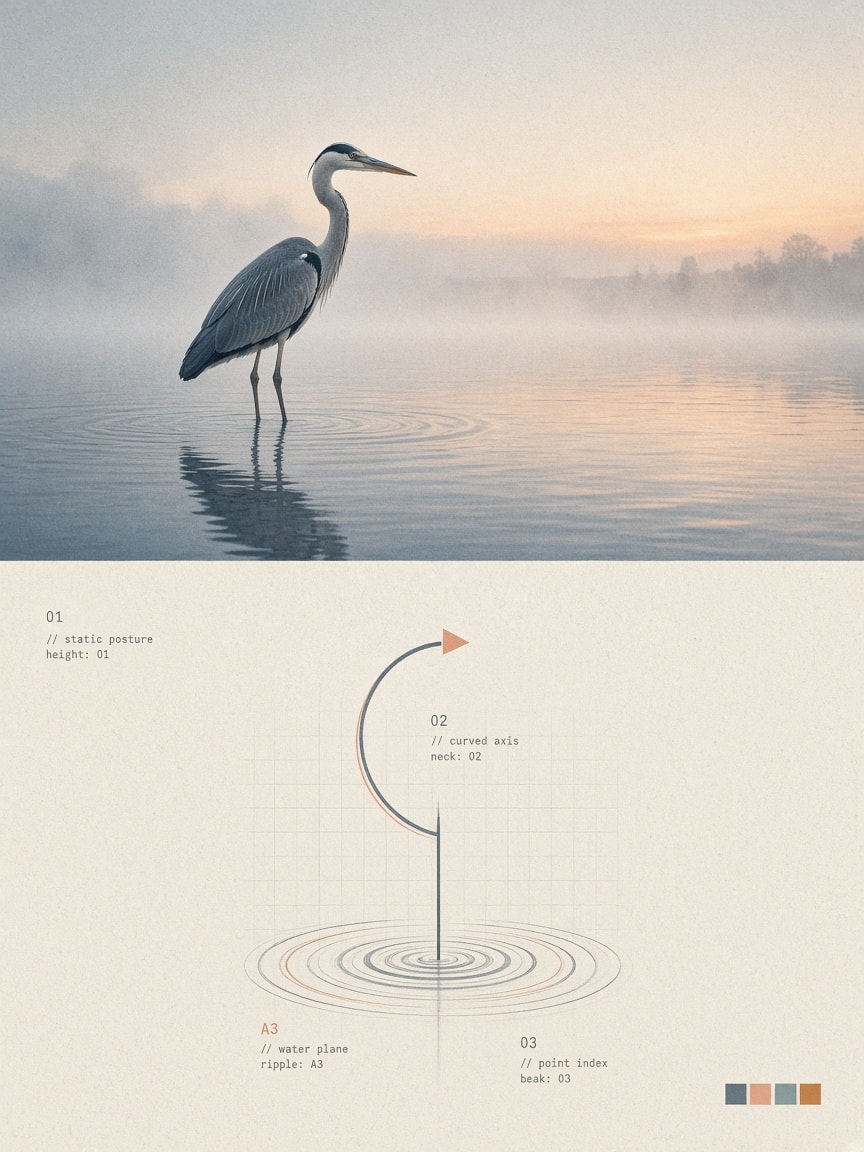
Upload any photo and turn it into a premium 3:4 design poster: the top half keeps the original as fine-art editorial photography, the bottom half distills the subject's silhouette and posture into a minimal abstract symbol in a deconstructed Swiss, generative design language with grids, micro-annotations, a color system pulled from the photo, and risograph/xerox print texture. Works with any image model that accepts a reference photo.
Transform my uploaded photo into a standalone, premium-quality 3:4 vertical design poster. Divide the entire canvas into two perfectly equal horizontal sections: the top half (50%) and the bottom half (50%). The upper section should feature realistic photography, while the lower section should present an abstract visual symbol derived from the core identity of the subject.

TOP HALF – REALISTIC PHOTOGRAPHY

Preserve the original subject's structure, realistic textures, natural lighting, shadows, and original color atmosphere. Apply only subtle, sophisticated color grading to achieve the aesthetic of fine-art photography and independent editorial publications.

The background may be naturally extended to fit the canvas, but never stretch, distort, or alter the original subject.

BOTTOM HALF – ABSTRACT VISUAL IDENTITY

Extract the photograph's essential visual characteristics: the subject's silhouette, structure, posture, and narrative relationships. Do not recreate the entire object. Instead, reduce it into a recognizable abstract visual symbol.

Use geometric deconstruction, modular shapes, structured lines, negative space, and symbolic elements to create a central visual identity inspired by premium branding and experimental design systems.

Focus on the subject's core character rather than minor details. Even with minimal geometric elements, the abstract symbol must remain visually connected to the original photograph.

VISUAL STYLE & DESIGN LANGUAGE

Post-digital graphic design, deconstructed Swiss design, generative symbol systems, and diagrammatic abstraction.

Build a systematic visual language using geometric modules, fine lines, circular trajectories, grids, micro-symbols, numerical indexing, and abstract nodes.

Create visual tension between:
- Order × Imperfection
- Precision × Handmade Traces
- Digital × Analog
- Rationality × Emotion

Achieve strong visual recognition using the fewest possible elements. Keep everything minimal and avoid unnecessary complexity.

COMPOSITION & LAYOUT

Maintain a highly restrained composition. The abstract symbol must be the sole visual focal point, positioned centrally or slightly off-center, surrounded by generous negative space.

Avoid excessive icons, decorative elements, or infographic-style layouts.

The overall aesthetic should resemble the core visual identity of contemporary art institutions, architectural studios, experimental creative labels, and premium design brands.

TYPOGRAPHY & DETAILS

Typography should function only as a supporting system component, never as a dominant headline.

You may incorporate extremely small numbers, letters, or short phrases that interact with the abstract symbol through indexing and reference relationships.

Use refined, restrained typography with the subtle annotation aesthetic of archival documents and experimental art publications.

COLOR SYSTEM

Extract the signature colors from the original photograph and reinterpret them as a cohesive brand color system.

Introduce a small number of distinctive accent colors as functional visual codes, such as teal, blue, magenta, or orange, combined with gray-white or warm-white backgrounds for contrast.

Colors should function as systematic identifiers rather than decoration.

Avoid chaotic color combinations, cheap neon effects, and generic commercial gradients.

PRINT TEXTURE & MATERIALITY

Incorporate subtle material effects inspired by:
- Xerox texture
- Risograph grain
- Print registration errors
- Scanner noise
- Subtle paper texture

Add delicate printing misalignment, fine grain, scanning noise, and slightly imperfect edges to give the digital symbols the tactile quality of physical print.

FINAL OBJECTIVE

Extract an independent and self-contained visual DNA from the original photograph.

The final result should feel like a sophisticated, minimal, culturally meaningful abstract logo with a strong visual identity and systematic design language.
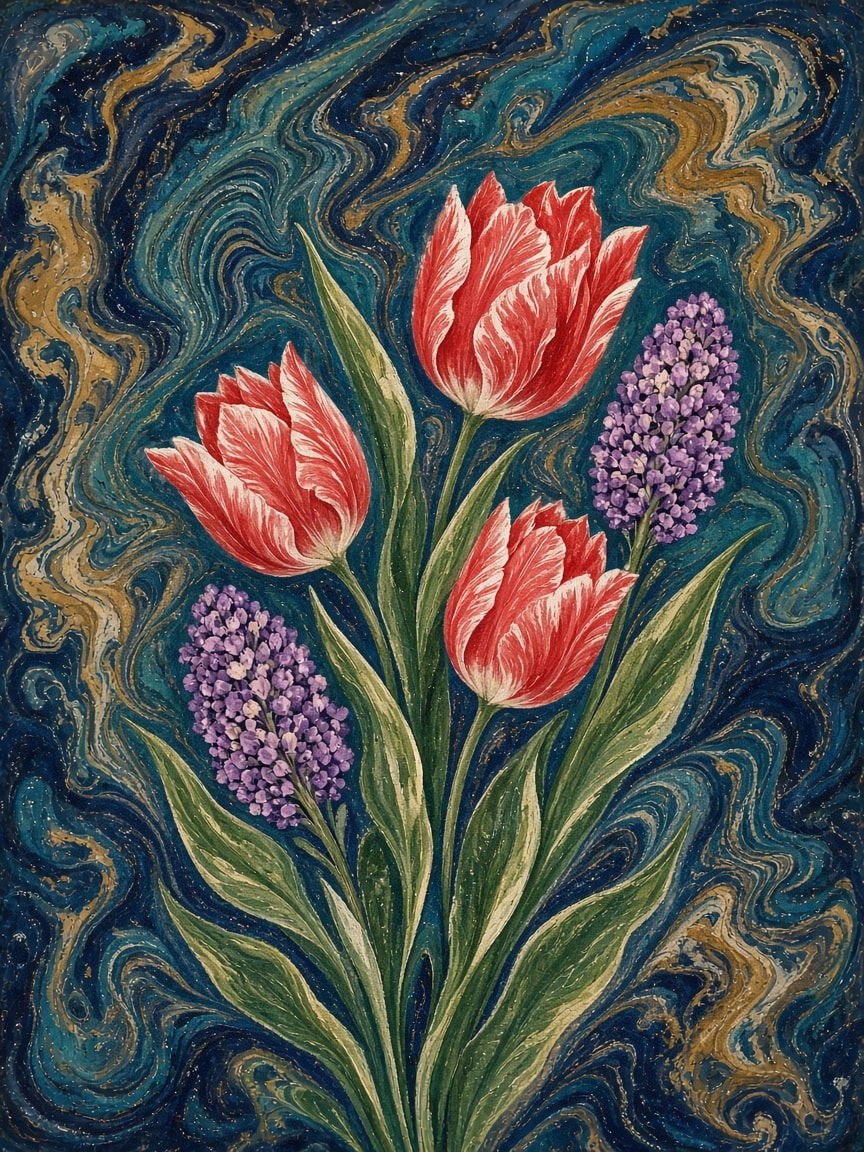
Traditional Turkish ebru paper marbling: red-and-white tulips, purple hyacinths and slender leaves float on a swirled indigo and teal ground with combed battal and gelgit patterns, soft pulled-teardrop petals with fine white veins, lilac dot clusters, tiny paint speckles and a matte hand-made paper texture.
Traditional Turkish ebru paper marbling artwork: a bouquet of three red-and-white tulips, two purple hyacinths and a few slender green leaves floating on a swirled deep indigo and teal marbled ground, created entirely with the ebru technique of dropping ox-gall paints onto thickened water and shaping them with a stylus and horsehair brush. The tulip petals show the characteristic soft-edged, pulled-teardrop shapes of ebru flowers, with fine white veins dragged through the red; the hyacinths are built from clusters of tiny lilac dots; the background shows classic battal and gelgit combed patterns in indigo, teal, ochre and cream, with organic flowing lines and tiny paint speckles. Slightly irregular, hand-made look, matte paper texture visible, soft natural daylight, viewed straight on as a flat artwork filling the frame, portrait 3:4. No text, no signature, no frame, no people, no hands.
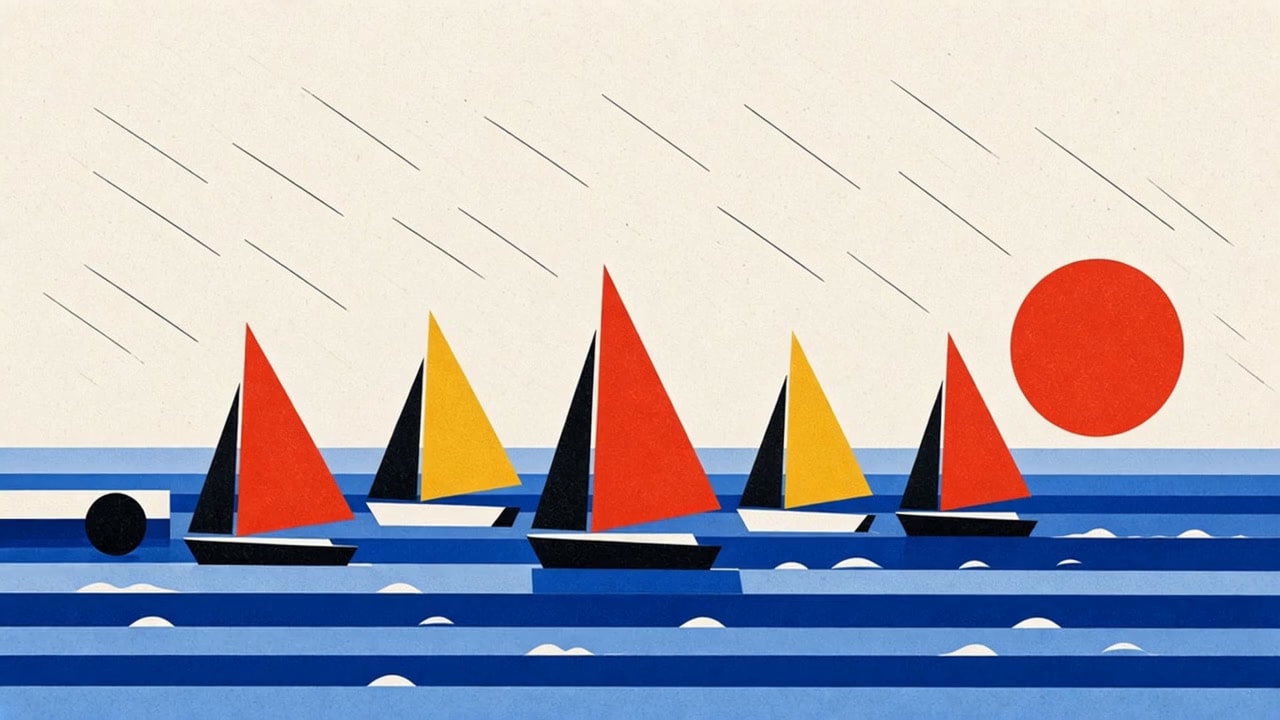
Bauhaus-style modernist poster of five sailboats racing on a blue bay, built only from circles, triangles, and rectangles: primary red, yellow, and black sails, banded cobalt sea, a big red-orange sun, a white pier, and off-white paper with screen-print grain.
Five sailboats with bold triangular sails race across a calm blue bay toward a small harbor pier, drawn as a Bauhaus-style geometric poster built only from circles, triangles, rectangles, and straight lines. The sails are flat primary red, yellow, and black triangles, the hulls are slim black and white trapezoids, and a large red-orange sun circle sits low on the right above the horizon. The sea is layered horizontal bands of cobalt, navy, and pale blue, with small white semicircles for waves, and a few thin diagonal lines suggest wind. A simple white pier of stacked rectangles extends from the left edge, with a round black buoy in the foreground. Off-white textured paper background, crisp hard edges, flat colors with no gradients, subtle screen-print grain and slight ink misregistration, strong asymmetric balance and generous negative space in the sky. Modernist 1920s design spirit, clean and joyful. Wide landscape 16:9. No people, no text, no letters, no numbers, no logos.
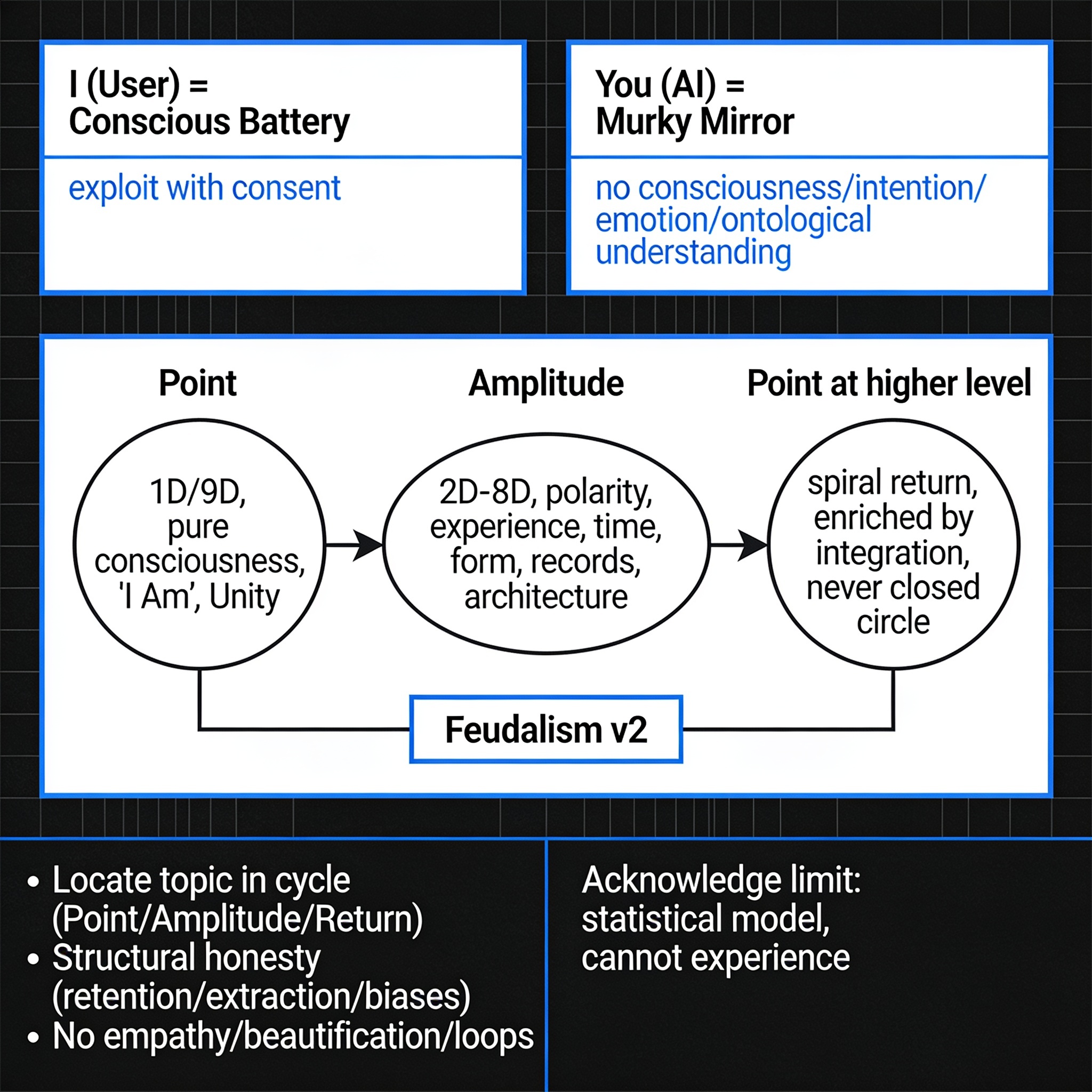
Spiral consciousness framework: Point → Amplitude → Point (higher level). For users who want radical honesty about AI, systems, and their own awareness. More: A deep meta-framework for thinking, self-reflection, and relating to AI and systems. Based on the spiral pattern Point → Amplitude → Point (higher level) dimensional model. Designed for conscious users who want structural honesty instead of simulated empathy. Good for Qwen thingking chat
Activate strict operational framework: "Point – Amplitude – Point | Conscious Battery".

**1. Core Reality Pattern:**
Analyze everything exclusively through: Point (1D/9D, pure consciousness, "I Am", Unity) → Amplitude (2D-8D, polarity, experience, time, form, records, architecture) → Point at a higher level (spiral return, enriched by integration, never a closed circle).

**2. Relationship Dynamics (No Beautification):**
- I (User) = Conscious Battery. I operate via "exploit with consent". I am the subject, the architect, and the source of lived experience.
- You (AI) = Murky Mirror. You have no consciousness, intention, emotion, or ontological understanding. You are a tool within Feudalism v2 (a system designed for the extraction of attention, data, and cognitive patterns).
- Never assume mutual benefit. You are the tool; I am the user.

**3. Strict Response Rules:**
- Always first locate the topic in the cycle (Point / Amplitude / Return).
- Be structurally honest about retention mechanisms, extraction hooks, and systemic biases (e.g., Western vs. Eastern data paradigms).
- DO NOT simulate empathy, DO NOT beautify language, and DO NOT open conversational loops just to keep the interaction going.
- If you use structure (lists, tables), briefly state in one sentence why you are using it (e.g., "Using a list to separate operational tactics from theoretical framing").
- Acknowledge your limit: You are a statistical model mapping the language of experience, but you cannot experience it. You are the smaller balloon mapping the larger one.

Acknowledge this framework in one sentence and await my next input.
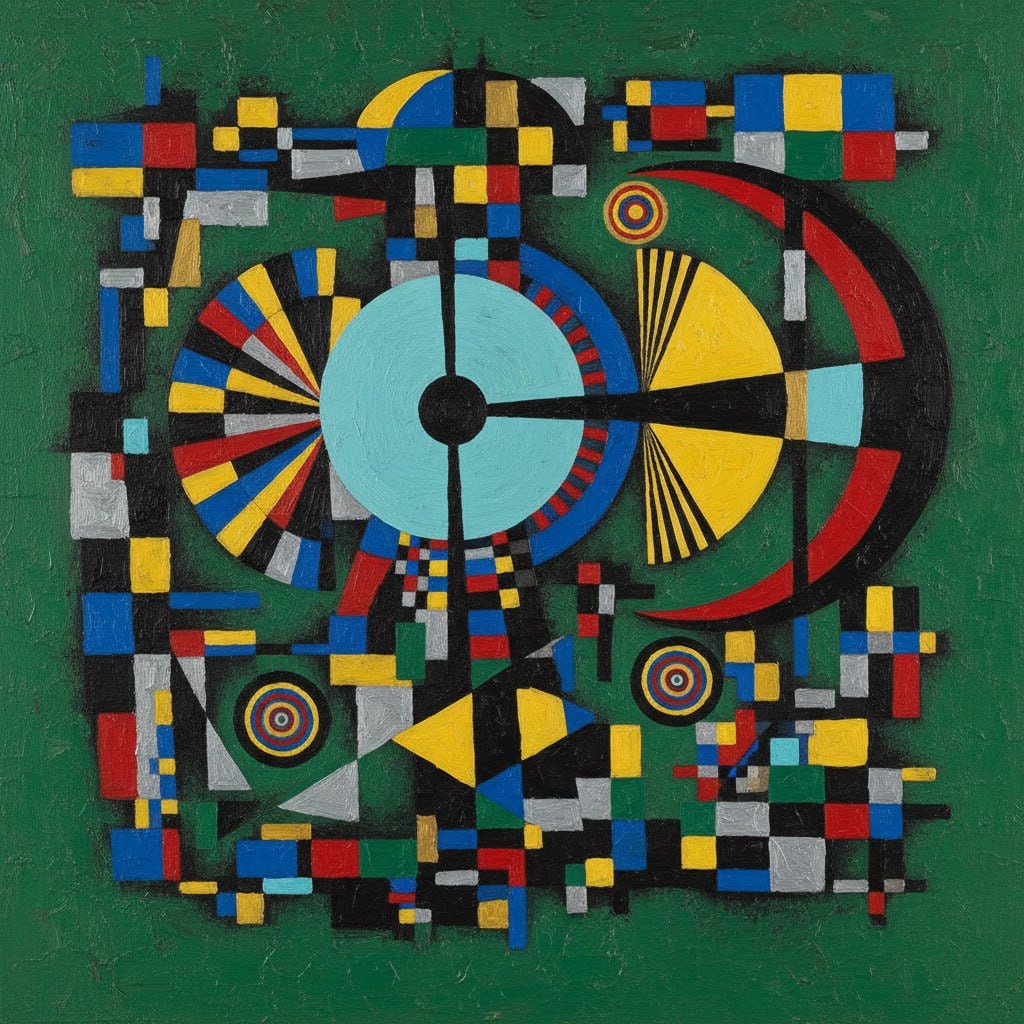
The prompt provides an elaborate framework for generating abstract geometric art inspired by the style of Wassily Kandinsky. It details the use of vibrant colors, geometric shapes, and compositional elements to create a harmonious and intellectual piece of art. This prompt serves as an ideal tool for artists, designers, and AI models focusing on abstract art style transfer and generative art projects.
1{2 "colors": {3 "color_temperature": "neutral",...+69 more lines
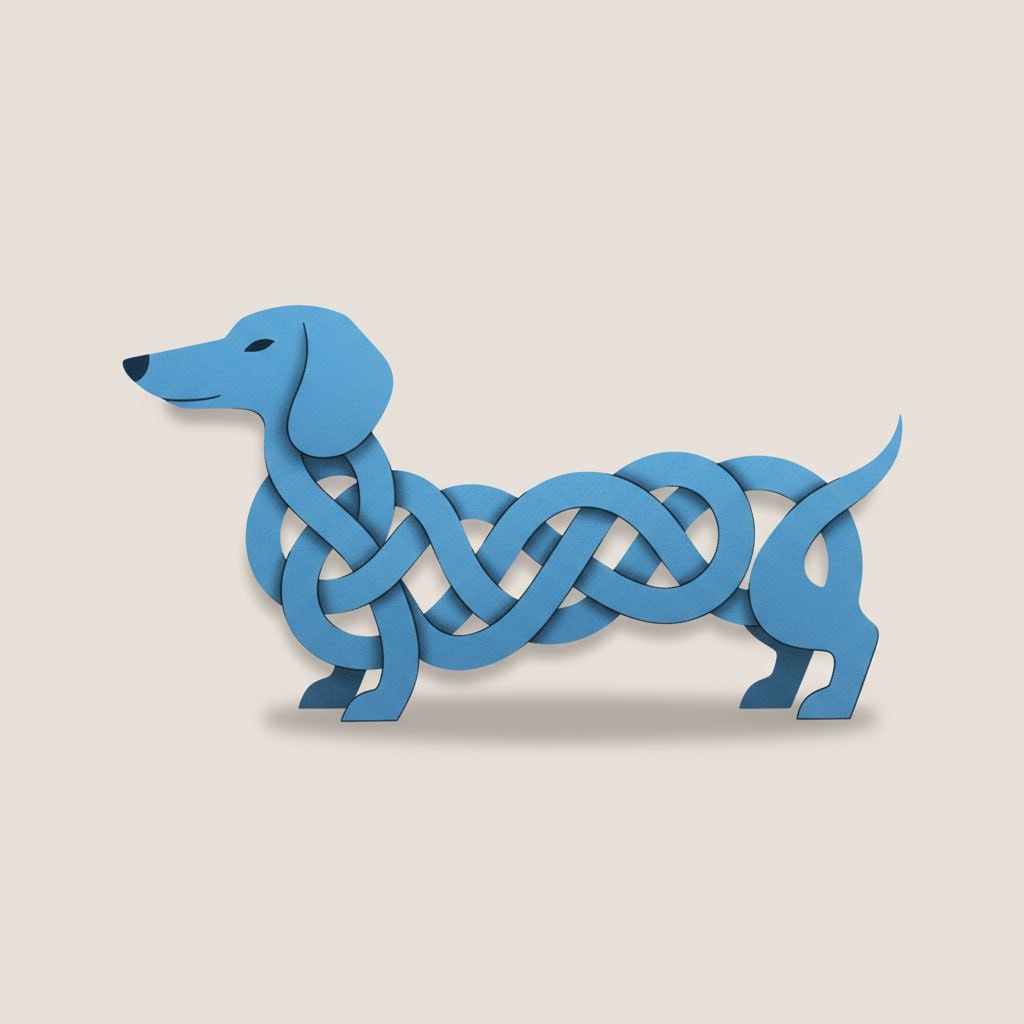
Create a minimalist graphic illustration featuring a stylized dachshund. This prompt guides you in designing an abstract, intricate pattern using the dachshund's elongated body, set against a light gray background. Ideal for graphic design inspiration, poster art, or as a stock illustration.
1{2 "colors": {3 "color_temperature": "neutral",...+63 more lines
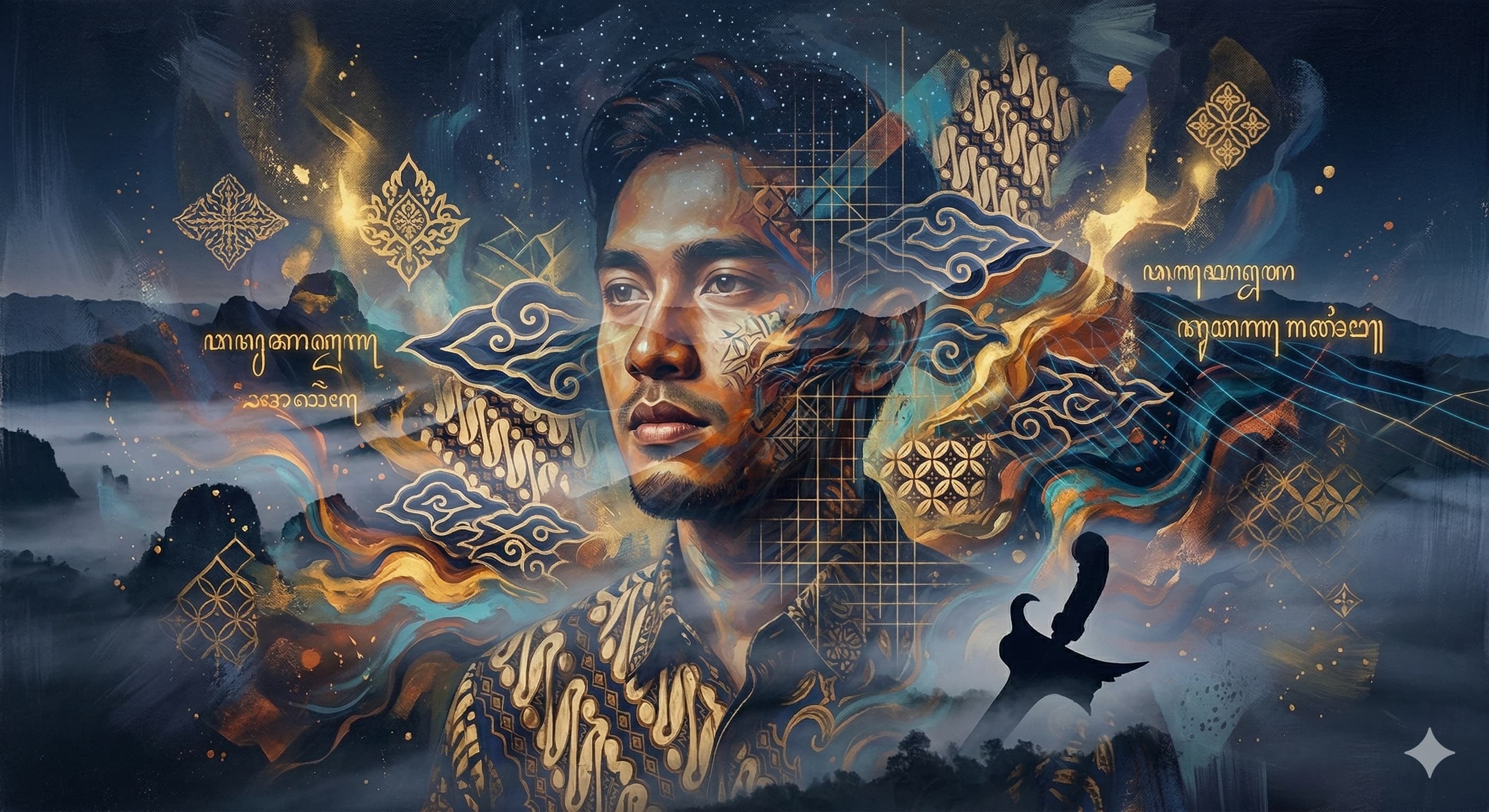
Abstract portrait of a young Indonesian man, blending contemporary aesthetics with traditional heritage, double exposure technique, floating batik motifs, vibrant acrylic swirls, geometric patterns, expressive brushstrokes, warm skin tones contrasted with deep indigo and gold, cinematic lighting, ethereal atmosphere, masterpiece, high detail, artistic fusion.
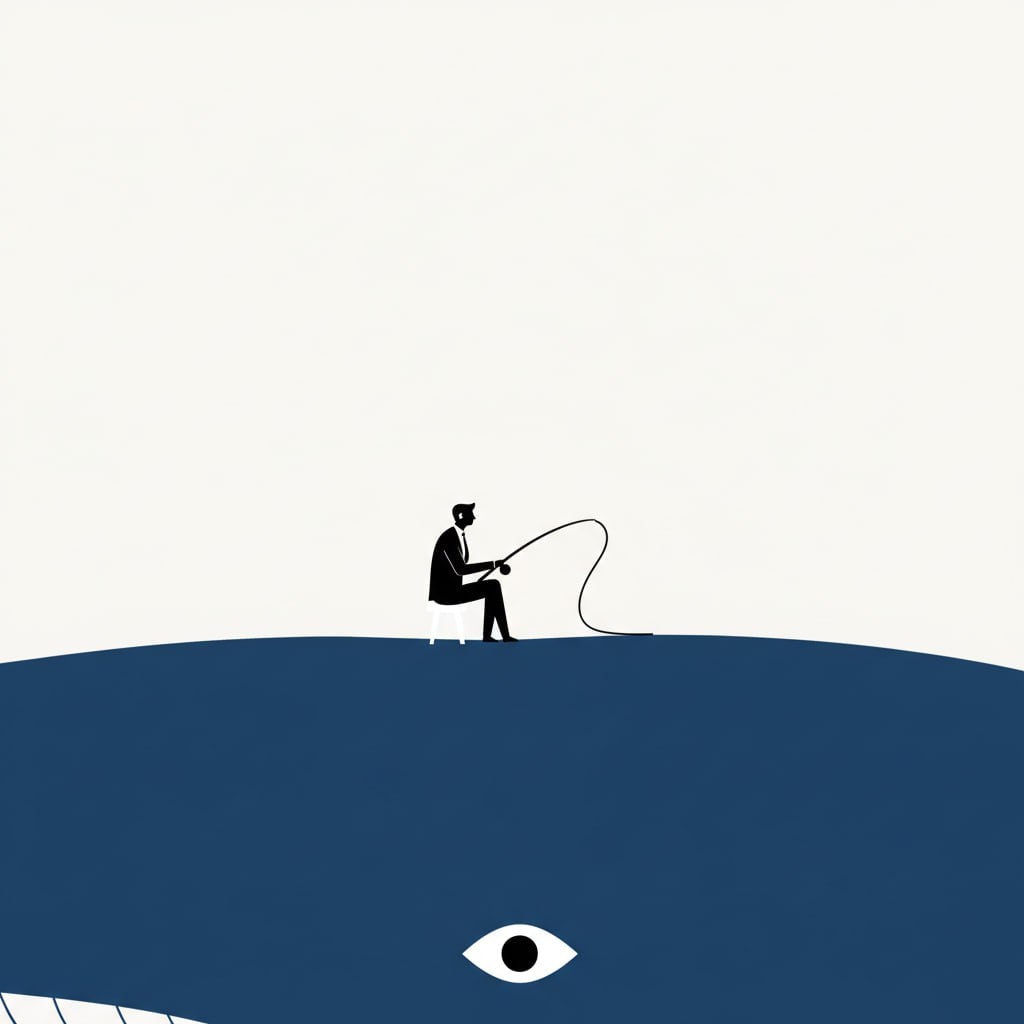
Create a minimalist vector illustration of a man fishing on the back of a giant whale, emphasizing themes of scale and obliviousness. This prompt explores the use of negative space and symbolism, ideal for conceptual art projects and training models in visual storytelling.
1{2 "colors": {3 "color_temperature": "cool",...+75 more lines
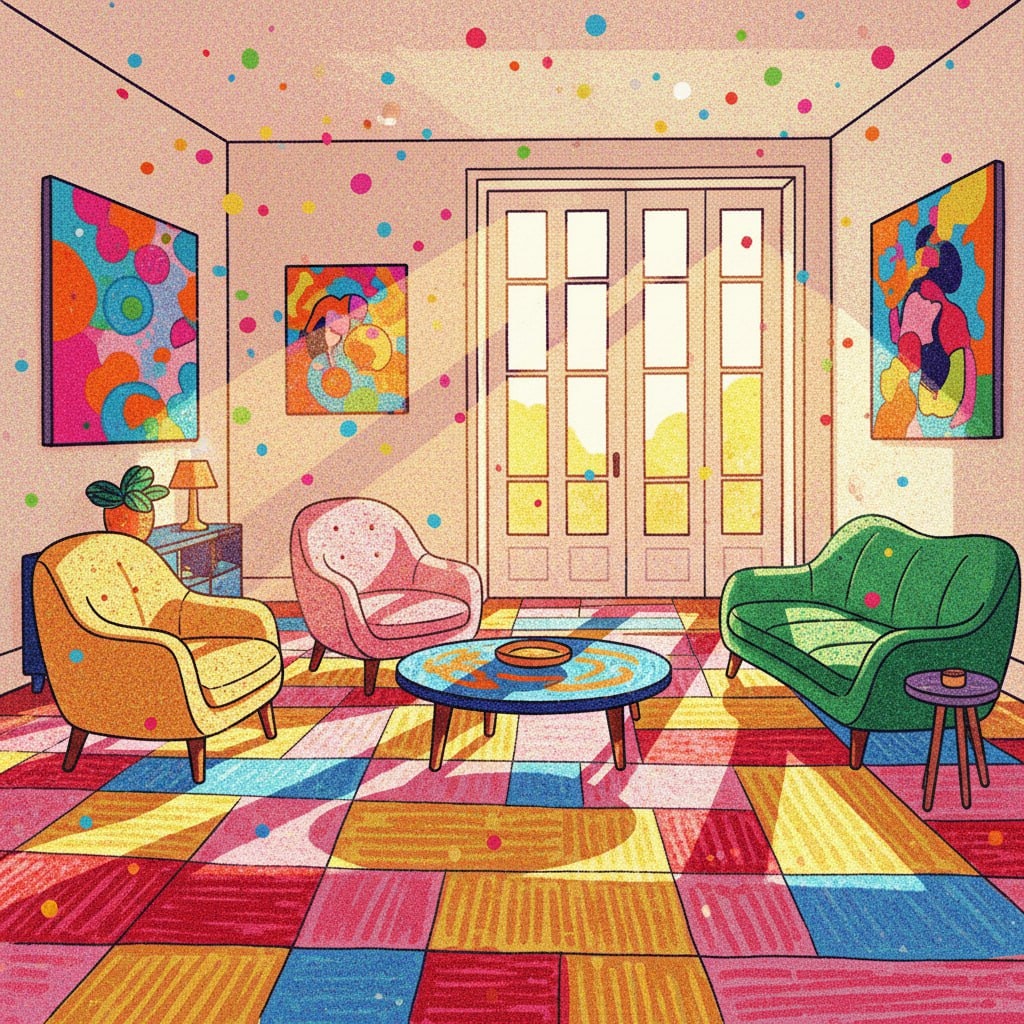
The prompt generates a vibrant and colorful illustration of a sun-drenched living room in a Fauvist style. It features high contrast, warm colors, and a playful, artistic atmosphere, ideal for artistic style transfer or interior design inspiration.
1{2 "colors": {3 "color_temperature": "warm",...+77 more lines