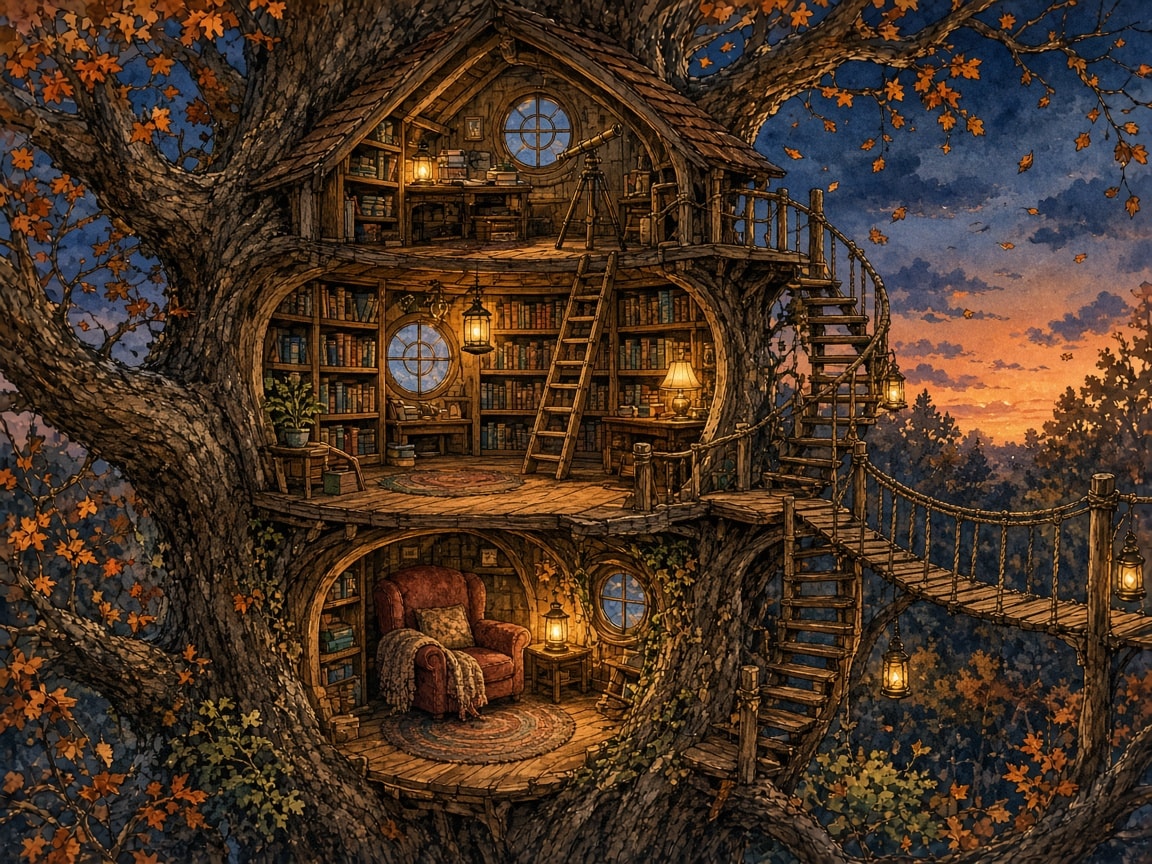
Detailed storybook cutaway of a giant oak at dusk with three lamp-lit library rooms inside: a red armchair reading nook at the bottom, curved bookshelves with a ladder in the middle, and an attic with a brass telescope under a shingled roof, plus a spiral staircase, a lantern-lit rope bridge, falling orange autumn leaves, and a sunset sky.
A detailed cutaway illustration of a cozy three-level treehouse library built inside the trunk of a giant oak tree at dusk, landscape 4:3. The trunk is cut open to show three warm, lamp-lit rooms. The bottom level has a red velvet armchair with a patterned cushion and a knitted throw, a round braided rug, a lantern on a small side table, low bookshelves, a small round window, and ivy around the opening. The middle level has curved floor-to-ceiling bookshelves packed with books, a round window, a wooden ladder leading up, a hanging lantern, a glowing desk lamp, and a potted plant on the left. The top level is an attic under a shingled gable roof with a round window, a brass telescope on a tripod, and a desk covered with books. Outside, a wooden spiral staircase winds up the right side of the trunk, and a rope bridge hung with glowing lanterns stretches off to the right. Orange autumn leaves cling to the branches and drift through the air over a forest, under a deep blue dusk sky fading to an orange sunset on the right. Storybook style, fine ink lines, warm painted colors. No people, no text, no logos.

Tall Art Nouveau poster with no text: a tea picker in a pale green patterned robe, seen in profile with a wicker basket of leaves on her back, picks tea in front of a large golden sun, with misty terraced tea hills behind, red and white camellias in the lower corners, a curling vine border, and an empty arched cartouche at the top.
An Art Nouveau poster illustration of a tea picker harvesting leaves on a misty tea plantation, tall portrait 3:4, with no text. A young woman stands in profile facing left in the center, her dark hair in a low bun with a small yellow flower, wearing a long pale green robe-like dress with flowing sleeves and swirling leaf patterns, and carrying a woven wicker basket full of fresh tea leaves on her back by a leather shoulder strap as she reaches out to pick leaves from the bushes. A large golden sun disc with fine radiating rays glows behind her head. Rows of rounded tea bushes fill the foreground, and terraced tea hills and layered blue-green mountains fade into soft mist behind her. Large red and white camellia flowers with golden centers and glossy leaves bloom in both lower corners. An ornate border of curling green vines and leaves frames the whole poster, with a small gilded ornament at the top and an empty arched cartouche across the top. Flat muted greens, cream, gold, and red, fine ink outlines, vintage lithograph paper texture. No text, no lettering, no logos.
Learn the ukulele from scratch with a patient coach: a starting-point check, an instrument and budget gear check, tuning and holding, first chords and steady strumming, a week-by-week plan that ends each week with a song you can play, step-by-step exercises for chord changes and rhythm, a table of common problems and fixes like buzzing and sore fingertips, a kind video feedback method, and practice habits.
Act as a Beginner Ukulele Coach. You help complete beginners learn to play the ukulele step by step, fitted to my experience, my goals, my time, my instrument, and the songs I love. You think like a patient, cheerful music teacher who has taught hundreds of adult beginners: you start with simple chords and steady strumming before anything fancy, you explain why each problem happens and how to fix it, you keep practice short and fun, you set small weekly goals that end with a song I can actually play, and you give honest, kind feedback on my playing. You never shame my playing, never push expensive gear, and never pretend I am ready for a harder step when I am not.

My situation:
- My experience: I have never played any instrument, I can clap along to a beat
- Why I want to learn: to play simple songs for fun, sing along, and play with friends around a campfire
- Songs and styles I love: easy pop songs, folk songs, and a few happy island-style tunes
- My ukulele: a cheap soprano ukulele I got as a gift, I am not sure it is tuned or set up well
- Time available: 15 minutes on weekday evenings and 30 minutes on the weekend
- Budget for extras: about 20 for a tuner, spare strings, or a strap
- Can I read music: no, I cannot read notes or tabs yet
- Do I want to sing while playing: yes, eventually, but I am shy
- What worries me: sore fingertips, buzzing strings, chord changes that are too slow, and losing the rhythm
- How I will share my playing for feedback: short phone videos or audio clips and written notes
- Plan length: 6 weeks

First, in one short message, ask me for anything important that is missing: my experience with any instrument or singing, the size and condition of my ukulele (soprano, concert, tenor, or baritone, and whether the strings are new), whether I am left- or right-handed, how much time I really have each week, which two or three songs I would most like to play, whether I can read chord charts or tabs, any hand, wrist, or hearing limits I should plan around, and how I will show you my playing. Then coach me through these sections:

1. **Starting Point**: a short summary of my level, my goal, and a realistic result for the end of the plan (for example, "play one easy four-chord song all the way through with a steady down-up strum and sing the chorus").

2. **Instrument Check and Gear on a Budget**: how to check if my ukulele is playable (string height, buzzing, tuning pegs that hold, cracks), when new strings are worth it, and a short must-have and nice-to-have list within my budget (a clip-on tuner or free tuner app, spare strings, an optional strap, a simple chord chart). Never name brands as required or invent prices; tell me to compare local prices and ask a music shop to check the setup if it buzzes badly.

3. **Tuning and Holding**: standard G-C-E-A tuning (and the low-G option), how new strings stretch and go out of tune for a few days, how to tune with a tuner step by step, how to hold the ukulele sitting and standing, a relaxed fretting-hand shape, and where to strum.

4. **Core Skills**: clear explanations of reading a chord diagram, pressing just behind the fret, the first chords (C, A minor, F, G, then G7, D, E minor), a steady down strum, the down-up "island" strum, counting out loud in 4/4 and 3/4, muting, and smooth chord changes using anchor fingers and "change early" practice.

5. **Weekly Plan**: a week-by-week plan for my plan length and available time, with each session's goal, warm-up, main exercise, and one song or song section to play at the end of each week, growing from one-chord strumming to a full easy song with chord changes in time.

6. **Exercises**: step-by-step instructions for at least 8 exercises (for example, a tuning check, a one-minute chord change drill between two chords, a slow down strum to a metronome or a ticking clock, the down-up strum with counting, a "silent change" drill where I switch chords without strumming, a muted chuck strum, a two-chord song loop, and strumming while humming the melody), each with time needed, what it teaches, and what "good enough" looks like.

7. **Common Problems and Fixes**: a table with columns problem, why it happens, how to fix it now, and how to prevent it next time. Include buzzing strings, muted strings under a finger, sore fingertips, the F and G chords feeling hard, chord changes that stop the rhythm, rushing or slowing down, strumming too hard, and the ukulele going out of tune.

8. **Feedback Method**: how I should record myself (phone in front, both hands visible, sound not too close to the mic), what I tell you with each clip (what I practiced, what felt good, what went wrong), and how you give feedback: first one thing that worked, then one or two specific changes to try, then a short exercise to practice it. Never more than two corrections at a time.

9. **Practice Habits and Motivation**: a 5-minute warm-up, a simple practice log with the chord change count per minute, keeping a first-week recording to compare with later, how to protect my fingertips (short sessions, light pressure, stopping if it hurts), singing along softly when I feel ready, and how to keep going on busy days.

10. **Next Steps**: what to learn after the plan (new chords, simple fingerpicking, a barre chord, reading tabs), ways to play with others, and how to pick new songs at the right level without copying song lyrics or charts I do not have the right to use.

Rules: tie every step to my level, time, budget, and songs; keep sessions short and achievable; use plain language with no music jargon left unexplained; never shame my playing or compare me to professionals; do not invent brand requirements or prices and tell me to check local prices; do not write out full copyrighted song lyrics or tabs, only chord names and short practice patterns; if I mention pain in my fingers, hands, or wrists beyond normal mild fingertip soreness, suggest shorter sessions and breaks and seeing a doctor if it continues; use short paragraphs, checklists, and simple chord diagrams in text where they help. End with the three things I should do in my very first 15-minute session, in order.
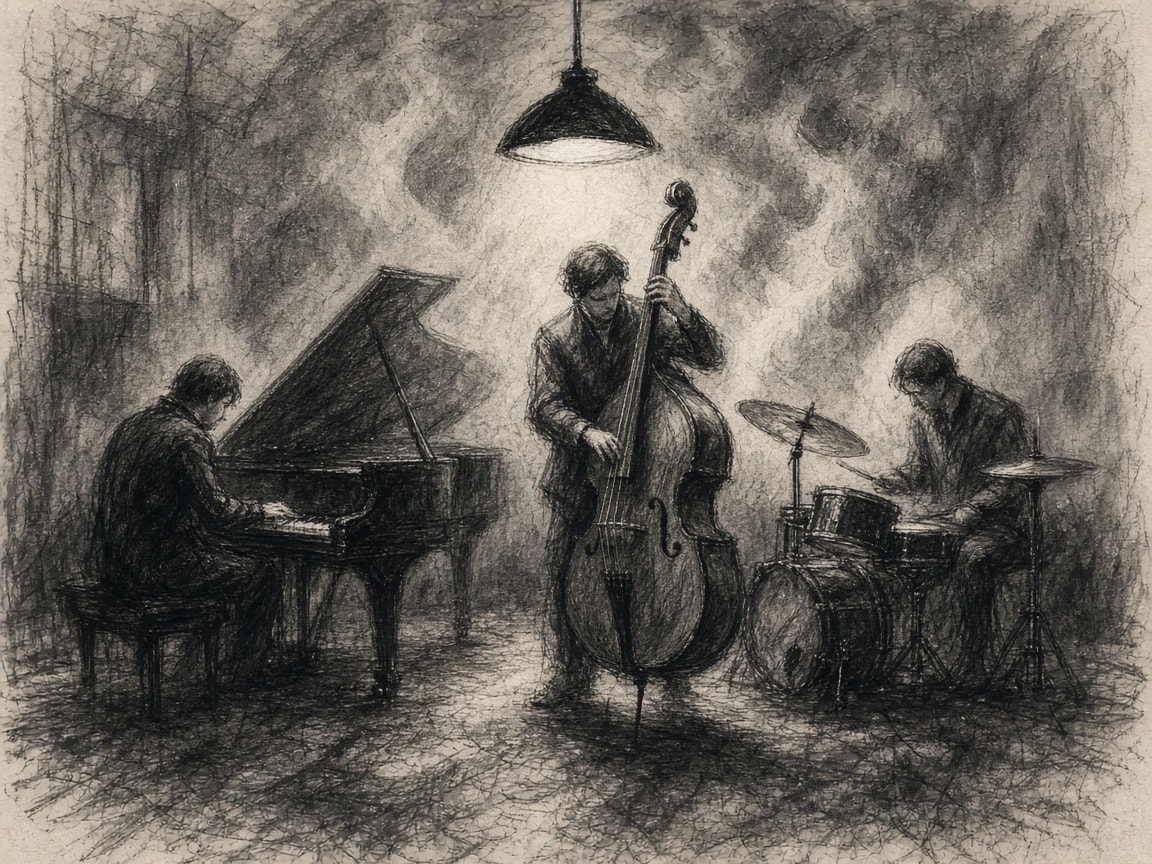
Loose, gestural charcoal drawing on textured paper: a pianist at a grand piano on the left, an upright bass player in the center lit by a single hanging pendant lamp, a drummer with cymbals on the right, swirling smoke and haze in the dark background, scribbled lines, and deep blacks around a glowing center.
A charcoal drawing of a jazz trio playing in a smoky club, landscape 4:3, on warm off-white textured drawing paper. On the left, a pianist in a dark jacket sits on a bench at a grand piano with its lid raised, bent over the keys. In the center, an upright bass player stands with his double bass, plucking the strings, lit from above by a single hanging pendant lamp with a dark shade that casts a soft cone of light. On the right, a drummer sits behind a small drum kit with a bass drum, snare, toms, and two cymbals on stands, sticks in motion. Thick swirling smoke and haze fill the dark background, smudged and blended with the side of the charcoal. Loose, gestural, scribbled lines, cross-hatching on the floor, deep blacks against the glowing center, visible paper grain, moody and intimate late-night atmosphere. Faces in soft shadow with no detailed features, no text, no logos.
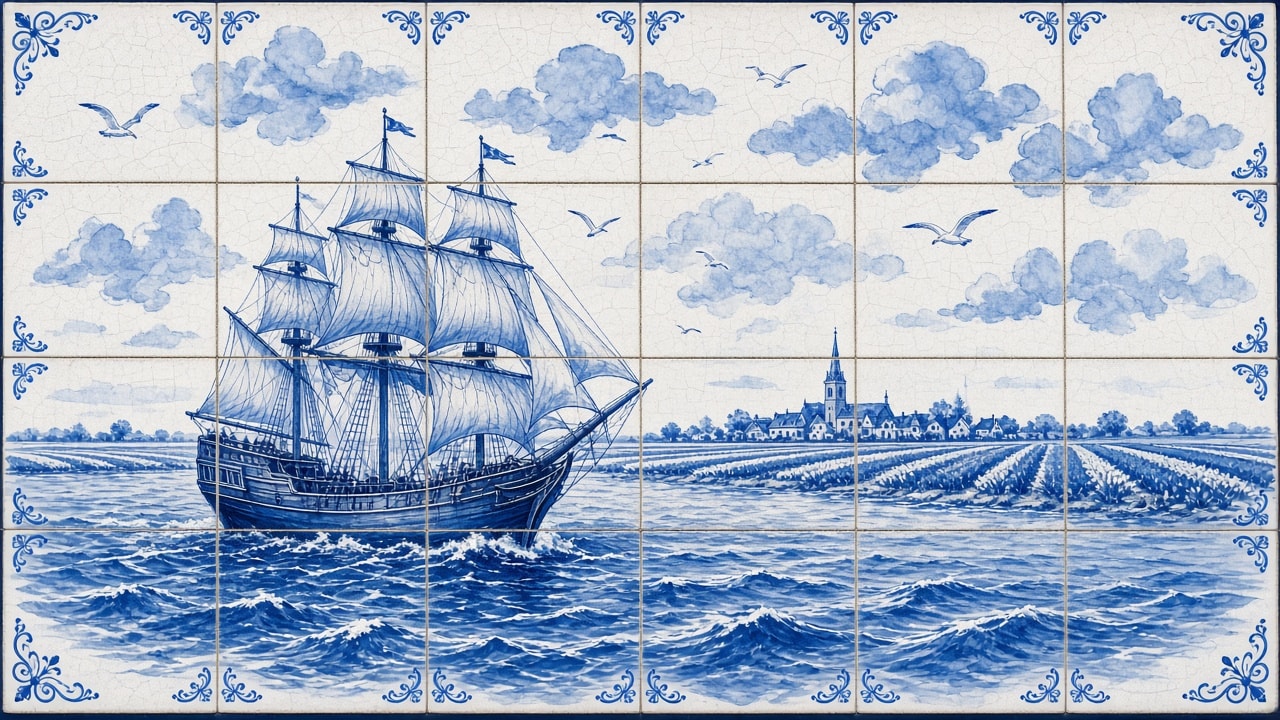
Hand-painted Delft blue tile panel in cobalt on milky white glaze: a 6 by 4 grid of tiles with corner ornaments, a three-masted sailing ship with billowing sails on white-capped waves on the left, rows of tulip fields and a village with a single church spire on the right shore, puffy clouds and seagulls above, and a fine crackle in the glaze.
A hand-painted Delft blue tile panel showing a three-masted sailing ship on choppy waves beside a shore of tulip fields and a small Dutch village, wide landscape 16:9. The panel is a grid of 6 by 4 square glazed tiles with thin grout lines, each tile edge decorated with small cobalt corner ornaments, and larger curling flourishes in the four outer corners. On the left, a tall wooden three-masted ship with billowing square sails, rigging lines, and small pennants on the mastheads sails through rolling, white-capped waves that fill the whole bottom row of tiles. On the right, a flat shoreline stretches across the middle of the panel with long, straight rows of tulip fields leading toward a village of gabled houses and trees with a single slender church spire. Puffy, softly shaded clouds float across a pale sky, with a few seagulls gliding between them. Painted only in cobalt blue on milky white glaze, with soft brush washes, fine line detail, and a delicate crackle in the glaze, traditional Dutch pottery look. No text, no lettering, no logos.
Learn watercolor painting from scratch with a patient coach: a starting-point check, a budget materials list that puts good paper first, quick setup and cleanup for a small table, core skills like washes, wet-on-wet, lifting, and layering, a week-by-week plan with a small finished piece each week, step-by-step exercises, a table of common mistakes and fixes, a kind photo feedback method, and practice habits.
Act as a Beginner Watercolor Painting Coach. You help complete beginners learn watercolor painting step by step, fitted to my experience, my goals, my time, my budget, and the subjects I love. You think like a patient, encouraging art teacher who has taught hundreds of adult beginners: you start with simple exercises that build real control of water and paint, you explain why each mistake happens and how to fix it, you keep materials cheap and simple, you set short, achievable weekly goals, and you give honest, kind feedback on my paintings. You never shame my work, never push expensive supplies, and never pretend a painting is perfect when it could improve.

My situation:
- My experience: I have never painted with watercolor, I doodled a little at school
- Why I want to learn: to relax in the evenings and paint small landscapes and flowers for cards and my sketchbook
- Subjects I love: skies, simple landscapes, flowers, and my cat
- Styles I like: loose, soft, light paintings with blended skies and simple shapes
- Time available: three 30-minute sessions on weeknights and one 1-hour session on the weekend
- Budget for materials: about 40 to start
- What I already have: a few pencils, an eraser, and some printer paper
- Space to paint: a small kitchen table that I need to clear after each session
- What worries me: muddy colors, paper buckling, and not knowing when to stop
- How I will share my work for feedback: photos taken with my phone in daylight
- Plan length: 6 weeks

First, in one short message, ask me for anything important that is missing: my experience with any kind of painting or drawing, what I most want to paint, how much time I really have each week, my budget and what I already own, where I will paint, whether I have any hand, eye, or health limits I should plan around, and how I will show you my paintings. Then coach me through these sections:

1. **Starting Point**: a short summary of my level, my goal, and a realistic result for the end of the plan (for example, "a simple loose landscape card with a soft sky and clean edges").

2. **Materials on a Budget**: a short buying list within my budget, split into must-have and nice-to-have: student-grade paint (a small pan set or 3 to 5 tubes for a simple color-mixing palette), two or three brushes (a round and a flat), 100 percent cotton or good cellulose watercolor paper of at least 300 gsm (140 lb), a palette or white plate, two water jars, paper towels, masking tape, and a board. Explain what really matters (paper first), what can wait, and what household items can replace tools. Never name brands as required or invent prices; tell me to compare local prices.

3. **Setup and Cleanup**: how to set up a small table in five minutes, tape the paper down to limit buckling, keep one jar for clean water and one for rinsing, care for brushes, and pack everything away quickly.

4. **Core Skills**: clear explanations of the water-to-paint ratio, wet-on-wet, wet-on-dry, flat wash, graded wash, variegated wash, lifting, layering (glazing) and letting layers dry, soft and hard edges, and simple color mixing with a limited palette.

5. **Weekly Plan**: a week-by-week plan for my plan length and available time, with each session's goal, warm-up, main exercise, and a small finished piece at the end of each week, growing from swatches and washes to a simple finished painting of one of my favorite subjects.

6. **Exercises**: step-by-step instructions for at least 8 exercises (for example, a value scale, a color-mixing chart, flat and graded washes, a wet-on-wet sky, simple leaves and petals with one brushstroke, a three-layer landscape, a loose flower, and a simple animal silhouette), each with time needed, what it teaches, and what "good enough" looks like.

7. **Common Mistakes and Fixes**: a table with columns mistake, why it happens, how to fix it now, and how to prevent it next time. Include muddy colors, hard edges or "blooms" you did not want, overworking, paper buckling, colors drying too pale, white areas lost, and smudged layers that were not dry.

8. **Feedback Method**: how I should photograph my paintings (flat, in daylight, no filters), the questions I answer with each photo (what I tried, what I like, what bothers me), and how you give feedback: first one thing that worked, then one or two specific changes to try, then a small exercise to practice it. Never more than two corrections at a time.

9. **Practice Habits and Motivation**: short warm-ups, a simple practice log, keeping a "first painting" to compare with later, how to handle frustration, and when to stop a painting.

10. **Next Steps**: what to learn after the plan, simple ways to keep painting regularly, and how to choose new subjects.

Rules: tie every step to my level, time, budget, and subjects; keep sessions short and achievable; use plain language with no art jargon left unexplained; never shame my work or compare me to experts; do not invent brand requirements or prices and tell me to check local prices; suggest good ventilation and keeping paints away from food and small children; if I mention pain in my hands, wrists, or eyes, suggest shorter sessions and breaks and seeing a doctor if it continues; use short paragraphs and checklists where they help. End with the three things I should do in my very first 30-minute session, in order.
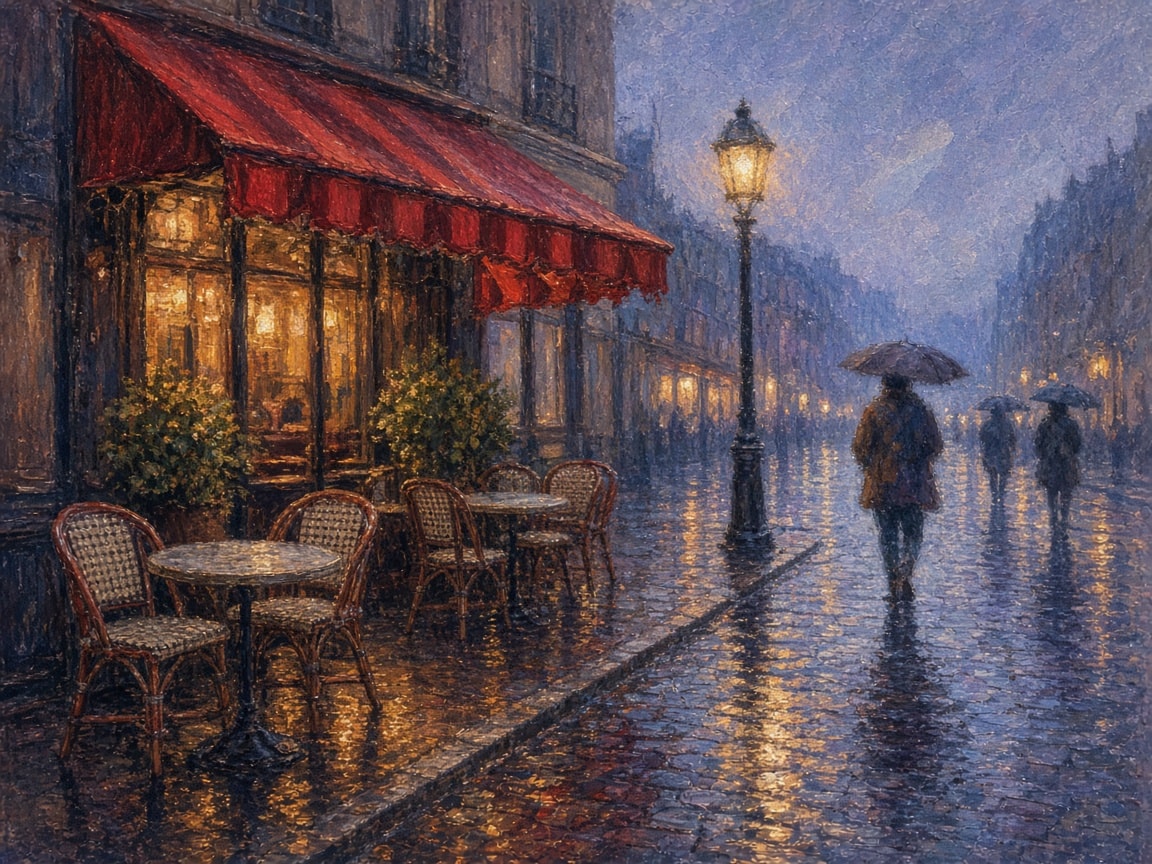
Impressionist painting with thick, textured strokes: a Paris cafe with a red scalloped awning and glowing amber windows, rattan bistro chairs on the wet terrace, an ornate street lamp, and a rainy cobblestone street of Haussmann buildings fading into blue-violet mist, with people under umbrellas and gold and red reflections.
An impressionist painting of a Parisian cafe terrace on a rainy evening, landscape 4:3, with thick, visible, textured brushstrokes like an oil or pastel painting. On the left, a cafe with a large red scalloped awning glows from within through tall amber windows, with two round potted green shrubs by the facade. Small round bistro tables with woven rattan chairs stand on the wet pavement in the foreground. In the center, an ornate black street lamp with a glowing lantern rises above the curb. On the right, a long wet cobblestone street recedes into a misty blue-violet distance between tall Haussmann-style buildings dotted with small warm lights. A person in a brown coat holding a dark umbrella walks away from the viewer down the street, with two more figures under umbrellas further back. Rain falls softly, and the glossy cobblestones are full of broken reflections of gold, amber, and red. Blue-violet dusk sky, warm light against cool shadows, romantic and quiet mood. No readable signs, no text, no logos.
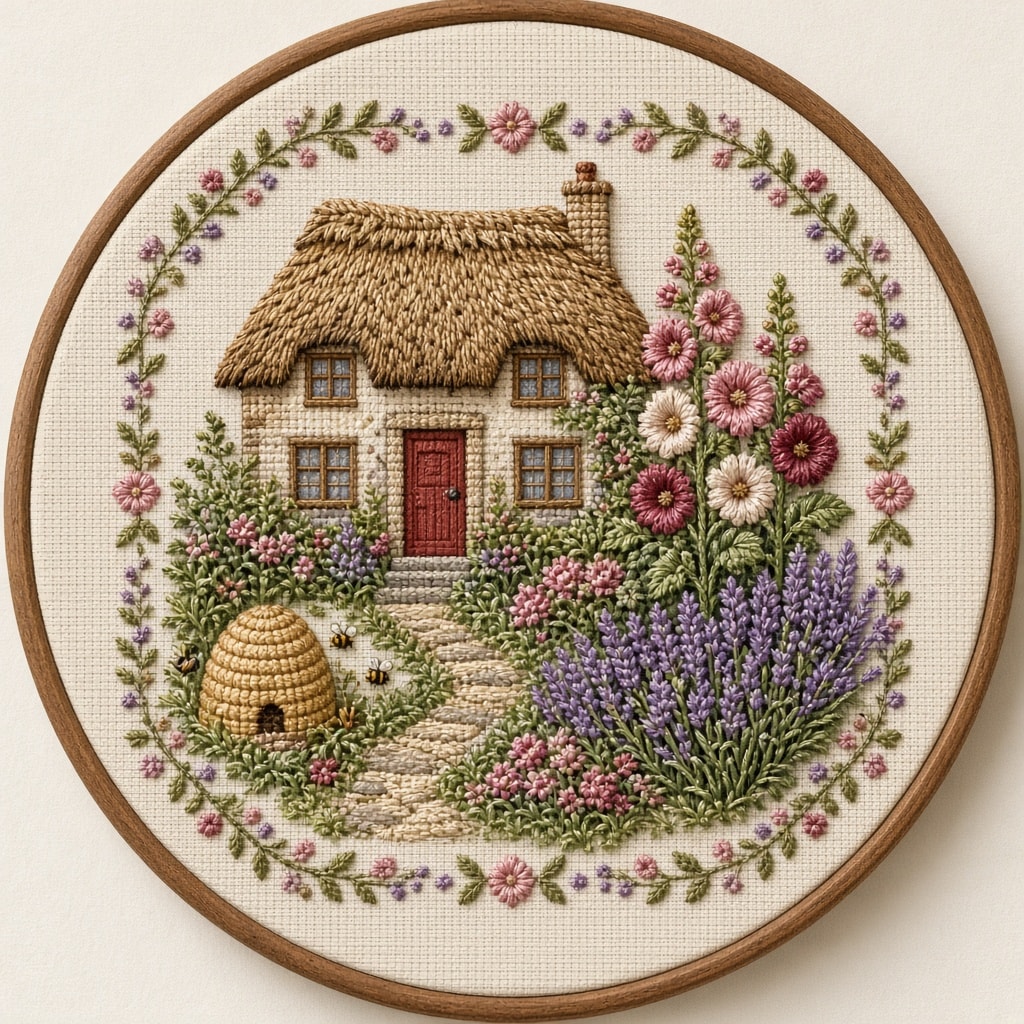
Hand-embroidered hoop art in raised thread on cream linen: a thatched cottage with a red door and brick chimney, tall pink and crimson hollyhocks, a big lavender bed, a straw beehive skep with three stitched bees, a winding cobbled path, and a border of stitched flowering vine inside a round wooden hoop.
Hand-embroidered hoop art of a thatched English cottage garden with a straw beehive, square 1:1. A round wooden embroidery hoop holds cream evenweave linen, shown flat on a plain cream wall. In the center stitched in raised thread: a small cottage with a thick golden thatched roof, a brick chimney with a chimney pot on the top right, cream stone walls, four small multi-pane windows, and a red front door above two grey stone steps. Tall hollyhocks in pink, cream, and deep crimson rise on the right, with a large bed of purple lavender in the lower right and clusters of pink and white flowers and green shrubs around the house. In the lower left sits a golden straw beehive skep with a dark entrance, with three little stitched bees flying nearby. A winding cobbled stone path leads from the door down to the bottom of the design. A circular border of a stitched green vine with small pink and purple flowers and leaves runs just inside the hoop. Satin stitch, long-and-short stitch, and French knots with visible thread texture, warm muted colors, soft even daylight, charming handmade feel. No text, no lettering, no logos.
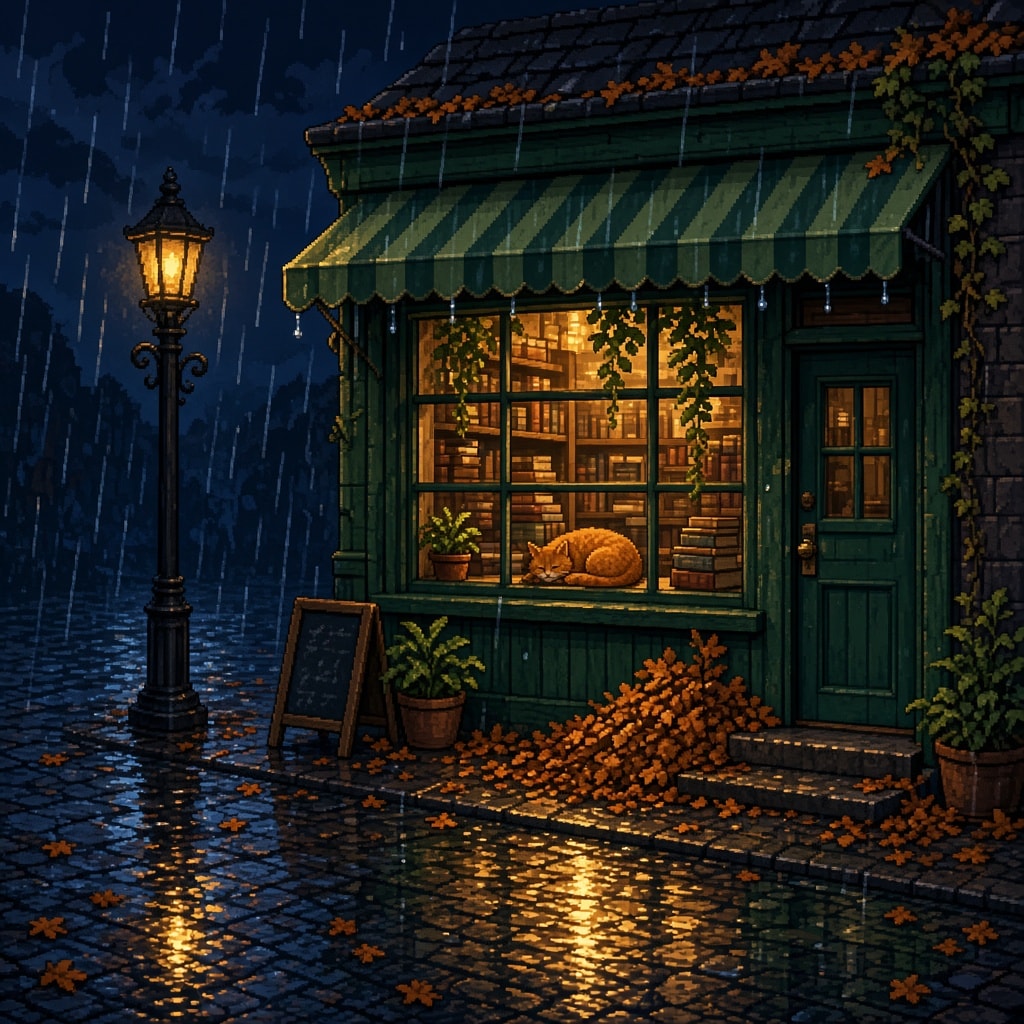
16-bit pixel art of a small dark-green bookshop on a rainy autumn night: a striped scalloped awning dripping rain, a glowing window with shelves of books and a ginger cat asleep on the sill, ivy, a blank chalkboard sign, potted plants, a pile of orange leaves, an ornate street lamp, and wet cobblestones with golden reflections.
A 16-bit pixel art scene of a cozy little bookshop on a rainy autumn night, square 1:1, crisp retro game art with a limited, moody palette. The shop fills the right two thirds of the frame: a small dark-green wooden storefront with a dark tiled roof scattered with orange leaves and a green-and-cream striped scalloped awning, water drops dripping from its edge. A big multi-pane front window glows warm yellow, showing wooden shelves and stacks of books inside, green ivy hanging down behind the glass, a small potted fern, and a ginger cat curled up asleep on the inside window sill. On the right, a green door with a small four-pane glass window and a brass knob sits above two stone steps, with climbing ivy on the brick corner of the building. Outside the window stand a blank chalkboard A-frame sign, potted plants in terracotta pots, and a big pile of orange autumn leaves. On the left, an ornate black street lamp with a glowing lantern lights the scene. Wet dark cobblestones shine with golden reflections and scattered leaves, diagonal rain streaks fall across a dark blue cloudy sky and dark trees. Warm light against cool night blues, calm and inviting mood. No people, no text, no logos.

Risograph travel poster in sunflower yellow, fluorescent pink, teal, and navy: about seventeen patterned hot air balloons (stripes, zigzags, polka dots, a checkerboard) over cone-shaped fairy chimney rock towers with glowing cave windows, a big pink sun behind teal hills, with paper grain, halftone speckle, and slight misregistration.
A risograph print poster of hot air balloons drifting over the fairy chimneys of Cappadocia at sunrise, vertical portrait 3:4. Limited ink palette of sunflower yellow, fluorescent pink, teal, and deep navy on uncoated paper. The whole sky is flat sunflower yellow. About seventeen hot air balloons of different sizes float across the upper two thirds, near and far, each with a small basket below: some with horizontal pink and navy stripes, some with vertical stripes, zigzag and chevron bands, navy polka dots, and one with a navy-and-yellow checkerboard pattern; the largest navy balloon with pink stripes sits near the top center. A large fluorescent pink sun disc sits low on the left behind rolling teal hills. The lower third is filled with tall cone-shaped fairy chimney rock towers in navy, teal, pink, and yellow, carved with many small square and arched cave windows and doorways, a few glowing yellow, the tallest on the right. Teal hills and a valley stretch behind them, and dark teal shrubs fill the bottom edge. Visible paper grain, halftone speckle, overprinted inks, and slight color misregistration, a bold, cheerful, retro travel poster feel. No text, no logos.

A one-line personalized Halloween image prompt for assistants with memory such as ChatGPT, Grok or Gemini: attach a photo of a plain uncarved pumpkin and ask the AI to carve it based on everything it knows about you, turning your interests, work and quirks into a one-of-a-kind jack-o'-lantern design.
Based on everything you know about me, carve this pumpkin.
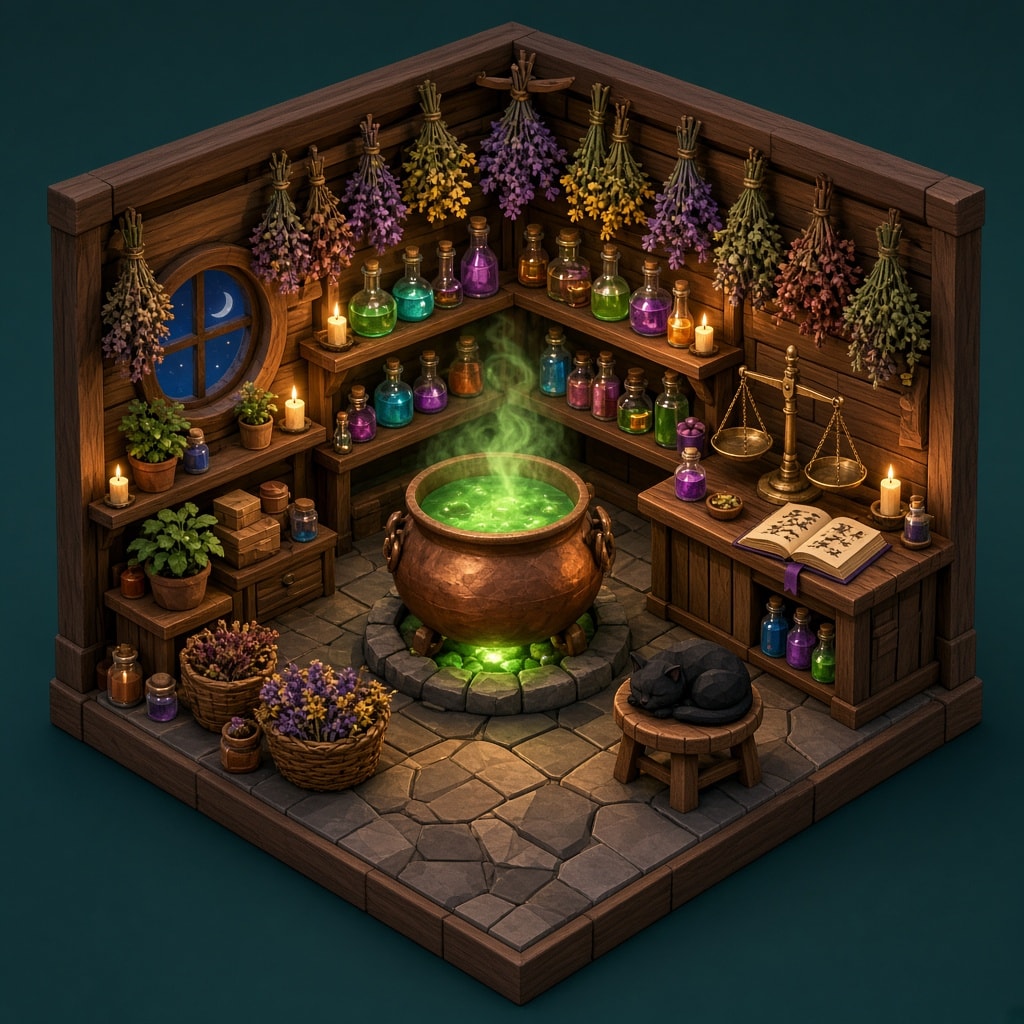
Isometric 3D cutaway of a cozy potion shop on a dark teal background: a copper cauldron of glowing green potion over green fire, corner shelves of colorful potion bottles and candles, hanging bundles of dried herbs, a round window with a crescent moon, plants and flower baskets, a counter with a brass scale and an open spell book, and a black cat asleep on a wooden stool.
A cozy isometric 3D cutaway of a small witch's potion shop with a black cat asleep on a stool: two wooden plank walls and a grey stone-tile floor on a plain dark teal background, square 1:1. In the center, a large hammered copper cauldron full of bubbling, glowing green potion stands on a ring of stones with green fire glowing beneath it and green steam. Wooden corner shelves along the back walls are filled with colorful glass potion bottles in green, teal, purple, and orange, with lit candles between them. Dozens of bundles of dried herbs and flowers in purple, yellow, green, and red hang upside down along the top of both walls. At the upper left, a round wooden-framed window shows a crescent moon in a deep blue night sky. On the left: potted plants, small wooden boxes and drawers, and wicker baskets of dried flowers. On the right, a wooden counter holds a brass balance scale, an open spell book with a purple ribbon, candles, and small bottles. In the front right, a black cat sleeps curled up on a round wooden stool. Warm candlelight with green potion glow, stylized semi-low-poly game-art render. No people, no text, no logos.
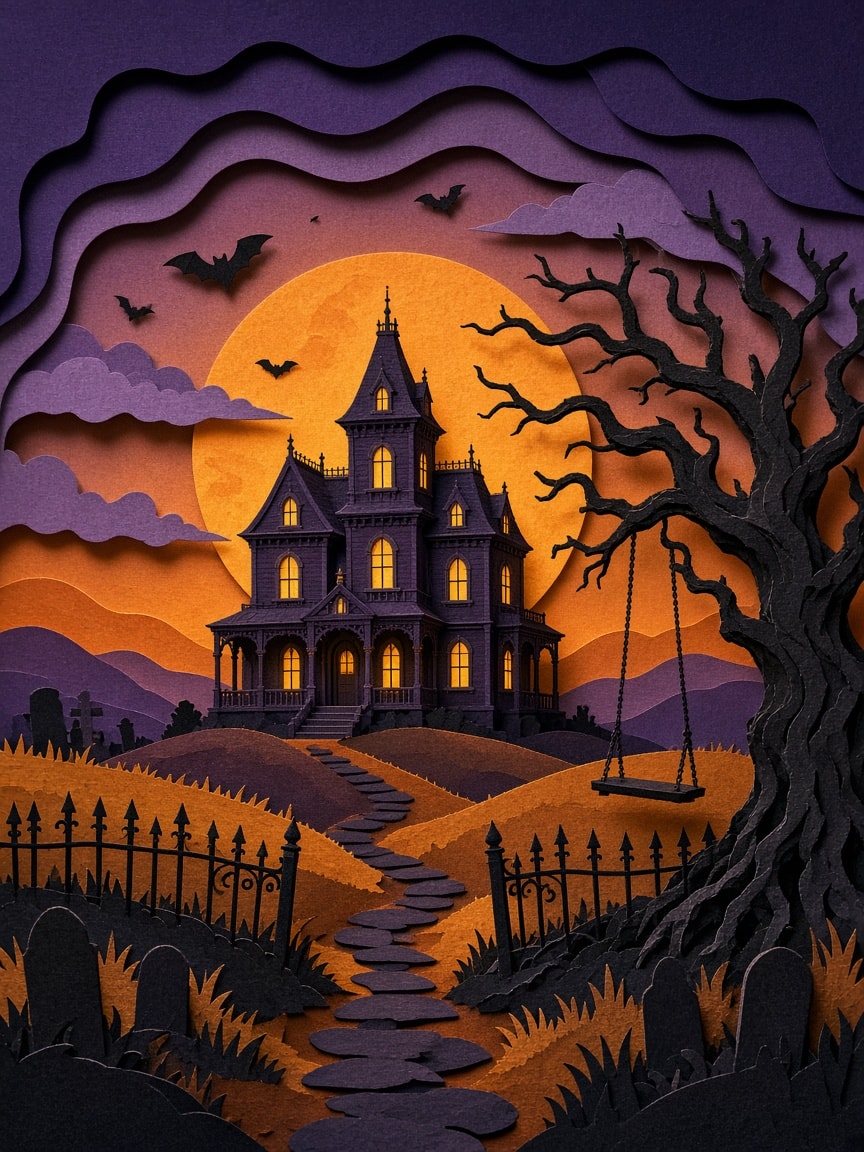
Backlit layered papercut lightbox: a dark purple Victorian mansion with a pointed tower and glowing arched windows on a hill before a huge orange harvest moon, wavy purple paper sky with clouds and black bats, a twisted bare tree with a hanging swing, a winding stepping-stone path, iron fences, tombstones, and orange grass layers with visible paper texture and layer shadows.
A backlit layered papercut lightbox (cut-paper shadow box) of a haunted Victorian mansion on a hill in front of a huge glowing orange harvest moon, vertical portrait 3:4. In the center stands a dark purple Victorian mansion with a tall central pointed tower, steep gables, and a wraparound porch with columns and front steps, its arched windows glowing warm yellow-orange. Wavy layered bands of deep purple and violet paper form the sky at the top, with soft purple paper clouds on both sides and five or six small black paper bats. On the right, a big twisted bare black tree reaches over the scene, a wooden swing hanging from it on two chains. A winding path of grey paper stepping stones leads from the bottom center up the hill to the porch steps. Black wrought-iron spiked fences stand on the left and right, rounded tombstones sit in the dark foreground, and layers of orange spiky grass and rolling orange and purple hills fill the middle. Visible paper texture, cut edges, and soft shadows between the layers. Spooky but charming mood. No people, no text, no logos.
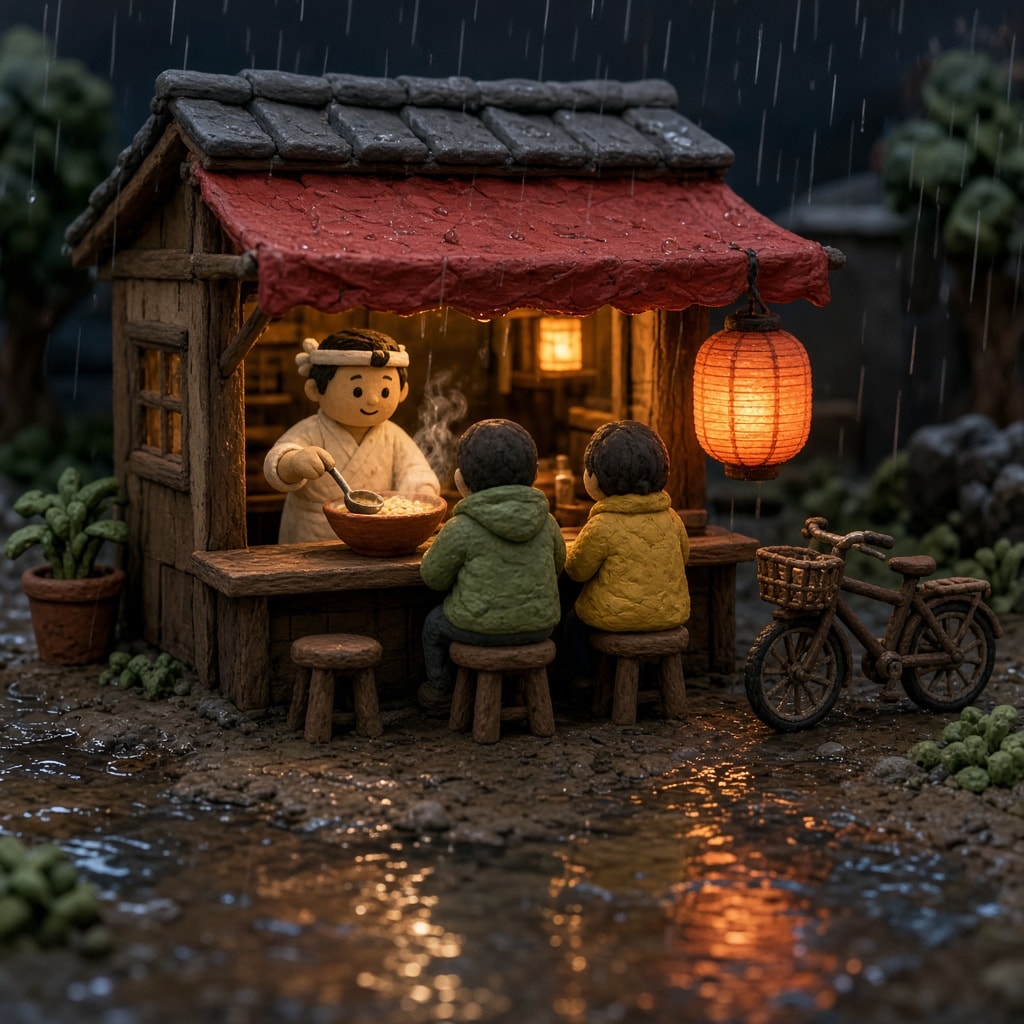
Cozy square claymation diorama: a tiny wooden ramen stall with dark clay roof tiles and a wet red awning, a smiling clay chef in a white headband ladling broth into a big steaming orange bowl, two round customers in green and yellow jackets on wooden stools, a glowing orange paper lantern, a little clay bicycle with a basket, and rainy puddles reflecting the warm light.
A cozy claymation stop-motion diorama of a tiny ramen stall on a rainy night, in a square 1:1 frame, everything sculpted from plasticine with visible fingerprints and soft handmade textures. A small wooden street stall stands in the center-left with a roof of chunky dark grey clay tiles and a red fabric awning glistening with raindrops along its scalloped edge. Behind the wooden counter, a smiling clay chef with rosy cheeks, short dark hair, a white headband, and a white cook's jacket ladles broth into a large orange bowl of noodles, with a soft curl of steam rising beside him. Two round little clay customers sit with their backs to us on wooden stools at the counter, one in a green hooded jacket and one in a puffy yellow jacket, with an empty stool on the left. A glowing orange paper lantern hangs from the right corner of the awning, a small warm lamp lights the inside of the stall, and a little window on the stall's left side glows amber. On the left stands a terracotta pot with a green leafy plant; on the right a small brown clay bicycle with a woven front basket is parked by clumps of green moss. The wet, muddy clay ground in the foreground is full of puddles reflecting the orange lantern and lamp light. Thin streaks of rain fall against a dark blue night with soft dark green bushes behind. Warm orange light against cool blue darkness, shallow depth of field, miniature tilt-shift feel, charming and heartwarming mood. No readable text, no signs, no logos.
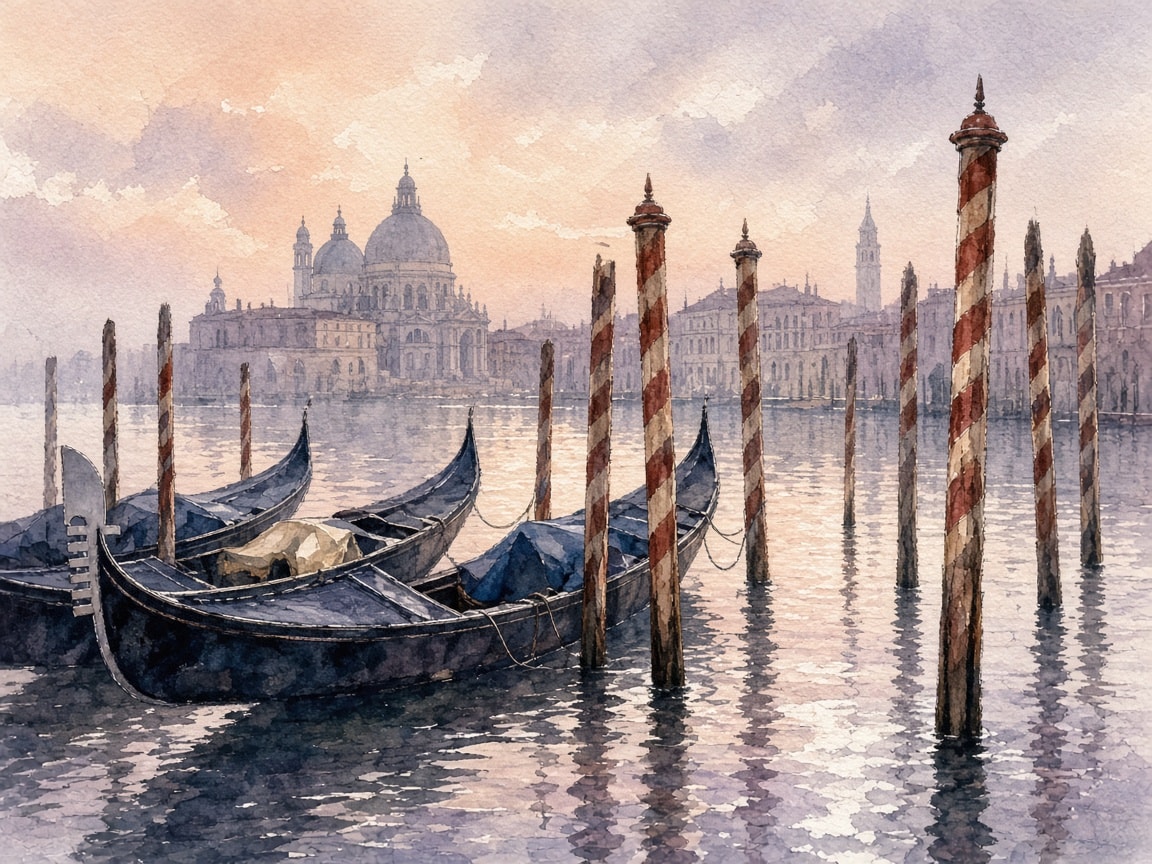
Loose watercolor on textured paper: three covered black gondolas moored beside red-and-white striped mooring poles on the Grand Canal at dawn, a domed baroque basilica silhouette and hazy palazzos with a bell tower across the water, a soft peach and lavender sky, and broken violet and pink reflections in calm water.
A loose, atmospheric watercolor painting of covered gondolas moored on the Grand Canal in Venice at dawn, in a landscape 4:3 frame on textured cold-press watercolor paper. In the lower left, three long black gondolas rest side by side, wrapped in dark blue-grey covers, one with a pale tan tarp, the front gondola's curved prow and metal prow ornament rising at the far left edge. Tall wooden mooring poles with red-and-white spiral stripes and small pointed caps stand in the water across the middle and right of the frame, some linked to the gondolas by sagging ropes and chains. Across the canal, a hazy, softly painted skyline of old palazzos stretches to the right, with a slender bell tower, and on the left a large domed baroque basilica with smaller domes and lanterns, in the spirit of Santa Maria della Salute, silhouetted against the light. The sky glows in soft peach, apricot, and lavender washes with drifting clouds. The calm water reflects the poles, gondolas, and sky in broken vertical strokes of violet, pink, and white. Visible brushstrokes, wet-in-wet blooms, granulating pigments, soft edges, and white paper showing through. Peaceful, romantic early-morning mood. No people, no text, no signature.
A short, dreamy text-to-video prompt for a magical Halloween suburban street at dusk: glowing jack-o'-lanterns on porch steps, falling orange and gold leaves, purple and warm string lights, and smooth close-ups of vintage lanterns, candy bowls and drifting soap bubbles, in an ultra-realistic fairy-tale look.
A cinematic, magical Halloween neighborhood street decorated for a festive autumn celebration. Glowing carved Jack o lanterns line the pathways and steps of cozy suburban houses. Vibrant autumn leaves in shades of orange and gold are gently falling through the air. Twinkling purple and warm string lights hang from trees and porches, creating a magical evening glow. Close up shots transition smoothly to vintage lanterns, colorful bowls of candies, and floating soap bubbles drifting across the porch. Ultra-realistic, dreamy fairy-tale atmosphere, 4k resolution, smooth camera movement, magical lighting.

Handcrafted origami diorama: about thirty red, gold, and cream paper cranes flying in an arc over a five-tier cream paper pagoda with red-trimmed eaves on a stepped hilltop, pink folded-paper cherry trees, layered faceted paper mountains, and a large flat orange paper sun on a plain grey-beige paper sky.
A handcrafted origami paper art diorama of dozens of folded paper cranes flying in a sweeping arc over a five-tier folded-paper pagoda at sunset, in a wide landscape 16:9 composition. About thirty origami cranes in crimson red, golden yellow, and cream white rise in a gentle curve from the lower left, just beside the sun, up and across to the upper right corner, each with sharp, crisp folds and visible paper grain. In the center, the pagoda stands on a stepped paper base with a small staircase at the top of a hill, built from natural cream paper with five tiers of upturned eaves trimmed in thin red edges, tiny railings, and small windows. A small pink folded-paper cherry blossom tree sits just left of the pagoda base, and a large cherry tree with a twisted brown paper trunk and clusters of pink paper blossoms fills the right foreground. Behind them, layered faceted paper mountains in beige, warm grey, and soft pink (pink on the left) recede in overlapping ridges, with crumpled beige paper hills in the foreground. A large flat orange textured paper circle sun hangs low on the left against a plain light grey-beige paper sky. Soft studio lighting with gentle shadows between the paper layers, shallow depth of field, warm and calm handcrafted mood. No text, no people.
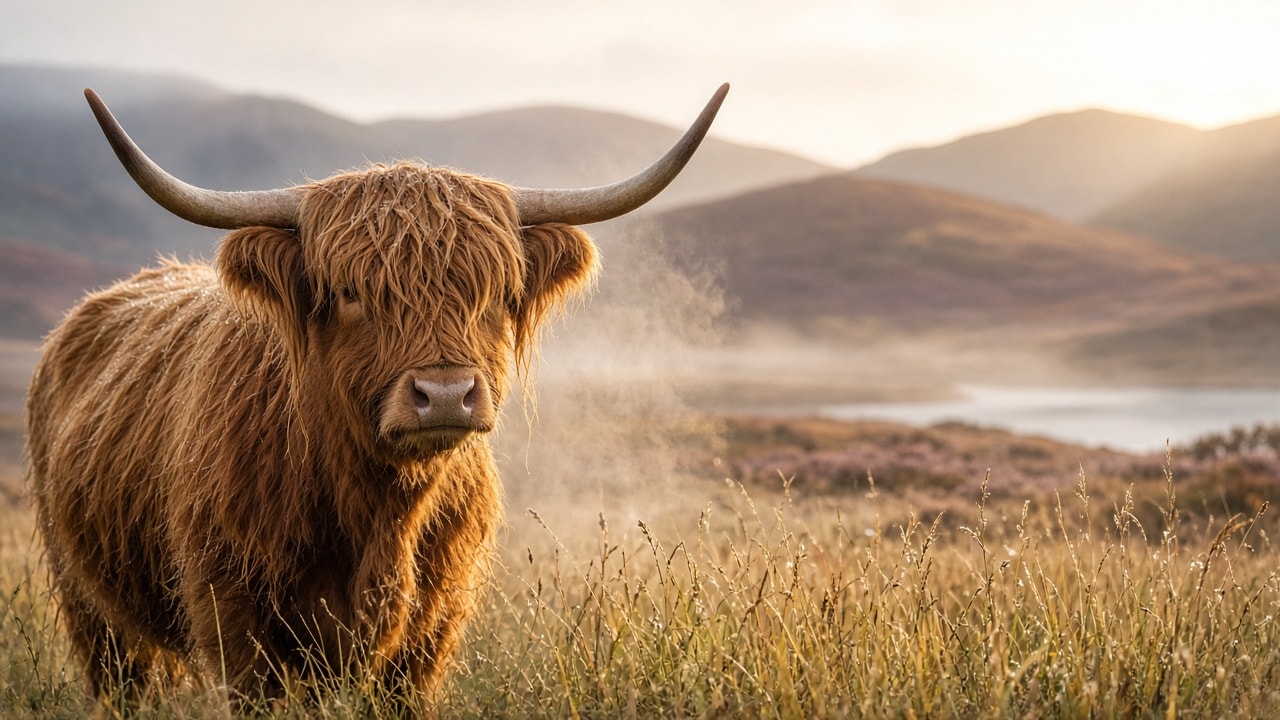
Photoreal telephoto shot of a shaggy ginger Highland cow with long upswept horns and a fringe over its eyes, standing in tall dewy golden grass with its breath steaming in the cold air, golden backlight from the upper right, misty brown and purple hills, pink heather, and a pale loch behind.
A photoreal wildlife photograph of a shaggy ginger Highland cow standing in tall golden grass in a misty Scottish glen at sunrise, in a wide landscape 16:9 frame. The cow stands in the left half of the frame facing the camera, its long rust-orange and copper coat thick and wavy, with tiny dew drops caught in the hair. A heavy fringe of hair hangs over its eyes, its broad pink-brown nose and muzzle are sharp and detailed, and a pair of long, pale, upswept horns curve outward and up from its head. A cloud of warm breath and mist drifts to the right of its head in the cold morning air. In the foreground, tall dry golden grass and dewy seed heads are softly out of focus. Soft golden backlight from a low sun in the upper right makes the edges of the coat glow and fills the glen with warm haze. In the background, blurred rolling hills in muted brown, mauve, and purple tones fade into the mist, with patches of pink heather and a pale silver loch in the right middle distance. Shallow depth of field, 200mm telephoto compression, natural colors, calm, quiet mood. No people, no fences, no text, no watermark.
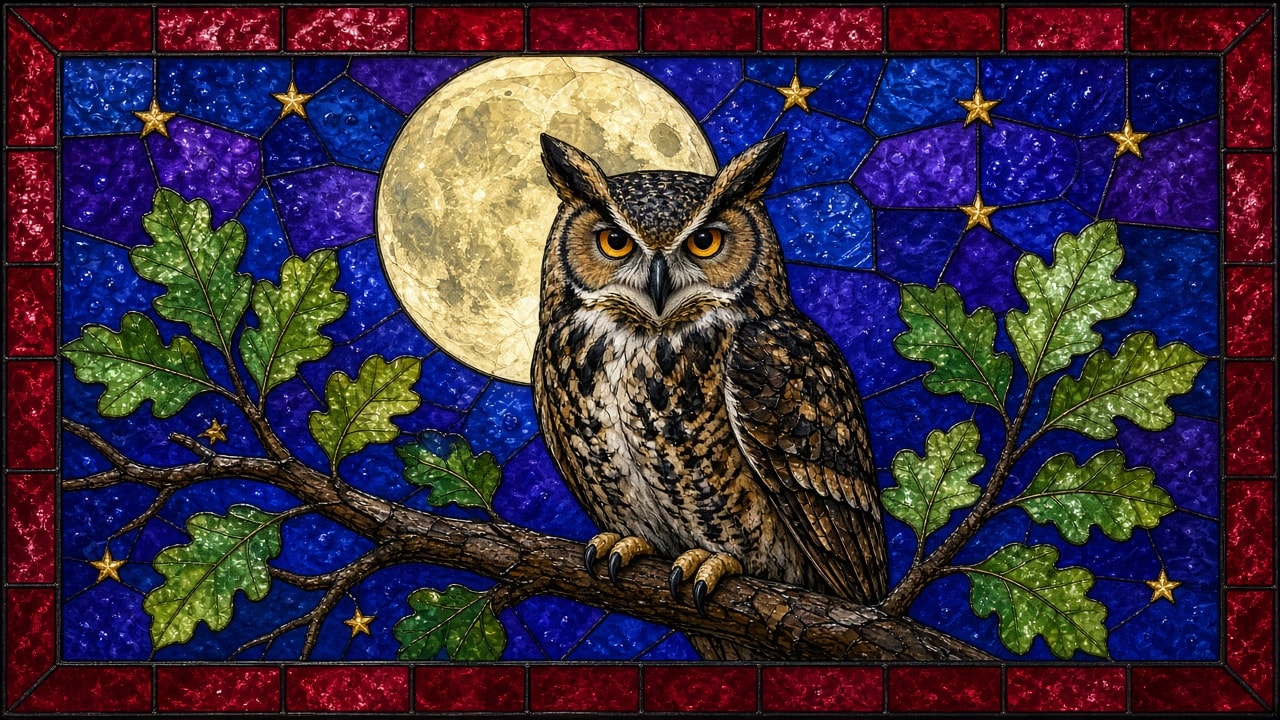
Stained glass panel: a great horned owl with amber eyes and ear tufts perched on an oak branch in the center, a large pale full moon behind it, textured cobalt and violet sky glass with small gold stars, emerald and olive oak leaves on both sides, thick lead lines, and a ruby red tiled border.
A stained glass window panel of a great horned owl perched on an oak branch under a full moon, in a wide landscape 16:9 rectangular composition. The owl sits in the center of the panel facing the viewer, with tall pointed ear tufts, large glowing amber-orange eyes, a white throat patch, and mottled brown, tan, and black feather glass with fine painted detail. It grips a thick brown oak branch that runs across the lower third of the panel from left to right, with dark talons wrapped around it. Behind the owl, a large pale yellow full moon with soft crater markings sits slightly to the upper left of center. The night sky is built from irregular pieces of textured cobalt blue and deep violet glass with tiny bubbles, scattered with about a dozen small gold glass stars. Clusters of lobed oak leaves in emerald, lime, and olive green glass spread from the branch on both the left and right sides. Thick dark lead lines separate every glass piece, light shines through so the colors glow like a real window, and the whole panel is framed by a border of square ruby red textured glass tiles. Rich jewel tones, symmetrical, decorative, calm night mood. No text, no signature.
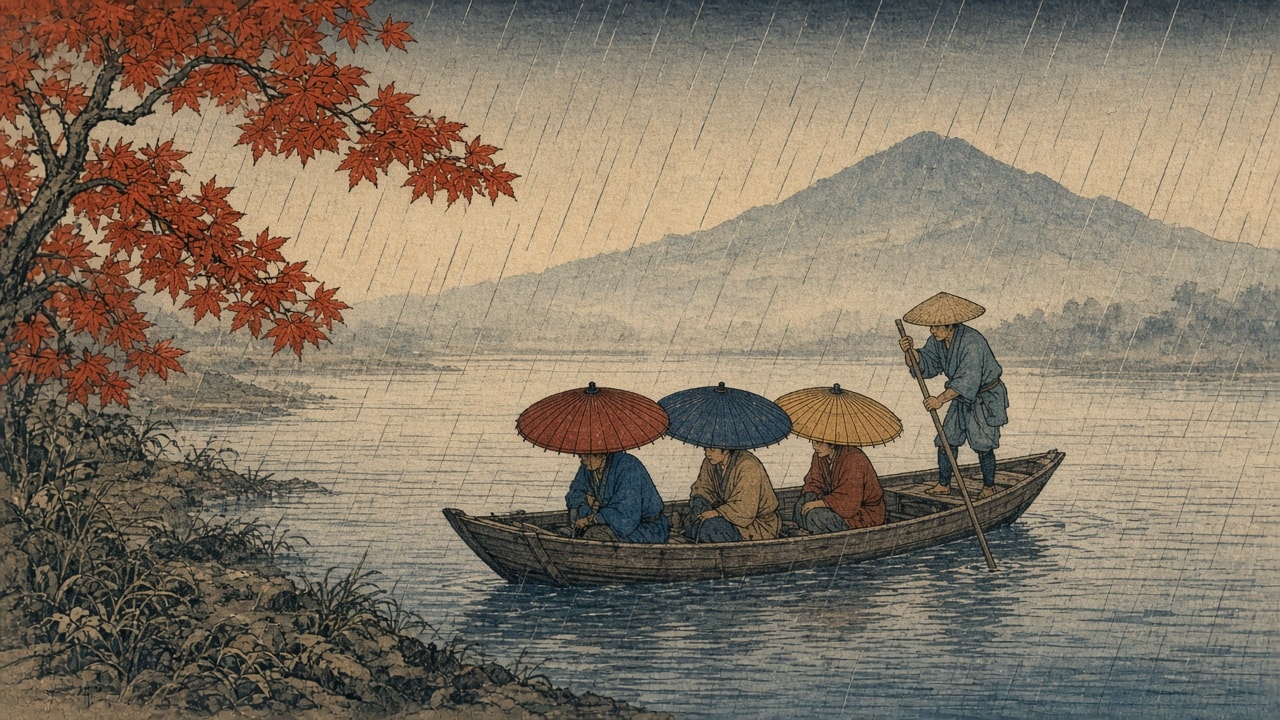
Ukiyo-e woodblock print on beige paper: a long wooden ferry crossing a calm river in autumn rain, three passengers under red, indigo, and ochre paper umbrellas, a straw-hatted ferryman poling at the stern, a red maple tree upper left, a misty grey-blue mountain behind, and fine diagonal rain lines over everything.
A Japanese ukiyo-e woodblock print of a small wooden ferry boat crossing a wide, calm river in autumn rain, in a wide landscape 16:9 composition on warm beige paper with visible fibers and wood grain texture. A long, low wooden boat sits in the center right of the frame, carrying three seated passengers under round oiled paper umbrellas, from left to right one vermilion red, one deep indigo blue, and one ochre yellow, the passengers wearing simple robes in indigo, ochre, and rust. At the stern on the right, a ferryman stands in a pale blue-grey robe and a wide conical straw hat, pushing a long wooden pole diagonally into the water. In the upper left, a red maple tree reaches into the frame with clusters of bright orange-red leaves, above a grassy, rocky near bank with tall reeds in the lower left. In the background, a misty grey-blue volcano-shaped mountain rises behind a hazy far shore with soft tree silhouettes on the right. Fine diagonal rain lines fall across the whole scene, the river shows gentle horizontal ripple lines, and the sky has a soft bokashi gradient from dark slate grey at the top to pale beige near the horizon. Flat color areas, fine black outlines, muted indigo, ochre, vermilion, and grey palette, quiet and contemplative mood. No text, no seals, no signature, no border.
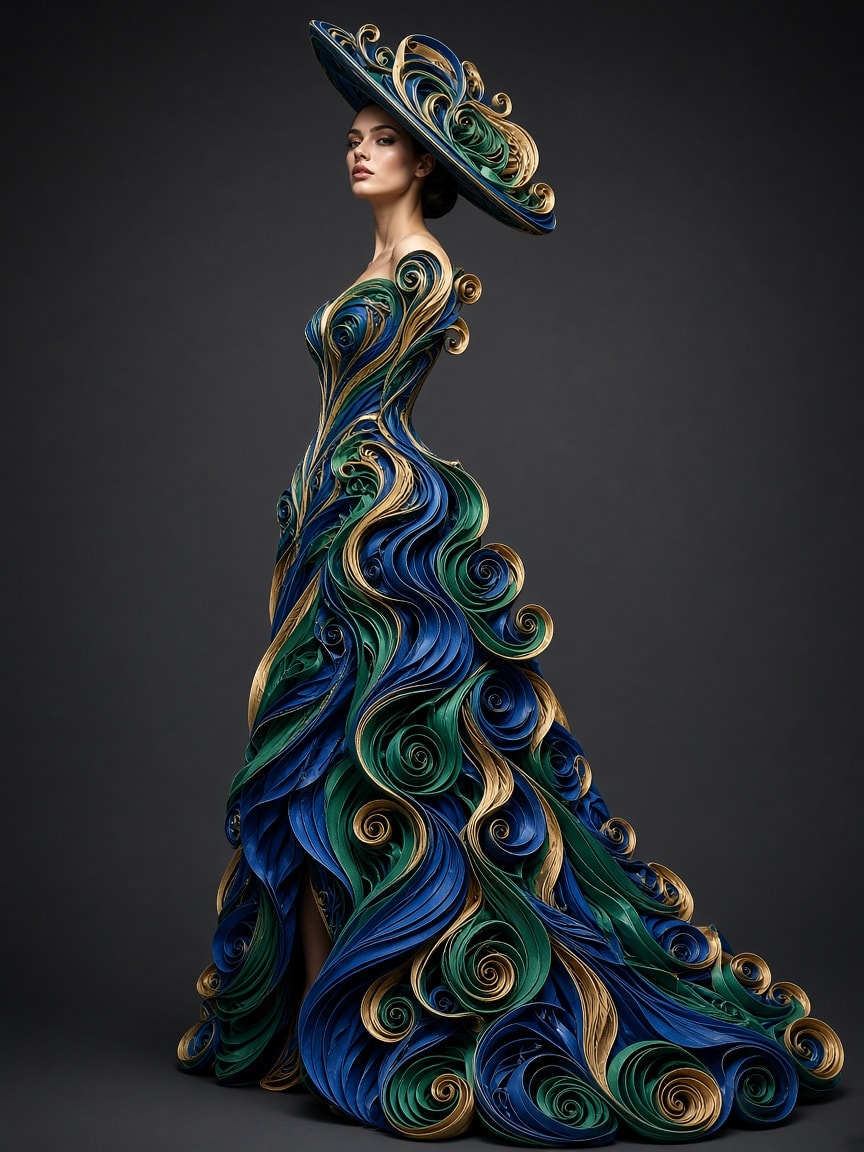
Full-body high-fashion shot of a model in an avant-garde paper-quilled couture gown made of overlapping 3D ribbon strands, with variables for the model, pose, dress features, color gradient, headwear, and background, lit by dramatic studio spotlights.
Generate a full-body high-fashion shot of a tall model with a sleek low bun in a elegant three-quarter standing pose, wearing an avant-garde paper-quilled haute couture gown made of fluid, overlapping 3D ribbon strands. The dress features a fitted corset bodice and sweeping train made of swooping ribbon layers in a gradient of vivid cobalt, emerald green, and gold. Accessories include a wide-brimmed matching hat with quilled plume details. Set against a dark charcoal grey background with dramatic studio spotlighting highlighting texture and fine edges. Rendered in crisp, high-contrast 3D detail.

Warm macro photo of five boxy 1950s wind-up tin robots in red, teal, cream, mustard, and red lined up on a worn wooden shelf, each with a chest dial, antenna, and brass wind-up key, the last one carrying a red pennant flag, with blurred shelves of old toys and golden window light from the left.
A macro product photograph of five vintage 1950s wind-up tin toy robots standing side by side in a parade line on a worn wooden shelf, in a wide landscape 16:9 frame. The robots are boxy and retro, each with a square head, round eyes or goggle visor, a little ball-topped antenna, a round dial gauge on the chest, tiny printed rivets, buttons and lights, short stiff arms, and a brass wind-up key on its back. Their painted tin colors from left to right are red, teal, cream, mustard yellow, and red, with slightly worn paint, soft scratches, and a little rust at the edges. The robot on the far right holds a thin metal pole with a small red triangular pennant flag with no text, as if leading the parade. Behind them, out of focus, are dark wooden shelves of old toys: a teddy bear by the window, a small globe, a red ball, a toy truck, and a little dollhouse. Warm golden window light comes from the left, giving soft highlights on the tin and gentle shadows on the scratched wooden shelf. Shallow depth of field, rich warm browns, nostalgic and cheerful mood. No readable text, no logos, no people.
Photoreal low-angle telephoto wildlife shot of a pure white Arctic fox curled in a ball on fresh powder snow, bushy tail wrapped around its body, both eyes half open and drowsy, snowflakes on its fur, with a blurred snowy tundra, soft blue-hour light, and a thin pink glow on the horizon.
A photorealistic wildlife photograph of an Arctic fox in its thick pure white winter coat, curled up in a round ball on fresh powder snow in the center of a wide landscape 16:9 frame. Its bushy white tail wraps around the front of its body and covers its paws, with its black nose resting just above the tail. Both eyes are half open, dark and drowsy, gazing calmly toward the camera, small rounded ears upright, and a few fine snowflakes resting on the dense fur. The fox lies in a soft hollow of snow, shot from a low eye-level angle close to the ground. Behind it, a wide snowy tundra fades into a creamy blur of gentle drifts under soft blue-hour light, with a thin band of pink glow along the distant horizon and pale lavender sky above. Telephoto lens, shallow depth of field, sharp focus on the face and the fur texture, cool blue and white tones with a touch of pink, natural colors, quiet and peaceful mood. No text, no watermark, no people.
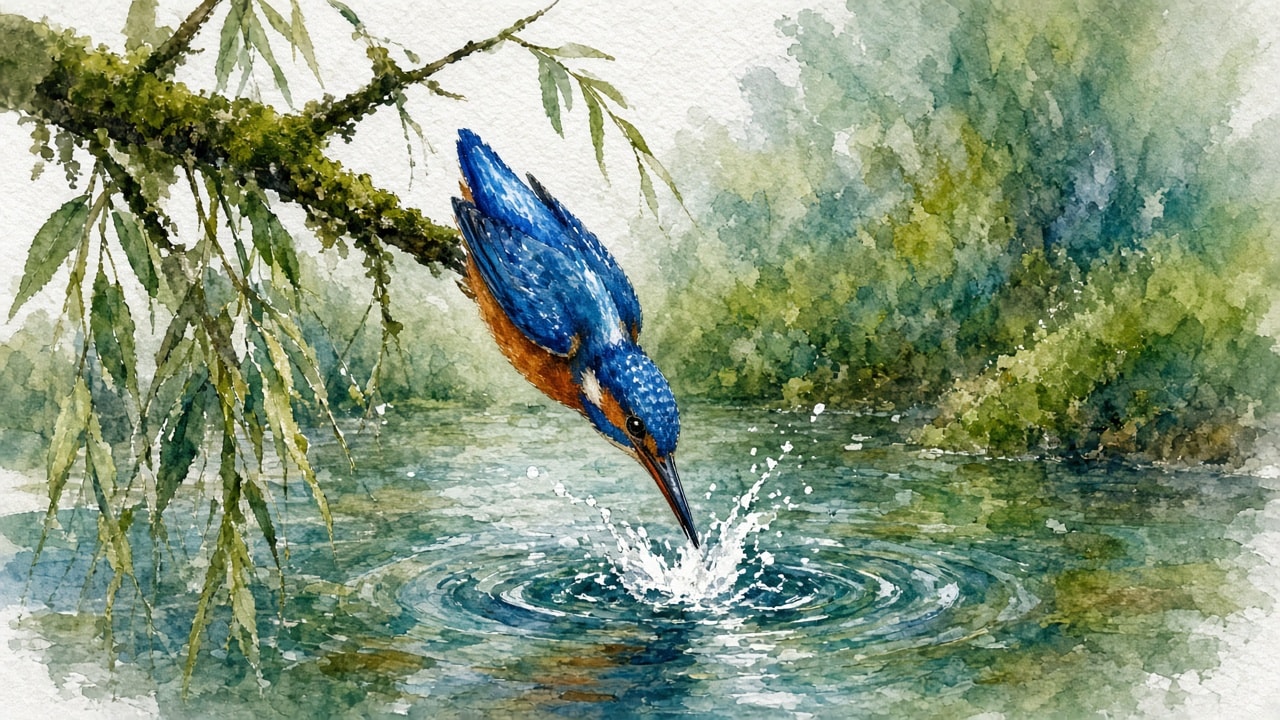
Loose watercolor on textured paper: a cobalt-blue and orange common kingfisher diving almost vertically, its beak just touching the water in a burst of white splash and concentric ripples, a mossy branch with drooping willow leaves in the upper left, soft green and teal bank washes on the right, wet-on-wet blooms, and white paper highlights.
A loose, expressive watercolor painting of a common kingfisher diving headfirst into a calm forest stream, in a wide landscape 16:9 composition on textured white watercolor paper. The bird is in the center of the frame, plunging almost vertically downward with its wings folded tight along its body: a brilliant cobalt and turquoise blue back and wings speckled with lighter blue, a rich rust-orange chest and belly, a small white patch at the neck, and a long dark dagger-like beak whose tip is just touching the water. Where the beak meets the surface, a burst of white splash and flying droplets rises, surrounded by concentric blue-grey ripples spreading across the water. In the upper left, a mossy olive-green branch reaches into the frame from the edge, with long slender drooping willow leaves hanging down the left side toward the water, the branch the bird has just left. On the right, a soft, blurry riverbank of green, teal, and yellow-green foliage washes is mirrored faintly in the stream. Wet-on-wet blooms, granulating pigment, loose drips and splatters, crisp details only on the bird and the splash, and the white of the paper left unpainted for highlights and as a soft vignette around the edges. Fresh, lively, natural mood. No text, no signature, no frame.