A documentary photo of a sunlit Roman villa floor mosaic: a terracotta octopus surrounded by sea bream, a moray eel, a lobster, squid, and a dolphin, two fishing boats casting a net, wavy cream and blue-grey water tesserae, a black and white wave scroll border, and authentic cracks and missing tiles in raking afternoon light.
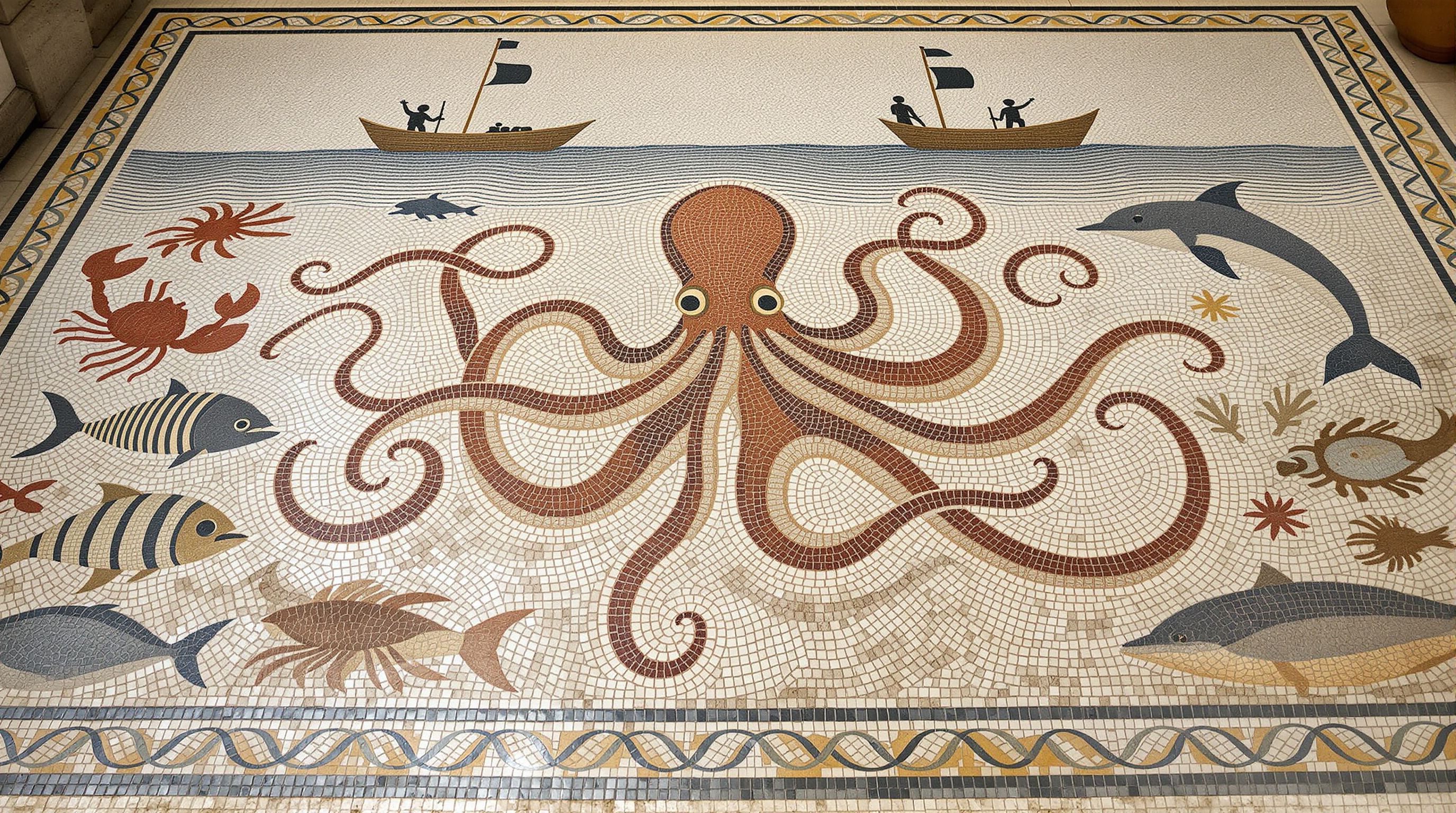
A wide, slightly elevated photograph of an ancient Roman floor mosaic uncovered in the courtyard of a Mediterranean villa ruin, the mosaic filling most of the frame in a 16:9 landscape composition. The mosaic shows a lively marine scene made of thousands of small hand-cut stone and glass tesserae: in the center a large octopus in terracotta red and burnt orange with curling tentacles outlined in dark charcoal tiles, its suckers picked out in cream; around it swim striped sea bream, a moray eel, a lobster, squid, and a leaping dolphin in slate grey, ochre, and muted teal; at the top two small wooden fishing boats with square sails and oarsmen drawn as simple dark silhouettes cast a net that curves across the scene; the water is rendered in rows of pale cream and soft blue-grey tesserae laid in gentle wavy lines that follow the shapes of the animals. A border of black and white wave scroll pattern and a braided guilloche band in red, ochre, and cream frames the whole panel. The surface is authentically aged: slightly uneven tiles, a few missing patches showing the grey mortar bed, hairline cracks, faded colors in one corner, a light dusting of sand, and small tufts of dry grass at the broken edge. Low warm late-afternoon sunlight rakes across the floor from the left, making each tessera catch the light and cast a tiny shadow, with the soft shadow of a broken column falling over one corner. Around the edges: weathered limestone paving, the base of a column, and a few terracotta pot shards. Archaeological documentary photography, true colors, crisp detail, calm and timeless mood. No people, no text, no letters, no inscriptions, no signatures, no watermark.