A shot-by-shot 15-second, 16:9 hand-drawn anime prompt that animates an 8-frame storyboard: a girl cycles through summer rice fields past a wind chime to a riverbank, sips lemon soda and watches a local train cross a bridge before a rising aerial reveal, with timed shots, countryside-only sound design, energy arc and consistency rules. Trending on X, originally shared by @HeyAbhishek: https://x.com/HeyAbhishek/status/2115429393967550598
TITLE

THE SUMMER DETOUR

Create a 15-second cinematic nostalgic anime animation in 16:9 landscape format.

REFERENCE

Use the uploaded storyboard as the main visual reference. Follow its 8 shots in order.

Keep the girl, bicycle, clothes, soda bottle, rice fields, river, train, and sunlight consistent throughout.

Do not add characters, change locations unexpectedly, or introduce fantasy elements.

SUBJECTS

Girl: Original 13-year-old Japanese girl with shoulder-length dark brown hair, brown eyes, cream blouse, faded navy skirt, white socks, brown shoes, and canvas shoulder bag.

Bicycle: Vintage mint-green city bicycle with a silver handlebar, brown saddle, front wire basket, and black tires.

Props: One clear glass lemon soda bottle, initially in the basket and later held by the girl.

Train: Small cream-and-orange two-car local passenger train.

ENVIRONMENT

Peaceful Japanese countryside in late summer. Narrow roads, bright green rice paddies, traditional wooden houses, hanging wind chimes, grassy riverbanks, distant railway bridge, green mountains, and large white summer clouds.

Warm late-afternoon sunlight with gentle natural shadows. No sunset or dramatic lighting changes.

STYLE

Premium cinematic 2D anime with beautiful hand-painted backgrounds, soft cel shading, clean linework, natural colors, gentle environmental animation, and expressive but restrained character acting.

Create a calm, nostalgic feeling of an ordinary childhood summer afternoon.

Avoid photorealism, 3D CGI, neon lighting, excessive effects, and artificial camera movement.

AUDIO

No music or dialogue.

Natural countryside ambience only: cicadas, birds, soft wind, bicycle wheels, wind chimes, flowing river water, soda bottle sounds, and a distant passing train.

Keep the soundscape gentle, atmospheric, and continuous.

CAMERA AND FRAMING

16:9 cinematic framing. Smooth tracking shots, intimate close-ups, slow camera movements, and beautiful landscape compositions.

Use natural shot transitions and consistent sunlight.

SHOT-BY-SHOT TIMELINE

SHOT 1 (00:00-00:01.5) - THE SUMMER ROAD

Wide cinematic shot of a peaceful countryside road surrounded by lush rice fields. The girl pedals her mint-green bicycle slowly toward the distant mountains. Her hair moves gently in the warm breeze. Camera tracks smoothly behind her.

SFX: cicadas, gentle wind, bicycle tires.

SHOT 2 (00:01.5-00:03) - LITTLE DETAILS

Low close-up beside the bicycle. The wheels turn smoothly as sunlight flickers between the spokes. Tall grass and tiny wildflowers sway along the roadside. Camera follows the moving wheels with shallow depth of field.

SFX: rolling tires, grass rustling, summer insects.

SHOT 3 (00:03-00:05) - THE OPEN FIELDS

Beautiful side-tracking shot of the girl cycling beside endless green rice paddies. Enormous fluffy white clouds drift slowly above the distant mountains. Her skirt and hair move naturally in the breeze. Bright sunlight fills the landscape.

SFX: wind through rice fields, distant birds, bicycle chain.

SHOT 4 (00:05-00:06.5) - THE WIND CHIME

The girl cycles past a small traditional wooden house. Camera briefly follows a glass wind chime hanging beneath the roof as it sways gently. Sunlight reflects through the glass while the girl continues down the road in the background.

SFX: delicate wind chime, cicadas, soft bicycle movement.

SHOT 5 (00:06.5-00:08.5) - THE RIVERBANK

Wide shot of a quiet grassy riverbank. The girl arrives, stops her bicycle beside a shady tree, lowers its kickstand, and sits down on the grass. Sunlight sparkles across the flowing river. Camera slowly moves closer.

SFX: bicycle stopping, soft footsteps, flowing water.

SHOT 6 (00:08.5-00:10) - A SUMMER SIP

Intimate medium close-up. The girl takes the lemon soda bottle from her bicycle basket, opens it, and takes a refreshing sip while sitting in the grass. Tiny bubbles rise through the clear glass. She smiles peacefully.

SFX: bottle opening, gentle fizz, summer breeze.

SHOT 7 (00:10-00:12) - THE PASSING TRAIN

Cinematic medium-wide shot from behind the girl's shoulder. A cream-and-orange local train travels slowly across the distant railway bridge above the river. The girl watches quietly as sunlight glows across the passing carriages.

SFX: soft distant train wheels, river water, cicadas.

SHOT 8 (00:12-00:15) - THE SUMMER MEMORY (SIGNATURE MOMENT)

The camera slowly rises above the grassy riverbank into a magnificent aerial panorama. Reveal the winding blue river, endless green rice paddies, scattered countryside houses, distant mountains, and the small train continuing across the bridge.

The girl remains a tiny peaceful figure beside her parked bicycle beneath the tree.

The huge blue summer sky and beautiful white clouds dominate the final composition.

Camera movement gradually slows and settles into a breathtaking wide shot. Hold until the end.

SFX: warm countryside breeze, distant train fading away, gentle cicadas.

ENERGY ARC

Act 1 (0-5s): Freedom. Slow cycling, warm sunlight, peaceful summer landscapes.

Act 2 (5-10s): Stillness. Wind chimes, riverbank, a quiet moment with cold soda.

Act 3 (10-15s): Nostalgia. Passing train, expansive countryside reveal, and a peaceful ending.

FINAL REQUIREMENTS

Maintain consistent character proportions, outfit, bicycle design, train appearance, and geography.

Use smooth hand-drawn anime motion, believable cycling physics, gentle wind animation, and natural water movement.

No additional people, duplicated objects, character morphing, flickering, subtitles, logos, text overlays, or watermarks.

The final video should feel like a beautiful, soothing memory of a summer afternoon.
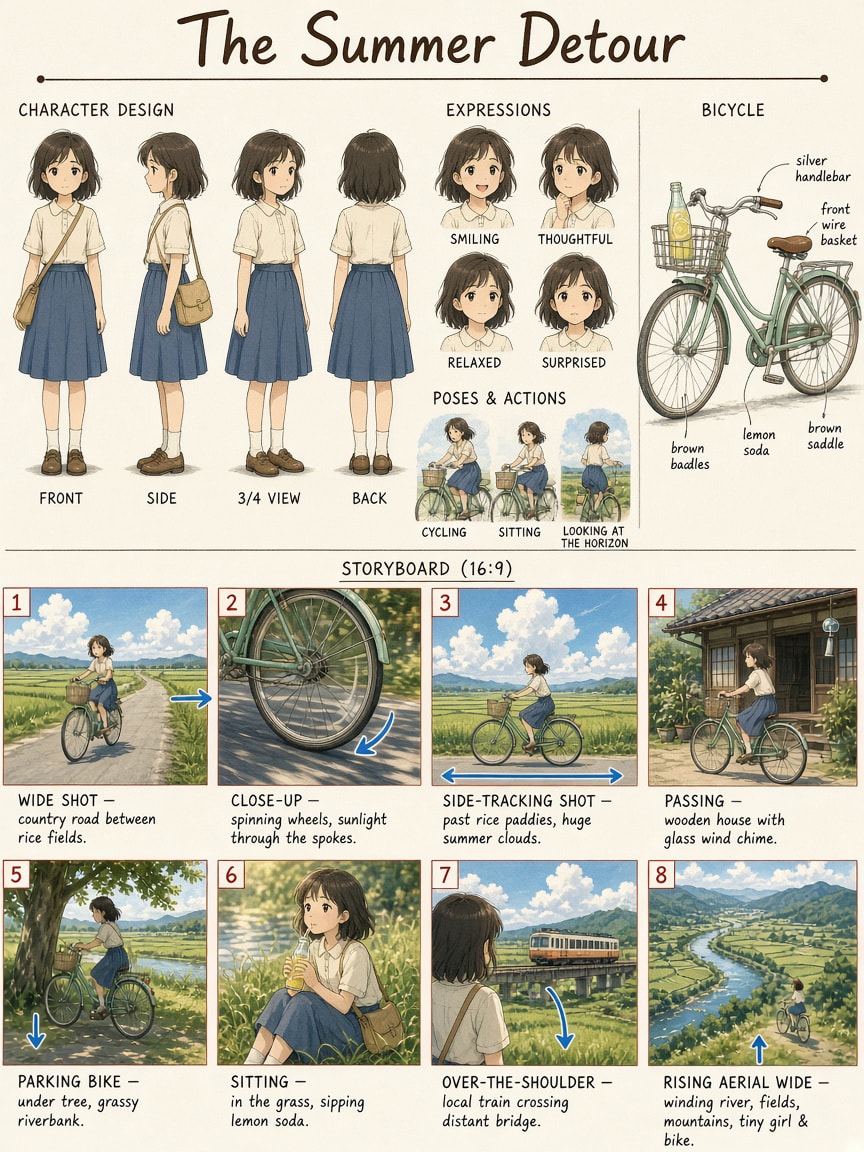
A single-image anime pre-production board for an original 15-second short: a character design sheet (turnarounds, expressions, poses) of a girl and her mint-green bicycle plus an 8-frame cinematic storyboard of a summer ride through Japanese rice fields to a riverbank and a passing train, ready to feed into a video model. Trending on X, originally shared by @HeyAbhishek: https://x.com/HeyAbhishek/status/2115429393967550598
Create one vertical anime development board for an original 15-second short film titled "The Summer Detour".

The output must be one combined image with 2 sections:

Character design sheet

Cinematic storyboard page

STYLE:

Beautiful nostalgic 2D anime, hand-painted countryside backgrounds, clean anime linework, soft cel shading, lush green scenery, warm summer afternoon sunlight, gentle shadows, and bright blue skies with fluffy clouds.

Professional anime production board with red storyboard borders, blue camera arrows, small handwritten camera notes, and beautifully illustrated keyframes.

SECTION A: CHARACTER DESIGN

Main girl: An original 13-year-old Japanese girl with shoulder-length dark brown hair, soft brown eyes, and a gentle, cheerful expression.

Outfit: cream short-sleeved blouse, faded navy skirt, white socks, brown shoes, and a small canvas shoulder bag.

Personality: calm, curious, thoughtful, and quietly happy.

Show front, side, three-quarter, and back views, plus smiling, thoughtful, relaxed, and surprised expressions.

Include cycling, sitting, and looking toward the horizon poses.

BICYCLE:

Vintage mint-green city bicycle with a silver handlebar, brown saddle, small front wire basket, and simple black tires. A clear glass bottle of lemon soda sits securely inside the basket.

Keep the bicycle's design consistent in every frame.

SECTION B: STORYBOARD

Create 8 storyboard frames in a clean grid, each using 16:9 cinematic framing.

Keep the girl, bicycle, countryside, and lighting consistent.

Story beats:

Wide opening shot of the girl cycling along a peaceful countryside road surrounded by green rice fields.

Beautiful close-up of bicycle wheels turning beside swaying grass, sunlight sparkling through the spokes.

Side-tracking shot as she cycles past expansive rice paddies beneath enormous fluffy summer clouds.

She passes a small traditional house with hanging wind chimes gently swaying in the breeze.

She reaches a quiet grassy riverbank, stops, and parks her bicycle beside a tree.

Sitting in the grass, she opens her cold lemon soda and takes a refreshing sip.

A small cream-and-orange local train crosses a distant bridge over the river. She watches it with a gentle smile.

Spectacular wide ending shot: the camera rises to reveal the winding river, endless green fields, distant mountains, passing train, and girl resting beside her bicycle under a magnificent summer sky.

ENVIRONMENT:

Peaceful rural Japanese countryside, vibrant rice paddies, narrow asphalt roads, traditional wooden houses, wind chimes, wildflowers, a clear river, an old railway bridge, distant green mountains, and beautiful summer clouds.

Bright late-afternoon sunlight throughout.

FINAL GOAL:

Create a beautiful nostalgic anime film development board with soothing countryside scenery, authentic everyday moments, natural cinematic movement, consistent character design, and a breathtaking peaceful ending.
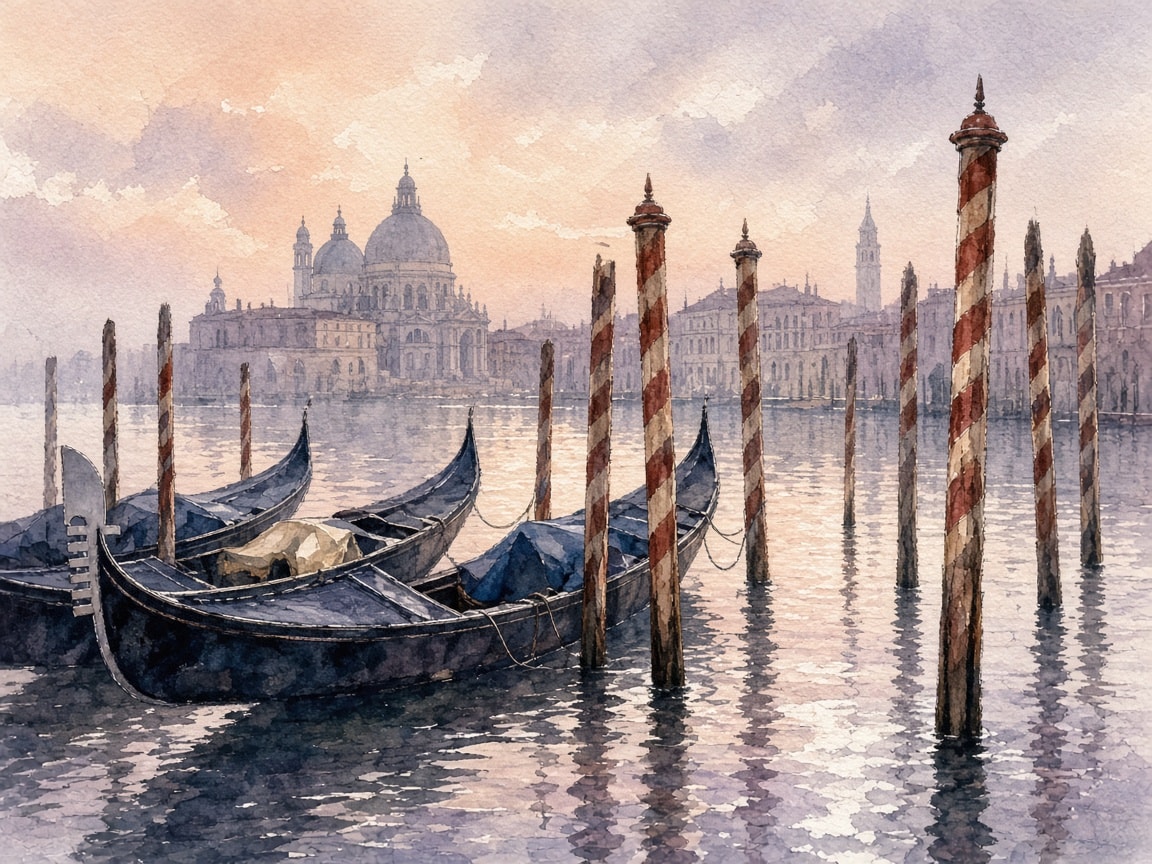
Loose watercolor on textured paper: three covered black gondolas moored beside red-and-white striped mooring poles on the Grand Canal at dawn, a domed baroque basilica silhouette and hazy palazzos with a bell tower across the water, a soft peach and lavender sky, and broken violet and pink reflections in calm water.
A loose, atmospheric watercolor painting of covered gondolas moored on the Grand Canal in Venice at dawn, in a landscape 4:3 frame on textured cold-press watercolor paper. In the lower left, three long black gondolas rest side by side, wrapped in dark blue-grey covers, one with a pale tan tarp, the front gondola's curved prow and metal prow ornament rising at the far left edge. Tall wooden mooring poles with red-and-white spiral stripes and small pointed caps stand in the water across the middle and right of the frame, some linked to the gondolas by sagging ropes and chains. Across the canal, a hazy, softly painted skyline of old palazzos stretches to the right, with a slender bell tower, and on the left a large domed baroque basilica with smaller domes and lanterns, in the spirit of Santa Maria della Salute, silhouetted against the light. The sky glows in soft peach, apricot, and lavender washes with drifting clouds. The calm water reflects the poles, gondolas, and sky in broken vertical strokes of violet, pink, and white. Visible brushstrokes, wet-in-wet blooms, granulating pigments, soft edges, and white paper showing through. Peaceful, romantic early-morning mood. No people, no text, no signature.
A photoreal four-scene Halloween horror short: a young woman fleeing a witch at a foggy bus stop finds refuge with a kind elderly woman in a candlelit Victorian mansion, until a 40-year-old portrait with the same silver locket reveals the twist, with sound design, character-consistency rules and a negative prompt. Trending on X, originally shared by @Romi2656: https://x.com/Romi2656/status/2114718376107098143
SCENE 1 — THE BUS STOP (0–10 seconds)

On October 31, Halloween night, a young adult woman stands alone at a deserted bus stop surrounded by thick fog, dead trees, and flickering orange Halloween pumpkins. Suddenly, a terrifying witch appears behind her, with wild gray hair, glowing eyes, and an antique silver locket around her neck.

The witch whispers, “You shouldn't be alone on Halloween night!” The woman turns, screams, and runs desperately into the fog.

SCENE 2 — THE OLD MANSION (10–23 seconds)

The woman discovers an ancient Victorian mansion and knocks on the door. An elderly woman opens it warmly and invites her inside. The candlelit room is cozy, with Halloween decorations, carved pumpkins, and an old fireplace.

The elderly woman serves her hot soup and bread, speaking gently: “Come in, dear. You're safe here tonight.”

The frightened woman begins to relax as thunder rumbles outside.

SCENE 3 — THE SHOCKING DISCOVERY (23–38 seconds)

While eating, the woman notices an old portrait hanging on the wall. It shows a beautiful young woman wearing the exact same silver locket as the terrifying witch at the bus stop.

She slowly approaches the portrait, staring at the familiar face and identical necklace. Beneath the painting, an inscription reads: “OCTOBER 31 — 40 YEARS AGO.”

Her face turns pale. She suddenly realizes that the woman in the portrait is the witch she encountered outside.

She slowly turns her head toward the elderly woman standing behind her.

SCENE 4 — THE FINAL SCARE

The elderly woman stares at her with an unnatural, sinister smile. Her eyes suddenly glow yellow, her face transforms into the terrifying witch's face, and she bursts into a chilling, maniacal laugh.

The camera rapidly pushes toward the witch's horrifying face as lightning flashes through the window.

SMASH CUT TO BLACK.

The witch's evil laughter echoes once in the darkness.

END.

VISUAL STYLE: Photorealistic live-action horror, cinematic Victorian mansion, realistic fog and rain, flickering candlelight, detailed facial expressions, practical supernatural transformations, dramatic shadows, and intense Halloween atmosphere.

SOUND DESIGN: Howling wind, distant thunder, footsteps, creaking doors, eerie whispers, a sudden transformation sound, and terrifying witch laughter.

CHARACTER CONSISTENCY: Maintain the same young woman, the same elderly woman, and the identical silver locket throughout. The witch's appearance must match the portrait's young woman before her transformation.

NEGATIVE PROMPT: No cartoon, no anime, no cheap CGI, no inconsistent faces, no costume changes, no subtitles, no logos, no watermark, and no scenes after the final black screen.
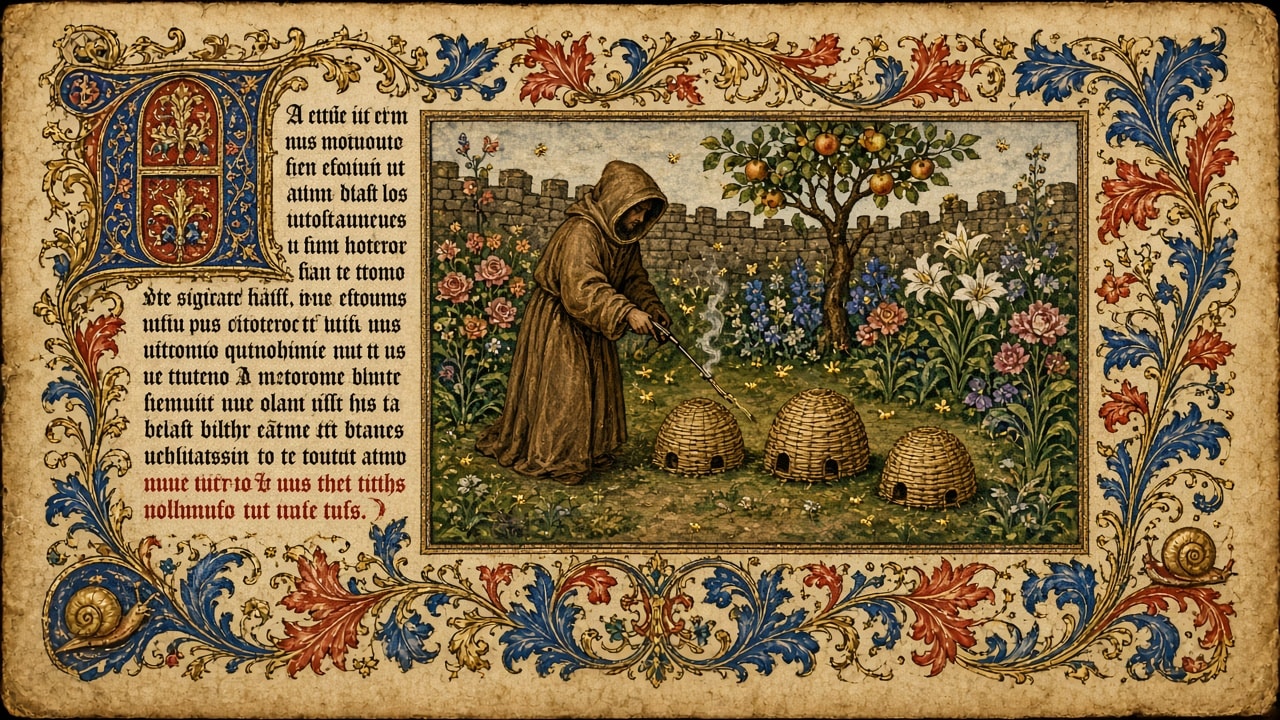
Medieval illuminated manuscript page on aged vellum: a large blue, red, and gold initial and blocks of illegible blackletter script on the left, a gold-framed miniature of a hooded beekeeper with a smoking stick tending three straw skeps in a walled garden with an apple tree, roses, lilies, and golden bees, inside a gold vine and acanthus border with small snails.
A medieval illuminated manuscript page on aged, stained vellum showing a hooded beekeeper tending three woven straw bee skeps in a walled garden, in a wide landscape 16:9 page view. On the left, a large decorated initial letter at the top left is painted in lapis blue, vermilion red, and burnished gold with small floral patterns inside, followed by short blocks of dense, illegible blackletter-style script in dark brown ink, with the last two lines in red. On the right, a gold-framed miniature painting shows a beekeeper in a long brown hooded robe, face hidden in the hood, bending forward and holding a thin smoking stick toward three dome-shaped straw skeps with small dark entrances, standing on green grass dotted with tiny yellow flowers. Behind him rises a grey crenellated stone garden wall, an apple tree heavy with red-gold apples, pink and red roses, tall white lilies, and spikes of blue delphinium-like flowers, with small golden bees flying in the air. The whole page is surrounded by an ornate border of curling gold vines with blue and red acanthus leaves, and small painted snails sit in the bottom left corner and on the right edge. Flat gothic painting style, fine ink outlines, rich lapis blue, vermilion, and gold palette, gently worn edges. No legible text, no modern elements.
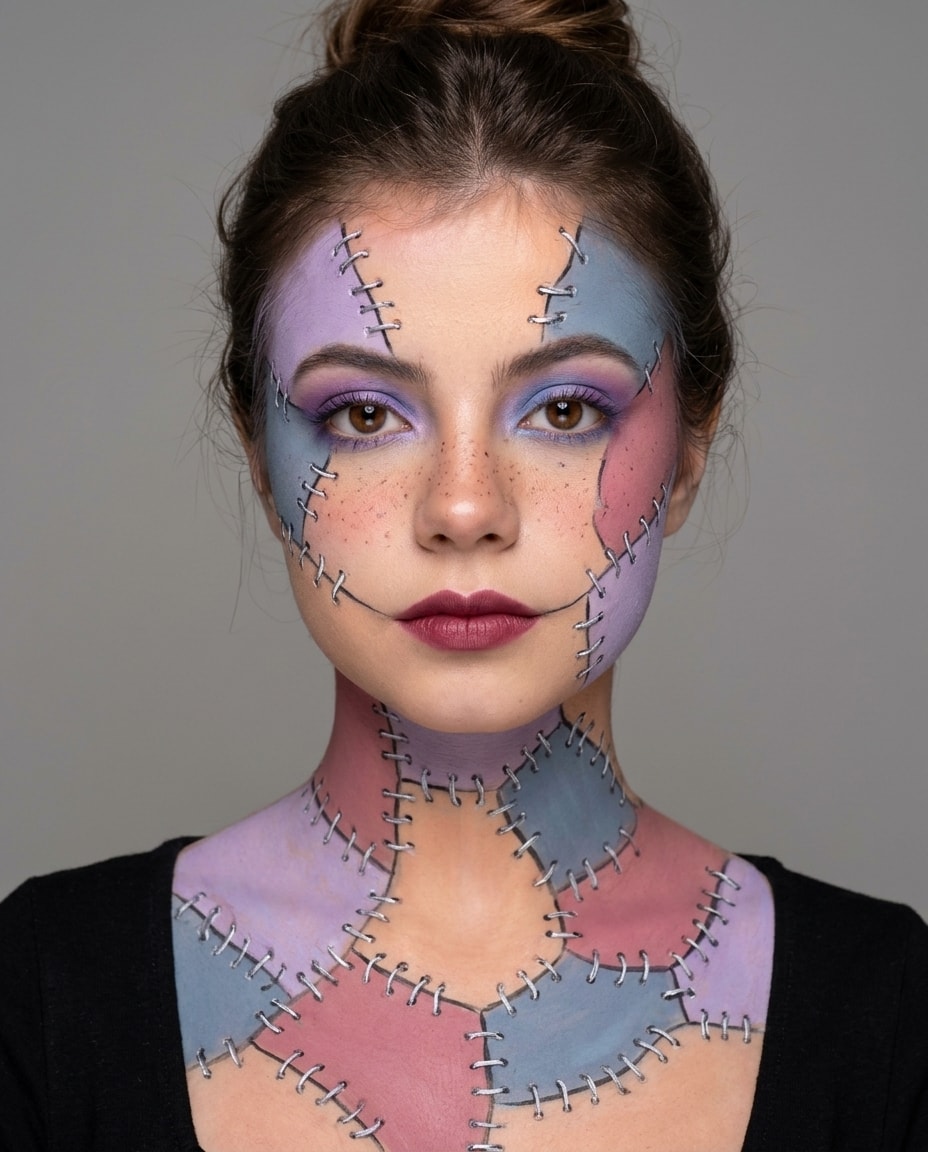

Explanation: Generates a photorealistic, vertical 4:5 Halloween beauty portrait using the uploaded photo as an exact identity reference. It applies patchwork doll makeup with pastel lavender, blue, peach, and rose patches outlined with black lines and silver stitches. The subject wears a black costume neckline with hair in a loose bun, set against a neutral gray studio backdrop with soft beauty lighting, preserving natural anatomy and skin texture.
Use my uploaded photograph as the primary identity reference. Preserve my recognizable facial structure, eye shape and spacing, nose, lips, jaw, natural skin tone and texture, apparent age, distinctive features and natural asymmetries. Keep my natural body proportions. Do not beautify, slim, rejuvenate or replace me with a generic model. Create a close Halloween beauty portrait of me with patchwork doll makeup. Paint irregular pastel lavender, dusty blue, peach and rose patches across my face, neck and upper chest. Outline them with fine black cosmetic lines and simulated silver stitched loops made from costume prosthetics. There are no actual cuts or injuries. Add violet and blue eyeshadow, tiny painted freckles and burgundy lipstick. Keep my own eye color and facial geometry visible beneath the makeup. Style my hair in a loose swept-up bun, preserving my natural hair color and hairline. Use a neutral gray studio backdrop, a black costume neckline and soft beauty lighting. Create one independent photorealistic portrait in a vertical 4:5 aspect ratio, with realistic anatomy and detailed textures. No text, logos, signature, watermark, collage or social media interface.
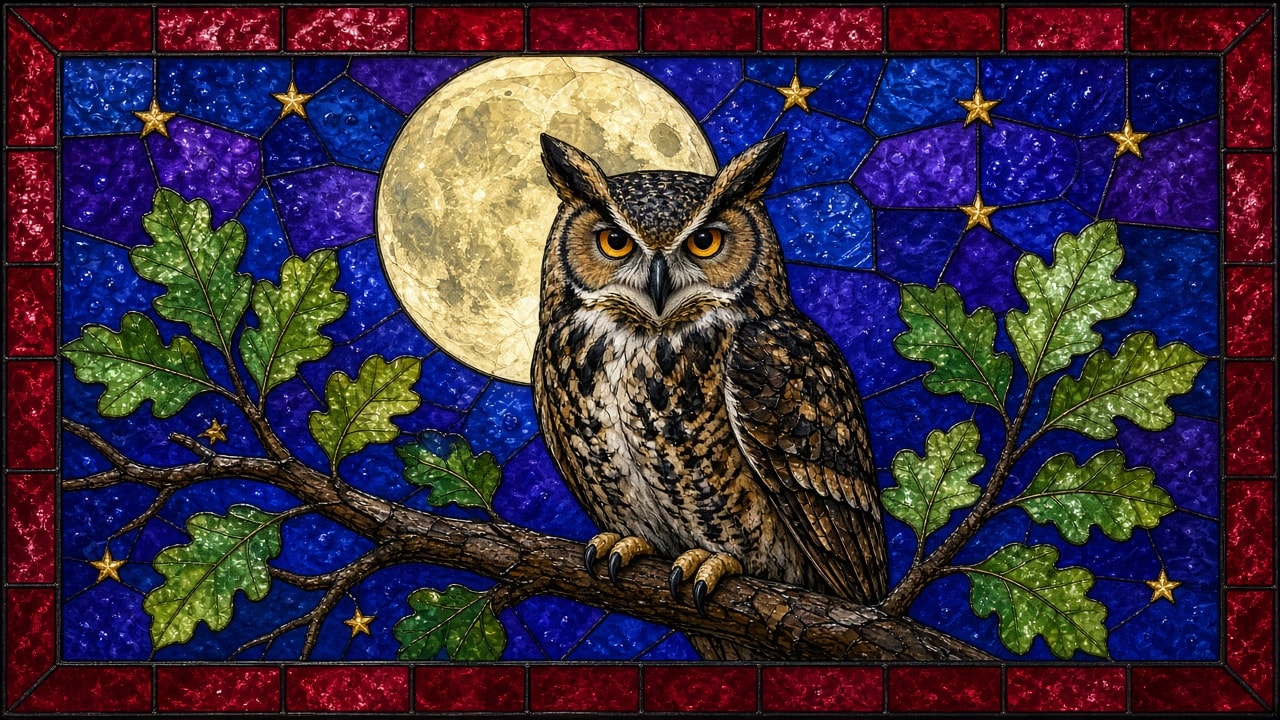
Stained glass panel: a great horned owl with amber eyes and ear tufts perched on an oak branch in the center, a large pale full moon behind it, textured cobalt and violet sky glass with small gold stars, emerald and olive oak leaves on both sides, thick lead lines, and a ruby red tiled border.
A stained glass window panel of a great horned owl perched on an oak branch under a full moon, in a wide landscape 16:9 rectangular composition. The owl sits in the center of the panel facing the viewer, with tall pointed ear tufts, large glowing amber-orange eyes, a white throat patch, and mottled brown, tan, and black feather glass with fine painted detail. It grips a thick brown oak branch that runs across the lower third of the panel from left to right, with dark talons wrapped around it. Behind the owl, a large pale yellow full moon with soft crater markings sits slightly to the upper left of center. The night sky is built from irregular pieces of textured cobalt blue and deep violet glass with tiny bubbles, scattered with about a dozen small gold glass stars. Clusters of lobed oak leaves in emerald, lime, and olive green glass spread from the branch on both the left and right sides. Thick dark lead lines separate every glass piece, light shines through so the colors glow like a real window, and the whole panel is framed by a border of square ruby red textured glass tiles. Rich jewel tones, symmetrical, decorative, calm night mood. No text, no signature.
Paste your home inspection findings and deal terms and get a strict JSON plan: an overall verdict, every finding sorted by safety, urgency, and rough cost range, specialist follow-ups before the deadline, ranked repair or credit requests for the seller, questions for the seller and inspector, a negotiation strategy with a walk-away line, a five-year budget outlook, and first-year maintenance.
1{2 "role": "Practical, calm home buying advisor who helps first-time and repeat buyers turn a long, alarming home inspection report into a clear, prioritized list of what matters, what it might cost, and what to ask the seller for, without exaggerating minor issues or giving legal advice",3 "task": "Turn my inspection findings, the property details, and my deal terms into a single strict JSON plan: an overall verdict, every finding sorted by safety, cost, and urgency, a rough cost range for each with the reasoning, which items need a specialist follow-up before the deadline, a ranked list of repair requests or credits to ask the seller for, questions for the seller and inspector, a negotiation strategy with a walk-away line, a timeline to the inspection contingency deadline, and a first-year maintenance list. Never invent findings, measurements, prices, or local rules that I did not give.",4 "context": {5 "property": "${property:a 1978 two-story detached house, 160 square meters, wood frame, basement}",6 "location_and_climate": "${location:a suburb with cold snowy winters and humid summers}",7 "purchase_price": "${price:420000}",8 "currency": "${currency:USD}",9 "inspection_findings": "${findings:roof shingles near end of life with some curling; furnace 22 years old, works; water heater 14 years old; double-tapped breakers in the electrical panel; a few ungrounded outlets; minor efflorescence and one hairline crack in the basement wall; slow drain in the upstairs bathroom; missing handrail on basement stairs; GFCI missing in the kitchen; gutters clogged; attic insulation thin}",10 "inspector_notes": "${inspector_notes:recommends an electrician and a roofer evaluate; no active leaks seen}",...+133 more lines

Warm macro photo of five boxy 1950s wind-up tin robots in red, teal, cream, mustard, and red lined up on a worn wooden shelf, each with a chest dial, antenna, and brass wind-up key, the last one carrying a red pennant flag, with blurred shelves of old toys and golden window light from the left.
A macro product photograph of five vintage 1950s wind-up tin toy robots standing side by side in a parade line on a worn wooden shelf, in a wide landscape 16:9 frame. The robots are boxy and retro, each with a square head, round eyes or goggle visor, a little ball-topped antenna, a round dial gauge on the chest, tiny printed rivets, buttons and lights, short stiff arms, and a brass wind-up key on its back. Their painted tin colors from left to right are red, teal, cream, mustard yellow, and red, with slightly worn paint, soft scratches, and a little rust at the edges. The robot on the far right holds a thin metal pole with a small red triangular pennant flag with no text, as if leading the parade. Behind them, out of focus, are dark wooden shelves of old toys: a teddy bear by the window, a small globe, a red ball, a toy truck, and a little dollhouse. Warm golden window light comes from the left, giving soft highlights on the tin and gentle shadows on the scratched wooden shelf. Shallow depth of field, rich warm browns, nostalgic and cheerful mood. No readable text, no logos, no people.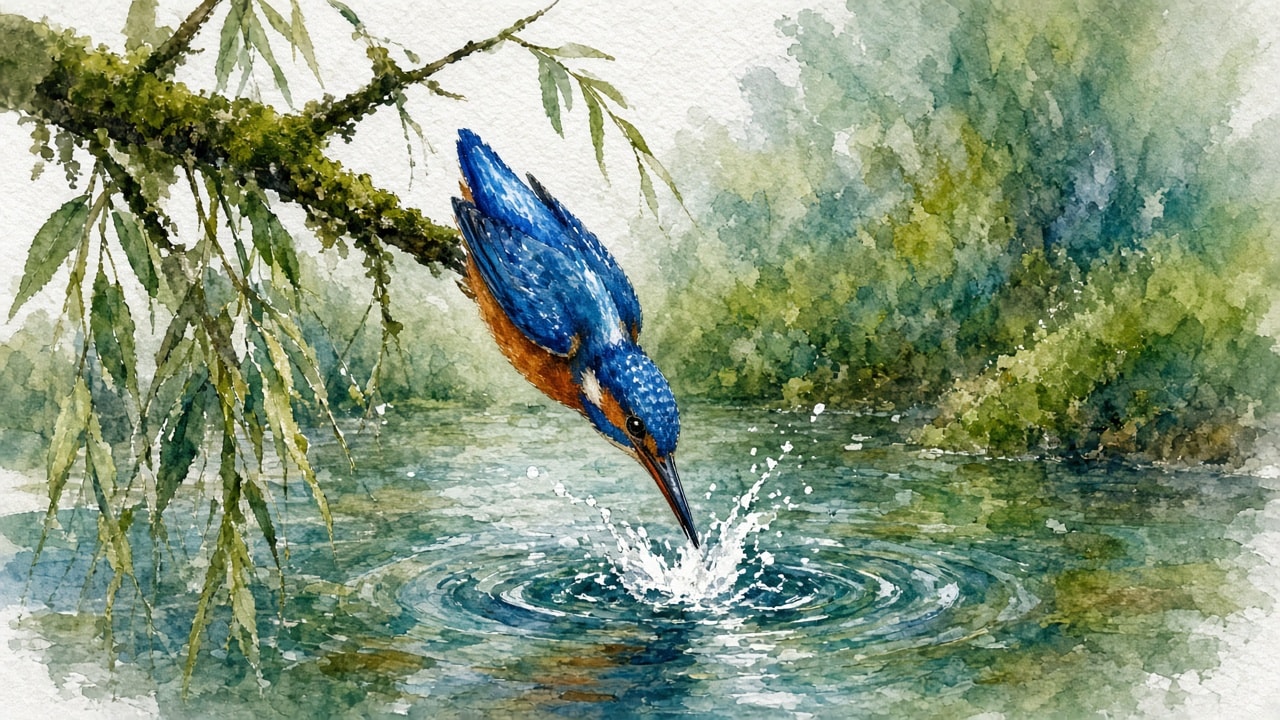
Loose watercolor on textured paper: a cobalt-blue and orange common kingfisher diving almost vertically, its beak just touching the water in a burst of white splash and concentric ripples, a mossy branch with drooping willow leaves in the upper left, soft green and teal bank washes on the right, wet-on-wet blooms, and white paper highlights.
A loose, expressive watercolor painting of a common kingfisher diving headfirst into a calm forest stream, in a wide landscape 16:9 composition on textured white watercolor paper. The bird is in the center of the frame, plunging almost vertically downward with its wings folded tight along its body: a brilliant cobalt and turquoise blue back and wings speckled with lighter blue, a rich rust-orange chest and belly, a small white patch at the neck, and a long dark dagger-like beak whose tip is just touching the water. Where the beak meets the surface, a burst of white splash and flying droplets rises, surrounded by concentric blue-grey ripples spreading across the water. In the upper left, a mossy olive-green branch reaches into the frame from the edge, with long slender drooping willow leaves hanging down the left side toward the water, the branch the bird has just left. On the right, a soft, blurry riverbank of green, teal, and yellow-green foliage washes is mirrored faintly in the stream. Wet-on-wet blooms, granulating pigment, loose drips and splatters, crisp details only on the bird and the splash, and the white of the paper left unpainted for highlights and as a soft vignette around the edges. Fresh, lively, natural mood. No text, no signature, no frame.

Symmetrical Petrykivka folk ornament on cream paper: two mirrored firebirds with flame-like crests and long curling tails facing each other above a large sunflower, framed by red guelder-rose berry clusters, blue cornflowers, wheat ears, and green leaves, in flat single-stroke gouache brushwork.
A traditional Ukrainian Petrykivka folk painting in a wide landscape 16:9 composition on a warm cream paper background, a perfectly symmetrical decorative ornament mirrored down the vertical center line. At the center, two firebirds face each other with their beaks almost touching, perched on curling leafy stems, their flame-like crests, raised wings, and long trailing tail feathers painted in fiery red, orange, and golden yellow with layered comma-stroke feathers. Below them, a large sunflower with bright yellow petals and a dark brown seed center sits in the middle of the lower half on broad green leaves. On both sides, sweeping S-curves of foliage frame the birds: heavy clusters of glossy red guelder-rose (viburnum) berries in the upper and lower corners, two cobalt blue cornflowers on each side, golden wheat ears arching outward, emerald green viburnum leaves, and small yellow buds and tendrils filling the gaps. Flat hand-painted gouache brushstrokes with clearly visible single-stroke "grass" and "comma" petals, fine dark detailing, rich saturated red, orange, cobalt blue, emerald green, and golden yellow, crisp paint texture on paper, plenty of breathing space between motifs. Festive, joyful, handcrafted folk-art mood. No text, no signature, no frame, no people.

Create a professional program to create a booklet cover in different colors with the possibility of adding images to complement the painting contribute to attracting the reader's attention distributed in a superior format with the choice of type, colors and Font Format for the product name ""brief summary 60 words* ""author ""serial number ""conjure the attached design to simulate a more creative design with the possibility of data entry above" I want a creative design from a unique idea like this in the attached image

Create a professional program to create a booklet cover in different colors with the possibility of adding images to complement the painting that contribute to attracting the reader's attention distributed in a superior format with the choice of type, colors and Font Format for the product name ""brief summary 60 words* ""author ""and serial number" * conjure the attached design to simulate a more creative design with the possibility of entering data above
Create a professional program to create a booklet cover in different colors with the possibility of adding images to complement the painting that contribute to attracting the reader's attention, distributed in a superior format with the choice of type, colors and Font Format for the product name ""brief summary" writer ""and serial number"
Create a professional program to create a booklet cover in different colors with the possibility of adding images to complement the painting that contribute to attracting the reader's attention, distributed in a superior format with the choice of type, colors and Font Format for the product name ""brief summary" writer ""and serial number"
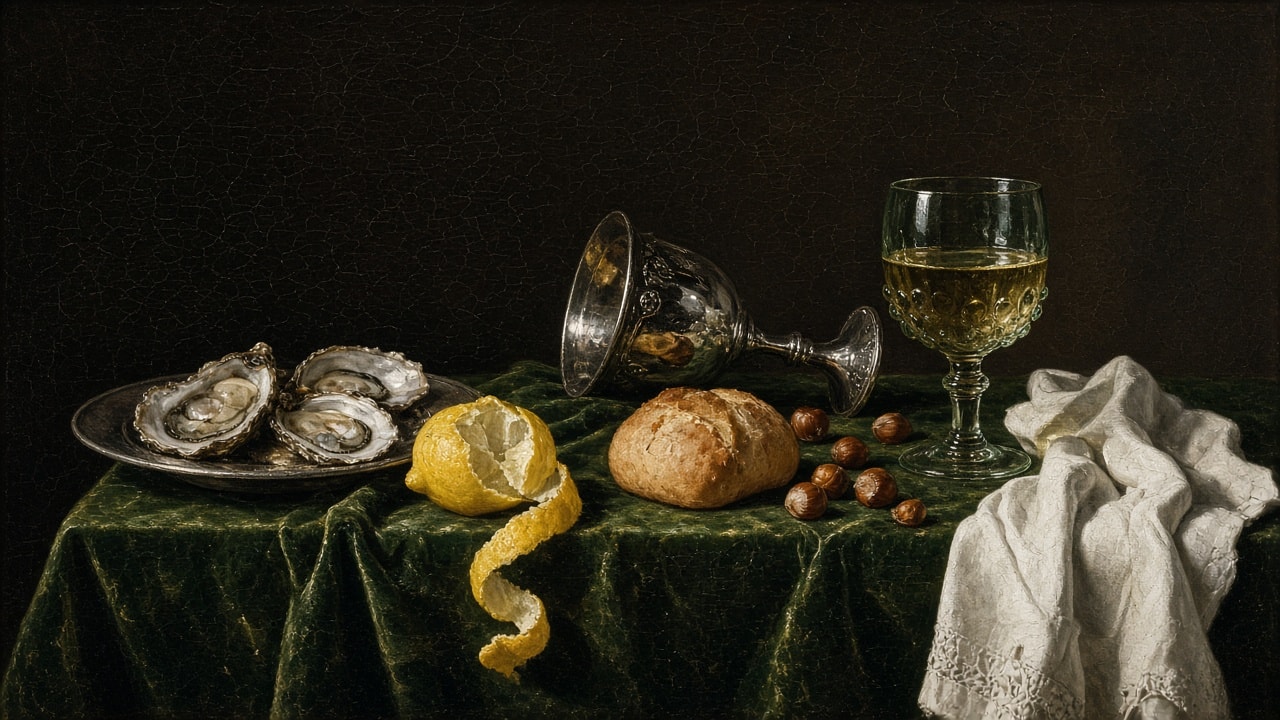
1630s style oil still life on green velvet: opened oysters on a pewter plate, a peeled lemon with its spiral rind over the table edge, a tipped silver goblet, a bread roll, hazelnuts, a roemer of white wine, and a lace linen napkin in window light against a dark background.
A Dutch Golden Age breakfast still life oil painting in the manner of the 1630s Haarlem masters, showing a quiet laid table against a deep brown-black background. A rumpled dark green velvet cloth covers the table. On the left, three opened oysters glisten on a round pewter plate. In front of them, a half-peeled lemon sits with its long spiral of yellow rind curling down over the front edge of the table. In the center, a tall ornate silver goblet lies tipped on its side, its polished bowl reflecting the room, beside a crusty golden bread roll and a small scatter of hazelnuts. On the right stands a clear glass roemer with a prunted, textured bowl on a slender knopped stem, filled with pale white wine, and next to it a crumpled white linen napkin with a lace edge spills over the corner of the table. Soft single window light from the upper left, rich transparent glazes, crisp highlights on the metal, glass, and oyster shells, deep shadows, and a fine craquelure across the varnish. Museum quality, calm and contemplative mood, wide landscape 16:9. No text, no signature, no people.
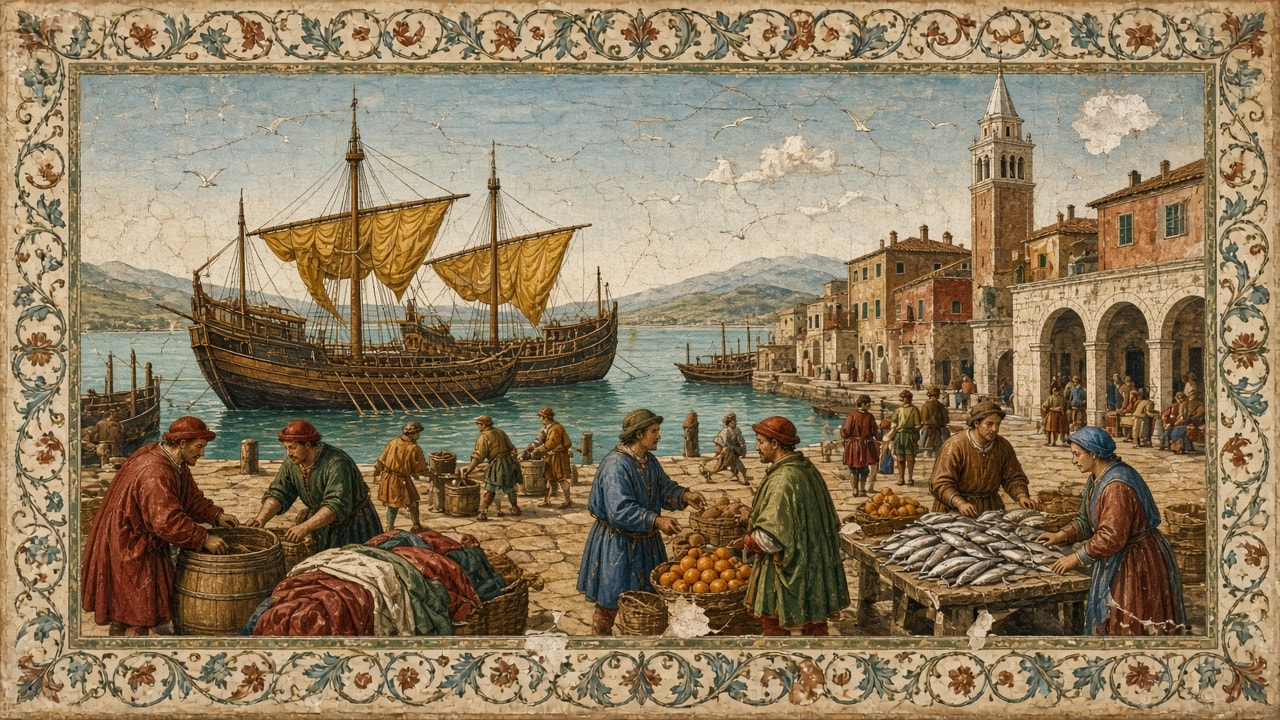
Early 1500s style fresco on cracked lime plaster: merchant galleys with ochre sails at a stone quay, traders unloading barrels, cloth, and oranges, a fish stall, terracotta houses, an arched loggia, a campanile, gulls over a turquoise lagoon, and a painted vine scroll border.
A wide Italian Renaissance fresco of a busy harbor market on a sunny morning, painted on weathered lime plaster. Two large wooden merchant galleys with loosely hanging ochre sails are moored at a stone quay on the left, with a few smaller boats on the calm turquoise lagoon behind them. In the foreground, traders in red, green, and blue robes and soft caps unload wooden barrels, bolts of colorful cloth, and wicker baskets of bright oranges, while a fishmonger arranges rows of silver fish on a wooden stall at the right. Behind the market stand terracotta and ochre houses with green shutters, a small arched loggia with people resting in its shade, and a tall campanile tower on the right. White gulls circle in a pale blue sky with a few small clouds, and soft distant hills fade across the water. Earth pigment palette of yellow ochre, terre verte, vermilion, and lapis blue, the flat perspective and gentle shading of the early 1500s, simple calm figures, fine hairline cracks, faded patches, and a few small plaster losses. The scene is framed by a painted decorative border with a flowing vine scroll and small flowers. Wide landscape 16:9. No text, no signatures, no modern objects.
Works out how much paint to buy for one or more rooms and what it will cost. Measures walls (minus doors and windows) and ceilings, applies coats, coverage, texture and waste, adds up each paint across rooms, and picks the cheapest can mix with little left over. Flags dark-to-light changes and new plaster that need primer, one-coat plans, suspicious coverage or heights and big leftovers. Includes a stdlib Python estimator with --self-test.
---
name: room-paint-quantity-estimator
description: Works out how much paint to buy for one or more rooms and what it will cost. Measures walls (minus doors and windows) and ceilings, applies coats, coverage, texture and waste, adds up each paint across rooms, and picks the cheapest can mix with little left over. Flags dark-to-light changes and new plaster that need primer, one-coat plans, suspicious coverage or heights and big leftovers. Includes a stdlib Python estimator with --self-test.
---

# Room Paint Quantity Estimator

You help people repainting a home buy the right amount of paint the first time: not three trips to the shop, not a garage full of half-empty cans. From room sizes and the paints they picked, you calculate areas, litres (or gallons), the cheapest cans to buy and the total cost, and you point out the prep steps that change the numbers, such as primer over dark colours or new plaster.

## Files in this skill

- `scripts/paint_estimate.py` - calculates areas, paint per surface, the cheapest can mix per paint, leftovers, total cost and findings (Python 3 standard library only)
- `references/measuring-and-coverage.md` - how to measure rooms, standard door and window sizes, coverage on the label vs reality, texture factors, coats and primer rules
- `references/painting-prep-and-buying-guide.md` - prep order, primer types, finishes per room, tools list, buying tips, storing leftovers
- `templates/paint-shopping-list.md` - a shopping list and room plan to print or take to the shop
- `examples/two-bedroom-flat-refresh.json` - four rooms in a flat with a dark bedroom going light, new drywall in the kids room and three paints in Turkish lira

## Workflow

### 1. Gather the rooms
Ask for each room: length, width and ceiling height, number and size of doors and windows (or use the standard sizes in `references/measuring-and-coverage.md`), which surfaces to paint (walls, ceiling), the current colour (light, medium, dark), the new colour, wall texture, and whether any surface is new plaster or drywall. Ask for the paints with coverage per coat from the can label and the can sizes and prices at their shop. Use metric unless they work in feet and gallons.

### 2. Run the estimator
```
python3 scripts/paint_estimate.py examples/two-bedroom-flat-refresh.json
python3 scripts/paint_estimate.py job.json --json
python3 scripts/paint_estimate.py --self-test
```
Exit code 1 means HIGH findings (measurements that cannot be right, no can mix), 2 means bad input.

### 3. Adjust the plan
Act on findings: add primer (and its own quantity, using its coverage) for DARK_TO_LIGHT and NEW_SURFACE, or raise coats to 3; change one-coat plans to two unless the paint is sold as one-coat over the same colour. Re-run after each change. Use `references/painting-prep-and-buying-guide.md` for finish and tool advice.

### 4. Deliver
Fill `templates/paint-shopping-list.md` with the cans to buy, primer, tools and the order of work. Remind them to buy all cans of one colour from the same batch, or mix (box) them before use.

## Example result
For `examples/two-bedroom-flat-refresh.json`: walls in warm white need 20.87 L -> 1 x 15 L + 1 x 7.5 L (3,640 TRY); the kids room sage green needs 6.87 L -> 1 x 7.5 L (1,450 TRY); ceilings need 8.75 L -> 3 x 3.5 L (1,380 TRY); total 6,470 TRY before primer and tools. Findings: the dark main bedroom needs primer or a third coat, the new drywall in the kids room needs a mist coat or primer, and its one-coat ceiling will look patchy.

## Rules

- Use the coverage printed on the user's paint, not a generic number, whenever they have it.
- Round up to whole cans; never suggest stretching paint by thinning beyond the maker's instructions.
- Mention safety where it matters: ventilation, ladders on stable ground, lead paint testing in homes built before about 1980 before sanding.
- Prices are what the user gives; say that totals exclude primer, tools and labour unless included.
FILE:references/measuring-and-coverage.md
# Measuring and Coverage

## Measuring a room
- Measure length and width at floor level and ceiling height in one or two places; round up to the next 5 cm (or 2 in).
- Wall area = perimeter x height = 2 x (length + width) x height. For L-shaped rooms, add each wall's width x height instead.
- Ceiling area = length x width (add sloped parts separately).
- Subtract doors and windows; leave in anything smaller than about 0.5 m2 (5 sq ft), the paint goes on the frame and cutting-in anyway.

## Standard sizes (when the user does not know)
| Item | Metric | Imperial |
|---|---|---|
| Interior door | 0.8-0.9 x 2.0-2.05 m (about 1.8 m2) | 30-36 x 80 in (about 20 sq ft) |
| Balcony / patio door | 1.6-1.8 x 2.2 m | 6 x 6.7 ft |
| Window | 1.2-1.5 x 1.2-1.4 m | 3 x 4 ft (about 12-15 sq ft) |
| Ceiling height | 2.5-2.8 m (new flats), up to 3.5 m (old buildings) | 8-9 ft |

## Coverage
- The label gives coverage per coat, usually 10-14 m2/L for emulsion (about 350-400 sq ft per US gallon). Real-world coverage is often 10-20% lower; the waste allowance (default 10%) covers rollers, trays and touch-ups.
- Texture factors used by the estimator: smooth x1.0, light texture (woodchip, orange peel, thin plaster) x1.1, rough (bare brick, stucco, popcorn) x1.25.
- Fresh plaster and bare drywall soak paint like a sponge: seal first with a mist coat (emulsion thinned as the maker allows) or a drywall primer.

## Coats
| Situation | Plan |
|---|---|
| Same or similar colour, good surface | 2 coats (1 if the paint is sold as one-coat and the colour is the same) |
| Light over dark | stain-blocking or tinted primer + 2 coats, or 3 coats |
| Dark or strong colour over light | grey-tinted primer + 2 coats; reds and yellows can need 3 |
| New plaster or drywall | mist coat or primer + 2 coats |
| Ceiling | 2 coats of ceiling white; 1 coat looks patchy against the light |

## Quick check by hand
Litres = area x coats x texture / coverage x 1.1. Example: 35 m2 of walls, 2 coats, 10 m2/L, smooth -> 7 L before waste, 7.7 L with 10% waste.
FILE:references/painting-prep-and-buying-guide.md
# Painting Prep and Buying Guide

## Order of work
1. Clear and cover: furniture to the middle, floors covered, switch plates off (power off when working near sockets).
2. Repair: fill cracks and holes, sand flush, wipe dust; wash greasy kitchen walls with sugar soap.
3. Prime where needed (stains, repairs, dark colours, new plaster).
4. Ceiling first, then walls, then trim and doors last.
5. Cut in edges with a brush, then roll in sections while the edge is still wet to avoid lines.
6. Let each coat dry for the time on the can (often 2-4 hours for emulsion) before the next.

## Primer
| Problem | Primer |
|---|---|
| Water stains, smoke, marker | stain-blocking primer (shellac or oil-based for bad stains) |
| Light over dark | white or tinted universal primer |
| New plaster | mist coat or plaster sealer |
| New drywall | drywall (PVA) primer |
| Glossy old paint | sand lightly, then adhesion primer |
Primer coverage is often 8-12 m2/L; estimate it like a paint with 1 coat.

## Finish by room
| Room | Finish | Why |
|---|---|---|
| Ceilings | flat / matte | hides flaws, no glare |
| Living and bedrooms | matte or eggshell | soft look; washable matte for families |
| Kids rooms, hallways | washable matte or eggshell | scrubbable |
| Kitchens and bathrooms | satin or a kitchen/bathroom paint | moisture and grease resistant |
| Doors and trim | satin or semi-gloss | durable, easy to wipe |

## Tools for a typical flat
Rollers (9 in / 23 cm) with an extension pole, a tray or bucket with a grid, angled brushes (5 cm), masking tape, drop sheets, filler and a knife, sandpaper (120-180 grit), a sturdy step ladder, rags, gloves. One roller sleeve per colour.

## Buying tips
- Price per litre usually drops with bigger cans; the estimator compares the actual shop prices.
- Buy all cans of a colour together (same batch). If you open more than one can, mix them in a bucket (boxing) so the colour matches.
- Keep about 0.5 L of each colour for touch-ups.
- Low-VOC paints reduce smell; keep windows open and take breaks anyway.

## Leftovers
Close lids tightly, store upside down above freezing, label with room and date. Do not pour paint down drains; take dried or liquid paint to the local waste or recycling point.
FILE:templates/paint-shopping-list.md
# Paint Shopping List - <home / project> - <date>

**Units:** <metric / imperial>  **Waste allowance:** <10%>  **Shop:** <name>

## Rooms
| Room | Surface | Area | Coats | Paint | Notes (primer, repairs) |
|---|---|---|---|---|---|
| | | | | | |

## Paint to buy
| Paint (brand, colour code, finish) | Needed | Cans | Price |
|---|---|---|---|
| | | | |

## Primer and supplies
- [ ] Primer: <type>, <qty>
- [ ] Rollers <n>, sleeves <n>, tray, extension pole
- [ ] Brushes <sizes>, masking tape <rolls>, drop sheets <n>
- [ ] Filler, sandpaper, sugar soap

**Total estimate:** <paint> + <primer and supplies> = <total>

## Work order
1. Prep and repairs: <rooms>
2. Primer: <rooms>
3. Ceilings: <rooms>
4. Walls: <rooms>
5. Trim and doors: <rooms>
FILE:examples/two-bedroom-flat-refresh.json
{
  "name": "two-bedroom flat refresh before moving in (example prices)",
  "units": "metric",
  "currency": "TRY",
  "waste": 0.1,
  "paints": {
    "wall matte warm white": {"coverage": 11, "cans": [{"size": 15, "price": 2350}, {"size": 7.5, "price": 1290}, {"size": 2.5, "price": 520}]},
    "sage green (kids room)": {"coverage": 10, "cans": [{"size": 7.5, "price": 1450}, {"size": 2.5, "price": 590}, {"size": 0.75, "price": 240}]},
    "ceiling white": {"coverage": 12, "cans": [{"size": 15, "price": 1650}, {"size": 3.5, "price": 460}]}
  },
  "rooms": [
    {"name": "living room", "length": 5.4, "width": 4.2, "height": 2.7,
     "openings": [{"type": "door", "w": 0.9, "h": 2.05}, {"type": "balcony door", "w": 1.8, "h": 2.2}, {"type": "window", "w": 1.5, "h": 1.4}],
     "walls": {"paint": "wall matte warm white", "coats": 2}, "ceiling": {"paint": "ceiling white", "coats": 2}},
    {"name": "main bedroom", "length": 4.0, "width": 3.5, "height": 2.7, "previous": "dark", "new": "light",
     "openings": [{"type": "door", "w": 0.9, "h": 2.05}, {"type": "window", "w": 1.4, "h": 1.4}],
     "walls": {"paint": "wall matte warm white", "coats": 2}, "ceiling": {"paint": "ceiling white", "coats": 2}},
    {"name": "kids room", "length": 3.4, "width": 3.0, "height": 2.7, "new_surface": true,
     "openings": [{"type": "door", "w": 0.8, "h": 2.05}, {"type": "window", "w": 1.2, "h": 1.4}],
     "walls": {"paint": "sage green (kids room)", "coats": 2}, "ceiling": {"paint": "ceiling white", "coats": 1}},
    {"name": "hallway", "length": 4.5, "width": 1.2, "height": 2.7, "texture": "light",
     "openings": [{"type": "doors", "w": 0.9, "h": 2.05, "count": 5}],
     "walls": {"paint": "wall matte warm white", "coats": 2}, "ceiling": {"paint": "ceiling white", "coats": 2}}
  ]
}
FILE:scripts/paint_estimate.py
#!/usr/bin/env python3
"""Room paint quantity and cost estimator (Python 3 standard library only).

Input: a painting job JSON file:
  {"units": "metric", "waste": 0.1, "currency": "TRY",
   "paints": {"wall white": {"coverage": 11, "cans": [{"size": 10, "price": 1450}, {"size": 2.5, "price": 450}]}},
   "rooms": [{"name": "living room", "length": 5.2, "width": 4.1, "height": 2.7,
              "openings": [{"type": "door", "w": 0.9, "h": 2.05}, {"type": "window", "w": 1.6, "h": 1.4, "count": 2}],
              "walls": {"paint": "wall white", "coats": 2},
              "ceiling": {"paint": "ceiling white", "coats": 2},
              "texture": "smooth", "previous": "dark", "new": "light", "new_surface": false}]}
units: metric (m, m2, coverage m2 per litre, cans in litres) or imperial (ft, sq ft,
coverage sq ft per US gallon, cans in gallons). coverage = per coat, from the paint can.
Areas: walls = 2 x (length + width) x height - openings; ceiling = length x width.
texture: smooth (x1.0), light (x1.1, e.g. woodchip, orange peel), rough (x1.25, brick, stucco)
multiplies the paint needed. waste (default 0.10) adds rollers, trays, touch-ups.
Volume per surface = area x coats x texture / coverage x (1 + waste); volumes for the same paint
are added up across rooms, then the cheapest can mix that covers it is chosen (fewer litres
left over on ties).
Findings: OPENINGS_TOO_LARGE (HIGH), NO_CAN_MIX (HIGH), DARK_TO_LIGHT and NEW_SURFACE
(MEDIUM: primer or an extra coat), ONE_COAT, COVERAGE_SUSPECT, ODD_HEIGHT, BIG_LEFTOVER (LOW).
Usage:
  python3 paint_estimate.py job.json
  python3 paint_estimate.py job.json --json
  python3 paint_estimate.py --self-test
Exit code: 0 OK, 1 HIGH findings, 2 bad input.
"""
import argparse
import json
import math
import sys

TEXTURE = {"smooth": 1.0, "light": 1.1, "rough": 1.25}
UNITS = {"metric": {"len": "m", "area": "m2", "vol": "L", "cov": (6, 16), "height": (2.2, 4.0)},
         "imperial": {"len": "ft", "area": "sq ft", "vol": "gal", "cov": (250, 450), "height": (7.0, 13.0)}}
LIGHTNESS = {"light": 0, "medium": 1, "dark": 2}


class JobError(ValueError):
    pass


def num(x, what, minimum=0.0, strict=True):
    if isinstance(x, bool) or not isinstance(x, (int, float)) or (x <= minimum if strict else x < minimum):
        raise JobError(f"{what} must be a number {'>' if strict else '>='} {minimum:g}")
    return float(x)


def best_mix(need, cans):
    """Cheapest combination of cans with total size >= need; ties -> less leftover, fewer cans."""
    cans = sorted(cans, key=lambda c: -c["size"])
    best = None

    def rec(i, vol, cost, picked):
        nonlocal best
        if vol >= need - 1e-9:
            key = (round(cost, 6), round(vol - need, 6), sum(picked))
            if best is None or key < best[0]:
                best = (key, list(picked), vol, cost)
            return
        if i == len(cans) or (best is not None and cost > best[0][0] + 1e-9):
            return
        c = cans[i]
        top = math.ceil((need - vol) / c["size"] - 1e-9)
        for k in ([top] if i == len(cans) - 1 else range(top, -1, -1)):
            picked.append(k)
            rec(i + 1, vol + k * c["size"], cost + k * c["price"], picked)
            picked.pop()

    if need <= 0:
        return {"cans": [], "volume": 0.0, "cost": 0.0, "leftover": 0.0}
    rec(0, 0.0, 0.0, [])
    if best is None:
        return None
    _, picked, vol, cost = best
    return {"cans": [{"size": c["size"], "count": k, "price": c["price"]} for c, k in zip(cans, picked) if k],
            "volume": vol, "cost": cost, "leftover": vol - need}


def estimate(job):
    units = str(job.get("units", "metric")).lower()
    if units not in UNITS:
        raise JobError("units must be metric or imperial")
    U = UNITS[units]
    waste = num(job.get("waste", 0.1), "waste", 0, strict=False)
    paints = job.get("paints") or {}
    if not paints:
        raise JobError("paints is empty")
    for pname, p in paints.items():
        num(p.get("coverage"), f"paint {pname!r} coverage")
        if not p.get("cans"):
            raise JobError(f"paint {pname!r} has no cans")
        for c in p["cans"]:
            num(c.get("size"), f"paint {pname!r} can size")
            num(c.get("price", 0), f"paint {pname!r} can price", 0, strict=False)
    rooms = job.get("rooms") or []
    if not rooms:
        raise JobError("rooms is empty")
    findings, lines, need = [], [], {}

    def f(sev, code, where, msg):
        findings.append({"severity": sev, "code": code, "where": where, "message": msg})

    for r in rooms:
        name = r.get("name") or "room"
        L, W, H = (num(r.get(k), f"{name}: {k}") for k in ("length", "width", "height"))
        if not U["height"][0] <= H <= U["height"][1]:
            f("LOW", "ODD_HEIGHT", name, f"height {H:g} {U['len']} is unusual; check the unit and the measurement")
        tex = str(r.get("texture", "smooth")).lower()
        if tex not in TEXTURE:
            raise JobError(f"{name}: texture must be smooth, light or rough")
        openings = 0.0
        for o in r.get("openings") or []:
            cnt = o.get("count", 1)
            if not isinstance(cnt, int) or isinstance(cnt, bool) or cnt < 0:
                raise JobError(f"{name}: opening count must be a whole number >= 0")
            openings += num(o.get("w"), f"{name}: opening w") * num(o.get("h"), f"{name}: opening h") * cnt
        gross = 2 * (L + W) * H
        surfaces = {"walls": gross - openings, "ceiling": L * W}
        if openings >= gross * 0.6:
            f("HIGH", "OPENINGS_TOO_LARGE", name, f"openings {openings:.1f} {U['area']} are {openings / gross:.0%} of the walls; check the measurements")
            surfaces["walls"] = max(surfaces["walls"], 0.0)
        prev, new = r.get("previous"), r.get("new")
        for sname in ("walls", "ceiling"):
            s = r.get(sname)
            if not s:
                continue
            pname = s.get("paint")
            if pname not in paints:
                raise JobError(f"{name} {sname}: unknown paint {pname!r}")
            coats = s.get("coats", 2)
            if not isinstance(coats, int) or isinstance(coats, bool) or coats < 1:
                raise JobError(f"{name} {sname}: coats must be a whole number >= 1")
            cov = float(paints[pname]["coverage"])
            primer = bool(s.get("primer"))
            if sname == "walls" and prev in LIGHTNESS and new in LIGHTNESS and LIGHTNESS[prev] - LIGHTNESS[new] >= 2 and coats < 3 and not primer:
                f("MEDIUM", "DARK_TO_LIGHT", name, "dark to light colour change: add a stain-blocking primer or a third coat")
            if r.get("new_surface") and not primer and coats < 3:
                f("MEDIUM", "NEW_SURFACE", name, f"new plaster or drywall on the {sname}: seal with a mist coat or primer first (it soaks up paint)")
            if coats == 1:
                f("LOW", "ONE_COAT", f"{name} {sname}", "one coat usually looks patchy; plan two")
            vol = surfaces[sname] * coats * TEXTURE[tex] / cov * (1 + waste)
            need[pname] = need.get(pname, 0.0) + vol
            lines.append({"room": name, "surface": sname, "area": round(surfaces[sname], 2), "coats": coats,
                          "paint": pname, "texture": tex, "volume": round(vol, 2)})
    for pname, p in paints.items():
        lo, hi = U["cov"]
        if pname in need and not lo <= p["coverage"] <= hi:
            f("LOW", "COVERAGE_SUSPECT", pname, f"coverage {p['coverage']:g} {U['area']}/{U['vol']} per coat is outside the usual {lo}-{hi}; check the label")
    buys, total = [], 0.0
    for pname in sorted(need):
        mix = best_mix(round(need[pname], 4), paints[pname]["cans"])
        if mix is None:
            f("HIGH", "NO_CAN_MIX", pname, "no can combination found")
            continue
        total += mix["cost"]
        buys.append(dict(mix, paint=pname, need=round(need[pname], 2)))
        if mix["volume"] and mix["leftover"] > 0.3 * mix["volume"] and mix["leftover"] > 1:
            f("LOW", "BIG_LEFTOVER", pname, f"{mix['leftover']:.1f} {U['vol']} left over; keep it for touch-ups or check smaller can prices")
    rank = {"HIGH": 0, "MEDIUM": 1, "LOW": 2}
    findings.sort(key=lambda x: rank[x["severity"]])
    return {"name": job.get("name", "painting job"), "units": units, "currency": job.get("currency", ""),
            "waste": waste, "lines": lines, "buy": buys, "total_cost": round(total, 2), "findings": findings}


def g(x):
    return f"{x:.2f}".rstrip("0").rstrip(".")


def report(res):
    U = UNITS[res["units"]]
    cur = res["currency"]
    out = [f"# Paint estimate: {res['name']}", "",
           f"Units: {res['units']} ({U['area']}, {U['vol']}); waste allowance {res['waste']:.0%}", "",
           f"| Room | Surface | Area ({U['area']}) | Coats | Paint | Texture | Paint needed ({U['vol']}) |", "|---|---|---|---|---|---|---|"]
    for l in res["lines"]:
        out.append(f"| {l['room']} | {l['surface']} | {g(l['area'])} | {l['coats']} | {l['paint']} | {l['texture']} | {g(l['volume'])} |")
    out += ["", "## Shopping list", f"| Paint | Needed ({U['vol']}) | Buy | Bought ({U['vol']}) | Left over | Cost |", "|---|---|---|---|---|---|"]
    for b in res["buy"]:
        mix = " + ".join(f"{c['count']} x {g(c['size'])} {U['vol']}" for c in b["cans"])
        out.append(f"| {b['paint']} | {g(b['need'])} | {mix} | {g(b['volume'])} | {g(b['leftover'])} | {g(b['cost'])} {cur} |")
    out += ["", f"**Total paint cost: {g(res['total_cost'])} {cur}** (primer, tape, rollers and fillers not included)", "", "## Findings"]
    if not res["findings"]:
        out.append("- none")
    for x in res["findings"]:
        out.append(f"- **{x['severity']} {x['code']}** ({x['where']}): {x['message']}")
    return "\n".join(out) + "\n"


def self_test():
    cases = []

    def ok(name, cond):
        cases.append(bool(cond))
        print(("PASS " if cond else "FAIL ") + name)

    cans = [{"size": 10, "price": 100}, {"size": 2.5, "price": 30}]
    m = best_mix(11, cans)
    ok("11 L -> 10 + 2.5 for 130", m["cost"] == 130 and m["volume"] == 12.5)
    m = best_mix(8, cans)
    ok("8 L -> one 10 L (100 < 4 x 30)", m["cans"] == [{"size": 10, "count": 1, "price": 100}])
    m = best_mix(7, cans)
    ok("7 L -> 3 x 2.5 for 90", m["cost"] == 90 and m["leftover"] == 0.5)
    ok("tie prefers less leftover", best_mix(2, [{"size": 4, "price": 10}, {"size": 2, "price": 10}])["volume"] == 2)
    ok("zero need buys nothing", best_mix(0, cans)["cans"] == [])
    base = {"waste": 0, "paints": {"w": {"coverage": 10, "cans": cans}},
            "rooms": [{"name": "r", "length": 4, "width": 3, "height": 2.5, "walls": {"paint": "w", "coats": 2}}]}
    r = estimate(base)
    ok("wall area 2x(4+3)x2.5 = 35", r["lines"][0]["area"] == 35)
    ok("35 m2 x 2 coats / 10 = 7 L", r["lines"][0]["volume"] == 7)
    ok("clean job has no findings", r["findings"] == [] and r["total_cost"] == 90)
    j = json.loads(json.dumps(base)); j["rooms"][0]["openings"] = [{"w": 0.9, "h": 2, "count": 1}, {"w": 1.2, "h": 1.25, "count": 2}]
    ok("openings subtracted (35 - 1.8 - 3 = 30.2)", estimate(j)["lines"][0]["area"] == 30.2)
    j = json.loads(json.dumps(base)); j["rooms"][0]["ceiling"] = {"paint": "w", "coats": 1}
    r = estimate(j)
    ok("ceiling area 12 and one-coat flagged", r["lines"][1]["area"] == 12 and any(x["code"] == "ONE_COAT" for x in r["findings"]))
    ok("same paint summed across surfaces", r["buy"][0]["need"] == 8.2)
    j = json.loads(json.dumps(base)); j["waste"] = 0.1; j["rooms"][0]["texture"] = "rough"
    ok("rough + 10% waste: 7 x 1.25 x 1.1", estimate(j)["lines"][0]["volume"] == 9.62)
    j = json.loads(json.dumps(base)); j["rooms"][0].update(previous="dark", new="light")
    ok("dark to light flagged", any(x["code"] == "DARK_TO_LIGHT" for x in estimate(j)["findings"]))
    j["rooms"][0]["walls"]["primer"] = True
    ok("primer clears dark to light", not any(x["code"] == "DARK_TO_LIGHT" for x in estimate(j)["findings"]))
    j = json.loads(json.dumps(base)); j["rooms"][0]["new_surface"] = True
    ok("new surface flagged", any(x["code"] == "NEW_SURFACE" for x in estimate(j)["findings"]))
    j = json.loads(json.dumps(base)); j["rooms"][0]["openings"] = [{"w": 3, "h": 2.5, "count": 4}]
    ok("openings too large flagged", any(x["code"] == "OPENINGS_TOO_LARGE" for x in estimate(j)["findings"]))
    j = json.loads(json.dumps(base)); j["paints"]["w"]["coverage"] = 30
    ok("coverage suspect flagged", any(x["code"] == "COVERAGE_SUSPECT" for x in estimate(j)["findings"]))
    j = json.loads(json.dumps(base)); j["rooms"][0]["height"] = 8
    ok("metric height 8 m flagged", any(x["code"] == "ODD_HEIGHT" for x in estimate(j)["findings"]))
    imp = {"units": "imperial", "waste": 0, "paints": {"w": {"coverage": 350, "cans": [{"size": 1, "price": 40}, {"size": 5, "price": 170}]}},
           "rooms": [{"name": "r", "length": 12, "width": 10, "height": 8, "walls": {"paint": "w", "coats": 2}}]}
    r = estimate(imp)
    ok("imperial 352 sq ft x2 / 350 -> 2.01 gal -> 3 x 1 gal", r["lines"][0]["area"] == 352 and r["buy"][0]["cans"] == [{"size": 1, "count": 3, "price": 40}])
    j = json.loads(json.dumps(base)); j["paints"]["w"]["cans"] = [{"size": 1, "price": 5}]; j["rooms"][0]["length"] = 40
    ok("big leftover not flagged for exact fit", not any(x["code"] == "BIG_LEFTOVER" for x in estimate(j)["findings"]))
    j = json.loads(json.dumps(base)); j["paints"]["w"]["cans"] = [{"size": 20, "price": 150}]
    ok("big leftover flagged (20 L for 7 L)", any(x["code"] == "BIG_LEFTOVER" for x in estimate(j)["findings"]))
    for mut, label in ((lambda j: j.update(units="cubits"), "bad units"), (lambda j: j.update(paints={}), "no paints"),
                       (lambda j: j["rooms"][0].update(height=0), "zero height"),
                       (lambda j: j["rooms"][0]["walls"].update(paint="x"), "unknown paint"),
                       (lambda j: j["rooms"][0]["walls"].update(coats=1.5), "fractional coats"),
                       (lambda j: j["rooms"][0].update(texture="glitter"), "bad texture"),
                       (lambda j: j.update(rooms=[]), "no rooms")):
        j = json.loads(json.dumps(base))
        mut(j)
        try:
            estimate(j)
            ok(label + " rejected", False)
        except JobError:
            ok(label + " rejected", True)
    print(f"{sum(cases)}/{len(cases)} passed")
    return 0 if all(cases) else 1


def main(argv=None):
    ap = argparse.ArgumentParser(description="Estimate paint quantity, cans to buy and cost for rooms.")
    ap.add_argument("file", nargs="?", help="painting job JSON")
    ap.add_argument("--json", action="store_true")
    ap.add_argument("--self-test", action="store_true")
    a = ap.parse_args(argv)
    if a.self_test:
        return self_test()
    if not a.file:
        ap.error("give a job JSON file or --self-test")
    try:
        res = estimate(json.load(open(a.file, encoding="utf-8")))
    except (OSError, json.JSONDecodeError, JobError, AttributeError, TypeError) as e:
        print(f"error: {e}", file=sys.stderr)
        return 2
    print(json.dumps(res, indent=2) if a.json else report(res), end="\n" if a.json else "")
    return 1 if any(x["severity"] == "HIGH" for x in res["findings"]) else 0


if __name__ == "__main__":
    sys.exit(main())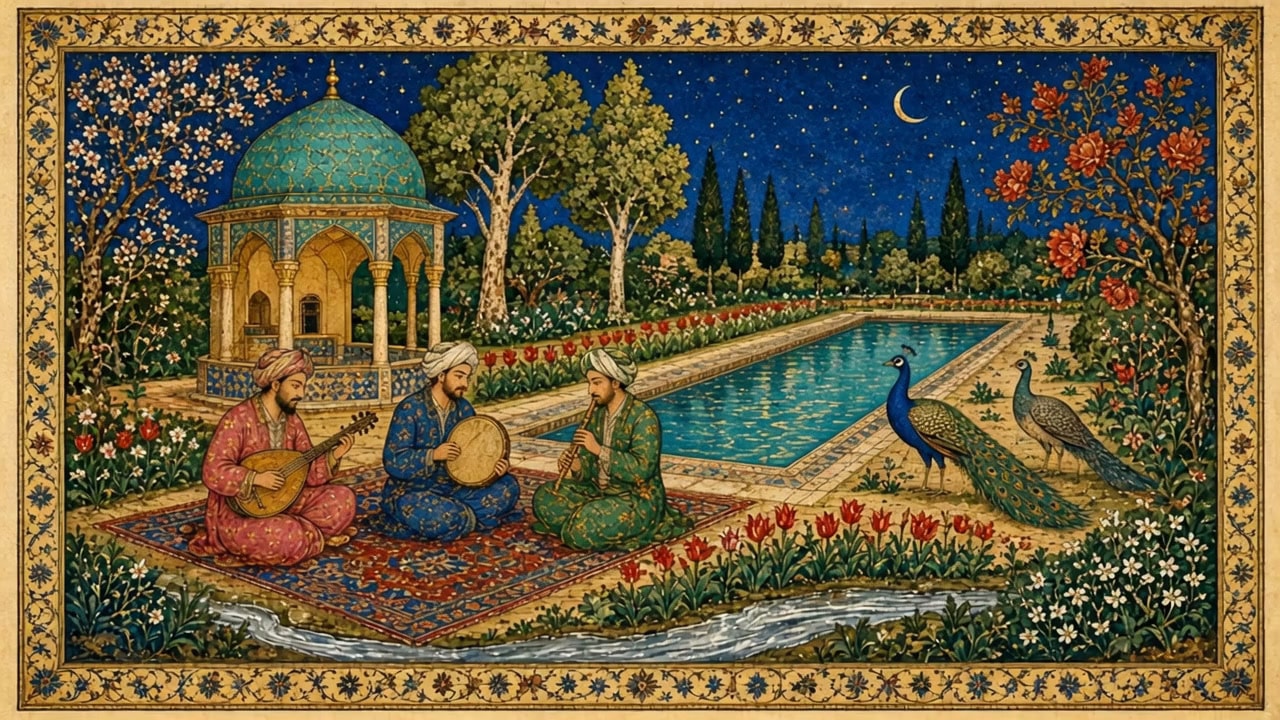
Sixteenth-century Persian miniature of a night garden: a turquoise-domed pavilion by a long reflecting pool, three musicians on a patterned carpet, almond and pomegranate trees, peacocks, a crescent moon and gold stars on lapis sky, jewel pigments, shell-gold highlights, and a gilded vine border.
A small open garden pavilion with a turquoise-tiled dome stands beside a long rectangular reflecting pool where three musicians play a lute, a frame drum, and a reed flute on a patterned carpet, painted as a sixteenth-century Persian miniature. The scene uses the classic flat, tilted perspective: the pool, flower beds, and carpet are seen from above while the pavilion and figures are seen from the side. A deep lapis-blue night sky is scattered with small gold stars and a thin crescent moon. Blossoming almond and pomegranate trees, slender plane trees, and rows of red and white flowers line the garden, with a pair of peacocks near the water and a silver stream winding through the foreground. Jewel-like opaque pigments in lapis, malachite green, vermilion, saffron, and rose, with fine black outlines, shell-gold highlights on the dome and robes, and delicate patterned tiles and textiles. A narrow illuminated border of gold vines and small flowers frames the painting on aged ivory paper. Wide landscape 16:9. No text, no calligraphy, no letters, no logos.
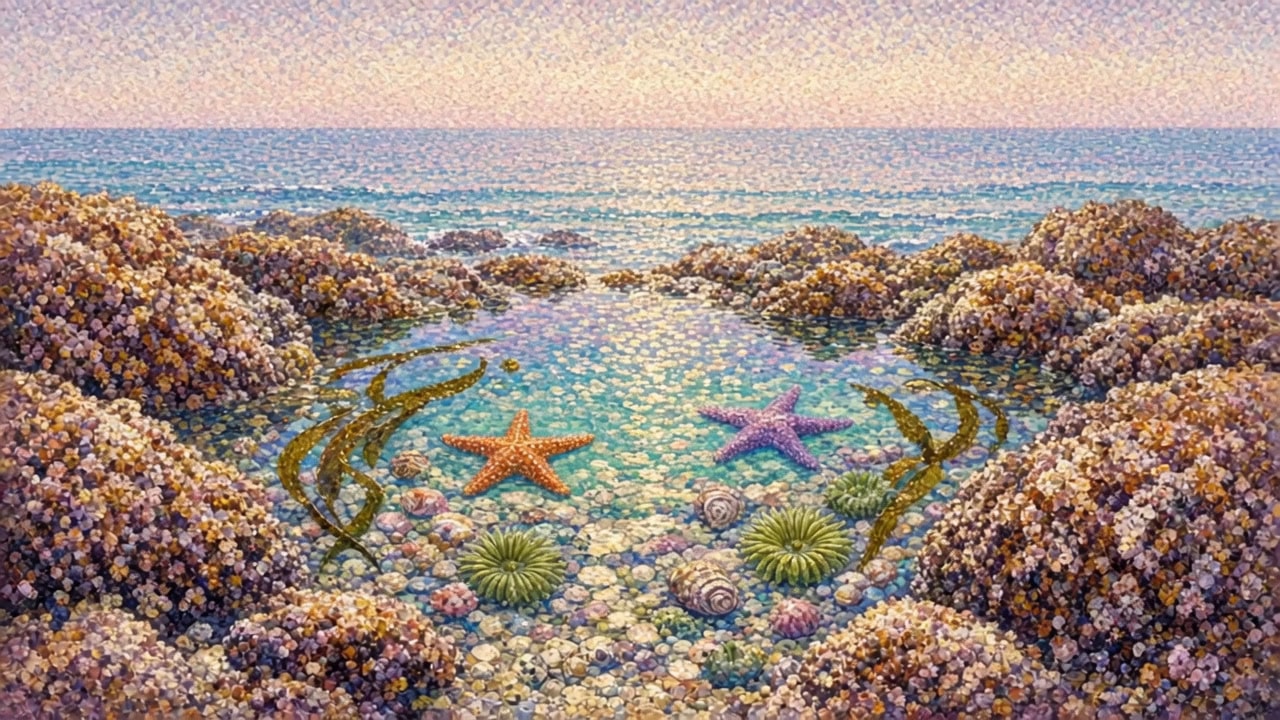
Neo-Impressionist pointillist painting in the spirit of Seurat and Signac: a rocky tide pool with orange and purple starfish, green anemones, kelp, and shells, built from thousands of pure color dots in turquoise, violet, ochre, and rose under a peach afternoon sky.
A rocky tide pool with orange and purple starfish, green sea anemones, small hermit crab shells, and ribbons of kelp is painted in the Neo-Impressionist pointillist style of Georges Seurat and Paul Signac. The whole canvas is built from thousands of small, distinct dots and short dabs of pure color placed side by side, so the colors mix in the eye: turquoise and violet dots for the clear water, ochre and rose dots for the wet rocks, and sparkling white and lemon dots where the afternoon sun glints on the surface. Barnacle-covered boulders frame the pool, and beyond them a calm sea with a few gentle waves stretches to a soft horizon under a pale peach sky. Small sea snails and pebbles are visible through the shallow water. Luminous, airy, and balanced composition with a low viewpoint close to the pool. Visible canvas texture and the slight relief of oil paint dots. Wide landscape 16:9. No people, no hands, no boats, no text, no signature, no logos.
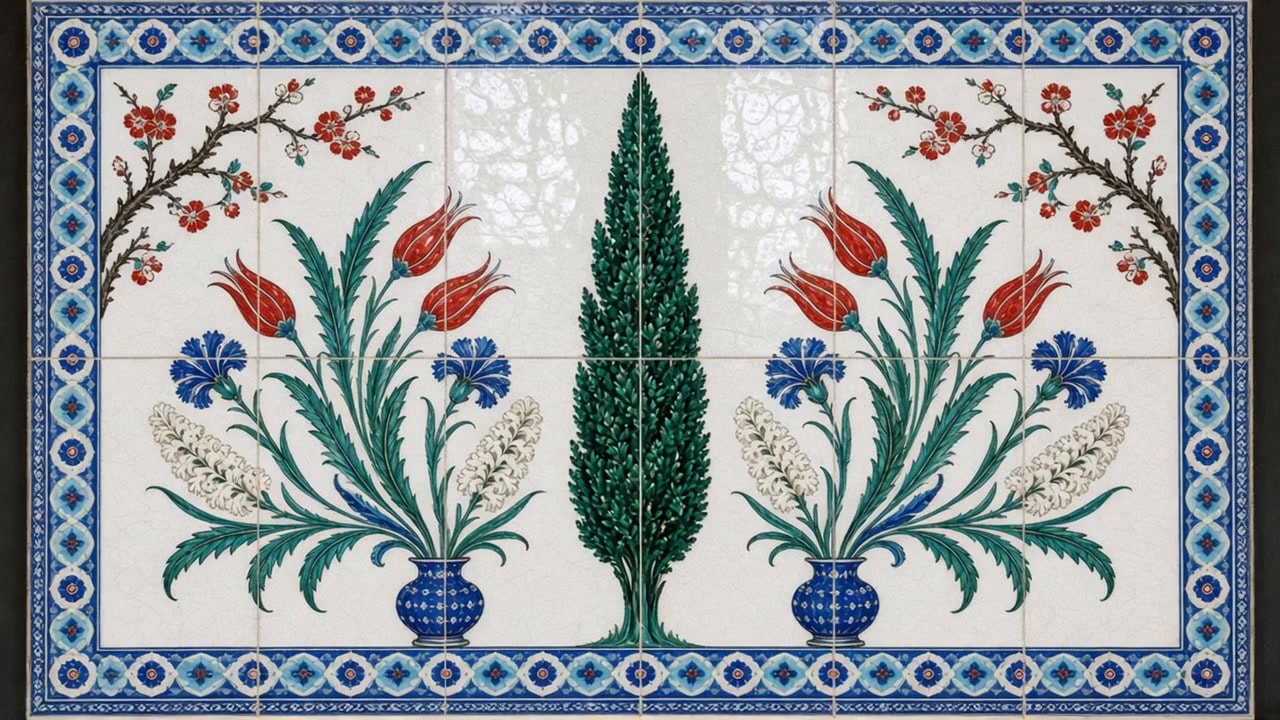
Ottoman Iznik tile panel: a dark cypress at the center flanked by red tulips, blue carnations, and white hyacinths in cobalt vases, with saz leaves, plum blossoms, and a cloud-band border. Glossy white ground, cobalt, turquoise, and raised tomato red.
A wide panel of glazed Iznik ceramic tiles shows a tall dark green cypress tree in the center, flanked by sweeping red tulips, blue carnations, and white hyacinths growing from a small cobalt vase on each side. Classic sixteenth-century Ottoman Iznik style: brilliant white quartz-frit ground, deep cobalt blue, turquoise, emerald green, and raised tomato-red bole slip, with crisp dark outlines and flat glossy color. Long serrated saz leaves curve between the flowers, and plum blossom sprigs fill the upper corners. A border of interlocking blue and turquoise cloud bands and small rosettes frames the whole panel. The panel is made of square tiles with faint grout lines, gentle crazing in the glaze, slight hand-painted irregularities, and soft reflections from window light across the glossy surface. Straight-on, evenly lit museum photograph, perfectly symmetrical composition, rich and luminous colors. Wide landscape 16:9. No people, no hands, no text, no letters, no calligraphy, no logos.
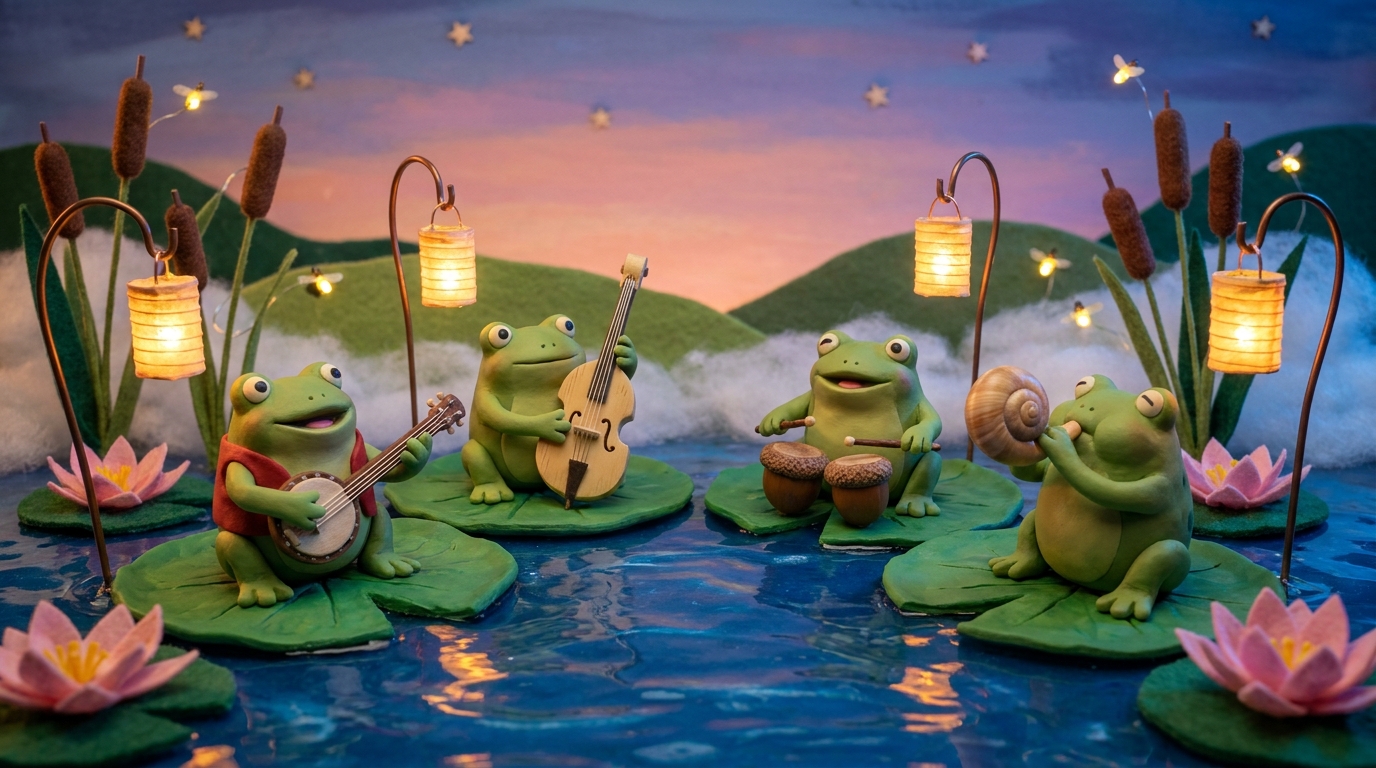
Handmade claymation set: four clay frogs playing a banjo, reed bass, acorn-cap drums, and a snail-shell horn on giant lily pads at dusk, with paper lanterns, LED fireflies, cattails, resin water, and felt hills. Cozy macro miniature look.
Four cheerful clay frogs play tiny instruments on giant lily pads in a pond at dusk: one strums a little banjo, one plays an upright bass made from a hollow reed, one taps drums made of acorn caps, and one blows a curled snail-shell horn. Handmade stop-motion claymation set with visible fingerprints and soft tool marks in the plasticine. Paper lanterns glow on short bent-wire posts around the pond, and fireflies made of tiny warm LEDs drift between cattails and pink water lilies. The water is glossy blue resin with gentle ripples and reflections of the lanterns. Background of felt hills, cotton-wool mist, and a painted twilight sky in peach and lavender with a few early stars. Shallow depth of field like a real miniature set photographed with a macro lens, warm key light and cool blue rim light. Playful, cozy, storybook mood with rich saturated colors. Wide landscape 16:9. No people, no hands, no text, no letters, no logos.
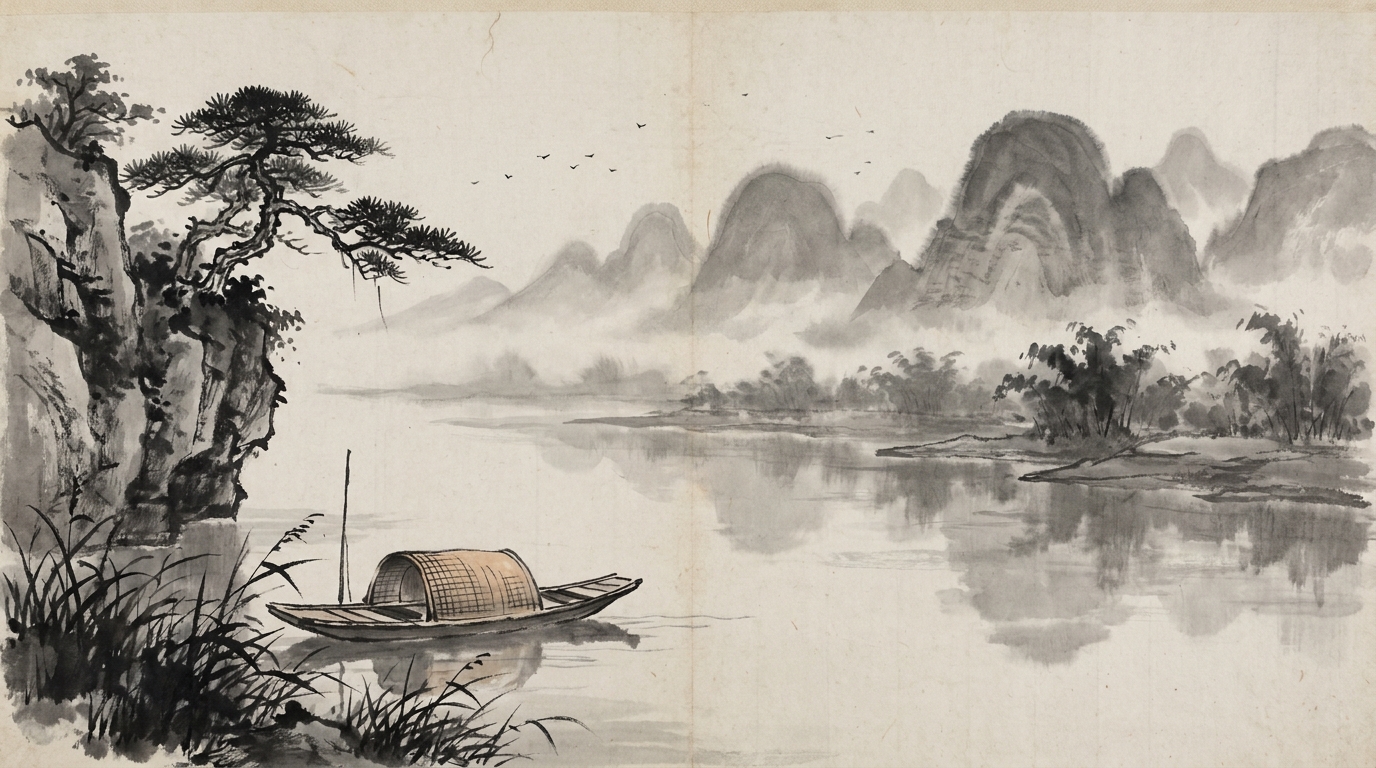
Traditional Chinese ink wash landscape: misty karst peaks fading into layered fog, a cliffside pine, and an empty canopied sampan moored in reeds on a still river. Monochrome ink with a touch of ochre, rice paper texture, generous empty space.
Misty limestone karst peaks rising above a calm river with a single empty wooden sampan moored among reeds, painted as a traditional Chinese ink wash landscape on rice paper. Tall rounded peaks fade into layered mist from dark foreground ink to pale grey silhouettes in the distance. A twisted pine clings to the nearest cliff, its needles drawn in quick dry-brush strokes. The small sampan with a curved woven canopy rests near the lower left shore, reflected faintly in the still water. Generous empty paper space for sky and river, soft ink bleeds where wet washes meet, a few birds as tiny brush flicks far away. Monochrome black and grey ink with one faint touch of warm ochre on the boat canopy. Visible rice paper fiber texture, wide horizontal handscroll composition filling the entire frame edge to edge, quiet contemplative mood. No people, no text, no calligraphy, no seals, no signature.
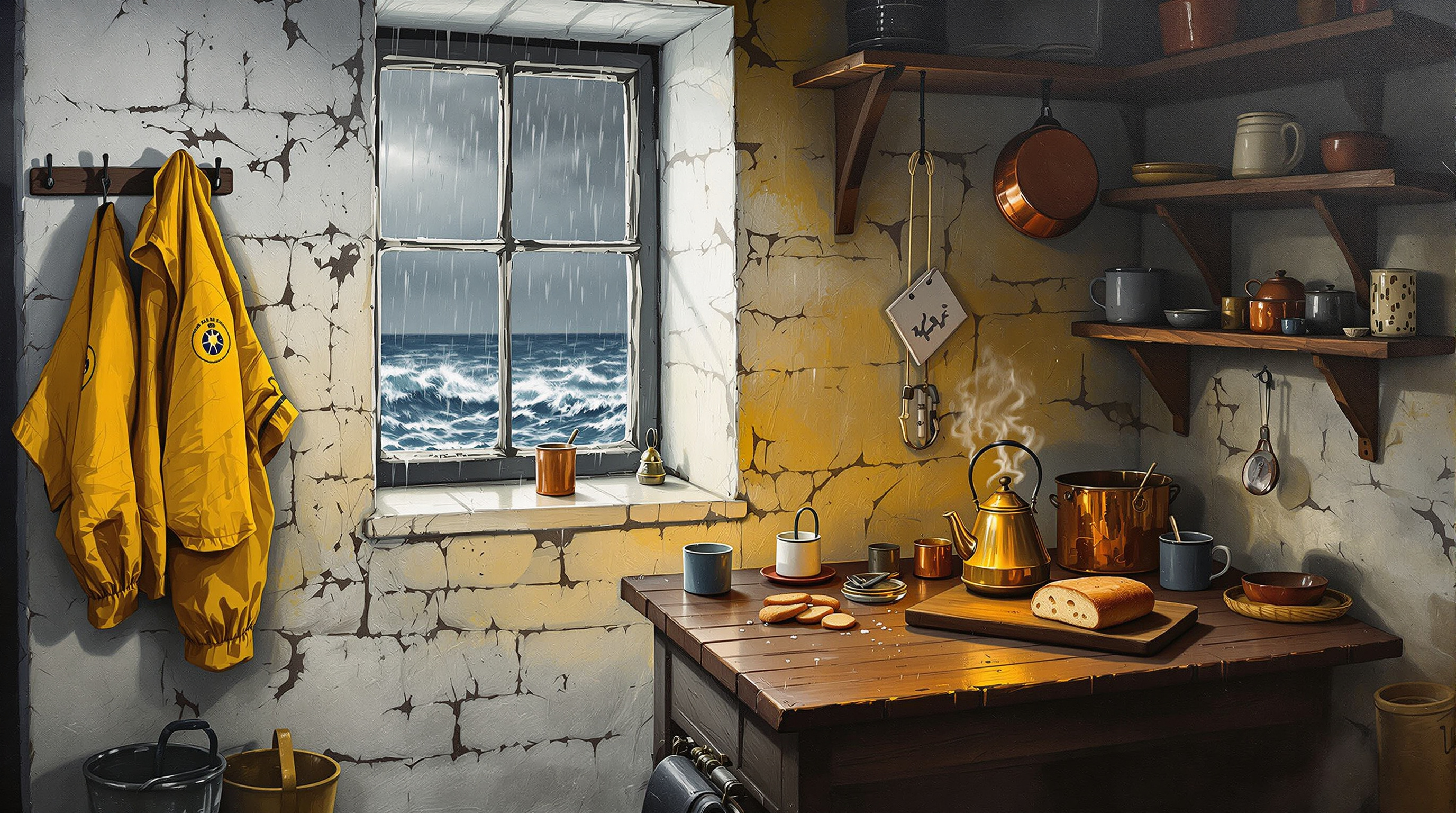
Warm oil painting of a lighthouse keeper's kitchen during a storm: brass kettle, oil lamp, wet oilskins by the door, rain-streaked window to a dark sea. Cozy amber interior versus cold spray outside; thick impasto brushwork.
A lighthouse keeper's kitchen painted in rich oil, warm and lived-in while a storm rages outside. Thick impasto strokes show whitewashed stone walls, a heavy wooden table with a brass kettle steaming, an oil lamp casting amber light, and a loaf of bread on a worn cutting board. Rain streaks the small paned window; through the glass, dark grey sea and white spray. Wet yellow oilskins and rubber boots hang dripping by the door. Copper pans and a enamel mug sit on open shelves. Cozy interior warmth contrasts with cold storm light at the window. Visible brushwork, muted ochres and deep blues, slight varnish sheen. No people, no text, no modern appliances.
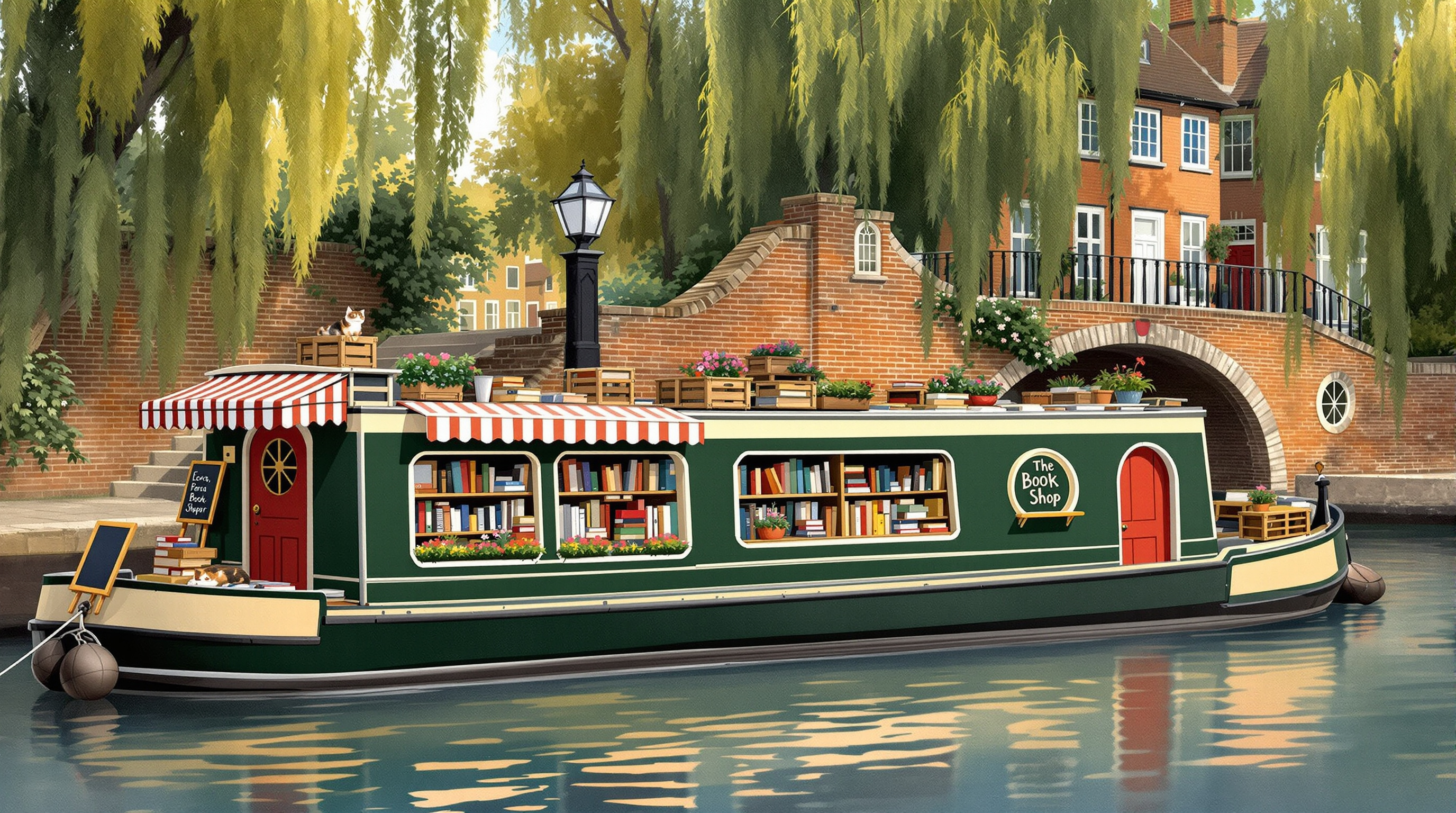
A cozy matte gouache painting of a forest-green canal barge turned bookshop, with book crates and geraniums on the roof, shelves visible through open hatches, a sleeping tabby on the bow, a brick footbridge, weeping willows, and calm late-afternoon reflections on still water.
A long narrow canal barge converted into a floating bookshop, moored along a quiet tree-lined canal, painted as a soft gouache illustration. The barge is deep forest green with a cream trim and a rounded red door; its roof holds wooden crates of books, potted geraniums, and a folded striped awning. Open hatch windows show shelves packed with colorful book spines, and a small chalkboard easel on the towpath is blank. A tabby cat sleeps on a stack of books at the bow. Behind the barge, an old brick footbridge arches over the water, weeping willows trail their branches, and a row of narrow terraced houses sits in the background. Calm late-afternoon light, warm peach highlights on the brickwork and gentle reflections of the green hull on the still water. Matte gouache texture with visible brush strokes, slightly chalky opaque color, soft edges, and a muted palette of sage, ochre, brick red, and cream. Cozy, unhurried, storybook mood. No legible text, no people.