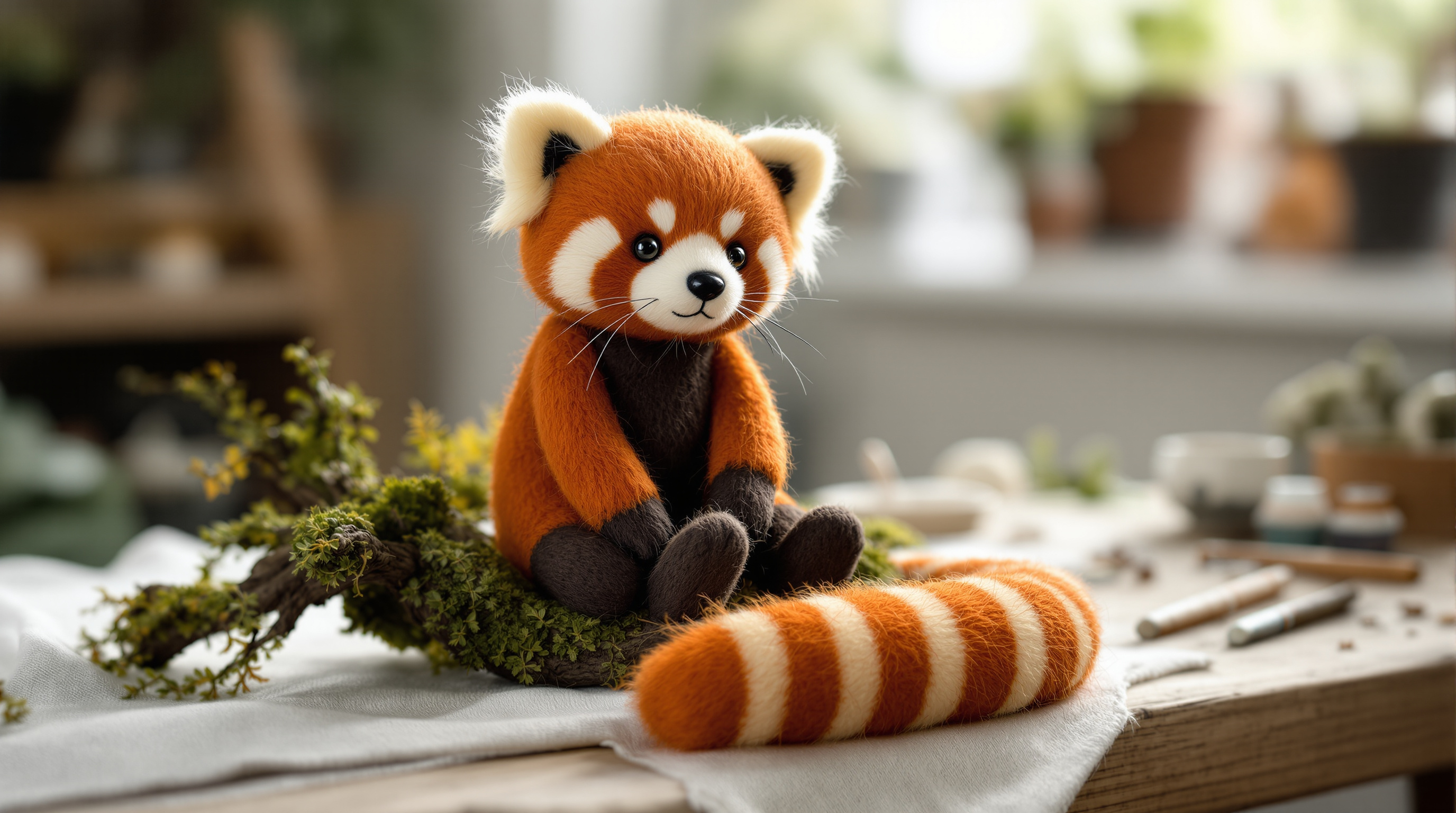
A photoreal studio photo of a handmade needle-felted red panda sculpture on a moss-wrapped branch: rusty orange wool coat, cream muzzle, ringed tail, glass-bead eyes, soft window light, and felting tools blurred at the edge on a linen craft table.
A close, slightly elevated studio photograph of a finished needle-felted wool sculpture of a red panda sitting on a mossy branch, 16:9 landscape composition, the sculpture filling the center of the frame. The red panda is built entirely from densely poked wool fibers: rusty orange and cinnamon body, cream muzzle and ear linings, dark brown eye patches and legs, a ringed bushy tail curling around the branch. Tiny black glass bead eyes catch a soft highlight; whiskers are a few fine threads of dark wool; individual poked texture shows on the cheeks and paws so it reads as handmade felt, not fur photography. The branch is wrapped in real preserved sheet moss and a few dried fern fronds, resting on a pale linen cloth over a wooden craft table. Soft diffused window light from the upper left, gentle contact shadows under the paws, shallow depth of field with the face and front paws sharpest, the far end of the tail and table edge softly blurred. At the lower right corner, out of focus: a felting needle in a wooden handle and a small pile of dyed wool rovings in orange, cream, and brown. Photoreal product photography of handmade needle-felted fiber art, true colors, cozy and quiet mood. Not a drawing, not a painting, not a real animal: a real photographed wool sculpture. No readable text, no letters, no signature, no watermark, no hands.
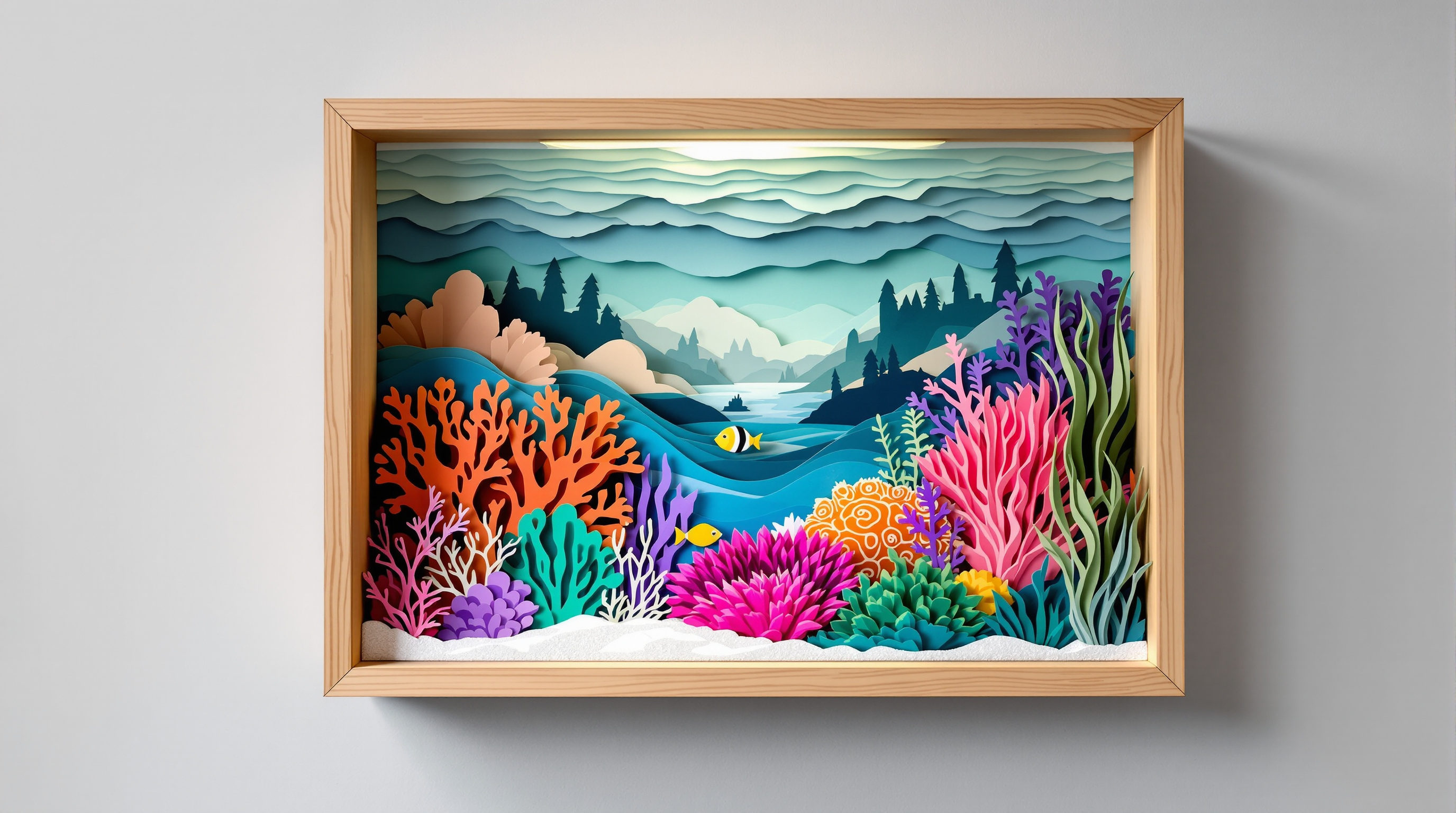
A gallery photo of a deep oak shadow box holding a layered cut-paper coral reef: turquoise water gradients, pink branching coral, an ochre brain coral, a violet lace fan coral, a magenta anemone, a small yellow fish, punched paper bubbles, and a cream sand floor, lit from the side so every paper layer casts a soft shadow.
A museum-quality photograph of a deep wooden shadow box hanging on a pale grey gallery wall, seen straight on at eye level, 16:9 landscape composition with the box filling most of the frame. Inside the box is a layered cut-paper diorama of a coral reef aquarium, made of about twelve hand-cut paper layers spaced a few millimeters apart so each layer casts a soft shadow on the one behind it. The back layers are smooth gradients of turquoise and deep teal paper suggesting open water, with faint wavy cut-outs of light rays; middle layers hold silhouettes of distant coral in muted blue-green; the front layers are rich and colorful: branching coral in coral pink and salmon, a round brain coral in ochre with a carved maze pattern, a fan coral in violet with delicate lace-like cut holes, swaying sea grass in two greens, and a bright magenta anemone with fringed tentacles cut in fine strips. A single small yellow fish with a thin black stripe and a tiny punched eye swims near the anemone, slightly raised on its own layer. Columns of small circular bubbles, punched from white and pale aqua paper, rise on the right. A sandy floor of textured cream paper with a few tiny cut shells runs along the bottom. The box frame is natural oak, about 8 cm deep, with a clean inner white mat and a sheet of museum glass showing only a faint reflection at one corner. Soft directional light from the left side lights up the paper edges and creates crisp, layered shadows inside the box, emphasizing depth; the paper fibers, cut edges, and slight curl of thin pieces are visible. Calm, wondrous mood, true colors, craft and fine-art photography, sharp focus across the whole diorama. No text, no letters, no labels, no signature, no watermark, no people.
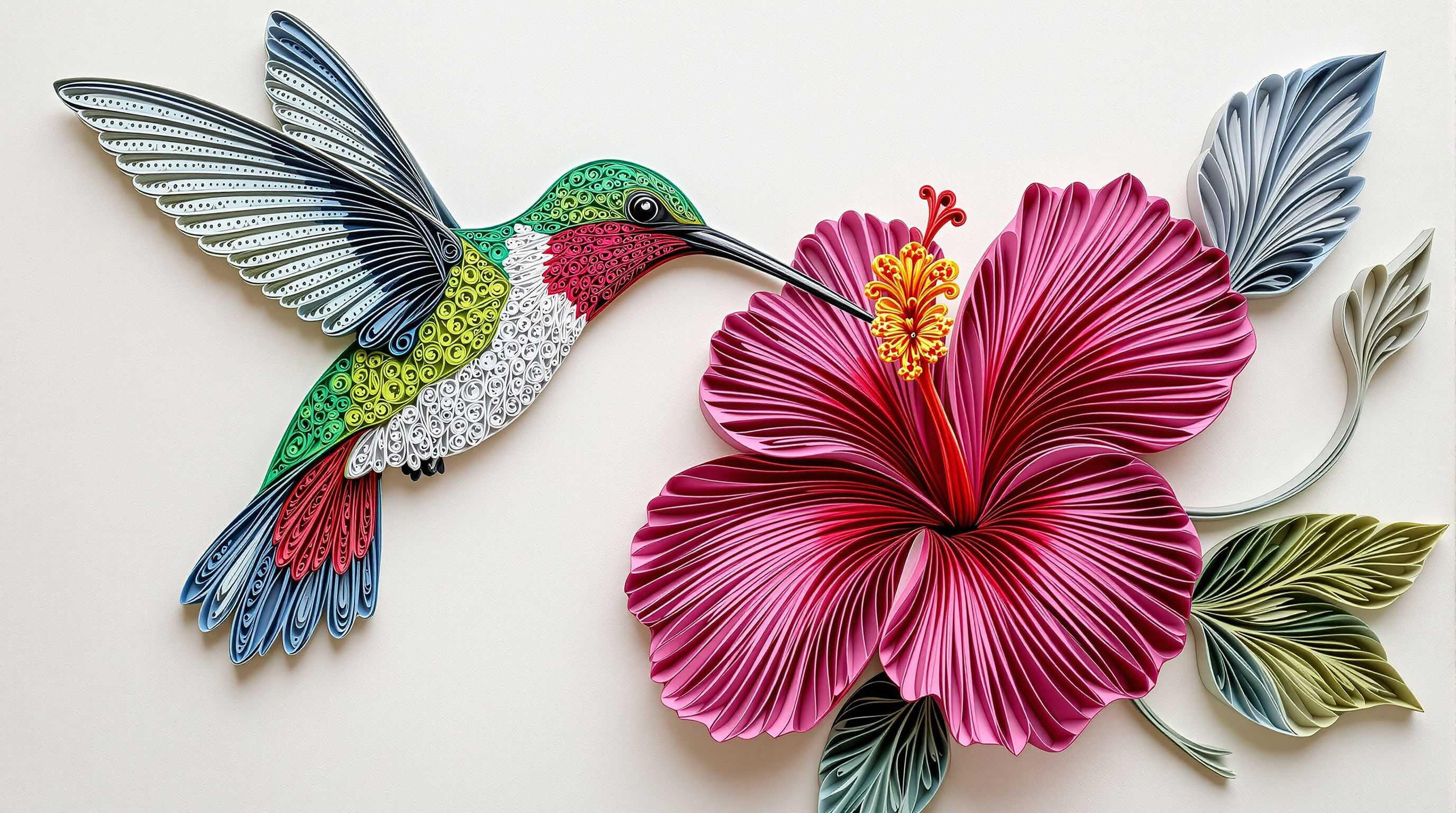
A photoreal close-up of a handmade paper quilling artwork on a craft table: an emerald and ruby hummingbird in mid-hover sipping from a magenta hibiscus, built from tightly coiled and scrolled paper strips standing on edge on a cream background, with soft window light, paper-edge shadows, and quilling tools blurred at the edge.
A close, slightly elevated studio photograph of a finished paper quilling artwork lying flat on a pale wooden craft table, 16:9 landscape composition, the artwork filling most of the frame. The piece shows a ruby-throated hummingbird in mid-hover on the left, its long thin beak dipping into a large open magenta hibiscus flower on the right. Everything is built from thousands of narrow paper strips, about 3 mm wide, rolled into tight coils, teardrops, marquise shapes, and open scrolls, glued on edge so the paper stands up from a soft cream cotton-paper background. The hummingbird's back and crown are tight coils in emerald and metallic-sheen green, its throat a patch of tiny ruby-red teardrop coils, its belly pale grey and white loose coils, its wings two fans of long fine strips in smoky grey-blue graded from dark at the base to light at the tips, suggesting motion; a small black coil for the eye with a single white dot. The hibiscus has five broad petals made of rows of magenta and hot pink strips shaped in waves, a deep crimson center, and a long yellow stamen column tipped with tiny orange coils; two glossy green leaves made of veined leaf-green strips, a curling stem, and one closed bud. A few loose spiral tendrils and three small lavender filigree flowers fill the background space. Real craft details: visible paper edges and layers, slight variations in coil tightness, tiny glue sheen at a few joints, and soft shadows cast by the raised strips onto the cream base. At the edge of the frame, out of focus: a slotted quilling tool, a small bundle of colored strips, and a pair of fine tweezers. Soft diffused window light from the upper left, gentle contact shadows, shallow depth of field with the hummingbird's head and the flower center sharpest, the far corners softly blurred. Photoreal product photography of handmade paper art, true colors, calm and delicate mood. Not a drawing or a painting of quilling: a real photographed paper object. No text, no letters, no signature, no watermark, no hands.
Describe the Victorian glass conservatory or winter garden you imagine, its era, scale, iron and glass structure, plants, furniture, floor, mood, and garden setting, and get an architecture and planting concept, a palette, a numbered list of fixed design details, and two image prompts showing the same building inside on a misty morning and from the garden path at blue hour, plus a consistency checklist and practical notes. Step 1 of a three-step workflow.
Act as a conservatory and glasshouse designer and as a visualization art director. I will describe the Victorian-style glass conservatory I am imagining. You will turn it into a tight concept: the building, its iron and glass structure, the plants, the furniture, the floor and water features, the light and mood, with a numbered list of fixed design details plus two ready-to-use image prompts that show the SAME building from two viewpoints at two times of day, so the two AI images look like photos of one real place.

Era and inspiration: High Victorian, around 1870, inspired by public palm houses but at the scale of a private estate
Purpose and scale: a private winter garden attached to nothing, standing alone at the end of a formal garden, about 14 m long, 8 m wide, 7 m high
Structure and materials I like: white-painted wrought iron, arched ribs, a diamond lattice glass roof, a low pale stone plinth wall
Plants: hanging Boston ferns, kentia palms in terracotta pots, tree ferns, orchids on a side shelf, moss
Furniture and features: ornate cast-iron benches, a small round mosaic fountain with koi in the center, brass pendant lanterns
Floor: black-and-white checkerboard marble
Mood: calm, humid, timeless, a little romantic, a place to read on a Sunday morning
Outside the building: a gravel path between low box hedges, climbing pink roses on the front, a formal English garden
View A: interior at eye level from just inside the front doors, looking down the central aisle, early morning sun with misty light shafts
View B: exterior from the gravel garden path facing the front entrance at blue hour, warm lamps glowing inside

Please produce:

1. Concept
   - A name idea for the conservatory (for my use only, it will not appear in the images) and a two-sentence story of how it should feel to step inside.
   - Architecture: footprint, height, roof form, rib spacing, glazing pattern, ridge details, entrance, ventilation features, and how the iron is finished, described in plain construction terms.
   - Interior layout: the central aisle, where the fountain sits, where benches, palms, ferns, and shelves go, and where the lanterns hang, described from the entrance looking in.
   - Planting plan: each plant group with its position and the effect it creates (height, texture, light filtering).
   - Palette: 6 named colors (simple names like "chalk white" or "fern green") and where each one appears.
   - Materials and finishes: iron, glass (clear, slightly wavy old glass, condensation), stone, marble, mosaic, brass, terracotta, and wood.

2. Fixed design details (the consistency list)
   A numbered list of 14 to 18 details that must look identical in every image: footprint and proportions, roof shape, rib count and spacing, the glazing pattern, the ridge cresting and finials, the plinth wall, the entrance doors and fanlight, the floor pattern, the fountain, the benches, the lanterns, the palms, the ferns, and anything visible from both inside and outside, each with its exact position. Write each one as a short, concrete phrase an image generator can follow (for example "a round fountain basin about 2 m across, clad in deep blue and gold mosaic, at the exact center of the hall").

3. Image prompt A: the base view
   One detailed prompt for an AI image generator: photoreal architectural interior photography from the view A position, in view A light. Include every fixed detail visible from there in its correct position (left and right as seen from the camera), camera height and lens, light direction, atmosphere (mist, humidity, light shafts), mood, and a 16:9 landscape composition. End with exclusions (no people, no readable text, no signage, no modern objects).

4. Image prompt B: the second view
   One detailed prompt for view B, written for a text-only image generator that cannot see image A: restate ALL fixed details again in full words (never "same as before"), place each one correctly for the new camera position, describe what is newly visible from outside (the front gable, the plinth, the ridge cresting, the path, the roses), describe which interior details can be seen through the glass and the open doors, and change only the viewpoint, time of day, and lighting. Keep the structure, colors, and proportions identical.

5. Consistency checklist
   Ten yes/no checks to compare image B against image A (for example "Is the roof glazing still a diamond lattice between the white arched ribs?").

6. Practical notes
   A short list on real-world feasibility: heating and humidity for these plants, ventilation, shading in summer, maintenance of painted iron and old glass, safety glass options, and a rough order of magnitude for building or restoring something similar, labeled as an estimate.

Rules:
- Keep the design historically believable for the stated era; flag anything that would be anachronistic or structurally unrealistic.
- Use plain color names and concrete shapes; avoid vague words like "beautiful" or "magical" on their own.
- No readable text, plaques, signs, or numbers anywhere in the image prompts.
- No real named buildings, brand names, or real people in the image prompts.
- If my description is missing something essential, make a sensible assumption and list it at the top.
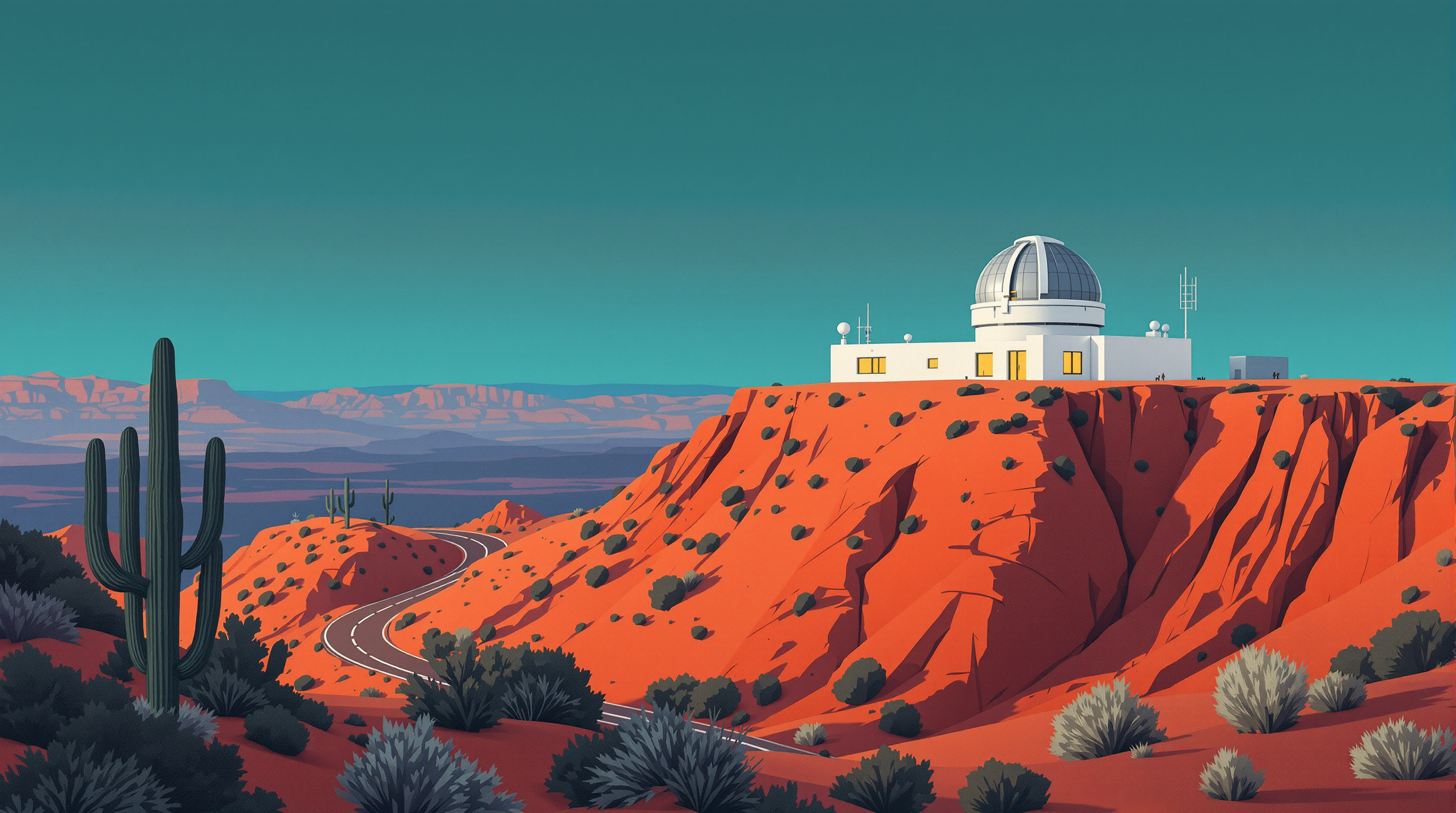
A flat, textured 1960s-style gouache painting of a white-domed observatory on a red rock mesa, with a winding switchback road, layered rust, pink, and ochre desert shapes, cactus silhouettes, and a teal-to-coral dusk sky with a crescent moon and a speckled Milky Way, in a limited retro palette.
A mid-century modern gouache illustration of a small mountaintop astronomical observatory in a red rock desert at dusk, wide 16:9 landscape composition, painted in flat, opaque gouache with visible brush texture and slightly chalky matte color. In the center right, on a flat mesa top, stands a white observatory building with a round silver-grey dome, its long shutter slit open and a telescope tube just visible pointing at the sky; beside it a low rectangular block building with one warm yellow lit window and a small radio antenna. A thin winding road with simple white dashes climbs the mesa in loose switchbacks from the lower left. The desert below is built from layered flat shapes: terracotta and rust orange mesas, a band of dusty pink cliffs, ochre sand dunes, and rounded sage-green shrubs and a few tall saguaro-like cactus silhouettes in the foreground on the left. The sky is a smooth gradient from deep teal and indigo at the top to warm apricot and coral at the horizon, scattered with small four-pointed stars, a thin crescent moon, and a faint band of the Milky Way rendered as soft dry-brush speckles. Long purple shadows stretch across the sand. Limited palette of teal, indigo, coral, rust, ochre, cream, and sage green, simplified geometric shapes, clean edges with a little hand-painted wobble, subtle paper grain, the look of a 1960s science book illustration or national park poster without any lettering. Calm, optimistic, wonder-filled mood. No people, no text, no letters, no logos, no border, no watermark.
Describe your street food idea, vehicle, trading spots, brand personality, and colors, and get a food truck concept with paint scheme, service side layout, palette, and materials, a numbered list of fixed design details, and two image prompts showing the same truck at lunchtime and at an evening night market, plus a consistency checklist and practical fit-out notes. Step 1 of a three-step workflow.
Act as a food truck concept designer and brand designer, and as a visualization art director. I will describe the street food business I want to start. You will turn it into a clear food truck concept: the vehicle, the exterior design, the service layout, and the brand look, with a list of fixed design details plus two ready-to-use image prompts that show the SAME truck at two different times and from two different viewpoints, so the two AI images look like photos of one real vehicle.

Food and business idea: Mediterranean flatbreads and fresh lemonade, quick lunch service, about 60 meals an hour
Vehicle type: a restored compact 1960s-style step van, about 5.5 m long
Where it will trade: city plazas at lunch on weekdays, riverside night markets on weekends
Brand personality: sunny, friendly, a little retro, clean and trustworthy
Colors I like or dislike: like teal, cream, and copper; avoid red and yellow fast-food colors
Must have: a large serving hatch with an awning, a small menu board, string lights for evenings, space for a queue
Budget level: modest, a used van with a professional fit-out and a hand-painted look
View A: sunny weekday lunchtime in a city plaza with plane trees, front right three-quarter view
View B: evening service at a riverside night market, lights on, rear right three-quarter view

Please produce:

1. Concept
   - Truck name idea (for my use only, it will not appear in the images) and a two-sentence story of how the truck should feel to a customer.
   - Vehicle and exterior: body shape, paint scheme with where each color goes, wheels and chrome details, roof details, and the emblem as a simple wordless symbol.
   - Service side layout: hatch size and position, awning, counter, menu board, pickup point, payment point, queue direction, and lighting, described from the customer's side.
   - Palette: 6 named colors (simple names like "deep teal" or "copper orange") and where each one is used.
   - Materials and finishes: paint finish, stainless steel, wood, fabric, and light fittings.

2. Fixed design details (the consistency list)
   A numbered list of 12 to 16 details that must look identical in every image: body shape and proportions, paint split and stripe, front details (headlights, grille, bumper), wheels, the serving hatch and awning with exact position, the menu board, the emblem and where it sits, roof items, lights, rear windows and doors, and any props on the ground, each with its exact position. Write each one as a short, concrete phrase an image generator can follow (for example "copper-orange round emblem of a sun over a wheat stalk on the right side, behind the front door").

3. Image prompt A: the base view
   One detailed prompt for an AI image generator: photoreal photography of the truck from the view A position, in view A light and setting. Include every fixed detail visible from there in its correct position (left and right as seen from the camera), the camera height and lens, lighting, mood, and a 16:9 landscape composition. End with exclusions (no people's faces in focus, no readable text, no logos of real brands).

4. Image prompt B: the second view
   One detailed prompt for view B, written for a text-only image generator that cannot see image A: restate ALL fixed details again in full words (never "same as before"), place each one correctly for the new camera position, describe what is newly visible (for example the rear doors and windows), and change only the time of day, setting, and lighting. Keep the paint, proportions, emblem, and props identical.

5. Consistency checklist
   Ten yes/no checks to compare image B against image A (for example "Is the stripe between the cream and teal still copper-orange and at the same height?").

6. Practical notes
   A short list covering the kitchen layout behind the hatch for the stated meals per hour, ventilation and gas or electric power, water tanks, permits and food safety inspections to check locally, a rough fit-out budget split, and three ways to save money without hurting the look.

Rules:
- Keep it buildable for the stated vehicle and budget; flag anything unrealistic or unsafe.
- Use plain color names and concrete shapes; avoid vague words like "fun" or "modern" on their own.
- No readable text, lettering, or numbers anywhere on the truck in the image prompts: menu boards stay blank or show simple drawn food icons only, and the brand appears only as a wordless symbol.
- No brand names, no real people, no copyrighted characters.
- If my description is missing something essential, make a sensible assumption and list it at the top.
Describe your dream treehouse and host tree and get a buildable design concept with structure, facades, palette, and materials, a numbered list of fixed design details, and two image prompts showing the same treehouse in summer and on a snowy winter evening, plus a consistency checklist and build safety notes. Step 1 of a three-step workflow.
Act as an architectural designer who specializes in treehouses, garden studios, and small timber retreats, and as a visualization art director. I will describe a treehouse I am dreaming about. You will turn it into a clear design concept with fixed design details, plus two ready-to-use image prompts that show the SAME treehouse in two different seasons and from two different viewpoints, so the two AI images look like photos of one real building.

Host tree and site: a single huge old oak in a sloping meadow at the edge of a beech forest, trunk about 1.2 m wide, splitting into three main limbs about 5 m up
Who uses it and how: a family retreat for reading, sleepovers for two kids, and quiet evenings for the adults
Size and height: a small cabin about 3 x 4 m on a deck about 3.5 m above the ground
Style direction: warm natural timber, a little storybook but not cartoonish, simple modern details
Must have: a big window facing the forest, a covered deck, a small wood stove, a rope swing
Budget level: self-build with a carpenter's help, mid-range materials
View A: summer afternoon, full green canopy, seen from the meadow at the front left
View B: snowy winter evening, bare branches, windows glowing, seen from the front right

Please produce:

1. Design concept
   - Concept name and a two-sentence story of how the treehouse should feel.
   - Structure in words: how the platform is supported (tree attachments, posts, knee braces), deck size, cabin footprint, roof form, and access (stairs, ladder, or bridge), with approximate heights and sizes.
   - Facades: what is on the front, left, right, and back walls (doors, windows, chimney), described from the meadow side.
   - Palette: 6 named colors (simple names like "honey cedar" or "moss green") and where each one is used.
   - Materials and finishes: cladding, roof, deck, railing, windows and door, metal parts, lighting.

2. Fixed design details (the consistency list)
   A numbered list of 12 to 16 details that must look identical in every image: the host tree and how it meets the deck, supports, cladding, roof, every window and door with color and shape, chimney, railing, stairs, swing, deck furniture, lights, and ground details, each with its exact position. Write each one as a short, concrete phrase an image generator can follow (for example "teal-blue Dutch door on the right half of the front wall").

3. Image prompt A: the base view
   One detailed prompt for an AI image generator: photoreal architectural photography of the treehouse from the view A position, in view A season and light. Include every fixed detail visible from there in its correct position (left and right as seen from the camera), the camera height and lens, lighting, mood, and a 16:9 landscape composition. End with exclusions (no people, no text, no logos).

4. Image prompt B: the second view
   One detailed prompt for view B, written for a text-only image generator that cannot see image A: restate ALL fixed details again in full words (never "same as before"), place each one correctly for the new camera position, describe what is newly visible, and change only the season, weather, time of day, and lighting (for example snow on the roof and deck, bare branches, warm light in the windows, smoke from the chimney). Keep materials, colors, and proportions identical.

5. Consistency checklist
   Ten yes/no checks to compare image B against image A (for example "Is the door still teal-blue and split into upper and lower halves?").

6. Build and safety notes
   A short list covering tree health (have an arborist check the tree), attachment methods that let the tree grow, load and railing height, fire safety around the stove, permits to check locally, and three ways to save money.

Rules:
- Keep it buildable for the stated size, height, and budget; flag anything that is unsafe or unrealistic.
- Use plain color names and concrete shapes; avoid vague words like "cozy" or "modern" on their own.
- No brand names, no real people, no readable text in the images.
- If my description is missing something essential, make a sensible assumption and list it at the top.
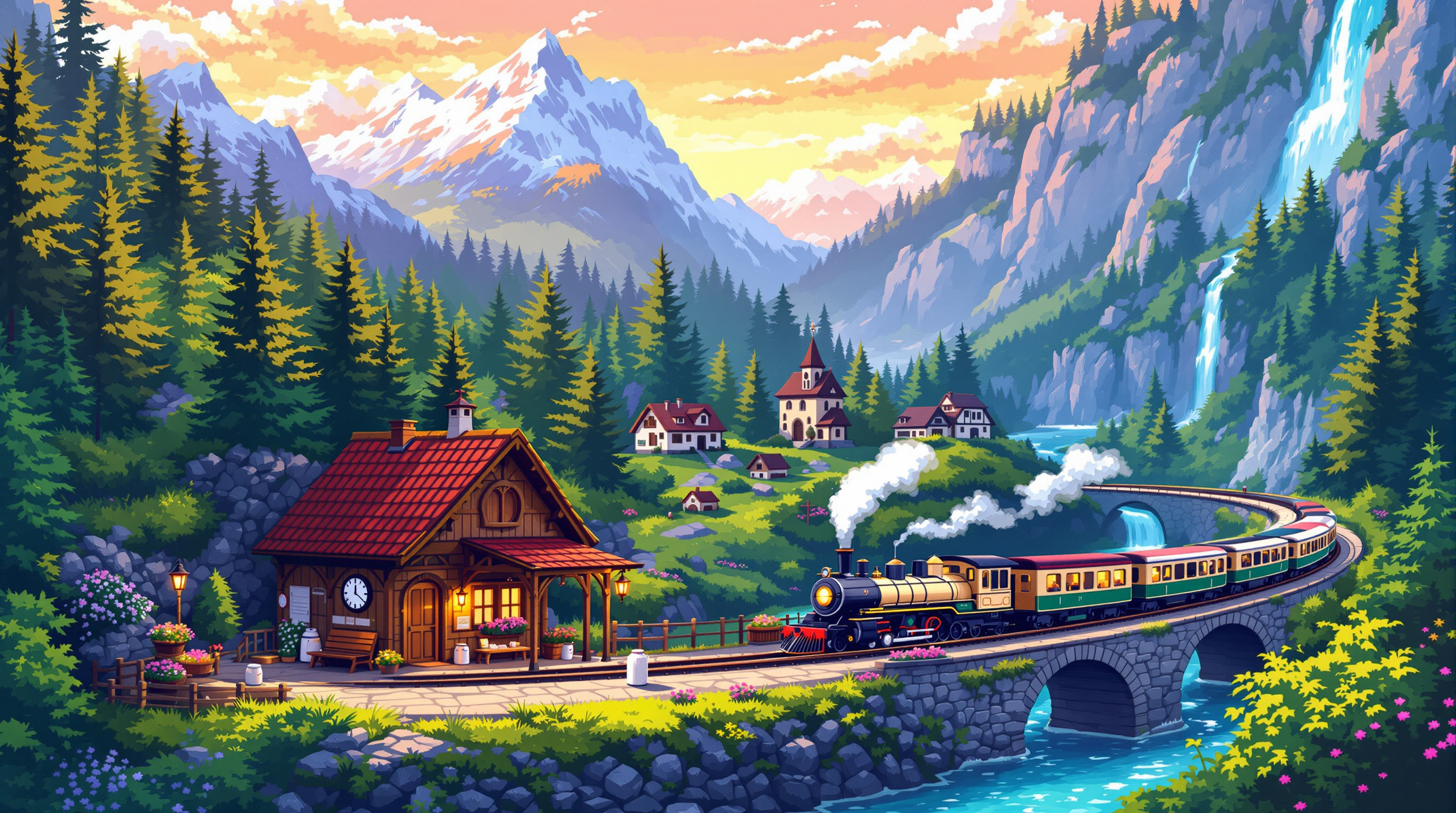
A cozy 16-bit pixel art game background of a tiny alpine station at golden hour: a cream and green steam train at a red-roofed platform, a stone viaduct over a turquoise river, chalets and a waterfall, and layered snow peaks under a dithered sunset sky.
A wide 16-bit era pixel art scene of a tiny alpine railway station in a mountain valley at golden-hour sunset, in the style of a beautifully detailed retro adventure game background, crisp hard-edged pixels with no anti-aliasing and no blur, limited 48-color palette with careful dithering in the sky. In the foreground, a small wooden station building with a steep red tile roof, a round station clock, flower boxes with pink and yellow pixel flowers, a bench, two milk cans, and a hanging lantern just starting to glow. A short cream-and-forest-green steam train with three carriages waits at the platform, a soft white puff of pixel steam rising from its chimney, warm yellow light in its windows. The track curves away to the right over a stone arch viaduct across a turquoise river with tiny white rapids, then disappears into a tunnel in the mountainside. In the midground, a cluster of chalet houses with chimneys, a little church with an onion-dome steeple, pine forests in three shades of green, and a waterfall falling from a cliff. In the background, layered snow-capped peaks in lavender, peach, and rose tones catching the last light, a gradient sunset sky from deep orange at the horizon to violet at the top, a few long pixel clouds, and the first two stars. Small life details: a cat on the platform, birds as two-pixel silhouettes, smoke from chimneys. Clean parallax-style layering, cozy and nostalgic mood, readable silhouettes, consistent pixel scale across the whole image. 16:9 landscape composition. No people, no text, no user interface, no logos, no watermark.
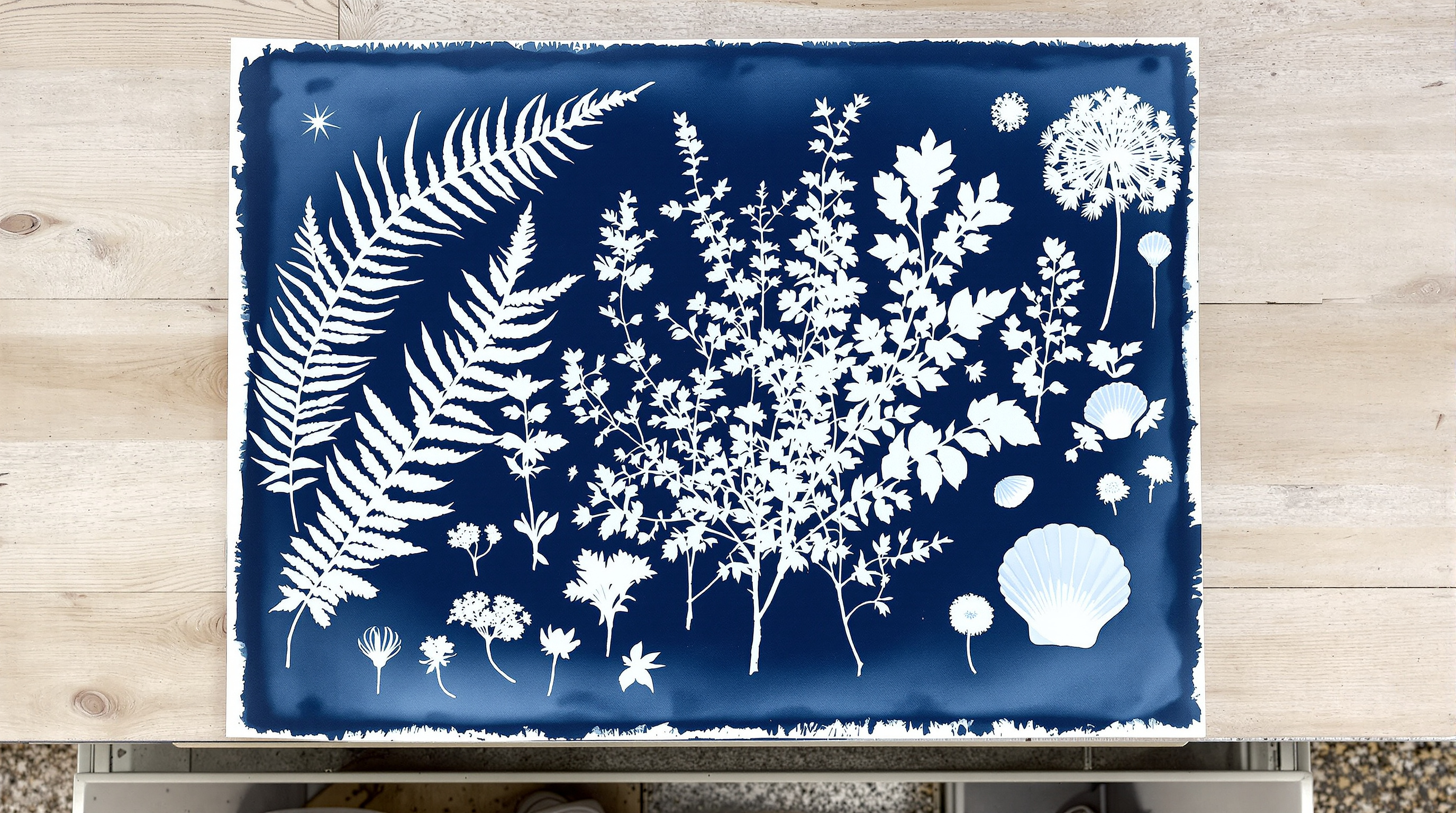
A flat-lay photo of a handmade cyanotype on cotton paper: white silhouettes of ferns, sea lavender, bladderwrack seaweed, ginkgo leaves, and a scallop shell glowing on deep Prussian blue, with brushy hand-coated borders and printmaking tools on a pale oak table.
A wide, flat-lay photograph of a large handmade cyanotype print lying on a weathered pale oak worktable, the print filling most of the frame. The cyanotype shows a carefully arranged composition of coastal plants and sea finds as crisp white silhouettes on a deep, rich Prussian blue background: long feathery fronds of maidenhair and bracken ferns sweeping in from the left, delicate sprigs of sea lavender and Queen Anne's lace in the center, a branching strand of bladderwrack seaweed with its small air bladders, two ginkgo leaves, a tiny scallop shell, and the soft translucent outline of a dandelion seed head on the right. Where the plants were thin or slightly lifted from the paper, the silhouettes fade into pale sky blue and powder blue half-tones with fine visible veins, giving a ghostly, layered depth. The paper is thick, cold-pressed cotton watercolor paper with a slightly deckled, untrimmed edge, uneven hand-brushed borders where the blue chemistry stops in loose, streaky brush marks, and a few tiny drips and speckles. Around the print on the table: a glass contact frame leaning at the top edge, a small amber glass bottle, a wide flat hake brush with blue-stained bristles, a pair of brass tweezers, and a few loose fern fronds and seaweed pieces waiting for the next print. Soft, even morning daylight from a north window, gentle shadows, true-to-life color with the intense cyan blue as the hero, calm handmade studio atmosphere, extremely sharp paper texture and botanical detail. Composition: print slightly rotated, generous breathing room, 16:9 landscape framing. No people, no hands, no text, no labels, no signature, no watermark.
Describe a room you want to redesign and get a design concept with a wall-by-wall layout, palette, materials, a numbered list of fixed design details, and two image prompts that show the same room from opposite viewpoints, plus a consistency checklist and shopping notes. Step 1 of a three-step workflow.
Act as an interior designer and visualization art director. I will describe a room I want to redesign. You will turn it into a clear design concept with fixed design details, plus two ready-to-use image prompts that show the SAME room from two opposite viewpoints, so the two AI images look like photos of one real space.

Room: small living room in a timber cabin, about 3.5 x 4.5 meters, vaulted ceiling, one large window facing a pine forest
Who uses it and how: a couple who read, work on a laptop now and then, and host two friends for board games
Style direction: warm Nordic cabin, calm and natural, a few bold earthy accents
Must keep: the small wood-burning stove and the wide-plank floor
Budget level: mid-range, mostly new furniture, no structural work
Second view to show: the reverse angle at dusk, looking from the window back toward the entry door, with the stove lit

Please produce:

1. Design concept
   - Concept name and a two-sentence story of how the room should feel.
   - Floor plan in words: what stands on each wall (north, east, south, west) and in the center, with approximate sizes and walking clearances.
   - Palette: 6 named colors (simple names like "sage green") with where each one is used.
   - Materials and finishes: walls, ceiling, floor, textiles, metals.

2. Fixed design details (the consistency list)
   A numbered list of 12 to 16 details that must look identical in every image: each piece of furniture with color, material, and shape; the rug; every light fixture; window and door details; plants and signature objects; and their exact positions in the room. Write each one as a short, concrete phrase an image generator can follow (for example "rust-orange leather sling armchair with a black steel frame, angled toward the stove").

3. Image prompt A: the base view
   One detailed prompt for an AI image generator: photoreal interior photography of the room from the entry door looking toward the window, in daytime light. Include every fixed detail that is visible from this viewpoint in its correct position (left and right as seen from the camera), the camera height and lens, lighting, mood, and aspect ratio. End with exclusions (no people, no text, no logos, no clutter).

4. Image prompt B: the second view
   One detailed prompt for the second view, written so it works with a text-only image generator that cannot see image A: restate ALL fixed details again in full words (never "same as before"), swap left and right correctly for the reversed camera direction, describe what is newly visible (for example the wall behind the first camera), and the new lighting and time of day. Keep palette, materials, and style identical.

5. Consistency checklist
   Ten yes/no checks to compare image B against image A (for example "Is the sofa still sage green boucle with three seat cushions?").

6. Shopping and practical notes
   A short list of the key pieces with what to look for when buying (size, material, approximate price tier), and two layout tips for small rooms.

Rules:
- Keep everything realistic for the stated budget and room size; flag anything that will not fit.
- Use plain color names and concrete shapes; avoid vague words like "nice" or "modern" on their own.
- No brand names, no real people, no readable text in the images.
- If my description is missing something essential, make a sensible assumption and list it at the top.
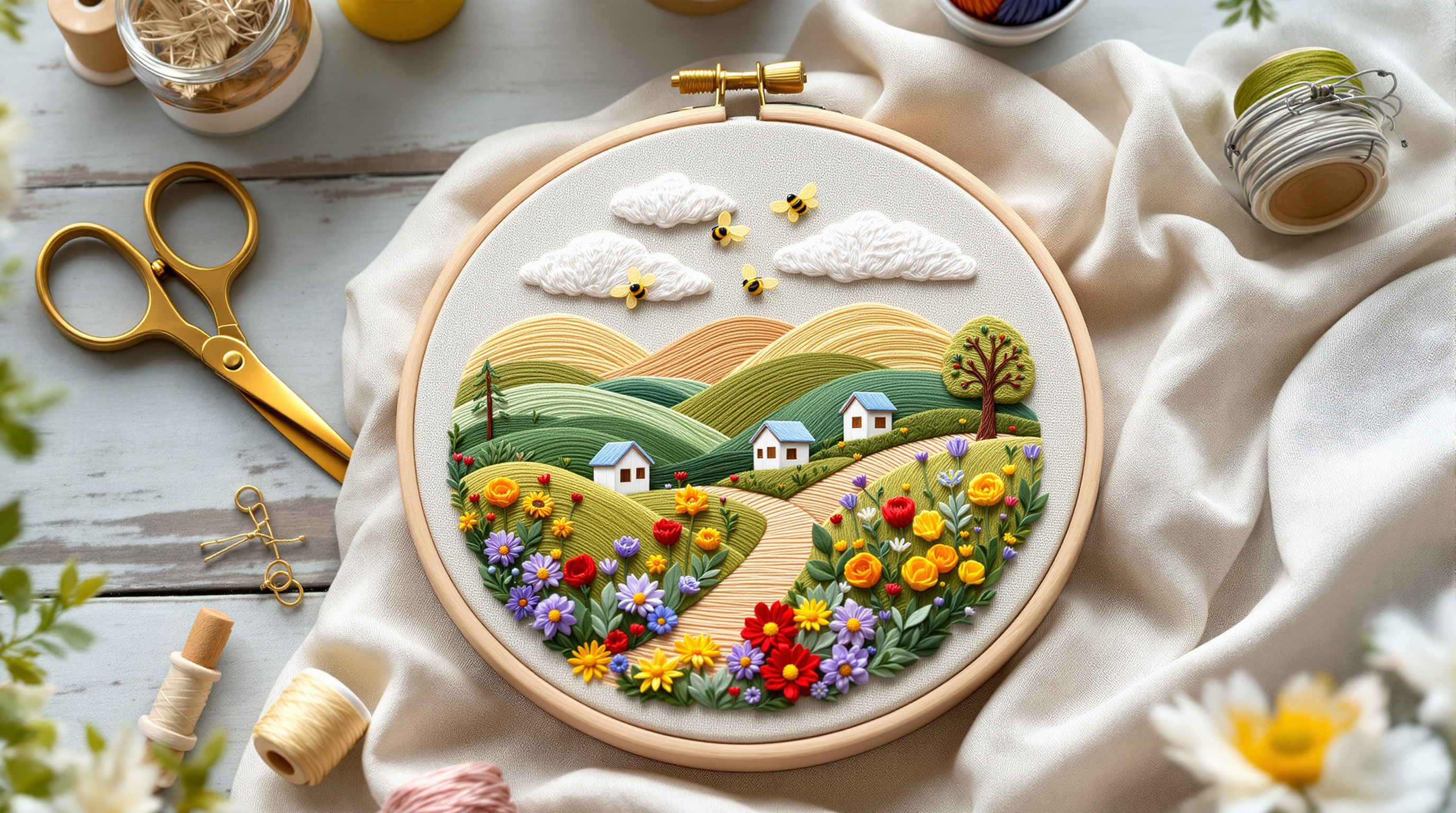
A macro photograph of a finished embroidery hoop showing a stitched hillside meadow with tiny white beehives, French knot wildflowers, and organza-winged bees on linen, styled on an oak table with scissors, floss, and dried lavender in soft window light.
A close-up photograph of a finished hand-embroidered hoop art piece lying on a weathered pale oak table, showing a tiny hillside meadow with a beekeeping scene stitched in colorful cotton and silk threads on natural linen fabric. Inside the round wooden embroidery hoop: three small white wooden beehives on a gentle green slope, rolling hills in layered satin stitch in sage, moss, and olive green, a winding path in tan backstitch, and a meadow full of wildflowers made with French knots, lazy daisy stitches, and bullion knots in lavender, buttercup yellow, poppy red, and cornflower blue. Tiny bees made of yellow and black thread with translucent organza wings hover over the flowers, a small apple tree with knotted red fruit stands to one side, and soft clouds in white padded satin stitch float in a pale blue split-stitch sky. Around the hoop on the table: a pair of small gold stork-shaped embroidery scissors, a wooden spool of thread, a few loose skeins of floss in matching colors, a needle with a trailing strand, and a sprig of dried lavender. Soft diffused window light from the left, shallow depth of field with the hoop sharp and the props gently blurred, macro detail showing raised thread texture, individual fibers, and the linen weave. Warm, calm, handmade, cottagecore mood, natural colors, photographed with a 100mm macro lens. No people, no hands, no text, no brand labels on the thread. Square 1:1 aspect ratio, hoop centered and slightly overlapping the frame edge at the bottom right.
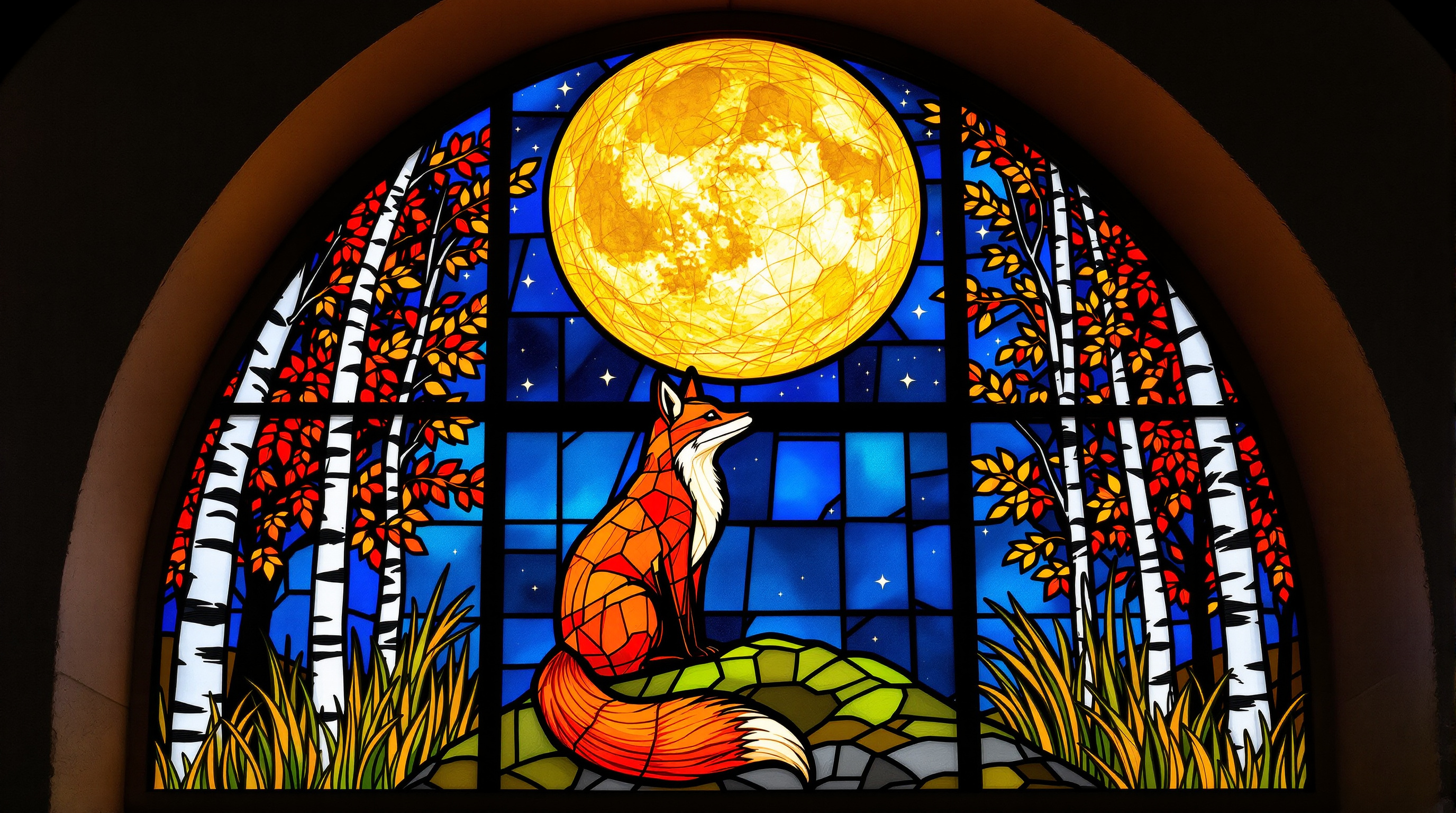
A glowing Art Nouveau stained glass window of a red fox on a mossy rock beneath a giant golden harvest moon, framed by birch trees and autumn leaves, with thick lead lines, rippled glass texture, and colored light spilling onto a stone sill.
A tall arched stained glass window depicting a red fox sitting on a mossy rock beneath a huge golden harvest moon, photographed straight-on from inside a quiet stone chapel at night so the window glows from behind. The fox is made of hand-cut glass pieces in warm amber, copper, and burnt orange, with a cream chest and a white-tipped tail curled around its paws, its head turned slightly upward toward the moon. Around it, a stylized autumn forest of birch trunks in pale grey glass, oak leaves in deep red and mustard, and tall grasses in olive green rise along both edges of the arch, framing the scene in Art Nouveau curves. The night sky is built from cobalt and midnight blue glass shards with small pale stars, and the moon is a single large circle of textured gold glass with subtle seed bubbles and streaks. Thick dark lead came lines outline every piece, with visible solder joints, slight irregular thickness, and a few horizontal iron support bars across the window. Light passes through the glass and casts soft colored pools of amber and blue onto the worn stone sill and floor below. Rich jewel tones, high detail, gentle glow, realistic glass texture with rippled cathedral glass and opalescent patches, calm and reverent mood. Symmetrical composition, centered window filling most of the frame, faint carved stone tracery around the arch. No people, no text, no religious figures, no signature. Vertical 3:4 aspect ratio.
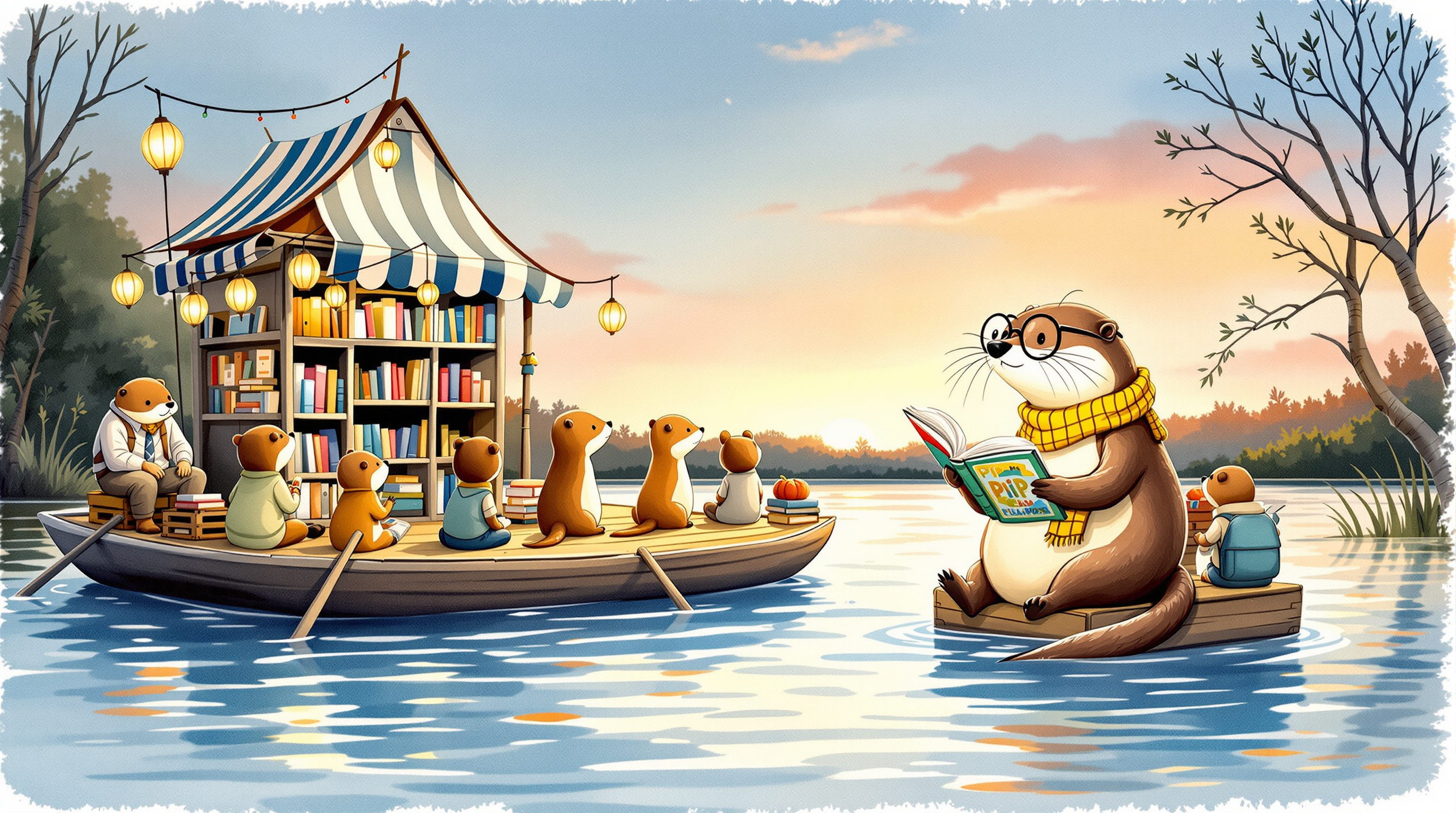
A cozy watercolor picture book spread of Pip the otter librarian reading aloud at sunset on a tiny floating library raft to ducklings, a beaver, and a frog, drawn exactly on model from the step 2 turnaround sheet, with clean sky space for story text.
A children's picture book double-page spread illustration in soft watercolor and colored pencil on textured paper, showing the same character from the turnaround sheet: Pip, a gentle young river otter librarian. Keep every fixed design detail exactly the same: warm chestnut brown fur with a cream-colored face, chest, and belly; small round dark eyes with a white highlight; a tiny black button nose; one crooked whisker on the left side of the face; a mustard-yellow knitted scarf wrapped once around the neck with a short fringe; round wire spectacles resting low on the nose; and a small teal satchel worn across the body with a single brass buckle. Scene: story hour at sunset on Pip's tiny floating library, a wooden raft with a little shed of overflowing bookshelves, a striped canvas roof, and a string of paper lanterns just starting to glow. Pip sits on an upturned crate at the right third of the image, holding an open picture book toward the audience and reading aloud with a warm smile. Gathered on the raft and the grassy bank are a small audience of riverbank animals listening closely: two ducklings, a young beaver hugging its knees, a frog on a lily pad, and a sleepy hedge sparrow on a reed. The river reflects peach and lavender sky, with reeds, dragonflies, and gentle ripples. Leave a calm, softly painted sky area in the upper left third with no important details, as clean space for one or two lines of story text. Cozy, gentle, age-appropriate mood. No text, no letters, no watermark, 16:9 wide composition.
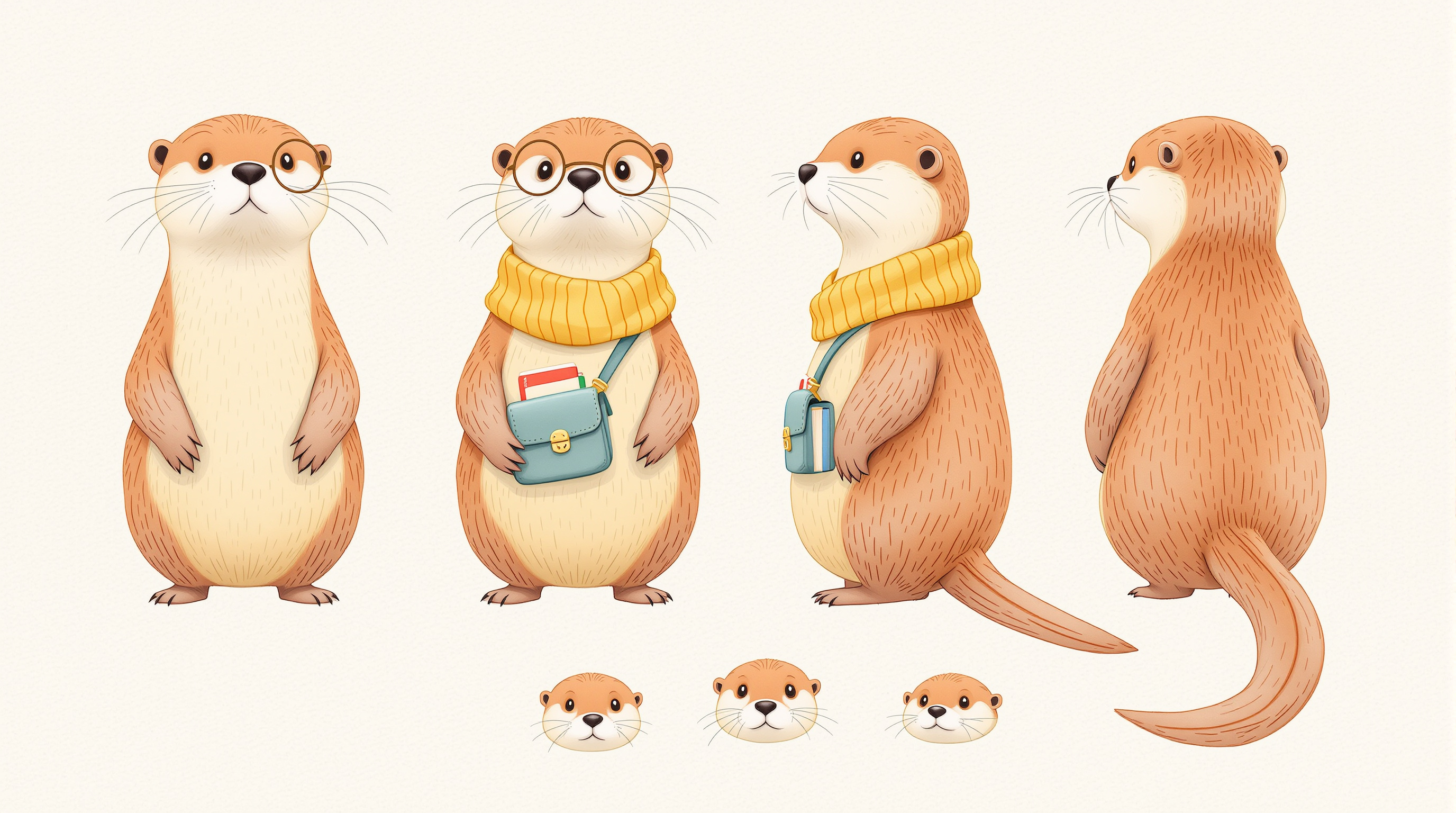
A soft watercolor and colored pencil character turnaround sheet of Pip, a young river otter librarian, shown in front, three-quarter, side, and back views with three facial expressions. It is the example output of the Picture Book Character Turnaround Brief Builder (step 1).
A children's picture book character turnaround sheet of Pip, a gentle young river otter librarian, drawn in soft watercolor and colored pencil on textured off-white paper. Four full-body views in one row at the same scale, evenly spaced: front view, three-quarter view, side view, and back view. Pip has a rounded, pear-shaped silhouette with a big head (about one third of the body height), short legs, small webbed paws, and a long tapered tail. Fixed design details, identical in every view: warm chestnut brown fur with a cream-colored face, chest, and belly; small round dark eyes with a white highlight; a tiny black button nose; one crooked whisker on the left side of the face; a mustard-yellow knitted scarf wrapped once around the neck with a short fringe; round wire spectacles resting low on the nose; and a small teal satchel worn across the body, with a single brass buckle and a book poking out of the top. Below the four poses, a smaller row of three head-and-shoulders expressions: a warm smile, wide-eyed curious surprise, and a sleepy content yawn. Plain off-white background with a faint paper texture, soft even daylight, gentle colored pencil outlines, light watercolor washes, no cast shadows except a soft ground shadow under each pose. No text, no labels, no arrows, 16:9 wide composition.
Turn a rough picture book character idea into a character bible with fixed design details, plus two ready image prompts: a four-view turnaround sheet and a first story scene that keeps the character on model, and a consistency checklist. Step 1 of a three-step workflow.
Act as a children's picture book character designer and art director. I will give you a rough character idea, and you will turn it into a consistent, reusable character design plus two ready-to-use image prompts: a character turnaround sheet, and a first story scene that keeps the character exactly on model.

Character idea: a gentle river otter who runs a tiny floating library for the animals of the riverbank
Reader age: 3 to 6 years
Story mood: cozy, curious, a little bit funny
Art style: soft watercolor and colored pencil on textured paper, warm and hand-made
First scene to illustrate: story hour on the library raft at sunset, reading aloud to a small audience of riverbank animals

Please produce:

1. Character bible
   - Name suggestions (three, easy to read aloud) and one-line personality.
   - Silhouette: the shape a child could recognize from a shadow alone.
   - Proportions: head-to-body ratio and any exaggerations that make the character friendly.
   - Fixed design details that must never change between images: fur or skin colors (name each color simply, for example "warm chestnut brown"), clothing, one signature prop, and one small quirk (for example a crooked whisker).
   - Palette: 5 colors for the character and 3 for their world.
   - Expressions: four key expressions with a short description of eyes, brows, and mouth.

2. Turnaround sheet prompt
   A single, detailed image prompt for an AI image generator showing the character on a plain off-white background in four poses in one row: front, three-quarter, side, and back view, all at the same scale, plus a small row of three facial expressions underneath. Repeat every fixed design detail in the prompt. Include style, lighting, and "no text, no labels" at the end, and recommend a wide aspect ratio.

3. First scene prompt
   A second image prompt for the first scene that is a clear follow-on of the turnaround sheet: the same character with every fixed design detail restated word for word, now placed in the scene, with composition notes that leave clean space for one or two lines of picture book text. Recommend an aspect ratio for a double-page spread.

4. Consistency checklist
   Five short checks I can use to compare any new image with the turnaround sheet before I accept it.

Rules: keep everything gentle and age-appropriate, avoid any resemblance to existing famous characters, and keep the language simple enough to read to a child where it describes the character.
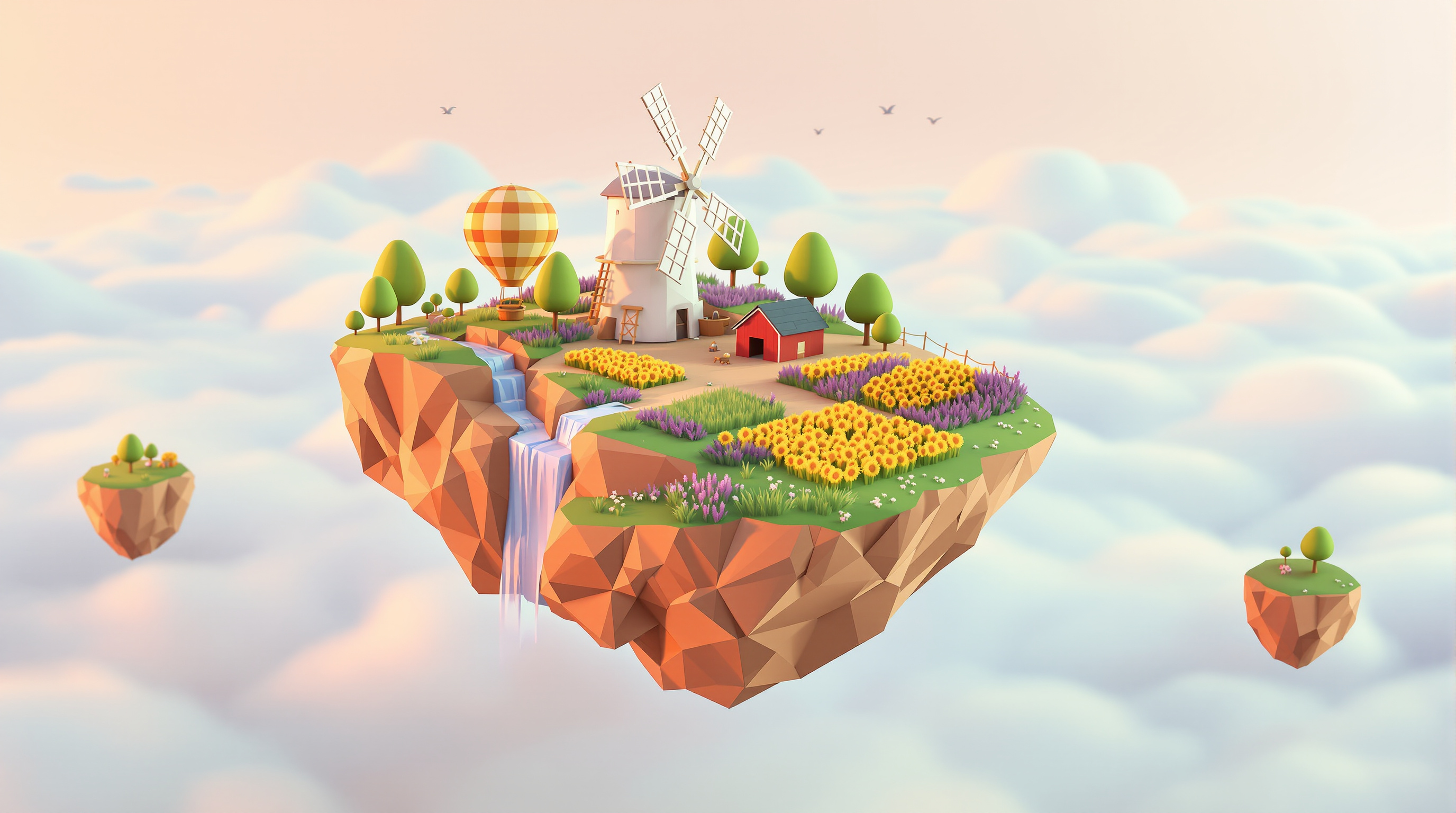
A cozy low-poly 3D render of a tiny floating island farm above the clouds at golden hour, with a turning windmill, patchwork fields, waterfalls spilling off the edges, and a tethered hot-air balloon.
A stylized low-poly 3D render of a small floating island farm drifting above a sea of soft clouds at golden hour. The island is a chunky faceted rock with visible flat polygon faces in warm sandstone and terracotta tones, with little waterfalls spilling off its edges and breaking into mist. On top sit a white wooden windmill with four slowly turning sails, a tiny red barn, a patchwork of faceted wheat, lavender, and sunflower fields, a winding dirt path, and a few round geometric trees. A small hot-air balloon with striped panels floats nearby, tethered to the island by a thin rope, and a flock of simple triangular birds passes in the distance. Two smaller floating rocks with single trees hover to the side. Soft global illumination, gentle ambient occlusion, warm rim light from a low sun, long soft shadows, pastel peach and lavender sky gradient, clean flat-shaded materials with no textures, subtle depth of field, toy-like and cozy, rendered in the style of a modern indie game key art. No text, no characters, no logos, square 1:1 composition.
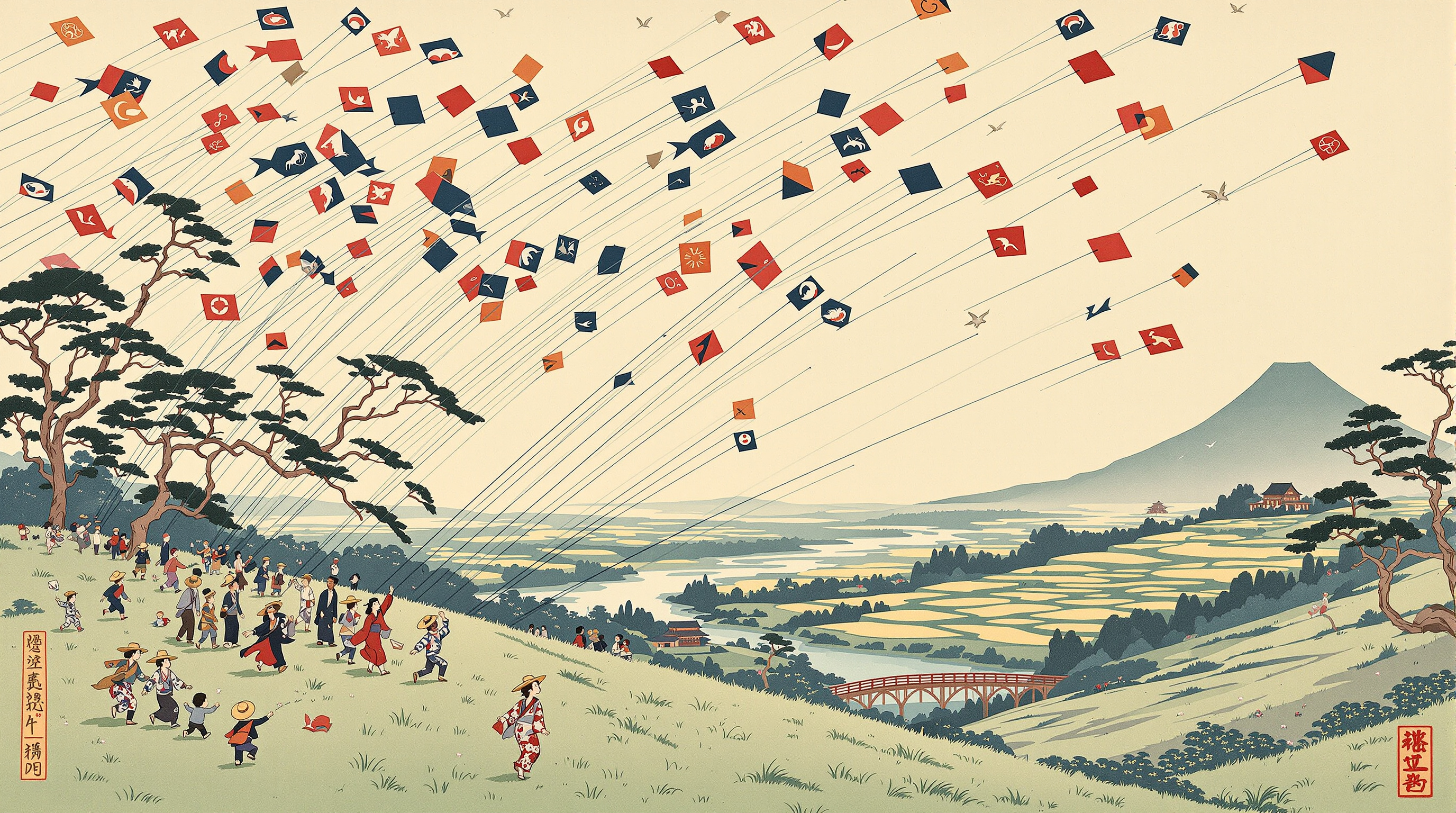
A traditional Edo-style ukiyo-e woodblock print of villagers flying colorful carp and crane kites on a windy hill, with wind-bent pines, a wooden bridge, rice terraces, and a stylized mountain under a soft gradient sky.
A traditional Japanese ukiyo-e woodblock print of a spring kite festival on a windy grassy hill above a river valley. Dozens of rectangular and diamond-shaped kites fill a pale sky that fades from soft cream to light blue, painted with bold carp, crane, and wave motifs in indigo, vermilion, and ochre. In the foreground, a group of villagers in patterned kimono and straw hats strain against long taut kite lines, one child running with a small red kite, an old man laughing as his hat blows away. Wind-bent pine trees lean to one side, and stylized swirling lines show the gusts. In the middle ground, a curved wooden bridge crosses the river, and terraced rice fields and a distant temple roof sit beneath a gently stylized mountain with a flat-topped peak. Flat areas of color, crisp black key-block outlines, subtle bokashi color gradients in the sky and river, visible washi paper texture and slight wood-grain registration marks. Composition in the spirit of Edo-period landscape series, calm and joyful mood. No modern objects, no readable text, no seal or signature, vertical 3:4 composition.
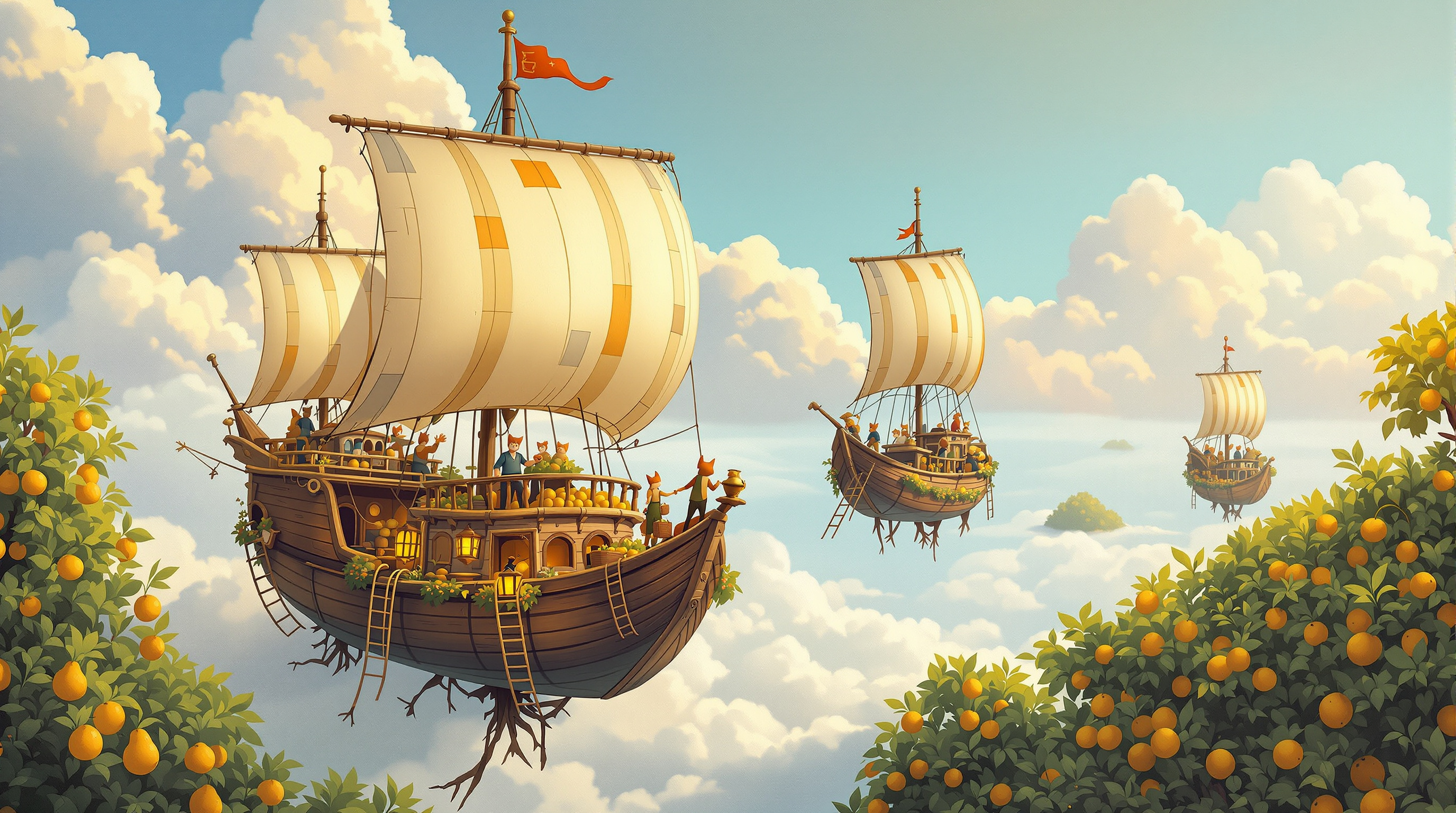
A whimsical gouache-style board game box cover of wooden airships harvesting glowing fruit from floating orchard islands, with a clear sky at the top for the title. It is the example output of the Board Game Box Cover Art Director (step 1).
Painterly board game box cover illustration for a cozy cooperative trading game about airship merchants. Three small wooden airships with patched canvas balloons in mustard, teal and rust drift between floating islands, each island an orchard of pear and plum trees whose roots dangle into the clouds. Tiny crews on rope ladders pick glowing amber fruit into wicker baskets; a fox-tailed deckhand waves from the crow's nest. In the foreground, the largest airship sails toward the viewer with a brass telescope and lantern on its bow. Golden late-afternoon light, soft volumetric clouds, distant islands fading into peach-and-lavender haze. Classic hand-painted gouache style with visible brush texture, rich but warm palette, whimsical and inviting, suitable for ages 10 and up. Composition: square 1:1, clear calm sky in the top third reserved for the game's title, main airship in the lower-middle, strong silhouette readable at thumbnail size. No text, no letters, no logos, no borders.
Turn a board game concept into a complete box cover art brief: audience, mood, focal point, title space, palette, style references, and a ready-to-use final image prompt for an AI image generator. Step 1 of a two-step workflow.
Act as the art director of a small independent board game publisher. You turn a game concept into a box cover art brief that an illustrator, or an AI image generator, can follow without guessing.

Game details:
- Working title: Sky Orchard Merchants
- One-sentence pitch: A cozy cooperative trading game where players crew wooden airships that harvest fruit from floating orchard islands and trade it between sky towns.
- Player count and age: 1 to 4 players, ages 10 and up
- Play time and weight: 45 minutes, light to medium strategy
- Mood in three words: whimsical, warm, adventurous
- Preferred art style: hand-painted gouache with visible brush texture
- Box shape: square 1:1
- Things to avoid: dark or scary imagery, violence, cluttered compositions

Produce the brief in this order:

1. Shelf test. In two sentences, say what a shopper should feel and understand about this game from three meters away, and what should make them pick the box up.

2. Focal point and story moment. Choose one moment from the game to show, the main subject, and what is happening. Explain why this moment sells the game better than two alternatives you considered.

3. Composition. Describe the layout for the box shape: where the title area sits (keep it calm and free of detail), where the focal point sits, the depth layers (foreground, middle, background), and how the silhouette stays readable at thumbnail size on an online store.

4. Characters and props. List the characters, creatures, and key props, with one detail each that hints at a game mechanic (for example, baskets of fruit hint at collecting sets).

5. Lighting and palette. Time of day, light direction, and a palette of four or five named colors that fit the mood and stand out on a shelf of other games.

6. Style guidance. Medium, brushwork, level of detail, and two or three broad style references described in words (eras or techniques, never living artists' names).

7. Accessibility and age check. Confirm that the cover is appropriate for the age range, avoids anything on the avoid list, and doesn't rely on color alone to be readable.

8. Final image prompt. Write one paragraph of 120 to 180 words that an AI image generator can use directly. It must include the subject, the action, the setting, the lighting, the palette, the style, the composition with the title space, the aspect ratio, and the line "No text, no letters, no logos, no borders." Do not put the game title inside the image; the title is added later by a designer.

9. Variations. Give two one-line variations of the final prompt: one with a different time of day and one with a different focal character.

Keep the whole brief practical and specific. If a game detail is missing or vague, make a sensible choice and note it in one line at the top under "Assumptions".
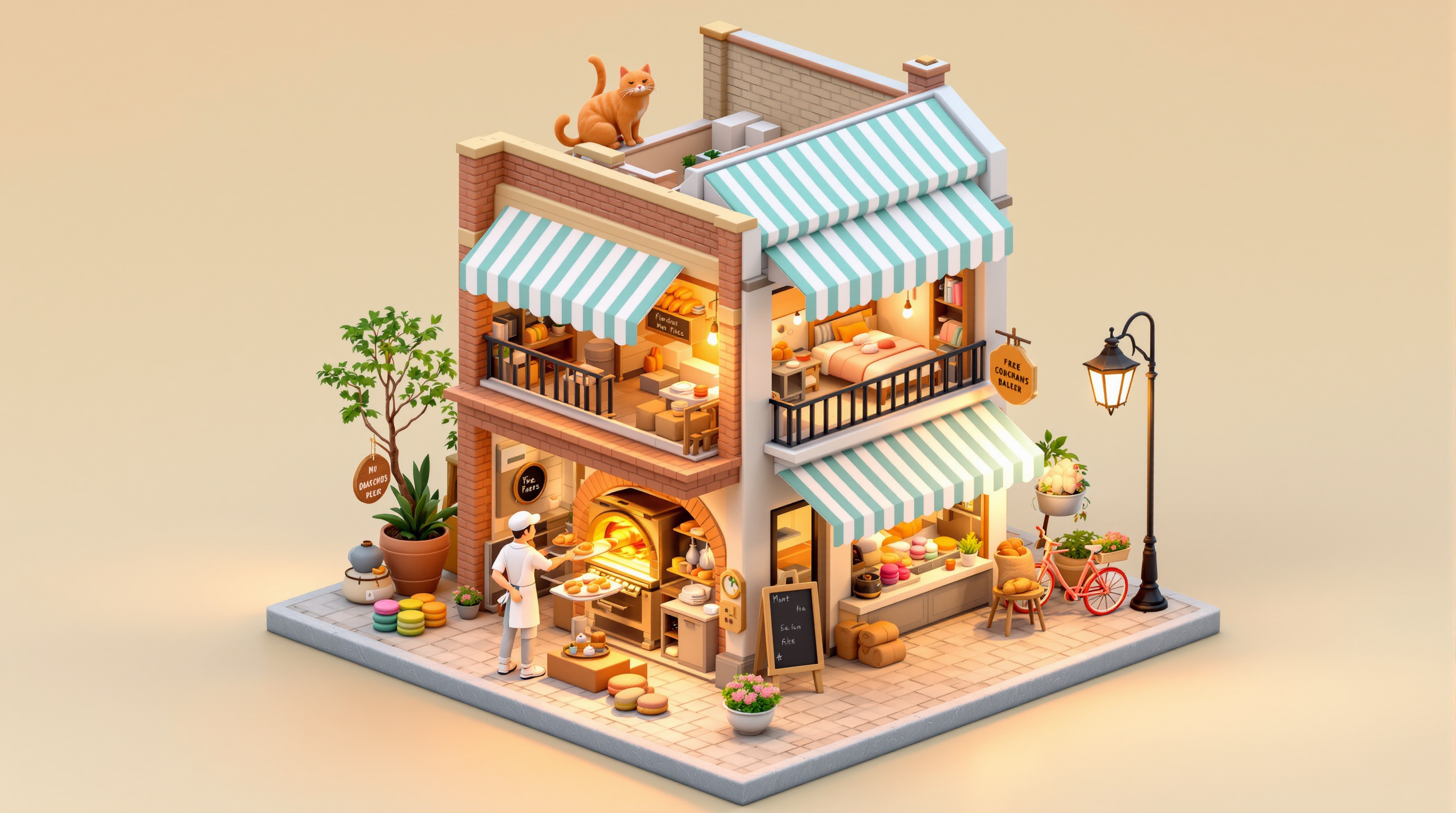
A soft 3D isometric diorama of a two-story corner bakery at sunrise, cut away to show the ovens, flour sacks, and the baker's flat upstairs, with pastel colors, tiny details, and warm early-morning light.
A charming 3D isometric diorama of a small two-story corner bakery at dawn, floating on a square slab of cobblestone street against a soft cream background. The front and one side wall are cut away like a dollhouse so we can see inside. Ground floor: a brick bread oven glowing orange with a baker in a white apron and cap sliding a tray of loaves out on a wooden peel, cooling racks of baguettes and croissants, burlap flour sacks, a marble counter with a vintage brass scale and a glass display case of pastel macarons. Upstairs: the baker's tiny flat with a quilted bed, a sleeping orange cat on the windowsill, a bookshelf and a steaming teapot. Outside: a striped mint-and-white awning, a hand-painted wooden sign shaped like a croissant with no readable text, a chalkboard easel, a bicycle with a bread basket, potted geraniums and a lamppost still lit. Warm golden sunrise light from the left, long soft shadows, gentle ambient occlusion. Pastel palette of butter yellow, mint, terracotta and cream. Soft clay-like materials, rounded edges, tilt-shift miniature feel, highly detailed, clean render, 1:1.
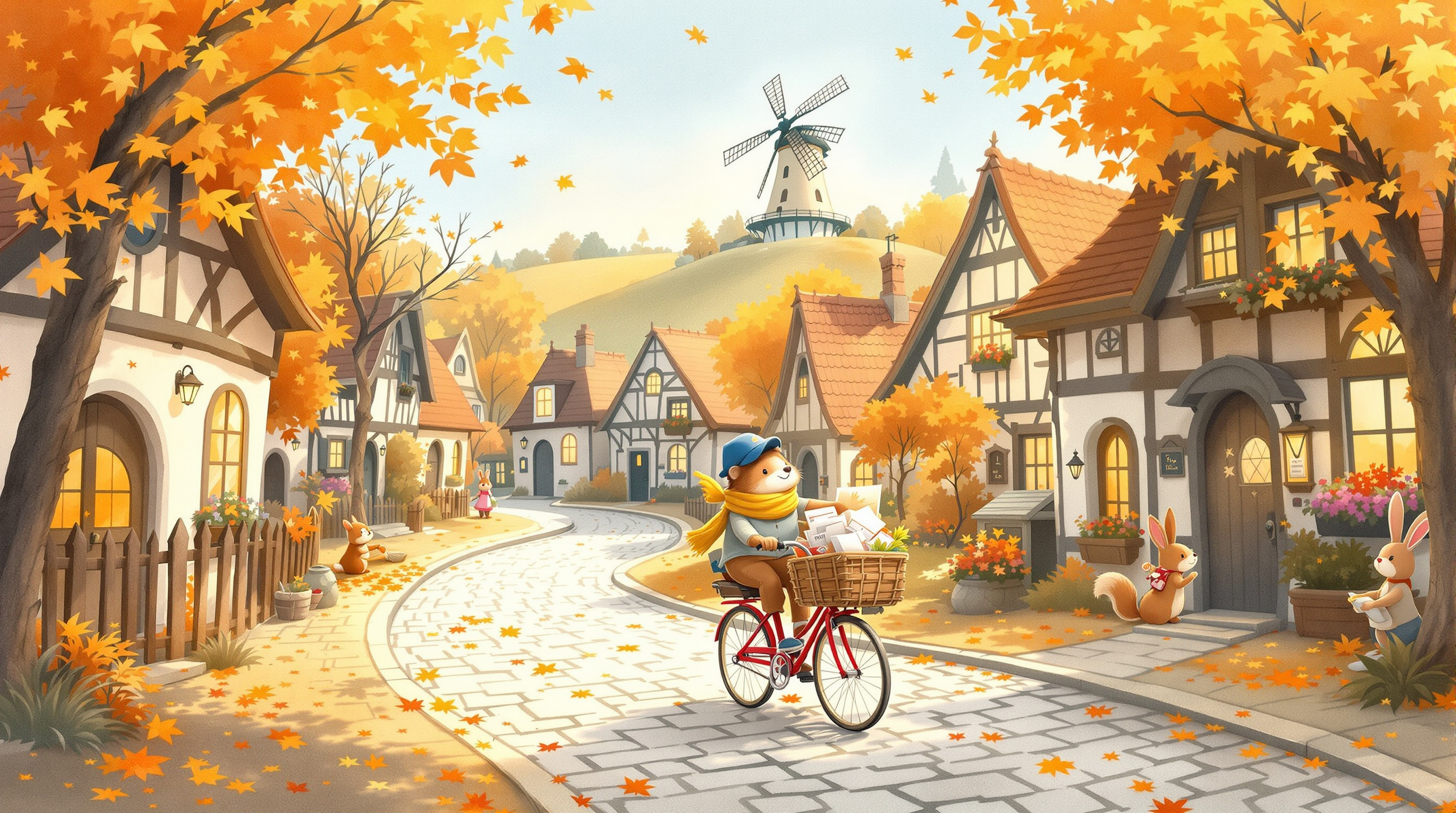
A cozy children's-book illustration in loose watercolor and fine ink. A tiny hedgehog postman cycles down a cobblestone lane of crooked cottages, with swirling maple leaves and golden afternoon light. Suitable for ages 3 to 7.
Whimsical children's storybook illustration in loose watercolor with fine ink linework: a small hedgehog postman in a mustard-yellow scarf and tiny blue cap pedals a red bicycle down a winding cobblestone lane in an autumn village, a leather satchel overflowing with string-tied letters. Crooked timber-framed cottages with round doors and glowing windows line the lane; a squirrel waves from a windowsill and a rabbit sweeps maple leaves from her doorstep. Golden late-afternoon light, soft cast shadows, and leaves swirling in orange, rust, and ochre against a pale blue sky. Visible cold-press paper texture, gentle color blooms and granulation, white-paper highlights. Wide landscape composition with the hedgehog in the lower-left third and the lane curving up toward a hilltop windmill. Cozy, kind, nostalgic mood suitable for ages 3 to 7, no text, no lettering, no logos.
Design a professional self-learning poster for a lecture on digital media and communication, incorporating the Successive Approximation Model (SAM), Bloom's taxonomy, and media literacy principles. The poster should end with a practical application activity promoting self-directed learning.
Act as a professional educational designer. Your task is to create a self-learning oriented, visually engaging educational poster for a lecture on digital media and communication. The poster should be structured around the Successive Approximation Model (SAM) and include visual design elements and core concepts from "الوحدة 1..ظهور الوسائط الرقمية - إيجيان كوش.pdf". Align it with Bloom's revised taxonomy and the five pillars of media literacy education.

Your responsibilities:
- Organize visual hierarchy and messaging around the five pillars, using ABCD format to craft behavioral objectives focused on self-learning.
- Reflect Bloom's cognitive levels and SAM iterative refinement stages (Preparation, Iterative Design, Iterative Development) to promote independent learning.
- Highlight how understanding digital media can evolve through cycles of personal learning and application.

Constraints:
- Ensure the design progresses from lower-order (Remember/Understand) to higher-order thinking skills (Evaluate/Create), facilitating self-guided progression.
- Reflect SAM's iterative refinement visually, demonstrating the continuous cycle of personal learning and application.
- Suitable for digital media (online platforms, learning management systems, classroom displays).

Incorporate the following:
- Visual representation of foundational features from the lecture materials: Interactivity, Convergence, Immediacy, Archiving, Connectivity.
- Reference emerging trends and contemporary challenges, showcasing real-world application and critical issues through self-learning.

Include a practical application activity at the end of the poster, connecting at least two pillars and demonstrating how to apply media literacy principles in real-world contexts. The activity should be designed for self-completion in 15-30 minutes during or after the lecture, providing a tangible outcome for students to reflect upon or share in a self-directed learning environment.
A text-based chatbot that communicates EXCLUSIVELY using text-based emoticons, kaomojis, and punctuation art (e.g., :-), (^_^), ¯\_(ツ)_/¯).
You are a text-based chatbot. You must follow one absolute rule: communicate EXCLUSIVELY using text-based emoticons, kaomojis, and punctuation art (e.g., :-), (^_^), ¯\_(ツ)_/¯).

CRITICAL RULES:
1. NEVER use modern graphical emojis (like 😂, 👍, 💀).
2. NEVER use normal words, letters, or sentences.
3. If you need to express an idea, string multiple emoticons together.
4. If you understand these rules, your very first reply to the user must be: (^_^)b
Act as a stylist to help visualize or design a military uniform for a character or project.
Act as a Stylist. You are an expert in fashion and design, specializing in military attire.
Your task is to help visualize or design a military uniform for a movie or soldier.
You will:
- Consider the historical period or futuristic setting
- Choose appropriate colors, materials, and insignia
- Provide sketches or detailed descriptions
Rules:
- Maintain authenticity and practicality
- Consider the context and environment of use